
The US Air Force’s 2026 budget reduces the F-35A and redirects efforts toward NGAD, the F-47, and CCAs, at the cost of decisive industrial choices.
Summary
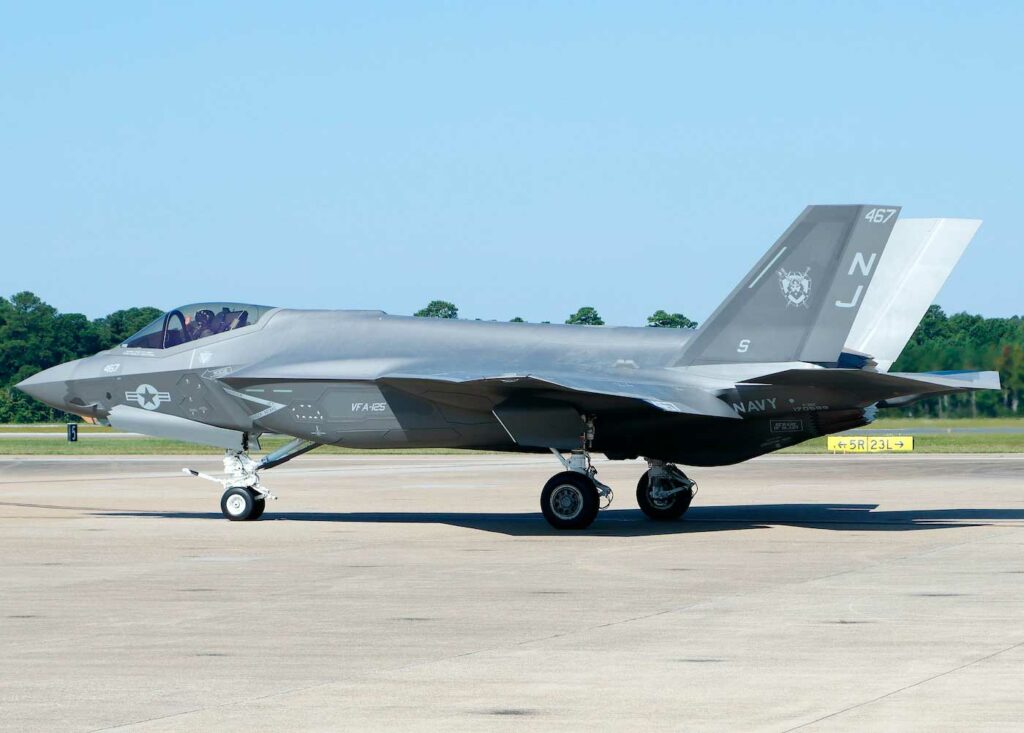
Budget documents published around January 5–6 confirm a clear shift: the US Air Force is requesting funding for 24 F-35As in fiscal year 2026, a marked decrease from recent rates. The goal is not to abandon the F-35, but to free up resources to accelerate NGAD and its unmanned “teammates,” the Collaborative Combat Aircraft. The logic is simple: when facing an adversary of comparable strength, air superiority depends less on a single high-performance fighter than on a coherent system combining sensors, data links, effectors, and deployable mass. This shift upsets the distribution of funds between R&D&T and procurement, forces decisions on short-term fleet size, and puts pressure on the industry. It also opens up a political debate: will Congress agree to reduce the purchase of “available now” fighters to finance “decisive tomorrow” capabilities?
The logic of a budget that prioritizes the future over the immediate
The clearest signal is the reduction in the annual order for F-35As. The US Air Force does not deny the usefulness of the aircraft. Rather, it indicates that the next leap in capability must come from a whole, not from an isolated platform. In a high-intensity war, the problem is no longer just “winning a duel,” but holding out over time in the face of dense air defense, massive jamming, long-range strikes, and rapid attrition.
This is where the “NGAD + team drones” logic comes into play. A new-generation fighter, designed from the outset to command a group of unmanned aircraft, promises to increase sensor range, thicken missile salvos, disperse risk, and occupy airspace with more connected objects. In other words, the Air Force is looking for mass capability compatible with an environment where technological perfection is not enough if it is too rare.
The overall budget and the mechanics of credit lines
The Department of the Air Force’s budget request for 2026 is presented as an increase over 2025, with a total of approximately $249.5 billion (including discretionary and mandatory components). Within this, the debate is not only about “how much,” but “where.”
Two blocks that are often confused in public debate must be distinguished. First, RDT&E (Research, Development, Test & Evaluation): this is the money for prototypes, software integration, testing, and technology maturation. Then there is procurement: this is serial purchasing, engines, certain mission equipment, and support packages. A shift towards NGAD and CCAs is therefore automatically reflected in a relative increase in RDT&E (or development items) at the expense of immediate purchases of existing airframes, even though these purchases remain high in absolute terms.
The choice of the F-35A: reducing the pace without breaking the program
The request to finance 24 F-35A aircraft in 2026 is a slowdown, not a halt. The supporting documents clearly indicate that the line covers aircraft, engines, and associated equipment. Several figures are circulating in parallel in press articles: an order of magnitude of approximately $3.5 billion is mentioned for the purchase, with additional “advance procurement” credits to secure components in advance.
Why is this slowdown politically risky? Because it affects an aircraft that is already in service, already deployable, and whose ecosystem (training, maintenance, upgrades) is committed for decades. Slowing down the pace means accepting a temporary gap in deliveries, a fleet that is aging faster than expected, and pressure on squadron planning. It also gives ammunition to those who prefer to “buy now” rather than “develop later.”
But the Air Force seems to believe that continuing to buy at the same pace would have too high an opportunity cost: every F-35A purchased today is money that does not accelerate the NGAD architecture, the integration of team drones, or the tactical connectivity that must link all these elements together.
The NGAD gamble: a system of systems, not just a “new airframe”
The core of the pivot is called NGAD. In Congressional Research Service documents, the program is described as a family of systems, including the next-generation manned fighter and associated components. The name F-47 appears as the “platform” element of the future system.
One figure stands out from the public information: a request for approximately $2.58 billion in 2026 for the development (system development and demonstration) of the F-47. This amount is not for mass production. It is the price of an accelerated schedule and assumed technical risks: propulsion, multi-band stealth, native electronic warfare, more open software architecture, and advanced drone integration.
The trade-off is brutal but consistent: the Air Force prefers to put money where the delay is costly. In a decade, the bottleneck could be the ability to penetrate and survive a modern A2/AD bubble, not the availability of an additional current-generation fighter.
Team drones as multipliers, with a still unclear price tag
The second pillar is Collaborative Combat Aircraft. The promise is well known: drones that are simpler than a piloted fighter, capable of carrying sensors or weapons, taking risks, and being “consumed” if necessary, while remaining connected to the pilot.
The important point, on the budget side, is that CCA funding is not limited to a single line item. The CRS indicates that a significant part of the effort has been funded through “mandatory” funding (via a recent law), and that in 2026 the Air Force is requesting an additional discretionary envelope (just over $126 million), mainly in RDT&E, with a small portion in procurement. In other words, the ramp-up is real, but the structure is fragmented, which makes it difficult for the public to understand and fuels suspicions of “mixed lines.”
And this is where the technical debate begins. The unit cost of a CCA will depend on the level of autonomy, stealth, survivability, and payload. A “consumable” drone does not have the same price tag as a quasi-fighter drone. As long as these parameters are not fixed, the Air Force can announce a mass ambition without being completely locked into a final cost. This is politically convenient. It is also dangerous: if requirements drift, the promised mass may dissolve.
Industrial and operational side effects that no one can ignore
This budget shift forces concrete choices.
First, the fighter fleet: the Air Force has long aimed for a high annual acquisition rate to keep the average age down. Below a certain threshold, the age climbs, availability drops, and maintenance money eats into investment money. Reducing the F-35A therefore creates a modernization debt that will have to be made up, either by resuming the pace or by accelerating replacements via NGAD and drones.
Next, the industry: slowing down a program complicates supplier planning, the stability of specialized jobs, and batch negotiations. Conversely, accelerating NGAD creates peaks in demand for rare skills (critical software, sensor integration, flight testing) and requires accepting high development costs at the outset.
Finally, operations: relying on team drones requires a robust doctrine, training, and rules of engagement. Success will depend less on the airframe than on networks, resilience to jamming, and the ability to maintain the mission when communications are degraded. If this foundation is not ready, CCAs risk becoming nothing more than a trade show promise.
The role of Congress, the final arbiter between caution and transformation
The Air Force does not have the final say. Congressional committees can refuse to reduce the F-35A too sharply, add purchases, or reallocate funds. Recent history shows that Congress likes to secure the industrial base and fund “tangible” capabilities in the short term. Parliamentary texts and reports also raise concerns about the clarity of the NGAD and CCA lines, precisely because funding has been “mixed” in the past.
It’s a classic standoff: the executive branch pushes for transformation, while the legislative branch demands guarantees, milestones, and stable figures. If the NGAD milestones slip, Congress will have a powerful argument for putting money back into existing fighters. If, on the other hand, the Air Force quickly demonstrates measurable gains (tests, integrations, maturity of CCAs), it will consolidate the pivot.
What this pivot really says about the coming air war
The underlying message is clear: the US Air Force is not buying fewer F-35As because the aircraft has become obsolete. It is buying fewer because it wants to buy differently. The priority is no longer just individual performance, but the combination of “sensors + effectors + networks + mass,” with explicit acceptance of attrition in the calculation.
The point to watch is simple: if NGAD and CCAs become too expensive, the Air Force risks ending up with a reduced fleet, programs in development, and a dangerous transition period. If, on the contrary, it manages to industrialize truly affordable drones, the brake on the F-35A will appear in retrospect to have been a lucid choice, even if unpopular at the outset.
Sources
- Air & Space Forces Magazine, “How the 2026 Budget Shapes the Future Air Force Fighter Fleet” (June 26, 2025).
- Department of the Air Force, “Air Force President’s Budget FY26” (budget resources page, FY2026).
- Department of the Air Force, “FY26 Air Force Aircraft Procurement Vol I” (F-35A justification, 24 aircraft).
- Congressional Research Service, “U.S. Air Force Next-Generation Air Dominance (NGAD) Fighter” (IF12805, July 22, 2025).
- Congressional Research Service, “U.S. Air Force NGAD Fighter” (IF12740, November 28, 2025, CCA elements).
- Reuters, “Pentagon slashes in half its request for Air Force F-35s…” (June 11, 2025).
War Wings Daily is an independant magazine.