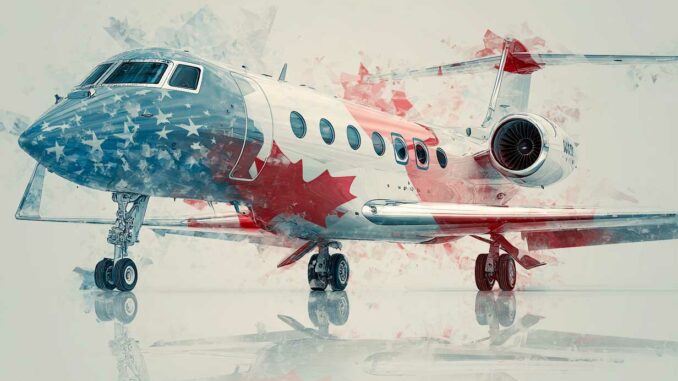
Trump is threatening to “decertify” Canadian aircraft. Is this a credible threat or a publicity stunt? We break down the FAA rules, the fleets affected, and the risks involved.
In summary
Donald Trump says he wants to decertify all “made in Canada” aircraft until Transport Canada has validated several Gulfstream jets. On paper, the announcement packs a punch: thousands of aircraft affected, US regional airlines exposed, and a potential shock to business aviation. In practice, the threat faces legal and operational obstacles. The FAA does not revoke type certificates to settle commercial disputes. It does so for safety reasons, following a contradictory procedure. But the episode is not insignificant. It puts pressure on a system based on trust between authorities, particularly through the BASA agreement between Washington and Ottawa. Even without enforcement, the mere fact of waving the certification weapon introduces a risk: regulatory uncertainty, pressure on deliveries, and a risk premium on financing, insurance, and the residual value of Canadian aircraft operating in the United States.
The threat of decertification: what exactly are we talking about?
The political message and its immediate trigger
The origin is a public message attributing the blockage to the non-certification in Canada of the Gulfstream G500, G600, G700, and G800. The ultimatum is simple: until these models are approved by the Canadian regulator, aircraft manufactured in Canada will lose their right to operate in the United States, and a 50% tariff will be imposed on Canadian aircraft sold on the US market.
This is not a minor communication detail. In the aviation industry, the words “certification” and “decertification” are not slogans. They are legal mechanisms that determine operation, insurance, leasing, and maintenance.
The difference between a slogan and an FAA action
An aircraft does not fly “by habit.” It flies because it complies with a type certificate, airworthiness certificates, and operating rules. Withdrawing a certificate is not an “on/off” switch. It is a regulated decision. It requires a regulatory basis, findings, and a procedure.
In other words, announcing a massive decertification is easy. Implementing it, especially for non-safety reasons, is another story.
How cross-border certification works between Washington and Ottawa
The central role of the “origin” authority
In the international system, the authority of the country of design and manufacture is the architect of airworthiness monitoring. For Canadian aircraft, the reference authority is Transport Canada. For American aircraft, it is the FAA. Neither does all the work of the other. They validate, verify, and rely on common procedures.
The BASA mechanism and institutional trust
The United States and Canada operate under a bilateral aviation safety agreement. Its purpose is clear: to accelerate the reciprocal validation of certifications and avoid costly duplication. This does not mean “automatic validation.” It means “organized validation,” with boundaries, exceptions, and technical exchanges.
This is precisely why the episode is serious: if certification is turned into a commercial weapon, the very logic of the agreement is undermined. A system designed for safety, not for tariff negotiations, is weakened.
American fleets truly exposed, beyond the Bombardier symbol
The figures that give the scale
Recent counts cite 5,425 aircraft manufactured in Canada and registered in the United States, all categories combined (airliners, regional aircraft, general aviation, helicopters). Of this total, approximately 2,678 are Bombardier aircraft built in Canada and operated by more than 1,200 operators, and there are approximately 150 Bombardier Global Express aircraft in the US registry.
This is not a marginal segment. It is a stack of operational chains: regional airlines, business aviation, medical missions, police, aerial work, training, and rotorcraft.
The exposure of regional networks, the case of CRJs
The most sensitive issue for airlines is regional jets from Bombardier programs, particularly CRJs. A concrete example: in 2025, the regional fleet associated with American Airlines included 122 CRJ-700s and 86 CRJ-900s. Even though these aircraft are no longer in production, they still structure daily rotations on hundreds of domestic routes.
If a measure were to render these aircraft unusable, the impact would not be primarily financial. It would be operational: cancellations, rescheduling, capacity shortages at small airports, and automatic price increases on routes where supply is contracting.
The case of the Airbus A220 and the trap of mixed industrial chains
The A220 is an aircraft sold as an Airbus, but historically designed in Canada, with production spread across North American sites. A “decertification” decreed on a national basis muddies the waters: what is a “Canadian-made aircraft” when the chain is multi-site and the type certificate, compliance, and final assembly can change depending on the batch? It’s an administrative nightmare and a risk of immediate litigation.
The case of helicopters produced in Canada, the blind spot in the debate
There is a lot of talk about jets. But Canada also manufactures helicopters for the US market. Bell assembles and produces several civilian models in Mirabel, Quebec. The Bell 429 is explicitly associated with this production. Again, this does not only affect VIPs: these are EMS (medical evacuation) fleets, public operators, and utility missions.
The likely financial impacts, even if nothing is enforced
The risk premium on residual value
The leasing and business aviation market hates regulatory uncertainty. Even the threat of certification withdrawal, however unlikely, can be enough to reduce the perceived residual value, tighten bank covenants, and increase insurance premiums. For a long-haul business jet, the effect is immediate: the liquidity of the secondary market depends on the stability of the rules.
The potential impact of tariffs on acquisitions
A 50% tariff on aircraft sold in the United States, if actually applied, would be a hammer blow to acquisition prices. Buyers would have to decide whether to postpone delivery, switch to other models, or renegotiate contracts. But let’s be clear: at this level, a tariff does not only “punish” the seller. It also affects American buyers, and therefore American companies, their costs, and their associated jobs (pilots, maintenance, operations).
The domino effect on employment and the MRO chain in the United States
Bombardier highlights its significant presence in the United States, with jobs and support activities. Even if the aircraft is Canadian, the maintenance, parts, training, and services ecosystem is often American. An escalation reduces activity, disrupts heavy maintenance plans, and introduces volatility into already tight schedules.
The question of realism, between aviation law and domestic policy
The FAA’s legal framework does not fit with a commercial sanction
The most important point is blunt: the FAA is not a commercial agency.
It is a safety authority. Withdrawals, suspensions, or limitations of approval are based on compliance and safety issues, not on a tit-for-tat approach in a validation dispute.
Therefore, presented as a retaliatory sanction, the scenario of “decertifying everything Canadian” looks more like political intimidation than a legally sound plan.
The real risk is less the act than the method
The main danger lies elsewhere. Even if the measure does not pass, the idea that a president can “threaten” the regulatory infrastructure sets a precedent. Industrialists read this as a signal: certification can become a political lever. This pushes players to cover themselves, diversify, delay, and factor risk costs into their decisions.
The Gulfstream case: technical disputes can exist without conspiracy
It is plausible that Transport Canada has its own technical or scheduling requirements for certain programs, especially on sensitive topics (software, validations, testing). This is often time-consuming, frustrating, and costly. But it is not necessarily “anti-American.” Modern certification has become slower everywhere, under political and media pressure since the certification crises of recent years.
The way out, if adults take back control
The technical and bilateral route rather than threats
The effective lever is not to “punish” certification. It is to address sticking points through the appropriate channels: technical committees, test exchanges, clarification of requirements, and public timelines. Political pressure may accelerate. The threat of decertification could break the machine.
The most likely scenario in the short term
The most realistic scenario is a sequence of strong communication, followed by a controlled de-escalation. The players have too much to lose. The United States needs a stable North American aviation ecosystem. So does Canada. And the industry does not have the capacity to “reconfigure” its fleets and supply chains in a matter of months.
So the real question is not “will it happen tomorrow?” The real question is: how many times can this type of weapon be wielded before regulatory confidence is permanently damaged?
War Wings Daily is an independant magazine.