If London refuses Diego Garcia and RAF Fairford, Washington loses logistical “shortcuts” for its bombers, and the Iran option becomes more difficult.
In summary
Press reports indicate that the United Kingdom is refusing to allow the United States to use two key bases, Diego Garcia and RAF Fairford, for an air campaign against Iran. The issue is not symbolic. It affects the cold mechanics of a long operation: sortie rates, maintenance, ammunition reloading, crew fatigue, and tanker consumption. It is still possible to strike Iran from US territory, but at the cost of a much heavier deployment and increased pressure on the refueling fleets. Diego Garcia provides a foothold in the Indian Ocean for sustained rotations. RAF Fairford serves as a forward platform in Europe for US bombers. The British refusal, if confirmed, would be motivated by legal risks related to international law and political tension surrounding the future status of the Chagos Islands. What is at stake, in essence, is a reality that is rarely mentioned: even the world’s leading military power depends on political authorization when it wants to wage a war from allied bases.
The heart of the matter and what is certain at this stage
The available information is based on “government sources” and leaks reported by several media outlets, then commented on by analysts. The common thread is the same: London would not want to give automatic green light to US strikes from Diego Garcia and RAF Fairford in the event of a campaign against Iran.
What is established, on the other hand, is more solid and sufficient to frame the issue:
- The United Kingdom regularly points out that non-routine use of British bases by the United States requires a British political decision on a case-by-case basis.
- Diego Garcia is a major US logistical hub for the Middle East, but its control is politically sensitive because it is linked to the Chagos issue.
- Washington has an interest in having forward operating bases if it wants to increase the pace of operations, rather than having to make return trips from the US mainland.
In other words, even without “official confirmation” of a formal refusal, the question is credible: it is consistent with the rules of sovereignty and historical precedents.
The role of Diego Garcia in a real air campaign
Diego Garcia is not a “practical” base. It is a structuring base. Located in the Indian Ocean, it allows operations to be sustained over several days or weeks without relying solely on bases in the Gulf, which are often subject to political constraints.
The operational advantage is simple: bringing aircraft closer to the area of action to increase rotations, reduce refueling requirements, and allow for heavy maintenance nearby.
The orders of magnitude give an idea of the scale. According to a widely cited analysis, Diego Garcia is located approximately 3,700 km (2,300 miles) east of Iran. This distance is compatible with “go-strike-return” mission profiles for bombers, but above all, it allows aircraft to be stationed, rearmed, and returned to service on site, which is the real lever for maintaining tempo.
Logistical value outweighs geography
In an air campaign, ammunition and maintenance rule the roost. Bombers can carry heavy loads, but they need to be reloaded, inspected, repaired, and their engine cycles managed. A forward base offers:
- fuel stocks and significant ground refueling capacity
- parking and armament areas
- workshops capable of repairing war damage and wear and tear
- reinforced maintenance teams, housed and protected
Without Diego Garcia, the alternative is to “shoot further” or to rely more on third countries in the Middle East. Both options have political and military costs.
The often underestimated role of RAF Fairford
RAF Fairford is less close to Iran than Diego Garcia, but its usefulness is different. It is a European entry point for forward deployment of US bombers, with infrastructure already proven by Bomber Task Force rotations.
Here too, distance explains its appeal. An estimate cited in several analyses places Fairford approximately 4,000 km (2,500 miles) west of Iran. This does not make Fairford an ideal “strike” base, but it does make it a generation and support base: preparing aircraft, launching missions, and quickly integrating reinforcements from the United States.
Above all, Fairford offers a dispersion option. When a campaign is prolonged, dispersing resources reduces vulnerabilities and simplifies fleet management: it avoids concentrating all assets on a few hubs in the Gulf, which are exposed to ballistic threats and political pressure.
The practical problem if London closes both doors
The issue is not that “the United States cannot strike.” The issue is that “striking becomes slower, more expensive, and more visible.”
From US territory, bombers can fly very long missions. But a sustained campaign requires volume and repetition. And that’s where two parameters explode: refueling aircraft and crews.
Dependence on refueling and the constraint of cycles
The critical factor is in-flight refueling. The farther away the base of departure, the more refueling is required, the more refueling aircraft are needed, and the more escort fighters, ISR aircraft, and electronic warfare aircraft are tied up to “open the way.”
The range figures show the difference:
- The B-52H Stratofortress claims a combat range without refueling of over 14,080 km (8,800 miles).
- The B-2 Spirit is designed for intercontinental missions, but its added value is not distance: it is penetration into dense defenses, at the cost of complex maintenance.
These ranges do not mean “no problem.” A sustainable campaign is not a distance record. It is a high rate of sorties, day after day. And for that, access to a forward base makes a mechanical difference.
Crew fatigue and maintenance: the hidden cost of “home-based” missions
The longer the flights, the more we multiply:
- breakdown and diversion windows
- post-flight inspections
- crew fatigue, with a direct impact on safety and regularity
- consumption of refueling resources
In other words, if the UK closes Diego Garcia and Fairford, Washington can compensate, but it “pays” by exhausting its tanker fleets more quickly and limiting the initial pace of a campaign.
The bombers involved and their likely use against Iran
In a campaign against Iran, the United States would typically seek to combine precision strikes with continuous pressure on critical nodes: air defense, command centers, missile infrastructure, nuclear sites, and depots.
Three platforms systematically recur in the scenarios:
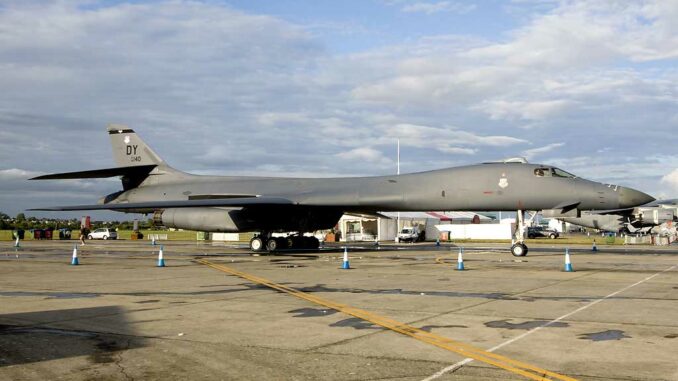
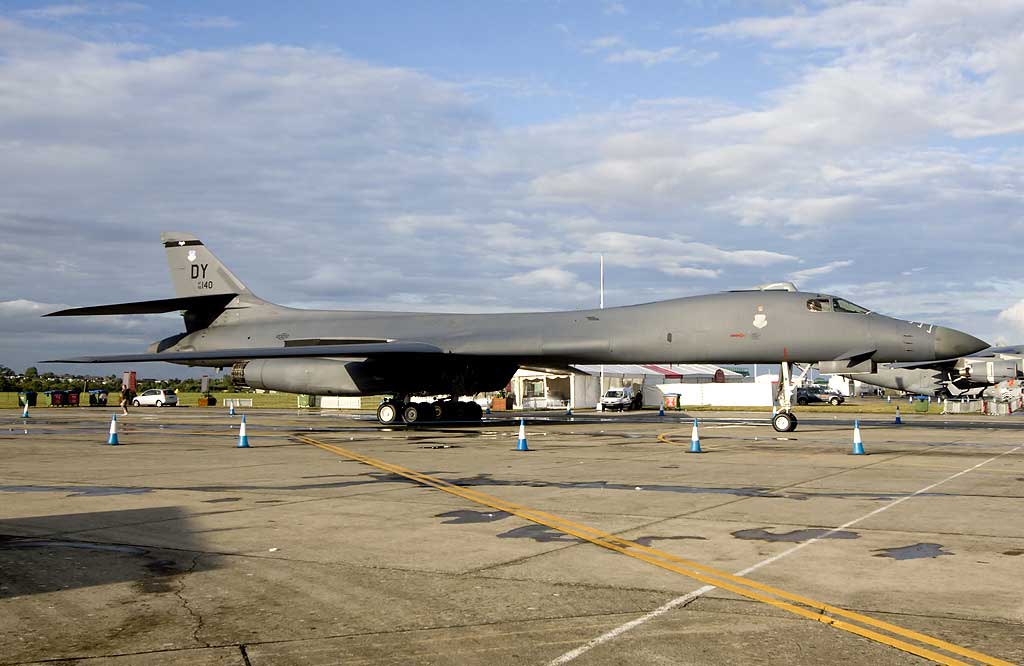
- the B-1B Lancer, useful for its carrying capacity and flexibility, but dependent on a controlled air environment
- the B-52H, a perfect “missile truck” for launching cruise missiles from a distance
- the B-2, used for the most protected targets, with penetrating weapons and demanding trajectories
This mix explains why bases matter. The B-52H and B-1B benefit from a base that simplifies rotations and armament. The B-2, on the other hand, benefits from operating from a site capable of supporting its delicate maintenance and protecting its procedures.
Possible British reasons, stated clearly
If London is hesitant, it is not because of “anti-Americanism.” It is a legal and political calculation.
Legal risk and the argument of international law
The United Kingdom is particularly sensitive to operations that could be considered preventive and not justified by self-defense. Several articles mention British reservations about the legality of a campaign if it is not clearly defined.
This is a point that is often misunderstood: authorizing the use of a base exposes the country politically, but also legally, to the debate on joint responsibility. London can accept transit, support, and intelligence, but refuse to allow strikes from its territory if the legal basis is disputed.
The Chagos issue, a political bombshell at the heart of the strategy
Diego Garcia is at the heart of the Chagos sovereignty issue. The transfer agreement to Mauritius, with a long-term lease mechanism, has become an explosive issue in the London-Washington relationship.
In this context, giving early approval to a campaign against Iran from Diego Garcia would be tantamount to publicly linking the Chagos issue to a potential war. The British government may want to avoid this political deadlock.
US options if British bases remain closed
The United States has no shortage of options, but none of them are free.
- Gulf bases: effective, close, but politically sensitive and exposed to retaliation.
- Aircraft carriers: very useful, but limited in ammunition volume and dependent on naval posture.
- Missions from US territory: possible, but cumbersome and requiring large numbers of refueling aircraft.
The sticking point is “duration.” A single strike is one thing. A campaign lasting several days is another. The longer the campaign, the greater the need for robust support, and therefore forward bases.
What this affair reveals about the special relationship
If confirmed, this episode tells us something very concrete: the special relationship does not eliminate sovereignty. The United Kingdom can be a key ally, but refuse to participate in an operation if it considers the legal or political framework too risky.
For Washington, this is a useful reminder. Military power is not just a question of weaponry. It is a question of access, permissions, and coalitions. A campaign against a country like Iran, with regional risks and intense legal debate, cannot be conducted “alone” without paying a diplomatic price.
Ultimately, the issue goes beyond the moment. It touches on the option of deterrence: if access to allied bases becomes uncertain, the United States will have to invest more in plans that are less dependent on authorizations, and therefore more costly, more visible, and often slower to implement.
Sources
- Reuters, “UK foreign minister to meet Rubio amid tensions over joint air base,” February 20, 2026.
- Financial Times, “UK signaled reluctance over allowing US to use British bases for possible Iran strike,” February 19, 2026.
- The Guardian, “Trump changed mind on Chagos deal ‘after UK blocked use of Diego Garcia for Iran strikes’,” February 19, 2026.
- Time, “Trump Again Warns Starmer Not to ‘Lose Control’ of Chagos Islands, Citing Iran Risk,” February 19, 2026.
- The War Zone, “U.K. Denying U.S. Use Of Key Bases Would Impact Bombers’ Role In Iran Air Campaign,” February 19, 2026.
- Chatham House, “US military base on Diego Garcia: What is its strategic importance,” February 2026.
- U.S. Air Force, “B-52H Stratofortress Fact Sheet” (unrefueled combat range), accessed February 2026.
- U.S. Air Force, “B-2 Spirit Fact Sheet,” accessed February 2026.
War Wings Daily is an independant magazine.