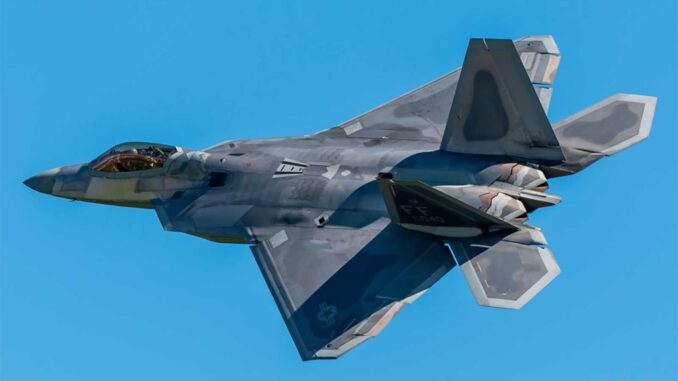
The F-22 remains reserved for the United States. Industrial secrecy, stealth, reverse engineering: why Washington refuses to export it.
In summary
The F-22 Raptor is the only fifth-generation fighter jet that has never been exported. Unlike the F-35, which has been sold to dozens of allied countries, the Raptor remains exclusively in the hands of the US Air Force. This uniqueness is based on a specific political decision: the Obey Amendment, passed by the US Congress in the late 1990s, which prohibits all foreign sales. Behind this legal barrier lies a deep strategic concern: the fear that the capture, even accidental, of an F-22 would allow adversaries to uncover the secrets of American stealth technology. The structure, absorbent materials, aerodynamic architecture, and certain sensor fusion algorithms are considered too sensitive to leave US territory. Even major partners such as Japan and Israel have been refused. This choice highlights the real technological hierarchy between the F-22 and the F-35, and reveals what Washington considers non-negotiable in its air superiority.
The paradox between a global F-35 and a strictly national F-22
At first glance, the situation is puzzling. The United States exports the F-35 Lightning II to more than 15 countries, some of which have only recently established relations with Washington. At the same time, the F-22 Raptor, although older, remains confined to the US military.
This contrast is no coincidence. The F-35 was designed from the outset as a multinational program, with shared sovereignty, international supply chains, and versions tailored to allies. The F-22, on the other hand, was born in the context of the end of the Cold War, as a tool intended exclusively to guarantee American air superiority against major state adversaries.
Export was never part of its industrial DNA.
The Obey Amendment, a voluntary legal barrier
The key to the ban lies in a specific piece of US law: the Obey Amendment, passed in 1998 and incorporated into defense budget legislation. This text explicitly prohibits any export of the F-22, even to allies.
Unlike other restrictions, this is not an administrative regulation that can be circumvented by a downgraded version. It is a legislative lock, reflecting a clear political will on the part of Congress to prevent the dissemination of technologies deemed critical.
This decision came at a key moment. The F-22 was then in advanced development, and the United States realized that some of its innovations should not leave their direct control, even at the cost of missed industrial opportunities.
The central fear of reverse engineering
The argument most often put forward by Washington is that of reverse engineering. The idea is simple: an exported aircraft can be observed, measured, or even recovered after an accident. Even a trusted ally cannot guarantee that an aircraft will never be examined by a rival power, either directly or indirectly.
In the case of the F-22, this fear is amplified by the very nature of its technologies. Unlike an aircraft whose performance relies primarily on electronics, the Raptor incorporates secrets deeply embedded in its physical structure.
Once revealed, these secrets can no longer be “updated.”
The stealth of the F-22, an inseparable whole
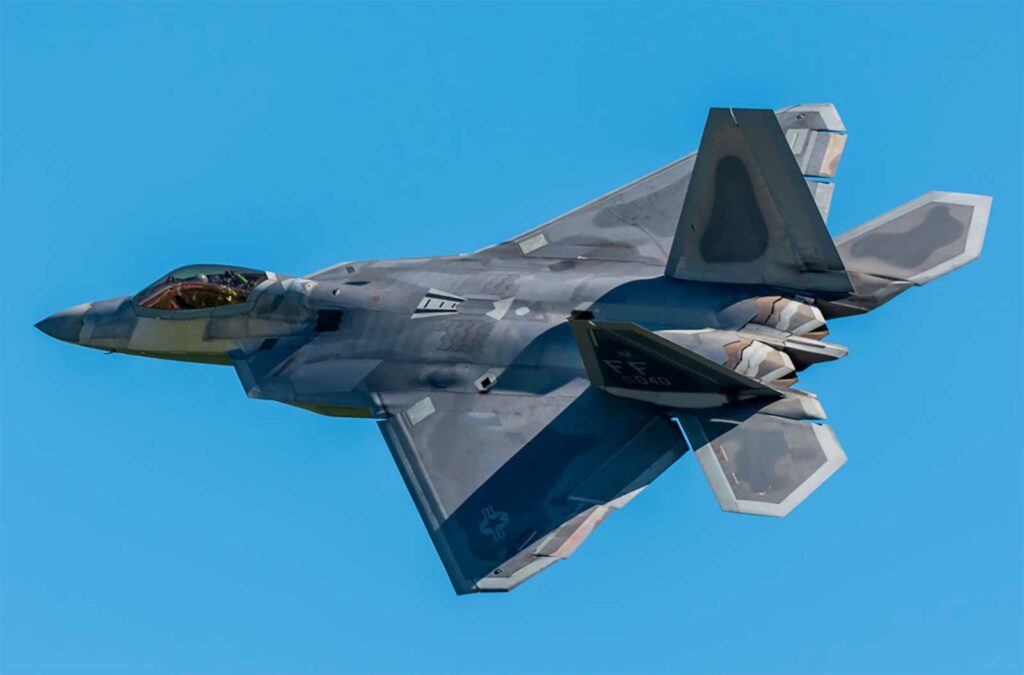
The stealth of the F-22 is not limited to absorbent coatings. It is based on a coherent whole: surface geometry, edge alignment, air intake integration, hatch shape, and engine thermal management.
These elements are structural. They cannot be removed without altering the aircraft. It is precisely this point that makes a credible “export” version impossible. Degrading the stealth capabilities of the F-22 would negate the very purpose of the aircraft.
Conversely, the F-35 was designed with a more “industrialized” stealth capability, intended to be produced in large numbers and shared within an allied framework, with certain compromises.
Materials and processes deemed too sensitive
Another major factor concerns materials. The F-22 uses advanced alloys, specific composites, and radar-absorbing coatings developed at a time when the United States had a clear lead over its competitors.
These materials are not only expensive. They reveal manufacturing methods, industrial tolerances, and design choices that provide valuable clues on how to counter stealth.
For Washington, allowing this information to circulate, even indirectly, would be tantamount to accelerating adversaries’ detection and interception programs.
Sensors and data fusion: another level of secrecy
The F-22 is often presented as less “connected” than the F-35. This is true on the surface. But it was the first operational fighter to integrate advanced sensor fusion, with AESA radar, passive systems, and automated tactical situation management.
This software architecture, although older than that of the F-35, remains classified in many respects. The algorithms, processing priorities, and certain electronic warfare capabilities are still considered sensitive.
Exporting the aircraft would involve either revealing these components or removing them, which would pose an operational consistency problem.
Refusals to close allies
Rumors of refusals to Japan and Israel are well-founded. Tokyo, faced with China’s rise to power, has repeatedly explored the possibility of acquiring the F-22. Israel, a major strategic partner of the United States, has also expressed interest.
In both cases, the American response was negative. Not out of political mistrust, but on principle. Washington felt that the technological risk outweighed the strategic gain.
These refusals have contributed to structural choices. Japan has strengthened its commitment to the F-35 and, at the same time, launched its own future fighter program. Israel, for its part, has obtained significant modifications to the F-35, but never access to the F-22.
Is the F-22 superior to the F-35?
This question comes up often, but it calls for a nuanced answer. The F-22 remains superior in one specific area: pure air superiority. Its supersonic cruise speed without afterburners, its maneuverability, and its frontal stealth make it a formidable air-to-air fighter.
The F-35, on the other hand, is a multi-role aircraft, optimized for networked warfare, precision strikes, and intelligence gathering. It is less effective in pure air combat, but much more versatile and interoperable.
In other words, the F-22 is a specialized scalpel, while the F-35 is a comprehensive system. This specialization also explains the US desire to keep the Raptor as a strictly national asset.
An aircraft too sensitive to be shared
Beyond its performance, the F-22 embodies an industrial philosophy that no longer exists today. It was designed without export constraints, without concern for allied standardization, and without compromise on certain costly choices.
Sharing it would mean revisiting this philosophy. The United States decided that the effort was not worth it, especially after the production line was shut down in 2012, with only 187 aircraft built.
Restarting production for export would have required massive investment for an aircraft that is already surpassed in certain software aspects by the F-35.
What the export ban really reveals
The ban on the F-22 is not simply a protectionist reflex. It reveals the real hierarchy of American technologies. Some can be shared, even partially. Others are considered non-transferable because they structure long-term dominance.
The F-22 belongs to this second category. It is not just an aircraft, but a concentration of industrial choices, materials, and doctrines that Washington prefers to keep under lock and key.
This decision also sheds light on the future. Sixth-generation programs, such as NGAD, will likely follow the same logic: a highly advanced domestic version and separate export solutions, designed from the outset to be shared without major strategic risk.
Sources
– U.S. Congressional documents relating to the Obey Amendment
– Official US Air Force publications on the F-22 Raptor
– Comparative analyses between the F-35 Lightning II and F-22
– Specialized reports on stealth and aeronautical reverse engineering
– Historical studies on Japanese and Israeli requests concerning the F-22
War Wings Daily is an independant magazine.