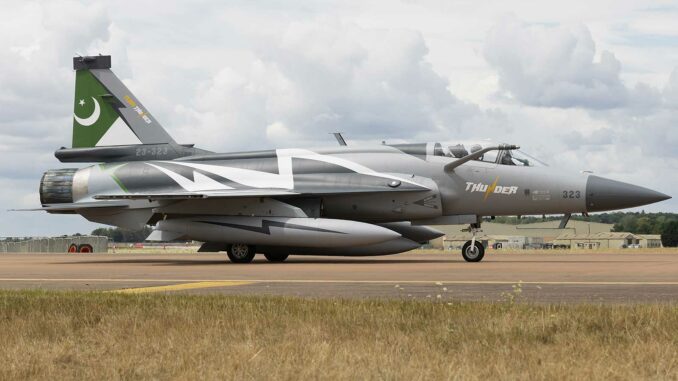
The JF-17 Block 3 is attracting new customers, from the Gulf to the Caucasus. Behind this interest lies an affordable, modernized fighter jet that is now better armed.
In summary
The PAC JF-17 Thunder has been receiving renewed attention since early 2026. Islamabad claims to be facing a sharp increase in export interest in the JF-17 Block 3, to the point of raising concerns about future strain on production capacity. This surge is driven by three factors. First, the aircraft is cheaper than most of its Western competitors. Second, the Block 3 standard addresses several historical weaknesses through an AESA radar, a helmet-mounted display, modernized avionics, and improved integration of air-to-air missiles. Finally, Pakistan is actively seeking to transform the JF-17 into a diplomatic and industrial tool. However, it is important to be precise: Azerbaijan is no longer exploring the option, since a contract was already announced in 2024 and then expanded in 2025. On the other hand, Saudi Arabia is indeed cited among the countries under discussion. As for the PL-10, it is indeed the same family of short-range missiles used by the J-20, but in an export variant. This distinction is important.
The commercial comeback that puts the JF-17 back in the running
For a long time, the JF-17 Thunder was seen as a compromise fighter. The aircraft was considered useful and affordable, but rarely ranked among the top exportable fighter jets. That perception is changing. In January 2026, Reuters reported that Pakistan was discussing arms sales with 13 countries, including 6 to 8 advanced negotiations, and that the JF-17 was at the heart of this export push. Saudi Arabia, Indonesia, Bangladesh, Morocco, Nigeria, and Sudan were among the names mentioned in these discussions. This movement is broad enough that it can no longer be treated as a mere public relations campaign.
However, the information needs to be clarified. The claim that Saudi Arabia and Azerbaijan are both exploring major contracts is no longer entirely accurate. Regarding Saudi Arabia, Reuters did report on January 7, 2026, that discussions were underway regarding a financing plan linked to Saudi loans, with a potential value of approximately $4 billion for the aircraft and up to an additional $2 billion for other equipment. There is no indication at this point of a final agreement. We are in the realm of serious negotiations, not that of a finalized contract.
For Azerbaijan, the situation is different. Reuters confirmed as early as September 2024 the signing of a contract for JF-17 Block III aircraft. Since then, several open sources have reported an expansion of the package to 40 aircraft for approximately $4.6 billion in 2025. In other words, Baku is no longer a theoretical prospect. It is already a major customer, and likely the program’s most significant export achievement to date.
The technical upgrade that is changing the aircraft’s image
The real driving force behind this push is not only diplomatic. It is also technical. The JF-17 Block 3 is the version that finally makes the aircraft more credible against 4.5-generation competitors. The official website of Pakistan Aeronautical Complex highlights an AESA radar, a Helmet Mounted Display, a Tactical Data Link, an integrated self-protection jammer, a redundant digital architecture, and three multifunction displays. This is no small matter. This means that Block 3 is no longer just a cheap, lightweight airframe: it is a much more coherent platform for modern combat.
The most significant improvement concerns air-to-air engagement. An active-scan radar improves detection, multi-target tracking, and resistance to countermeasures compared to older standards. The helmet-mounted display, for its part, changes the logic of close-range combat. The pilot no longer needs to strictly align the aircraft’s axis with the target, as was the case with older generations. Once the missile and the targeting system are properly integrated, the pilot can engage a target at a highly offset angle. This is precisely what makes the PL-10E so valuable.
Let’s be frank: the JF-17 is still not on par with a Rafale, an F-16V, or a Gripen E across all criteria. It still lags behind in several areas, notably the overall maturity of the ecosystem, logistical depth, the reputation for long-term support, and, according to many analysts, the overall quality of certain electronic warfare components. But it is no longer fair to describe it as a second-rate aircraft without nuance. Block 3 takes it to a whole new level, especially for air forces that want a modern fighter without paying the Western price tag.
The PL-10 missile that finally gives Block 3 real bite in close combat
The most talked-about development since February 2026 is the visible integration of the PL-10E on the JF-17 Block 3 at the World Defense Show in Saudi Arabia. Pakistan showcased the aircraft with this missile as a cohesive export package. Image matters. It tells potential customers that Block 3 doesn’t just come with an improved airframe, but with a state-of-the-art close-range weapon.
We must, however, be precise in our wording. The missile presented for export is the PL-10E, not necessarily the exact domestic version of the PL-10 in service with the People’s Liberation Army Air Force. But the technological kinship is clear. Specialized and academic sources classify it in the same family as the best contemporary short-range missiles, featuring an imaging infrared seeker, strong off-boresight engagement capability, and thrust vectoring.
Put another way, it is the type of missile designed to fully exploit a helmet-mounted display and to strike a target that is not strictly in front of the aircraft.
This is where we must correct a statement often repeated too hastily. To say that the JF-17 carries “the same missile as the J-20” is true in spirit, but approximate in detail. The accurate statement is as follows: the JF-17 Block 3 is now equipped with the export version of a missile from the PL-10 family, the same family used on the J-20 in its Chinese variant. This nuance avoids overselling the information while maintaining its significance.
Operationally, this integration changes the JF-17’s value proposition. A light fighter equipped with an AESA radar, a helmet-mounted display, and a missile with a wide firing arc becomes far more dangerous in visual combat than a half-modernized aircraft. This does not guarantee air superiority. But it significantly enhances the product’s credibility for export.
The commercial logic driving Saudi Arabia to consider the Pakistani-Chinese option
Why would Saudi Arabia be interested in an aircraft like the JF-17 when it already operates heavier and more prestigious fleets? Precisely because the JF-17 does not compete in the same segment. The kingdom has F-15s and Eurofighter Typhoons—heavier, more expensive aircraft designed for a different level of air power. The JF-17 may appeal to Riyadh as a complementary solution, offering higher production volumes, lower acquisition costs, more accessible technology transfers, or diversification of its suppliers.
There is also a political factor. Reuters reported in January that Saudi Arabia was seeking to further diversify its security partnerships amid persistent doubts about automatic U.S. commitment to the region. Pakistan, for its part, needs to export more weapons and sees its Muslim partners as a logical target. The JF-17 thus becomes a tool of military diplomacy as much as a fighter jet.
However, we must keep our feet on the ground. Saudi Arabia has no obvious need for a massive short-term replacement in the niche covered by the JF-17. Any potential agreement would depend on much broader considerations: political alignment, financing terms, the role granted to local industry, negotiations with American and European suppliers, and the acceptability of the Chinese footprint within the system. The matter is therefore serious, but far from a done deal.
The Azerbaijani case, which proves that the JF-17 can break out of the captive market
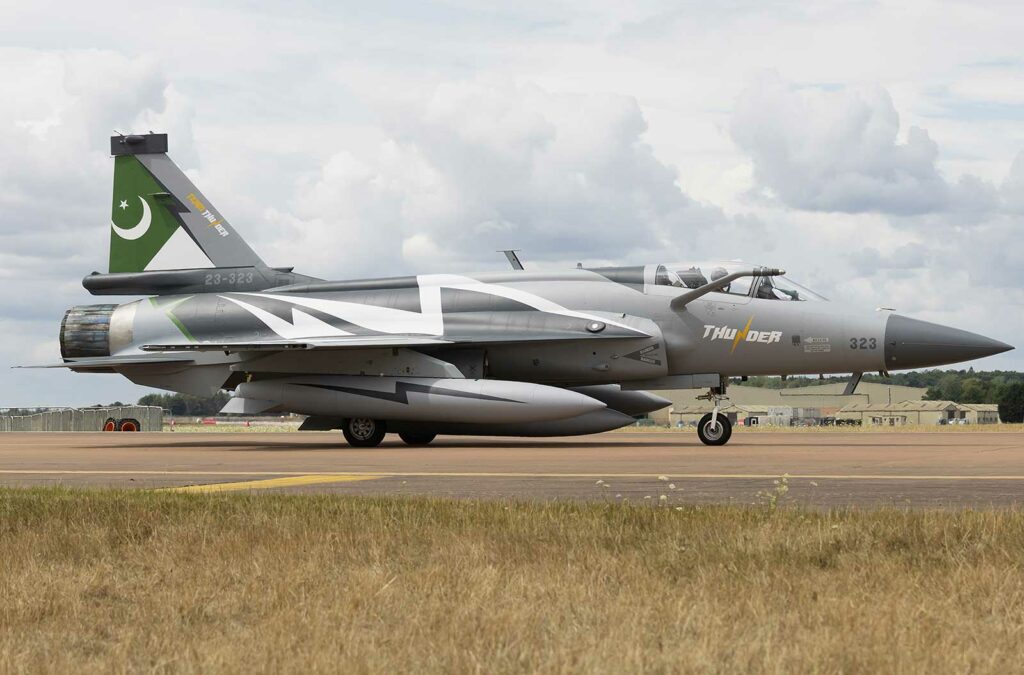
The Azerbaijan case is even more significant than Saudi interest, as it marks the export of Block 3. Until now, the JF-17 had mainly broken into smaller markets such as Myanmar and Nigeria. With Azerbaijan, Pakistan is moving to a new level. The contract signed in 2024, then expanded in 2025 according to Pakistani announcements and several industry sources, gives the program a more visible reference in a sensitive theater, in the midst of the Armenian-Azerbaijani conflict and under the watchful eye of Turkey, Russia, and the West.
Why did Baku choose this path? The simplest answer is also the most solid: the JF-17 Block 3 offers a rapid upgrade at a political and financial cost that is likely more acceptable than other options. It also allows Azerbaijan to further strengthen its military cooperation with Pakistan, which is already solid on the diplomatic front. For Islamabad, this sale plays a crucial role. It shows that a customer can move beyond a small symbolic batch and commit to a significant fleet.
This success does not guarantee a global wave. But it corrects a problem that has long plagued the JF-17: the notion that the aircraft appealed to almost no one outside Pakistan. That is no longer true.
The surge in demand also reveals the program’s limitations
The rise in export interest is real, but it raises a less flattering question: Can Pakistan keep up industrially? Reuters, Bloomberg, and other media outlets have reported that recent demand risks straining the production capacities of the Sino-Pakistani partnership. Pakistan has also indicated that a significant ramp-up is not expected before 2027. This point is decisive. An aircraft can become attractive but lose markets if it cannot be delivered on time.
There is also another, more structural limitation. The JF-17 Block 3 is competitive because it is cheaper, more flexible, and more politically accessible than some rivals. But this strength is also its limitation. As soon as a country has the means to purchase higher-end aircraft and bear the associated operating costs, the JF-17 may once again become a secondary choice. Its market niche is therefore clear: air forces on a tight budget, countries seeking strategic diversification, or customers wanting a modern fighter without being entirely dependent on Washington or Europe.
This is what makes the current period interesting. The JF-17 Thunder is not overturning the global fighter jet market. However, it is carving out a more significant niche than before in the segment of affordable yet genuinely modernized fighters. And this time, it’s no longer doing so with just theoretical talk. It’s doing so with a better-equipped Block 3, a PL-10E visible under the wing, a major customer already on board, and several capitals closely examining the offer. It’s less spectacular than a fifth-generation program. But commercially, that’s often how an aircraft ends up making a difference.
War Wings Daily is an independant magazine.