
The TAI Kaan reaches a milestone with an Indonesian contract for 48 aircraft. Performance, military integration, and expectations surrounding the new-generation Turkish fighter jet.
In summary
The TAI Kaan program, formerly known as TF-X, has reached a political and industrial milestone with the announcement of a contract worth approximately $10 billion for 48 aircraft destined for Indonesia. This agreement, which is still structured in stages, marks a turning point for the Turkish aerospace industry. It validates Ankara’s ambition to establish itself as a credible player in the new-generation fighter aircraft market, facing already well-established competitors.
Beyond the commercial announcement, the Kaan raises major technical and operational questions: actual level of stealth, maturity of mission systems, dependence on foreign engines, and integration schedule within the Türk Hava Kuvvetleri. Expectations are high, both in Turkey and among export partners. The program is progressing rapidly, but remains subject to technological and political constraints. This Indonesian contract therefore acts as a revelation: the Kaan is no longer just a national demonstrator, but a project closely watched by air forces seeking a partial alternative to American and European standards.
The context of a strategic agreement with Indonesia
The announcement of an agreement between Turkey and Indonesia for 48 TAI Kaan aircraft is the program’s first major export success. The amount involved, close to US$10 billion, includes airframes, initial support, training, and a local industrial component. For Jakarta, the challenge is twofold: modernizing a heterogeneous fleet and strengthening its national industrial capabilities, particularly through PT Dirgantara Indonesia.
For Turkey, this agreement goes beyond a simple sale. It serves as a signal of international credibility for an aircraft still in the development phase. Unlike announcements of intent, this contract is part of a state cooperation strategy, with a strong political commitment. It comes at a time when Indonesia is seeking to reduce its exclusive dependence on certain Western suppliers, while avoiding a sudden technological break.
However, this choice remains a cautious one. Deliveries are not expected before the mid-2030s. Indonesia is therefore betting on Turkey’s ability to meet its deadlines and develop the Kaan into a truly operational standard. For Ankara, this external commitment creates unprecedented industrial and technical pressure: any delay or deterioration in performance would have a direct impact on the program’s reputation.
Expected performance of the TAI Kaan
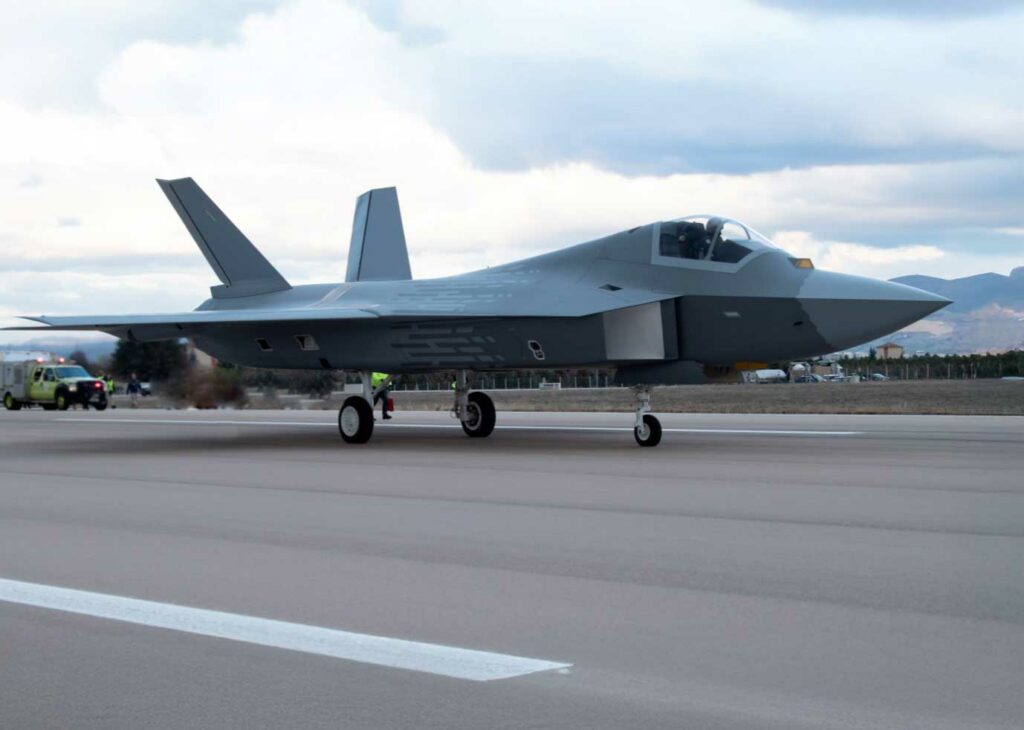
The Kaan is designed as a fifth-generation multirole fighter, with a strong emphasis on air superiority. Its dimensions place it in the heavy category: a length of approximately 21 meters, a wingspan of close to 14 meters, and an estimated maximum takeoff weight of 27 tons. These figures bring it closer to the F-22 than to lighter single-engine fighters.
The announced maximum speed exceeds Mach 1.8 (approximately 2,200 km/h at high altitude). The operational ceiling is estimated at 16,800 meters (55,000 ft), with a range of over 1,000 kilometers without refueling. The Kaan should also be capable of supercruise, although this remains dependent on the final engine configuration.
Stealth is a key feature of the program. The airframe has angular shapes, S-shaped air intakes, and internal bays designed to reduce its radar signature. However, the actual quality of the absorbent materials and their durability remain unknown at this stage. In this regard, the Kaan is still in a phase of gradual optimization, far from a fixed standard.
Engine choices and their limitations
The Achilles heel of the program remains the engine. Current prototypes use General Electric F110 engines, a proven engine but one that is not optimized for a new-generation stealth platform. This solution speeds up flight testing but limits certain performance characteristics, particularly in terms of supercruise and specific fuel consumption.
Turkey has set itself the goal of developing a national engine via TRMotor and TEI, with a target power output of more than 130 kN with afterburner. However, designing a turbojet engine of this level represents a major technological challenge. International precedents show that this type of development often requires more than 15 years and investments exceeding several billion euros.
In the short and medium term, the Kaan will therefore remain partially dependent on foreign suppliers. This reality poses a political risk, particularly in the event of diplomatic tensions. For export customers such as Indonesia, this dependence is a key parameter in assessing the aircraft’s life cycle.
Embedded systems and digital architecture
The Kaan relies heavily on an open digital architecture, designed to gradually integrate new capabilities. The AESA radar, developed by Aselsan, is announced with more than 1,500 transceiver modules, offering advanced multi-target tracking and electronic warfare capabilities.
The data fusion system is another key feature. The aim is to provide the pilot with a unified tactical picture, integrating internal sensors, data from accompanying drones, and information from external networks. This approach is part of a collaborative combat strategy, which is still being developed.
The cockpits of the first prototypes feature a fully digital interface with large screens and simplified controls. The pilot’s cognitive load is presented as a key criterion. However, the software’s maturity remains to be demonstrated in complex scenarios, particularly in intense electronic warfare environments.
Integration into the Türk Hava Kuvvetleri
For the Turkish Air Force, the Kaan is set to gradually replace the F-16 from the 2030s onwards. The stated objective is to build a fleet of more than 100 aircraft in order to maintain credible air superiority and deep strike capabilities.
This integration will take place in stages. The first batches will likely be used in mixed roles, with capabilities still below the latest Western standards. Pilot training, maintenance implementation, and adaptation of operational doctrines represent a considerable undertaking.
The Kaan must also fit into a broader ecosystem, including combat drones, surveillance aircraft, and air command capabilities. The coherence of this ensemble will largely determine the aircraft’s real operational value.
Expectations and areas of uncertainty
The Indonesian agreement creates high expectations, but also legitimate questions. The announced timelines remain ambitious. The first flight took place in 2024, but the path to initial operational capability still extends beyond the decade.
Actual stealth performance, the reliability of onboard systems, and operational availability will be closely scrutinized. The export market does not forgive broken promises. At this stage, the Kaan is a credible program, but still fragile, subject to industrial, financial, and political risks.
An ambitious goal, under international scrutiny
The TAI Kaan symbolizes a clear desire: Turkey’s desire to assert itself as an independent aerospace power. The contract with Indonesia partially validates this ambition, without removing all uncertainties.
The Kaan is neither a simple prestige project nor an established standard. It is evolving in an intermediate zone, where every milestone will count.
The next few years will be decisive. Flight tests, industrial ramp-up, and the ability to deliver an aircraft that meets expectations will determine whether the Kaan becomes a lasting player in the military aviation landscape or remains a costly gamble with limited scope.
Sources
Turkish Aerospace Industries – institutional press releases
Statements by the Turkish Ministry of Defense
Public data from Aselsan and TEI
Sector analyses on new-generation fighter programs
War Wings Daily is an independant magazine.