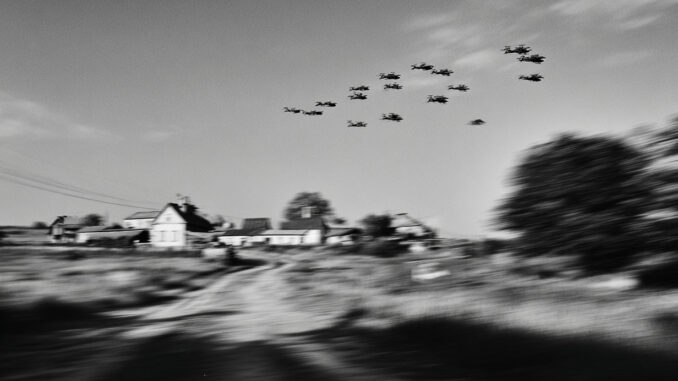
Swarms of autonomous robots are moving from centralized control to distributed decision-making, to become more resilient and efficient.
In summary
Artificial intelligence systems organized into swarms break with the logic of a single control center. Inspired by insect colonies, schools of fish, and flocks of birds, these multi-agent systems are based on simple local rules applied by dozens or even thousands of agents. The goal is clear: to keep the mission alive, even if part of the swarm is destroyed or cut off from communication. This decentralized architecture enables distributed decision-making, where each robot adjusts its behavior based on its neighbors and the environment, without a detailed overall plan. Bio-inspired AI algorithms manage coordination, task distribution, information fusion, and fault detection. Recent work shows that a swarm can maintain more than 70 to 80% of its performance, even after the loss of a significant fraction of its agents, thanks to swarm resilience and self-healing mechanisms. This approach is of interest to both civilian robotics (surveillance, agriculture, rescue) and the military sector, where the ability to continue a mission in a degraded environment is becoming a key criterion.

Swarm artificial intelligence: much more than a conceptual fad
Swarm collaboration is not just a marketing slogan. It is a very direct response to an operational problem: how to cover an area of several square kilometers, inspect hundreds of points of interest, or map a complex urban environment without relying on a single, expensive, and fragile platform. A multi-ton MALE drone remains vulnerable to a missile costing tens of thousands of euros, whereas a swarm of 100 micro-drones is much more difficult to neutralize completely.
The basic principle of swarm flight comes from nature. Boids-type models, developed in the 1980s, have shown that with three local rules—separation, alignment, and cohesion—a group of agents can produce a coherent collective movement without a leader or overall plan. Robotics has taken these models and combined them with algorithms for planning, obstacle detection, and trajectory optimization.
In a typical swarm of ground robots or drones, each agent has simple sensors: a laser rangefinder with a range of several tens of meters, a camera, GNSS, and IMU. The interaction radius is limited, often less than 50 meters, and sometimes less than 10 meters for micro-robots. Communication is multi-hop, or sometimes non-existent: information is propagated through agent encounters, which is sufficient for many coverage or search tasks.
The value of artificial intelligence in this context is not to “replace humans,” but to manage complexity that quickly becomes unmanageable for an operator. Supervising a swarm of 200 drones, each making several decisions per second, is impossible to do manually. AI takes care of low-level coordination, while humans set macroscopic objectives: area to explore, target to follow, behavior to adopt in case of loss of connection.
The shift from centralized control to distributed decision-making
Early multi-robot systems often used a centralized scheme: a ground server or “lead drone” calculated trajectories and then sent commands to each agent. This approach reassures engineers: the logic is concentrated, largely controllable, and easier to certify. The problem is obvious: the central point becomes a bottleneck and an ideal target. A failure, a cyberattack, or simple radio interference can paralyze the entire group.
With decentralized architecture, the system accepts a less comfortable but more realistic reality: communication is limited, imperfect, and sometimes non-existent. Each agent has autonomous control, capable of deciding locally on its trajectory, its neighborhood, and its contribution to the mission. Distributed decision-making is based on simple algorithms, executed in parallel on all agents.
In concrete terms, this means that the overall “strategy” is encoded in local rules:
– maintain a given distance from neighbors;
– move towards the least covered area;
– follow a concentration gradient (chemical, radio, thermal);
– update one’s opinion on the best target based on the signals received.
Recent work shows that swarms of robots can reach a reliable consensus on the best choice among several options, even when each robot frequently makes mistakes in its measurements. This is based on opinion dynamics inspired by bees or ants: reinforcement of the best perceived option, cross-inhibition of alternatives, collective decision thresholds.
The consequence is clear: the failure of an agent or the loss of a local connection does not block the group’s reasoning. Information circulates redundantly. The decision emerges from the network, not from a single server.
Bio-inspired AI as a driver of swarm collaboration
Bio-inspired AI is not a “nature-friendly” gadget. It is a brutal toolbox for enforcing collective behavior in limited processors, with little memory and sparse communications. The models are inspired by ants, bees, schools of fish, neurons, and even the immune system.
In practice, several families of algorithms dominate:
– Ant Colony algorithms for pathfinding and task distribution. “Pheromones” become digital markers: a heat map, a potential field, a simple counter. They allow the group to collectively converge on short paths or areas that have not yet been explored.
– Flocking dynamics (Boids, Vicsek, Olfati-Saber) for formation cohesion. They ensure that the swarm does not break up, even with noisy sensors, while avoiding collisions.
– Decision models inspired by bees, where each robot “dances” to promote an option and receives signals from other robots in return. Consensus is formed when one of the options exceeds a certain activation threshold in the network.
– Approaches inspired by the immune system for detecting failures or abnormal behavior in the swarm. Recent work shows that an “artificial antibody” model can identify degraded robots and limit their influence on the mission while maintaining approximately 79% of nominal performance.
The advantage of these approaches is pragmatic: they tolerate error. A robot may measure incorrectly, misinterpret, or even fall into a local loop. As long as the majority follows the rules, collective self-organization corrects individual deviations. In a swarm of 100 agents, losing 10 or 20 units does not mean stopping the mission; this is the very principle of distributed redundancy.
Resilience and self-healing after the loss of agents
A credible swarm does not have to look good in simulation. It must survive an unpleasant scenario: loss of 30% of agents, partial jamming, unexpected obstacles, stuck or damaged robots. This is where swarm resilience becomes the key criterion.
In a centralized architecture, the loss of a few nodes can break the communication topology and isolate entire segments. In a distributed architecture, each agent attempts to maintain a certain degree of local connectivity. If a neighbor disappears, the robot extends its search, moves closer to other agents, or changes its trajectory to fill the “gaps” in the formation. Work on decentralized control shows that a swarm can continue to cover a target region as long as the density of agents remains above a critical threshold, typically a few robots per square kilometer depending on the mission.
Self-healing relies on several mechanisms:
– Formation reconfiguration. If a group of drones loses a segment, neighbors reorganize the distances between agents to fill the gap. Local density changes, but coverage remains acceptable.
– Task reallocation. In collection or surveillance scenarios, robots that are still operational increase their patrol frequency or extend their area of responsibility. Simple rules, based on local load and the number of neighbors, are sufficient to redistribute the work without central supervision.
– Isolation of faulty agents. Bio-inspired AI of the “immune system” type can detect robots that behave abnormally, for example by sending inconsistent data or remaining immobile for too long. The swarm can then ignore these agents, reduce their weight in decisions, or assign them a peripheral position.
The figures speak for themselves. In certain studies of robotics for collection in degraded environments, the presence of detection and reassignment mechanisms makes it possible to maintain around 75 to 80% of nominal performance despite the gradual degradation of several robots over time. It’s not perfect, but it’s much better than a monolithic system where the failure of the main platform ends the mission.
Concrete applications and limitations of distributed decision-making
The promises are appealing, but we must remain clear-headed. Distributed decision-making works very well for tasks where the global optimum emerges from local behaviors: exploration, coverage, source search, gradient tracking, consensus on a better site. It is less suitable for missions where there are strong constraints in terms of security, legality, or inter-domain coordination.
In environmental monitoring, a swarm of 200 micro-drones can track an oil spill in real time over several dozen kilometers of coastline, adapt its measurement density, and continue to operate even if drones crash or lose their connection. Similarly, in precision agriculture, swarms of ground robots can cover plots of several hundred hectares, identify areas of water stress, and take action locally.
In the military field, the discourse is more brutal. A swarm of suicide drones can continue to search for and saturate an air defense even after half of the aircraft have been destroyed. As long as a few agents reach the target area, the tactical objective can be fulfilled. Fault tolerance and redundancy become weapons in themselves.
But distributed decision-making has blind spots. It can be manipulated if false information is injected into a significant fraction of the group. It can be trapped in local attractors, for example by concentrating too many units in an area that is “interesting” but irrelevant to the mission. Coordination between swarms, or between a swarm and piloted systems, remains a work in progress.
Finally, the cognitive cost on the human side is not neutral. Supervising a swarm is not “piloting more drones”; it means accepting to relinquish fine control and focusing on the mission framework, rules of engagement, and prohibited areas. Many organizations are not ready for this cultural change, even if the technology is available.
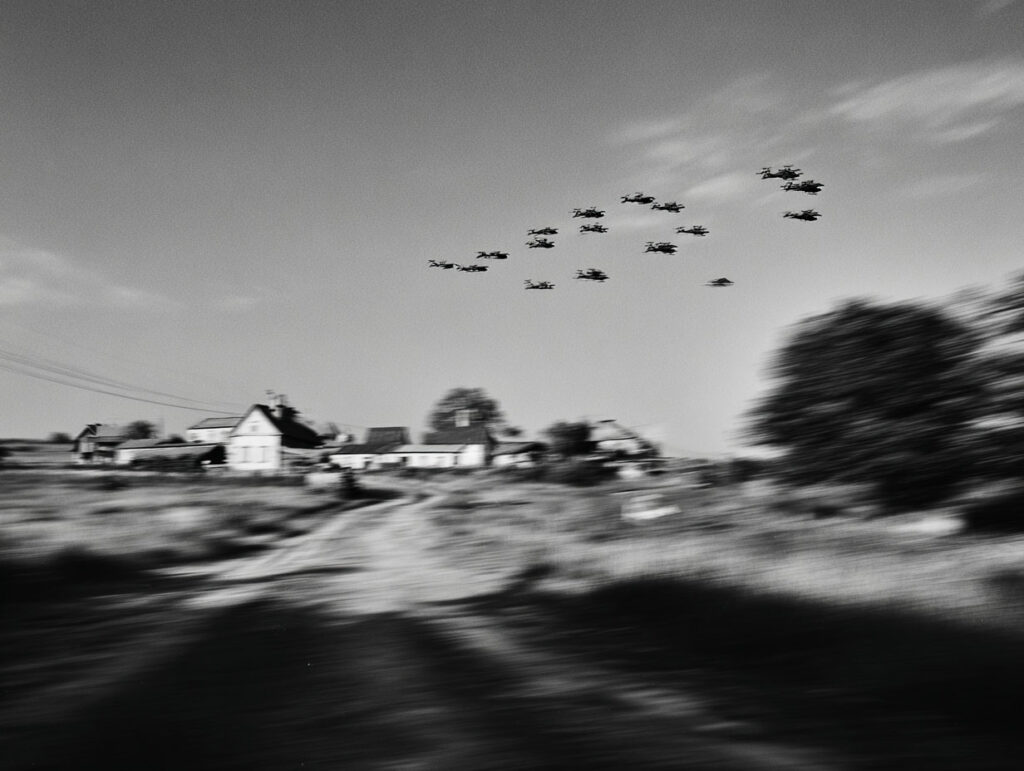
The swarm as a test of the maturity of our relationship with autonomous systems
Swarm artificial intelligence presents engineers and decision-makers with a clear choice. Either we persist with comfortable but fragile architectures, with bloated control centers, saturated data links, and single platforms that we protect at all costs. Or we accept the logic of a system where we tolerate the loss of agents, where we delegate decisions to simple units, and where the mission no longer belongs to a flagship machine but to a collective.
Technically, the direction is clear: work on the development of scramjet engines or other futuristic technologies will have less operational impact in the short term than the ability to deploy robust swarms in degraded environments. Politically and ethically, the discussion is far from over. A swarm of robots capable of reorganizing themselves after significant losses raises clear questions of control, responsibility, and transparency.
We can dance around the issue, but the reality is simple: the next generation of autonomous systems will be collective or remain isolated. Centralized artificial intelligence architectures are already showing their limitations in complex operations. Bio-inspired swarms, on the other hand, have proven that they can take hits, compensate for errors, and keep moving forward. The real question is no longer “is it feasible?” but “how far are we willing to let these collectives decide for themselves, even partially, how the mission unfolds?”
Sources
Journal articles on swarm robotics and swarm intelligence (ScienceDirect, MDPI)
Recent work on bio-inspired decision-making in swarms (arXiv, ResearchGate)
Studies on decentralized control and distributed architectures in multi-agent robotics
Publications on flocking models (Boids, Vicsek, Olfati-Saber) and their robotic applications
Work on fault detection and self-healing inspired by the immune system in robot swarms
War Wings Daily is an independant magazine.