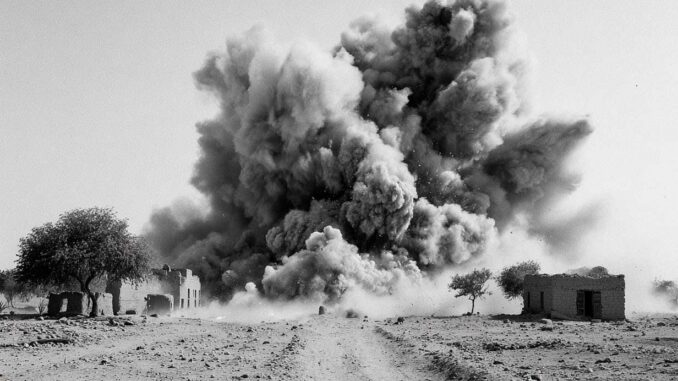
Morocco is stepping up its offensive in Western Sahara with armed drones, turning a frozen conflict into a high-tech war. Precision strikes are weakening the Polisario Front, but raising accusations of humanitarian violations affecting civilians and foreigners. Find out how this military development is reshaping the geopolitical landscape.
In summary
The conflict in Western Sahara has pitted Morocco against the Polisario Front since the 1970s. Rabat controls about 80% of the territory, while the Polisario administers the liberated areas east of the sand wall. In 2020, the breakdown of the ceasefire reignited hostilities. Morocco has invested heavily in armed drones, such as the Turkish Bayraktar TB2 and the Chinese Wing Loong, to monitor and strike enemy positions. These aircraft have enabled precision operations, killing Polisario leaders and disrupting their movements. However, reports document strikes in the UN-mandated buffer zone, affecting Sahrawi civilians and Algerian and Mauritanian truck drivers. In 2025, an attack destroyed an Algerian truck, exacerbating tensions with Algiers. This “drone war” renders the Polisario obsolete in the face of technological superiority, but raises ethical questions about compliance with international humanitarian law. Morocco defends these actions as defensive, while the Polisario denounces them as targeted assassinations. In total, more than 50 strikes have been reported since 2021, with an estimated human toll of dozens of civilian casualties.
The historical context of the conflict in Western Sahara
Western Sahara has remained a disputed territory since Spanish decolonization in 1975. Morocco annexed the region, citing ancient historical and territorial ties. The Polisario Front, an independence movement, proclaimed the Sahrawi Arab Democratic Republic in 1976. This dispute led to open warfare until the 1991 ceasefire, supervised by the UN through the United Nations Mission for the Referendum in Western Sahara (MINURSO).
The stakes involve natural resources such as phosphates and coastal fisheries. The territory covers 266,000 square kilometers, with an estimated population of 600,000, mostly under Moroccan control. The Polisario controls about 20% of the land, mainly desert areas in the east. Algeria supports the Polisario, providing logistical and diplomatic assistance, which fuels regional rivalries.
The breakdown of the ceasefire in 2020
In November 2020, Sahrawi protesters blocked the Guerguerat road, a vital crossing point to Mauritania. Morocco deployed troops to reopen the route, sparking renewed fighting. The Polisario declared an end to the ceasefire, accusing Rabat of violating it. Since then, clashes have been concentrated along the sand wall, a 2,700-kilometer fortification built by Morocco in the 1980s.
This resumption marked an asymmetrical turning point. The Polisario is conducting guerrilla attacks, with rocket fire and ambushes. Morocco is responding with advanced air power. In 2024, the Polisario claimed more than 200 attacks, causing limited damage to Moroccan infrastructure. Rabat downplays these actions but admits to isolated losses.
Morocco’s drone arsenal
Morocco has modernized its armed forces with a massive investment in drones since 2019. The military budget reached $5.1 billion in 2024, with a significant portion allocated to unmanned systems. These aircraft provide surveillance, reconnaissance, and precision strikes, adapted to the desert terrain of Western Sahara.
Turkish-made Bayraktar TB2s
The Bayraktar TB2, acquired from Turkey in 2021, forms the backbone of this strategy. Each drone is 6.5 meters long, with a wingspan of 12 meters, and can fly at 150 kilometers per hour for 27 hours. Armed with MAM-L missiles, they have a range of 150 kilometers. Morocco has at least 25 units, which are used for night missions thanks to infrared sensors.
In April 2023, a Bayraktar TB2 eliminated a Polisario convoy near Bir Lahlou, killing three fighters.
These drones have proven their effectiveness in other conflicts, such as in Libya, where they destroyed armored vehicles with 95% accuracy.
The Chinese Wing Loong
The Wing Loong II, supplied by China since 2020, completes the arsenal. Larger, with a length of 11 meters and a range of 20 hours, they carry Blue Arrow-7 missiles, effective up to 8 kilometers. Morocco has ordered a dozen of them, integrated into bases such as the one in Laayoune.
A strike in May 2025 targeted a Polisario armed group east of the wall, destroying two vehicles. These drones excel at detecting nomadic movements, thanks to synthetic radar.
Israeli systems
Israel supplies drones such as the IAI Harop and Hermes 900. The Harops are loitering munitions, crashing into the target with a 23-kilogram explosive charge. Morocco acquired 150 units in 2021. In January 2025, a Harop neutralized a Polisario command post, killing four people.
These collaborations reinforce Morocco’s air superiority, with technology transfers for partial local production.
Operations in the buffer zone
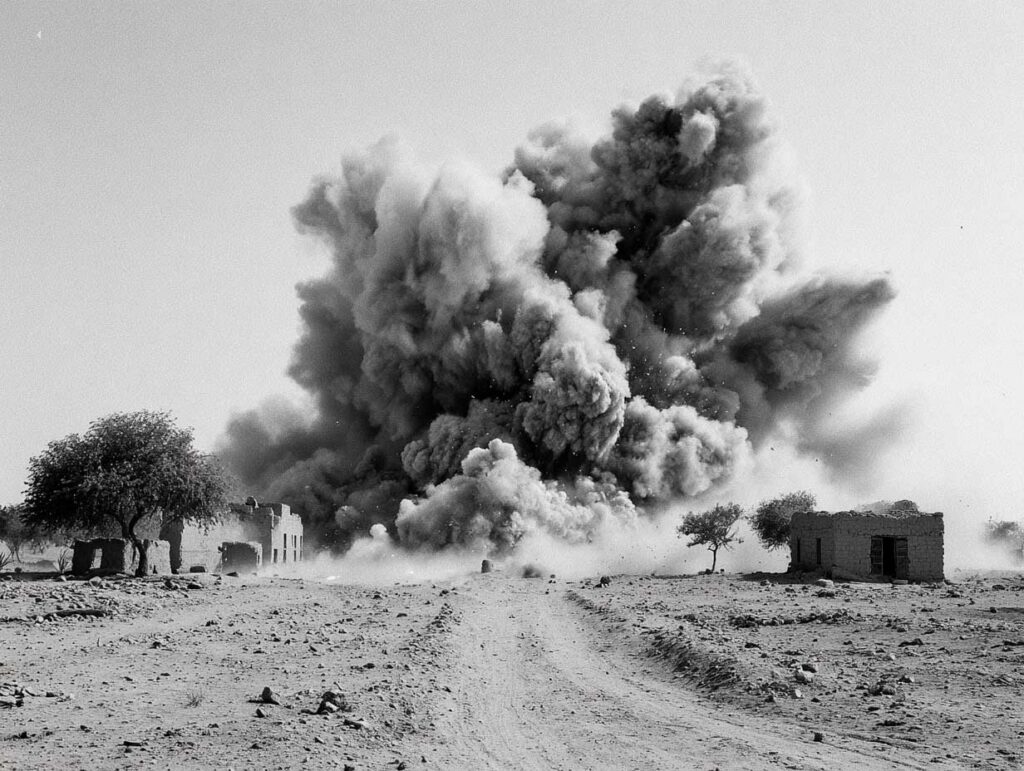
The buffer zone, 5 kilometers wide along the sand wall, is demilitarized under a UN mandate. However, Moroccan drones operate there regularly. In June 2025, a strike destroyed an Algerian truck near Tifariti, killing two civilians. The Polisario Front denounces these incursions as violations of international law.
Drones monitor the area 24 hours a day, detecting infiltrations. In 2024, more than 30 missions were reported, with preventive strikes. Morocco justifies these actions by the need to secure its borders, in the face of Polisario rocket fire that sometimes reaches Smara, 40 kilometers inland.
Controversy over strikes affecting civilians
Humanitarian reports highlight collateral damage. In April 2025, a drone bombed a Mauritanian convoy near the border, killing three truck drivers. Algeria accuses Morocco of targeted assassinations, with at least 10 incidents involving foreign nationals since 2022.
A 2025 report estimates that 40 civilians have been killed in strikes, 60% of them in the south of the territory. The Polisario Front has published videos showing debris from Israeli drones at civilian sites. The UN has investigated five cases, confirming potential violations of humanitarian law. Morocco refutes this, claiming to target only armed threats.
These events exacerbate regional tensions. Algiers has threatened international referrals, while Nouakchott calls for restraint.
The impact on Polisario forces
Drones have rendered Polisario tactics obsolete. Once based on desert mobility, their operations are now limited. In 2025, Polisario lost 50 fighters in strikes, including key commanders.
The movement is adapting its methods, using low-cost Iranian drones for counterattacks. In July 2025, a Polisario drone damaged a Moroccan base. However, Morocco’s technological superiority is forcing the Polisario into a war of attrition, with logistical losses estimated at 30%.
This asymmetry is pushing the Polisario toward alliances, such as with Algeria, which supplies surface-to-air missiles. The conflict could spread if drones continue to strike beyond the lines.
Moroccan drones are not only redefining this conflict, but also raising questions about the future of warfare in Africa.
Faced with accessible technology, groups such as the Polisario Front could invest in electronic countermeasures, such as jammers. The diplomatic implications remain: the UN is struggling to impose a referendum, while foreign powers, Turkey, China, and Israel, are profiting from these sales. This high-tech theater could inspire other nations, but at the cost of a humanitarian escalation that calls for urgent mediation.
Sources:
- Maghrebi.org, “Sahara: Algeria-Morocco tensions flare after deadly drone strike,” June 5, 2025.
- Crisis Group, “Managing Tensions between Algeria and Morocco,” November 29, 2024.
- RFI, “Algeria accuses Morocco of targeted killings after drone attack in Western Sahara,” April 13, 2022.
- Middle East Eye, “Ghost towns, rockets and drones: the Polisario Front’s war in Western Sahara,” December 15, 2021.
- Le Desk, “Polisario says it is suffering repeated drone strikes east of the defense wall,” January 4, 2024.
- Slate, “In the Sahel, drone warfare is becoming widespread and terrorizing populations,” September 12, 2025.
- AL24 News, “Western Sahara: Moroccan occupation continues to target civilians with drones,” April 10, 2025.
- UN, Security Council Report S/2022/733, October 3, 2022.
War Wings Daily is an independant magazine.