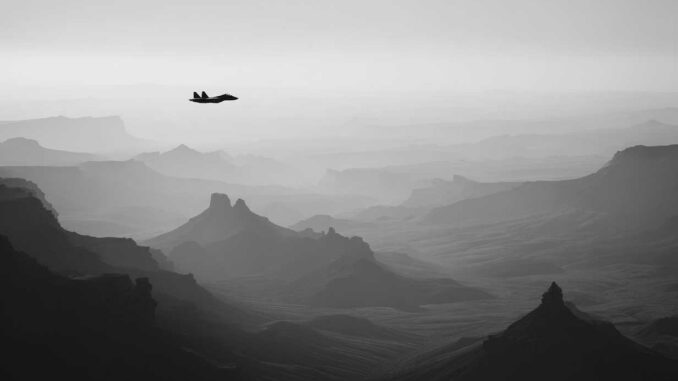
Images show a Su-57E flying over Algeria. What is the value of Russian exports, how much do they cost, and what does this change for Morocco and Tunisia?
In summary
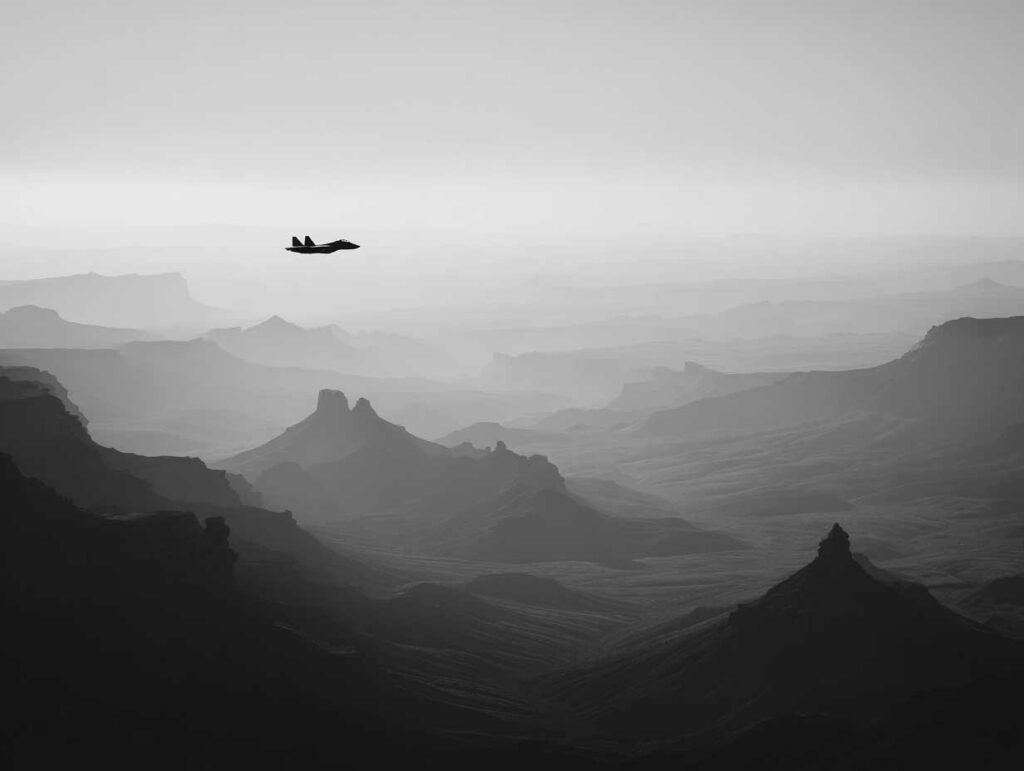
On February 8, 2026, a video appeared online showing a fighter jet with a shape and configuration compatible with the Su-57E flying over a desert landscape, escorted by Sukhoi jets painted in Algerian colors. Taken in isolation, a video clip is not enough to “prove” that the aircraft has entered service. But when viewed in the context of Russian announcements about a first export delivery, statements by Algerian state media about the purchase and training of pilots, and the parallel upgrade to Su-35s, the most coherent hypothesis is that Algeria has begun familiarization flights on its territory. The real issue is not the announcement itself. It lies in the details: an export version is rarely identical to the domestic version, especially in terms of sensors, data links, and self-protection. And operational integration takes time: hangars, engine support, ammunition, doctrine, training. With an estimated military budget of $21.8 billion in 2024, Algiers can absorb this program. Morocco and Tunisia, on the other hand, must respond differently: F-16 modernization on the Moroccan side, a more defensive posture on the Tunisian side.
The video sequence that ended the doubt, without settling everything
On February 8, 2026, images posted on social media showed an aircraft strongly resembling the Su-57 flying over typical southern Algerian terrain, accompanied by Sukhoi-type fighters with Algerian markings. The most straightforward interpretation is simple: the aircraft is already in Algeria, at least for testing purposes.
However, we must be rigorous. A short video does not reveal who owns the aircraft or its exact status: Russian demonstration, transfer flight, or the beginning of its acquisition by the Algerian Air Force. But this skepticism has its limits. First, because Moscow has already announced a first delivery to a foreign customer, without naming them. Second, because the Algerian press has already presented the country as the first export customer, with training in Russia. Finally, because the escort by aircraft bearing Algerian markings only makes sense if the event is part of a schedule of delivery and ramp-up.
The most cautious conclusion is therefore as follows: there is now a body of credible evidence indicating the start of Su-57E operations in Algeria, at least in the testing and crew conversion phase.
The Su-57E as seen by Algeria, not as seen by Russia
The Su-57 is often presented as the “rival” of the F-35. This is a selling point, but it is misleading. The Su-57 is a fifth-generation aircraft in the broad sense: sophisticated stealth, internal fuel tanks, sensor fusion, and efforts to reduce its infrared signature. However, its design choices and industrial schedule make it an aircraft halfway between a “stealth” approach and a “highly maneuverable heavy fighter” approach.
For a buyer country, the key question is the difference between the export version and a “full standard” Russian version. On paper, an export version can retain the aerodynamics and much of the performance, while being restricted in three areas.
Propulsion and the unfulfilled promise of the new-generation engine
For years, Russia has been targeting the Izdeliye 30 engine to improve thrust, fuel consumption, and signature, and to move closer to a true sustainable supersonic cruise regime. Until this engine becomes widespread, many Su-57s will rely on engines closer to previous generations, typically associated with the AL-41F1 family, according to publicly disclosed configurations. For an export customer, the most likely scenario is that the first batch will be delivered with the available and proven engine, because this is what allows for quick delivery and in-service support.
In practical terms, this means that Algeria can obtain a high-performance aircraft, but not necessarily one that is at the “top” of the Russian roadmap.
Sensors and fusion, where exports are most often cut back
Stealth is not just about shape. It is a complete chain: discreet sensors, data links, computers, electronic warfare, and adapted ammunition. On the Su-57, the most frequently cited component is the AESA N036 “Byelka” radar and its distributed antennas. In exports, the most common differences concern threat libraries, certain modes, cryptography, and link protocols. It is rarely stated in black and white, but it is the rule of the market: the platform is sold, and access to the most sensitive functions is controlled.
The operational consequence is clear: Algeria can gain in detection range and multi-target capability, while having less autonomy over software development and access to the “latest fusion bricks.”
Air-to-air weaponry: the gap between compatibility and availability
The Su-57 has been shown with several families of missiles, and the advantage of the modern standard is the ability to engage at long range with active guidance and datalink munitions. The iconic weapon cited in recent analyses is the R-77M missile, associated with the idea of better range and greater resistance to countermeasures.
But the sticking point, once again, is actual availability for an export customer: what is demonstrated is not necessarily delivered in quantity, quickly, or with the same parameters. Algeria can therefore adopt a gradual approach: first integrate the aircraft, then qualify the weapons, and only then achieve full operational value.
The real cost, between the national budget and the industrial bill
Algeria is not just buying an aircraft. It is buying a capability: training, infrastructure, parts, tools, ammunition, simulators, and support for ten to twenty years. The exact amounts are not public. Figures circulating in the specialized press suggest a budget of around $2 billion for an order of up to 14 aircraft. This type of order of magnitude is plausible: it corresponds to a modern heavy fighter, plus the initial support “package,” without necessarily including all ammunition.
What is, however, well documented is Algiers’ relative financial capacity. According to SIPRI, Algerian military spending reached $21.8 billion in 2024, up 12% year-on-year, and represents a very high proportion of public spending. In the same document, Morocco is given a figure of $5.5 billion in 2024. This gap shapes regional dynamics: Algeria has the budgetary space to run several major programs in parallel, while Rabat has to make tougher choices.
Another point that is often overlooked is that stealth aircraft also come at a cost in terms of availability. The more demanding the surface maintenance, coating checks, and sensor diagnostics are, the more the availability rate depends on the supply chain. This is where Algeria is taking a risk: dependence on Russian support, at a time of industrial constraints, may weigh more heavily than the face value.
Integration into the Algerian force, a long and discreet project
Algeria already operates a large fleet of Sukhoi and MiG aircraft. This facilitates the arrival of a new Russian aircraft, but does not make it trivial.
The advantage of delivering Su-35s in parallel is clear: it is a highly capable aircraft, immediately operational, and serves as a bridge. It can absorb missions while the Su-57E ramps up, and it shares support and training logic similar to the Sukhoi family.
The message sent is twofold: Algiers is rapidly improving its modern fighter fleet and preparing a qualitative “spearhead” with the Su-57E.
In terms of organization, the most credible sequence looks like this: initial training in Russia, creation of a core group of instructor pilots, adaptation of bases (hangars, control facilities, ground protection), then a gradual ramp-up. The first few months are spent securing procedures and building up maintenance capabilities. The next phase consists of linking the aircraft to the rest of the air defense system: ground radars, C2 chain, and joint training.
Finally, there is the most political dimension: external pressures. The warnings related to CAATSA are not theoretical. They are specifically aimed at discouraging purchases of Russian equipment by targeting financing, banks, and sometimes certain Western technology transfers. For Algiers, this may reinforce a reflex: to buy everything from the same “family” of suppliers in order to limit exposure. But this also creates a trap.
The balance of power with Morocco: the real test lies elsewhere than in stealth
In an aerial duel, the Su-57E does not “win” by magic. It wins if it is integrated into a system: detection, planning, electronic warfare, refueling, availability, and training.
Morocco, for its part, is relying on a different logic: a force that is more interoperable with the American ecosystem and a qualitative leap forward through modernization. The 2019 US notifications describe a clear trajectory: the purchase of 25 advanced F-16s and the modernization of an existing fleet to the Viper standard, often summarized by the label F-16V, for a total estimated at around $4.8 billion. It is not a stealth aircraft, but it is a mature, well-supported standard with broad access to Western weaponry and proven maintenance chains.
Put bluntly: Algeria is seeking cutting-edge superiority and regional deterrence, while Morocco is seeking network and support superiority. In the short term, availability and training will be as important as the technical specifications. In the medium term, the advantage will go to whoever can keep up with maintenance, parts, and ammunition.
Tunisia’s place: armed spectator rather than direct adversary
Tunisia is not in the same race. Its priority remains surveillance, internal security, and border control, rather than heavy fighter competition. Its fighter inventory is limited, often consisting of a fleet of aging F-5s according to open databases, with modernization focused more on avionics than on breaking new ground in terms of capabilities.
However, this does matter in the regional equation. Algeria, equipped with Su-57Es, is strengthening its position as the dominant air power in the Maghreb. But this gain is mainly focused on deterrence and strategic depth. Tunisia, for its part, will mainly look at the indirect effects: diplomatic pressure, security cooperation, and the balance of relations with the United States and Europe.
The real question, the one that videos never show
The Su-57E in Algeria, if fully confirmed, is a significant event. But its importance depends on a mundane criterion: how many aircraft actually fly each week, with what missiles, and what level of crew training.
This is where the editorial becomes simple: Algeria is buying an image of modernity, but above all, it is buying industrial dependence.
If Moscow delivers, supports, and develops, Algiers will obtain a credible deterrent and a rare penetration capability in the region. If support is irregular, if parts are missing, if updates are slow, the aircraft becomes an expensive “totem,” impressive in a parade but less decisive in a crisis.
The balance in the Maghreb will not be tipped by a filmed flight. It will be tipped if Algeria transforms this aircraft into an operational, sustainable, and supported system. The rest is just images.
War Wings Daily is an independant magazine.