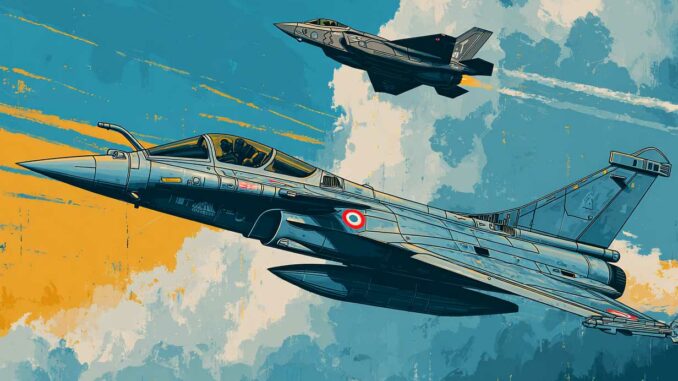
Rafale vs. F-35: orders, dependencies, ITAR, data, and politics. Why Europe is hesitating between strategic autonomy and NATO alignment.
In summary
The Rafale vs. F-35 debate goes beyond technical specifications. Since 2022, a majority of European countries have been purchasing the F-35 to align themselves with the United States, pool training resources, share maintenance costs, and strengthen NATO interoperability. To date, Europe has ordered or contracted for approximately 567 F-35s, with additional options in several capitals. This choice comes at a price: dependence on support, software updates, export authorizations, and the management of certain operational data. The Rafale offers greater national freedom and an industrial chain that is less exposed to US rules, but it suffers from an unfavorable network effect in Europe, where fleets are already structured around the F-16, Eurofighter, or Gripen. Behind the aircraft, the divide is political: immediate security and a pro-American signal on one side, strategic autonomy and European preference on the other. In between, some countries are buying American while financing European programs.
The European divide between autonomy and alignment
The Rafale vs. F-35 duel is not a performance contest. It is a discussion about freedom of action, military credibility, and Europe’s place in a tougher strategic order. Since 2022, replacement schedules have accelerated. Threats have changed status. The risk has become immediate for part of the continent.
In the East and North, the logic is simple. Deterrence must be swift. Compatibility with American standards is essential. It must be possible to operate in a coalition led by the US Air Force without having to relearn warfare with each exercise. In this view, buying the F-35 is buying a shortcut. A shortcut to common procedures. A shortcut to a wealth of experience. A shortcut to a “club” that, in the event of a crisis, already structures the effort.
In the West, and particularly in France, the reasoning often starts from a different point. An industrialized continent cannot delegate its security indefinitely. It must preserve an industrial and technological defense base. It must be able to decide, modernize, and export without depending on foreign authorizations. In short, it must aim for a form of European strategic autonomy.
This is where the divide lies. It does not mean that one side is right and the other wrong. It means that the priorities are not the same. Above all, it means that combat aviation has become a choice of sovereignty as much as a choice of aircraft.
F-35 order figures in Europe
Snapshot of firm orders
The F-35 has become the quantitative benchmark on the continent. Adding up the contracts signed or letters of offer and acceptance made public, Europe has contracted for approximately 567 aircraft. This total does not include certain political intentions or unexercised options.
- United Kingdom: 48 F-35Bs ordered. A political target of 138 aircraft has been reaffirmed. A purchase of at least 12 F-35As has been announced to join an Alliance nuclear mission.
- Italy: 90 aircraft in the program format. An increase to 115 has been mentioned by 2035.
- Netherlands: 46 F-35As.
- Norway: 52 F-35As, program delivered.
- Denmark: 43 F-35As (27 initial, plus 16 additional approved).
- Belgium: 45 F-35As (34 initial, plus 11 additional announced).
- Germany: 35 F-35As, with recurring discussions about an additional batch.
- Finland: 64 F-35As.
- Poland: 32 F-35As.
- Czech Republic: 24 F-35As.
- Romania: 32 F-35As, with an option for 16 more (48 in total).
- Greece: 20 F-35As, with an option for 20 more.
- Switzerland: 36 F-35As contracted, but a downward adjustment has been announced to stay within the approved budget.
These figures hide a simple fact. Signing the contract locks in the ecosystem for decades.
You’re not just buying an aircraft. You’re buying infrastructure, simulators, inventory, support contracts, ammunition, and a doctrine. Even when the aircraft has not yet been delivered, the architecture of dependency is already beginning.
The mechanics of joining the F-35 club
The larger the club grows, the more rational it becomes to join. Training is standardized. Schools share syllabi. Exercises become more predictable. And, above all, military staffs plan more quickly because technical assumptions are common.
The continent also benefits from an industrial base in Cameri, Italy. A European site assembles aircraft and serves as a regional center for heavy maintenance and modernization. This detail carries more weight than is commonly acknowledged. In times of tension, the problem is not having “the best aircraft.” The problem is maintaining a pace of sorties. And repairing quickly.
The constraints of independence associated with the F-35
The question is not whether the F-35 is good. It is. The question is what a country is willing to delegate in order to obtain it and then keep it going. In a modern combat system, dependence is not only visible in the cockpit. It is hidden in software rights, cryptographic keys, threat libraries, and support contracts.
The weight of ITAR rules in real life
The first topic is ITAR. These rules govern the export and re-export of U.S. defense equipment, as well as technical components, software, documentation, and related services. In practical terms, this translates into authorizations. It can also translate into modification restrictions. And into reduced flexibility when a country wants to integrate an unplanned component, a national sensor, or “off-catalog” weaponry.
Let’s be honest. No Western fighter jet is delivered without conditions. France controls its exports. So does Sweden. The difference lies in the degree of centralization and the scale of the ecosystem. With the F-35, the architecture is designed as a global system. The core software and certain critical functions remain under US control. Even when political relations are excellent, this structural constraint remains.
Data sovereignty and the support chain
The second issue is data sovereignty. The F-35 produces a considerable volume of information: maintenance, diagnostics, configuration, incidents, mission parameters. The program has long been associated with ALIS, then with ODIN, the system designed to modernize management and reduce friction. Digitization is not the problem. The problem is: who hosts, who reads, who corrects, and who authorizes.
Customer countries negotiate safeguards. They want national hosting. They want access rights. They want local maintenance. But the aircraft lives by patches and global standards. This reality creates a support dependency. And this is not an abstract concept. Public U.S. reports have pointed to maintenance cost overruns and persistent difficulties with availability targets.
This is where the debate becomes brutal. A country may order 32 aircraft. At any given moment, only a fraction of them may actually be combat-ready if the supply chain breaks down, parts are missing, or maintenance capacity is lacking. Yet deterrence is based on certainty, not on paper inventory.
The issue of “shutdown” and the levers that matter
The debate over a “kill switch” is often exaggerated. There is no public evidence of a magic button that can remotely shut down an allied fleet. On the other hand, there are real levers: access to support, delivery of parts, distribution of software versions, and feeding threat databases.
In the F-35, these levers are sensitive because military value depends on the fusion of sensors, threat libraries, and mission files. Mission data files are not an administrative detail. They determine the ability to identify and classify what the aircraft “sees.” Without updates, an F-35 remains effective. But it loses some of its informational advantage. The real “shutdown,” if it exists, is more like a gradual degradation than a sudden cut-off.
The structural reasons for the F-35’s success
Why, despite these constraints, is Europe buying so many F-35s? Because, for many countries, the benefits outweigh the political cost. And because these benefits are not only military. They are diplomatic, industrial, and doctrinal.
Coalition logic and NATO standardization
The first explanation is the simplicity of coalition. The same aircraft. Compatible data links. Common procedures. Harmonized training. A country that buys the F-35 also implicitly buys a ticket to a standard of planning and conducting operations.
In a military alliance, this translates into more seats at the table. And a more credible ability to operate in an environment dense with air defenses. In this calculation, the argument of NATO interoperability has an immediate value that the Rafale, however excellent, cannot reproduce on its own, as long as the European ecosystem remains fragmented.
The nuclear dimension as a discreet accelerator
The second explanation is nuclear. Within the Alliance, certain air forces participate in a deterrence mission with American weapons stored in Europe, under a political dual-key system. Access to this mission, known as nuclear sharing, is a status marker and a lever of influence.
The integration of the B61-12 on the F-35A reinforces this logic. For Germany, replacing the Tornado in this role is a strategic priority. For others, it is a way of being at the heart of the decision without owning the weapon. This point carries weight, even if it is rarely explained in public.
The industrial package and the volume effect
The third explanation is industrial. Buying the F-35 means entering a global chain where part of the work comes back to Europe via integrated sites and subcontractors. This is not industrial sovereignty. It is integration. But for governments that have to justify a multi-billion dollar investment, the existence of business returns and maintenance centers on the continent changes perceptions.
The volume effect also plays a role in ammunition, sensors, and standards. The closer the fleets are, the more logical it becomes to buy the same missiles and interfaces. This reduces coordination costs. And it further reinforces the “standard” circle.
Reasons why the Rafale is not selling well in Europe
It is wrong to say that the Rafale “is not selling” in Europe. Greece and Croatia have ordered it. France is the operator. But compared to the momentum of the F-35, the Rafale remains in the minority on its own continent. The reasons are less technical than one might think.
Replacement schedules and already structured fleets
Most European countries have made their decisions within narrow windows. F-16 operators have often switched to the F-35 to remain within the American logistical and operational continuum. Eurofighter operators are extending or modernizing because they have already invested in infrastructure, training, and industrial chains. Gripen operators in Central Europe are bound by lease contracts, support agreements, and doctrine choices.
The Rafale then arrives as a visible shift. New simulators. New stocks. New training. New maintenance organization. This is not a criticism of the aircraft. It is the political and budgetary cost of a change in ecosystem.
Positioning vis-à-vis the Gripen and the Eurofighter
On paper, the Rafale and the Eurofighter are in the same category: high-end “4.5” generation multi-role aircraft. But the Eurofighter benefits from an industrial workshare between four nations. This provides political protection. Buying the Eurofighter means supporting BAE Systems, Leonardo, and Airbus, and maintaining assembly and modernization lines in several countries. For a government, this argument carries almost as much weight as performance.
Compared to the Gripen, the Rafale is not in the same budget segment. The Gripen is often presented as lighter, less expensive to operate, and suited to countries that primarily want to defend their airspace with a reduced logistical footprint. The Rafale sells better when the need is for strike capability and multi-domain superiority. However, many European forces are primarily seeking to rebuild a credible air defense.
The limits of the sovereignty argument when war becomes networked
The Rafale scores points on independence. It offers a more direct margin of integration for certain European components. It reduces exposure to US rules. But the sovereignty argument is no longer enough, because modern warfare is a matter of networks. An isolated aircraft is worth less than an interconnected system.
In today’s Europe, the advantage of the F-35 lies in its network effect. And the Rafale suffers from a narrower user base on the continent. This is a commercial handicap. It is also a handicap in terms of standardization and pooling.
European industrial synergies that hinder a single standard
One might think that a Europe that talks about autonomy should converge towards a single European aircraft. The reality is the opposite. European industry is organized into blocs. And these blocs protect themselves.
The weight of existing consortiums
The Eurofighter is not just an aircraft. It is an industrial and political pact. Each partner nation gains jobs, maintains skills, and gains a shared export capacity. This architecture makes it very difficult to abandon the Typhoon, even in the face of the push for the F-35.
Many countries prefer to “supplement” with the F-35 rather than replace it entirely. It is expensive. It is complex. But it is politically profitable: you buy stealth capability while maintaining the existing European ecosystem.
The FCAS and GCAP competition that is also fracturing the European offer
The same phenomenon is repeating itself with the aircraft of the future. The SCAF (FCAS) brings together France, Germany, and Spain. The GCAP brings together the United Kingdom, Italy, and Japan. Instead of converging, Europe is creating two future competitors. With different timelines and interests.
In this context, purchasing the Rafale today may be perceived in certain capitals as a choice that strengthens France’s position in the future, to the detriment of the internal balance of a consortium. Conversely, some in France see purchases of the F-35 as a direct weakening of the European industrial base. As a result, each side accuses the other of sabotage, and the American standard wins in the middle.
The often unspoken political and psychological factors
Talking about aircraft means talking about alliances. It also means talking about bilateral relations. A purchase decision reflects trust. Trust in the stability of relations. Trust in the availability of support. Trust in the way a partner behaves when it has the upper hand.
The relationship with France as an industrial and political partner
France has a direct strategic culture. It talks about national interest. It defends its industrial base. Depending on the situation, it can appear demanding, even abrasive. This is consistent. But it can upset partners who expect a more subtle compromise.
There have been public tensions surrounding the industrial sharing of the SCAF. Others have arisen when French players have criticized the loyalty of partners who buy American while demanding a place in European programs. Whether these criticisms are justified or not, they leave their mark. And in multi-billion dollar decisions, political “chemistry” matters.
The signals sent to Washington by an order
Buying American is not just about buying an aircraft. It is about sending a message. In post-2022 Europe, this message is often sought after. For countries close to Russia, the pro-American political signal is a deterrent in itself. It increases the likelihood of Washington’s long-term commitment. It reduces ambiguity.
The French position, on the other hand, often sends the opposite message. “We must be able to act without dependence.” This position reassures those who want a powerful Europe. It worries those who consider the American guarantee irreplaceable in the short term. The result: a Europe that talks about autonomy but buys certainty.
Anti-French perceptions and transactional realities
Is there an “anti-French sentiment” in Europe? In some places, yes. Just as there is skepticism towards other partners, depending on the subject. But that is not the main explanation.
The explanation is transactional. A country buys what maximizes its perceived interest: security, financing, jobs, compatibility, status. If France appears to be a difficult partner in terms of industrial sharing, program governance, or commercial flexibility, this reduces the attractiveness of the Rafale, even if the aircraft is solid. The useful question is therefore not “do they like France?” It is “is it in their interest to depend on France?”
Plausible scenarios for reducing the divide
Europe will not solve this dilemma with a slogan. It will solve it with concrete mechanisms: standards, contracts, infrastructure, and a less toxic culture of cooperation.
The rise of digital sovereignty
Even for countries that are already F-35 customers, the most pragmatic priority is to strengthen national capacity to manage data, keys, and updates. Investing in infrastructure, cyber teams, reprogramming laboratories, and contractual clauses that clarify rights of use in a crisis. If Europe wants autonomy, it must make its armies less vulnerable to software dependency, regardless of the aircraft.
Accepting a double standard rather than an all-or-nothing approach
The most realistic scenario, which is already visible, is a mix. An F-35 core for initial entry and NATO integration. A European fleet to maintain an industrial base and freedom to evolve. It’s expensive. It dilutes volumes. But it’s politically tenable.
Greece illustrates this: Rafale for rapid ramp-up and European continuity. F-35 for the stealth segment and integration into the club. Others will follow, because this model buys time and avoids having to decide too early between two rival European futures.
The choice of compromise country by country, without illusions
A single European standard is unlikely as long as Europe does not decide who pays, who produces, and who orders. The Rafale can win where independence is a priority and where France can offer a credible industrial partnership. The F-35 will win where the threat is immediate and where the coalition takes precedence. The other options will retain their strongholds where national ecosystems are already structured.
The real challenge is not to eliminate the division. It is to make it sustainable. To avoid a Europe with fleets incapable of fighting together. To also avoid an industry incapable of existing without American orders. Between these two risks, priorities must be chosen, not slogans.
The final test, when the crisis takes off the gloves
The choice between the Rafale and the F-35 sometimes resembles an expert debate, almost comfortable. But the decisive question is not one of stealth or range. It is the question of the aftermath of a major crisis: who can decide quickly, who can fly for a long time, and who can adapt their system without waiting for an external green light?
Today, European procurement tells an unflattering truth. The fear of isolation outweighs the desire for independence. And until Europeans build a truly common standard of cooperation, the standard from elsewhere will remain, by default, the easiest to buy.
War Wings Daily is an independant magazine.