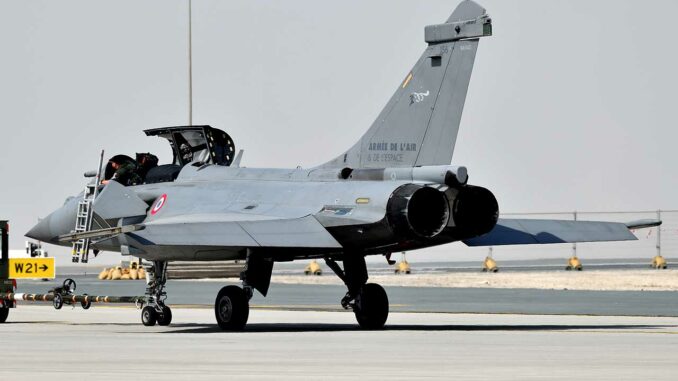
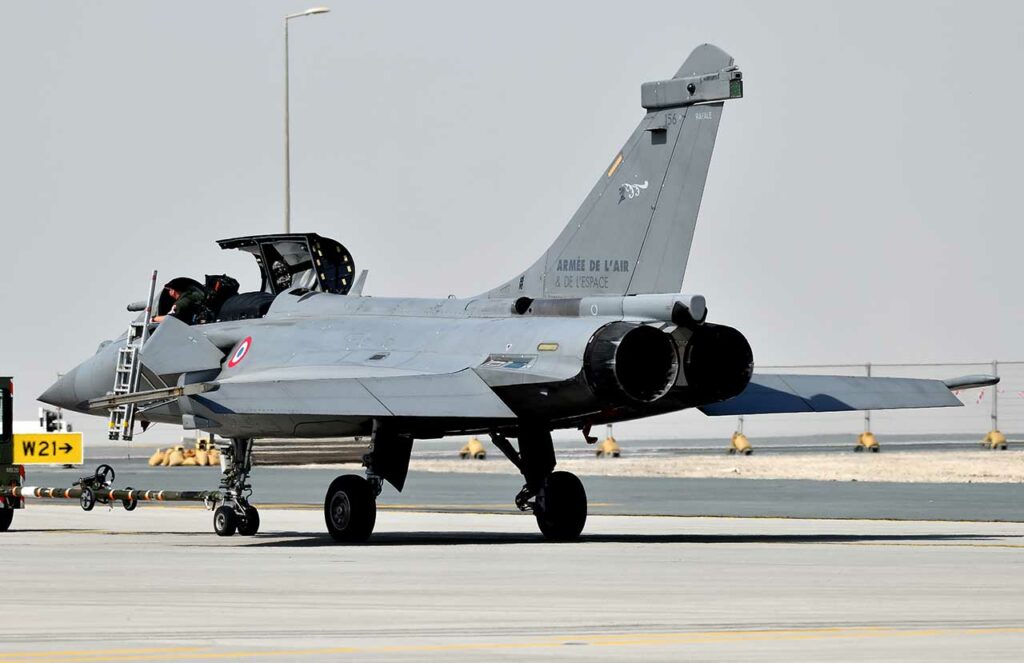
Express sales, aircraft taken from stock, production under pressure: how Paris is turning used Rafale jets into an immediate diplomatic tool.
In summary
The sale of second-hand Rafales taken from French stocks has become a diplomatic shortcut. In 2021, Greece purchased 18 Rafales for around €2.5 billion, 12 of which came from the French Air and Space Force, then increased its total to 24 with an additional order. In 2021, Croatia signed a €999 million agreement for 12 Rafales transferred from France, to be delivered between April 2024 and April 2025. For Paris, the benefits are clear: fast delivery, strengthening of strategic relations, and sending a credible signal to a partner under pressure. There is also a cost: temporary gaps in the fleet, pressure on maintenance, and the obligation to order new aircraft to replace those sold. The model remains powerful, but it can only work if production ramps up and French availability holds. And each transfer is difficult to repeat.
Second-hand as a strategic accelerator
There are two ways to buy a modern fighter jet. The first is traditional: you order new aircraft, wait, build hangars, train teams, and then receive the aircraft as they roll off the production line. The second is more brutal: you take aircraft already in service with a friendly army, transfer them, and then settle the industrial bill. France has taken this second route with the used Rafale.
The principle is similar to a capacity loan, except that there is no return. The purchasing country quickly obtains usable aircraft. The selling country gains diplomatic time: it solidifies an alliance in a matter of months, not a decade. But it accepts a temporary loss of mass, at a time when the intensity of air alerts and exercises is increasing.
In the European Union, this mechanism is worth its weight in political gold. It circumvents the slowness of cooperation, budgetary decisions, and electoral cycles. It also meets a simple need: to replace an aging fleet without leaving a gap in capacity.
The French mechanism of stock levies
The state-to-state contract as a tool for speed
At the heart of the model is the state-to-state contract. It simplifies negotiations, secures guarantees, and allows for the handling of issues that would otherwise be spread out in a single package: equipment transfer, training, initial support, and sometimes weapons and infrastructure.
This framework facilitates a central promise: delivery time. When a country buys new equipment, it is subject to the order book, the availability of engines, radars, computers, and test slots. With aircraft that have already been built, the schedule changes. The time is focused on upgrading, acceptance flights, crew conversion, and support organization.
The hidden work behind a “used” aircraft
A Rafale in service is not a vehicle that can be resold with a simple technical inspection. The airframe history, potential, cycles, and condition of sensitive equipment must be checked, and the configuration must be harmonized. Customers want a homogeneous fleet with clear standards, up-to-date software, and stable procedures. This requires workshop visits, modifications, and validation campaigns.
Added to this work is the logistics: parts, tools, documentation, simulators, and building up an initial stock. This is often what makes the difference between “owning” an aircraft and “generating” sorties. The French model sells a promise: usable operational capacity, not a grounded aircraft.
Greece, a showcase for speed and political signaling
In January 2021, Greece finalized the purchase of 18 Rafales for approximately €2.5 billion. The deal is telling: 12 aircraft came from French stocks and 6 were new. The transfer of these aircraft taken from stocks made it possible to ramp up quickly, in a context of ongoing tensions with Turkey.
The “second-hand” component not only saved time, it also reduced the initial cost of the airframes: media reports put the value of the 12 second-hand aircraft at around €400 million, with the rest of the contract being driven by weapons, support, and infrastructure. This is the angle that governments are looking at closely: the airframe is visible, but the full capability is paid for as a package.
The timeline illustrates the immediate benefit. The first deliveries began in early 2022. Dassault indicated that the 18 aircraft in the first contract would be fully deployed in Greece by the summer of 2023. Athens then added six new Rafales through a contract signed in 2022, bringing the total to 24, with deliveries announced to begin in the summer of 2024. In early January 2025, Greece announced the delivery of the last aircraft in this order.
Speed is not only measured in months. It is measured in posture. In just a few training rotations, Athens has integrated a modern multi-role platform, and the purchase has strengthened a broader bilateral relationship, which has also resulted in naval acquisitions. Even the strategic scope of the associated weaponry is part of the debate: Athens, for example, has emphasized the importance of long-range strike capabilities within its navy, with missiles announced at 1,000 km (621 miles) on new-generation frigates. This is not a decorative detail. In a defense relationship, aircraft, ships, and weapons form a political system: one also purchases continuity of supply and operational compatibility.
Croatia: a generational leap without waiting a decade
Croatia offers a textbook case. Zagreb needed to replace its aging MiG-21s without losing its ability to control its airspace. A “brand new” solution would have led to a dangerous gap, or prolonged dependence on allied air policing. The opportunity shortened this risk.
The Croatian contract, signed in 2021 and valued at €999 million, covers 12 Rafale F3-R aircraft transferred from the French Air Force. The fleet consists of 10 single-seaters and 2 two-seaters, a format consistent with training crews and establishing a core of instructors. The first six aircraft arrived on April 25, 2024. The Croatian Ministry of Defense confirmed that the last aircraft was delivered on April 25, 2025, completing the squadron.
This pace is rare in Europe. Between the decision, the signing, the training, and the arrival of the last aircraft, we are talking about approximately four years. This is precisely what the French strategy sells: rapid access to a modern combat standard, without waiting for industrial slots to become available.
The real price for Paris, between capacity gaps and availability tensions
Technical availability as an adjustment variable
The blind spot in the narrative is the cost to France. One transferred aircraft means one less aircraft for training, permanent alert, and operations. However, the Air Force does not have excess capacity.
A budget report by the National Assembly, based on the 2022 annual performance report, indicates that the technical operational availability rate of the Air Force’s “combat aircraft” aggregate was 62% in 2022, compared to a target of 84%. The same document highlights that this availability has been put under pressure by the reduction in the fleet and logistical constraints, and explicitly points to the effect of decisions to transfer aircraft. It also raises a politically sensitive issue: certain detailed availability statistics are no longer published at the same level, in the name of protecting sensitive data. This does not eliminate the problem. It simply makes it less visible.
Let’s be frank: this type of sale is a trade-off. It exchanges the mass available today for immediate influence and a promise of replenishment tomorrow. In an army under pressure, this choice can be paid for in flight hours, airframe fatigue, and workshop saturation. Technical availability then becomes an implicit bargaining chip.
Replacement orders as a political condition
To make the maneuver acceptable, the state must order new aircraft as replacements. This is the key: replacement orders transform a loss of capacity into a simple delay, at the cost of a budgetary effort.
Dassault indicates that in 2021, France placed a specific order for 12 Rafales to replace the 12 aircraft transferred to Greece. For Croatia, specialized media outlets have explained that France also plans to supply 12 additional aircraft to compensate for those sold. These replenishment orders are in addition to those planned in the military program, and they shift the problem: we have to hold out until delivery.
The industrial chain, the discreet arbiter of strategy
Second-hand sales work as long as the industry can absorb the shock. However, the Rafale is not produced at rates comparable to those of a highly mutualized American program. The production rate is therefore the needle that measures the sustainability of the model.
The debate is now public. Articles have described production of around two aircraft per month, with a stated target of increasing to three per month in 2026, then to four per month around 2028-2029. The actual pace can also be seen in deliveries: according to the industry press, Dassault delivered 26 Rafales in 2025, including 15 for export, a rate still below three aircraft per month. On a French scale, this is a major change. On the scale of a massive export order book, it remains tight.
The transfer of second-hand aircraft creates a paradoxical effect. It accelerates diplomacy, but it stretches the industrial schedule, as it is necessary to deliver to customers, modernize standards, support fleets, and deliver replacements to the French army. All this without sacrificing quality, because a fighter jet cannot be “caught up” in service by a simple update.
The purchasing countries and the figures that structure the model
In Europe, France’s second-hand strategy has materialized in two cases.
For Greece, this involves a total of 24 Rafales. The first batch of 18, approved in 2021 for €2.5 billion, included 12 aircraft from the French fleet and six new ones. The second block of six aircraft, signed in 2022, brought the total to 24, with deliveries spread out until early 2025.
For Croatia, the contract is for 12 used Rafales, announced at €999 million. Deliveries began in April 2024 and were completed in April 2025, according to the Croatian Ministry of Defense.
These figures may seem limited, but they have a ripple effect. They show that a European country can switch to modern Western combat aircraft without waiting ten years. They also provide a selling point: the Rafale is not only a high-performance aircraft, it is also a scheduling solution.
The limits of a strategy that cannot become routine
There is a risk in romanticizing “second-hand” equipment. The model is not easily generalized.
First, because France cannot empty its squadrons without weakening itself. Second, because each transfer requires internal political negotiation. Finally, because a transferred aircraft must be standardized, supported, and sometimes modernized, which consumes industrial and human resources.
There is also a market limit. Not all countries want an inherited standard. Some require the F4, specific data links, national standards, or particular weapon integrations. However, a used aircraft is, by definition, the product of a past configuration.
Finally, there is a financial factor. Yes, second-hand aircraft reduce waiting times and can lower the price of the airframe. But support, training, weapons, and infrastructure remain significant costs. The “cheaper” option is often an illusion when comparing a bare aircraft to a complete package.
The real balance between diplomatic speed and military opportunity cost
The “second-hand France” strategy is effective because it responds to a European reality: threats evolve faster than acquisition schedules. It offers a concrete, visible, and rapid tool for diplomatic leverage. It also creates mutual dependence: the purchasing country gains aircraft, while the selling country gains a structured relationship over two decades.
But it does not come without a price. It imposes an opportunity cost on French forces, especially during the window when replacements are not delivered. It puts pressure on maintenance. And it forces the industry to ramp up production in a context of strained supply chains.
The question that arises is therefore not “does it work?” We know it works. The question is “how many times can we do it again without weakening ourselves?” If Paris wants to continue selling quickly, it will also have to produce quickly, provide better support, and publicly acknowledge that diplomatic efforts sometimes involve aircraft that we would have preferred to keep.
War Wings Daily is an independant magazine.