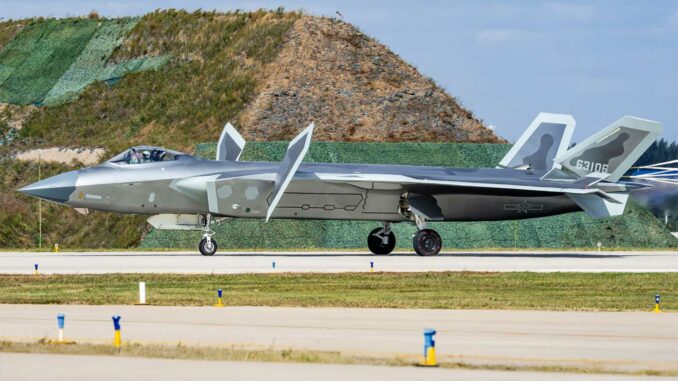
A Chinese military attaché offers a model of the J-20 to Tehran. No sale, but a strong signal about Iranian and Chinese armaments.
Summary
On February 10, 2026, a Chinese military attaché in Tehran presented a model of the J-20 to the commander of the Iranian Air Force, Brigadier General Bahman Behmard. No contract was announced. No timetable has been confirmed. However, the gesture was enough to raise a key question: is China ready to take its military cooperation with Iran to the next level at a time when the region remains under severe strain? The J-20 is a fifth-generation aircraft designed for long-range air superiority, with advanced sensors and a “networked combat” architecture. On paper, it addresses several structural weaknesses in the Iranian air force. In practice, the obstacle is not technical: it is financial, logistical, political, and strategic. In this case, the model is primarily a message. The question remains as to whom it is primarily addressed: Washington, Iran’s neighbors, or both.
A diplomatic gift to Tehran, without official announcement
The bare facts are simple. A Chinese officer stationed in Tehran presents a model of a J-20 stealth fighter to an Iranian official. A photo is circulated. The scene is public. But no authority announces a sale, a letter of intent, or a financing mechanism. This type of sequence is not uncommon in military relations: a model is offered, a catalog is shown, a door is opened, and then rumors are allowed to spread.
The journalistic interest lies elsewhere: the choice of model. The J-20 is not a “run-of-the-mill” product of Chinese industry. It is the most visible symbol of the rise of Chinese combat aviation. By putting it on the table in Tehran, Beijing is testing reactions without tying its hands. It is a low-cost, high-impact signal.
This does not prove that a sale is imminent. It proves that a channel of discussion exists, or that a player wants to make people believe that it exists. At this stage, the event should be treated as a strategic communication maneuver rather than a contractual milestone.
The Chengdu J-20, a stealth fighter designed for long range
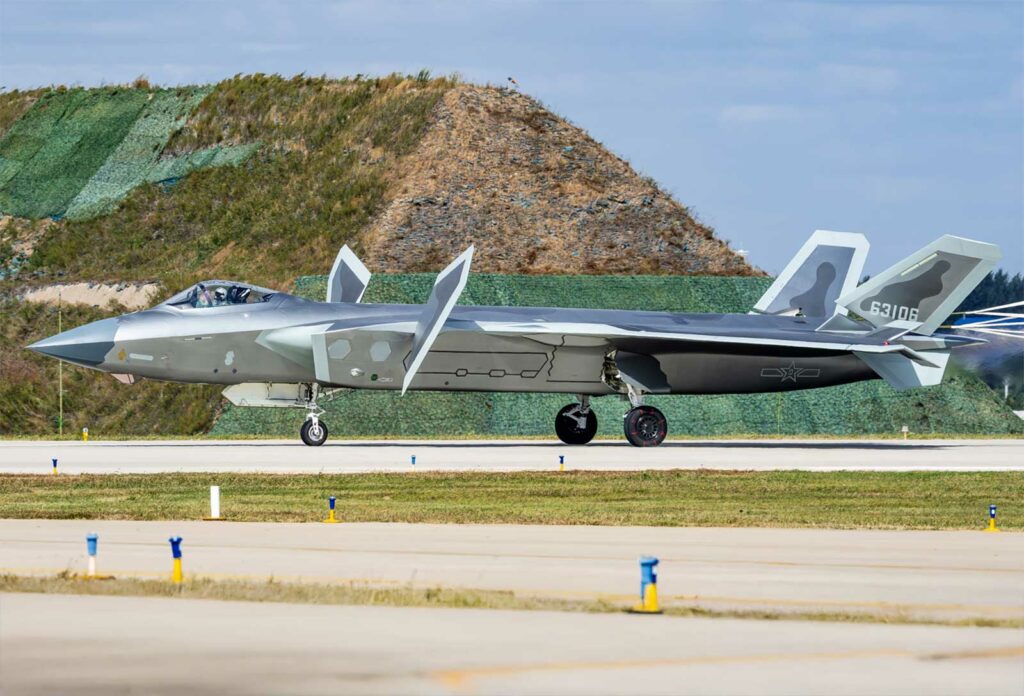
The J-20 (often called the “Mighty Dragon”) is designed to give China modern air superiority, with a clear logic: detect from a distance, shoot from a distance, and survive in a dense environment. Its appeal lies not only in its shape, but also in its combination of airframe, sensors, data links, and weapons.
The airframe and survivability logic
The J-20 is a large aircraft for its class. Open estimates put its length at around 20.3 to 20.5 m, with a maximum takeoff weight estimated at between 34,000 and 37,000 kg.
This size suggests a large internal volume, and therefore plenty of room for fuel, weapon bays, and avionics. This is consistent with a mission of long-range patrol and interception beyond the front line.
Stealth remains the most debated point, because no one publishes verifiable figures. We must therefore speak in terms of industrial logic: reduction of radar signature, internal integration of weapons, treatment of leading edges, thermal management. Even with limitations (particularly the rear section and the nozzle), the leap forward compared to fighters from the 1970s–1990s is real.
Sensors, the heart of the system
The J-20 is designed for networked warfare: it collects, merges, and shares data. Open sources mention AESA radar, electro-optical and infrared sensors, and data links for cooperation with aircraft, drones, or ground-to-air systems. In this logic, the aircraft is not an isolated “duelist”: it becomes a network node.
Armament and the “shoot first” doctrine
The operational interest of the J-20 is linked to its internal missile payload. Open analyses describe side bays for short-range missiles and a main bay for long-range missiles. The key point is the PL-15 missile, often presented as a long-range air-to-air munition, at the heart of the Chinese approach: engage before being engaged, taking advantage of sensors and a coherent targeting chain.
Finally, it is important to remember one reality: figures for range, maximum speed, or “supercruise” remain speculative in open sources. A serious article must say so. The J-20 is a credible capability. But its exact performance against modern defenses remains difficult to measure without classified data.
The situation of Iranian aviation, between an aging fleet and asymmetry
To understand why a J-20 is attracting attention in Tehran, we need to look at the state of Iranian combat aviation. Iran still has American aircraft inherited from before 1979 (F-4, F-5, F-14) and more recent but aging Russian platforms (MiG-29, Su-24). The problem is not just age. It is maintenance, parts availability, access to modern ammunition, and the ability to maintain high training standards under pressure.
Assessments cited by Western sources speak of “a few dozen” strike aircraft actually available, despite larger theoretical inventories. This is consistent with a structural constraint: decades of sanctions limit access to the ecosystem that makes the difference (sensors, components, test benches, supply chains, guided munitions).
In this context, Iran compensates with other means: drones, surface-to-surface missiles, surface-to-air defense. Reuters mentions an arsenal of more than 3,500 surface-to-surface missiles, which sums up a doctrine: if aviation cannot dominate, deterrence must come from elsewhere.
A modern stealth fighter could theoretically help Iran rebalance part of the balance of power.
But it is not enough to buy an airframe. A complete chain is needed: training, maintenance, ammunition, simulators, doctrine, and the ability to plan complex air operations.
The logic of a “good fit”… and the reasons that make the purchase unlikely
On paper, the J-20 ticks several boxes for Iran.
First, survivability. A stealth fighter reduces the risk posed by modern radars. Next, interception: in a region where threats can come from afar, the ability to detect early and shoot from a distance is an advantage. Finally, the political effect: displaying fifth-generation capability serves as a regional deterrent, even if the volume acquired is small.
But the industrial and political reality is harsher.
The question of exports and technological risk
One hypothesis prevails: Beijing has not, so far, shown any desire to export its best stealth fighter. And that is rational. Selling a J-20 means exposing signatures, systems, and maintenance methods, thereby creating a risk of adversarial intelligence. Conversely, there are several signs that China is pushing exportable platforms such as the J-10C, including to countries seeking rapid modernization. A US Department of Defense report even notes Iranian interest in the J-10C.
The wall of support and sustainability
The main obstacle is logistical dependence. A stealth aircraft has specific requirements: high-quality coatings, non-destructive testing, maintenance procedures, suitable hangars, and parts supply chains. Without this ecosystem, the aircraft flies less, wears out quickly, and its availability drops.
There is also the issue of training. Who would train the pilots? China, directly, with instructors, simulators, and training courses? It is possible, but politically costly. And then there is the training of mechanics, armourers, avionics specialists, and electronic warfare specialists. This is not a program that can be completed in a few months. It is a project that will take several years.
The price and method of payment
Even taking a cautious approach to unit costs (open estimates vary widely), a credible fleet quickly runs into billions of euros: aircraft, ammunition, simulators, parts, initial support, infrastructure. And the question is not just “how much.” It’s “how to pay” under sanctions: energy bartering, payments via indirect channels, or non-transparent bilateral agreements. The higher up the range, the riskier this arrangement becomes for Beijing, as it exposes banks, manufacturers, and supply chains to retaliatory measures.
The regional context and the message sent to Washington
The J-20 move comes at a time when the region remains volatile. The United States has already strengthened its air presence in the Middle East several times in recent months, according to Reuters, amid open warfare between Israel and Iran.
In this climate, brandishing the possibility of Sino-Iranian cooperation on a high-level aircraft has three effects.
First effect: psychological pressure. Even without delivery, the idea of a better-equipped Iran forces neighbors to recalculate their assumptions.
Second effect: a signal to Washington. Beijing is showing that it can complicate the US game at limited cost. This is not necessarily a desire for head-on confrontation. It is leverage.
Third effect: a reminder of China’s growing position as an alternative supplier. When Western channels are closed, Beijing may appear to be the only player capable of selling, financing, and delivering, without moralizing. This is a reality of power relations, not a posture.
The cold reading: a symbol more than a contract, for now
At this stage, the model does not make a sale. It creates a useful smokescreen. It suggests a J-20 option, while leaving room for maneuver. China gains influence without committing its most sensitive technology. Iran gains a political sequence, both internally and externally, without spending a euro immediately.
What we need to watch out for are not the photos. It is the heavy signals: industrial visits, public discussions on exportable platforms (J-10C), training announcements, infrastructure upgrades, or negotiations on modern air-to-air munitions. If a pivot takes place, it is more likely to start with less sensitive aircraft, with limited transfers, rather than with a top-tier stealth fighter.
In this case, the central question is not “Will the J-20 arrive in Iran?” The question is: Does China want to bear the strategic cost of further arming an actor already under pressure, at the risk of fueling regional escalation and further straining its relationship with the United States? The gift itself does not answer this question. It sets the stage.
Sources
- Iran International, article and visuals on the delivery of a J-20 model to Tehran, February 2026
- DefaPress (Iran), Persian coverage of the event, February 2026
- Mehr News (Iran), Persian coverage of the event, February 2026
- U.S. Department of Defense, Annual Report to Congress: Military and Security Developments Involving the PRC (2025 edition), passages on Chinese aviation and exports (J-10C, foreign interests)
- CSIS ChinaPower Project, analysis sheet on the Chengdu J-20 (dimensions, estimates, and architecture)
- Reuters, comparative analysis of Iran–Israel air capabilities and data cited from the IISS, April 2024
- Reuters, US air deployments in the Middle East against the backdrop of the Israel–Iran war, June 2025
War Wings Daily is an independant magazine.