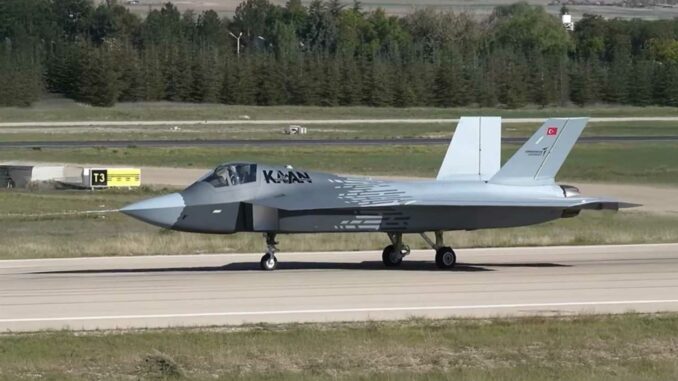
Turkish Aerospace says it is in the final stages of negotiations with Saudi Arabia on KAAN: purchase of a squadron or extensive cooperation, including an assembly line.
Summary
On February 12, 2026, Turkish Aerospace said it was in the “final stages” of discussions with Saudi Arabia on participation in the KAAN program. Two scenarios are being discussed: the purchase of a small squadron of around 20 aircraft, or a deeper industrial partnership. The latter could go as far as a final assembly line in Saudi Arabia, but it would require higher volumes and an agreement on technical transfers. The staging at the World Defense Show 2026 in Riyadh, with a KAAN model bearing a Saudi flag, lends weight to the hypothesis of a deal, without proving that it has been signed. For Riyadh, the interest is as much military as it is industrial: accelerating the localization of defense, securing air capabilities, and diversifying its dependencies. For Ankara, the stakes are financial and political: transforming KAAN into a credible exportable product.
Riyadh’s signal, between communication and real negotiation
The starting point is a public statement. Turkish Aerospace explains that discussions with Saudi Arabia are in the final stages. The important word is “final,” but it remains vague. It does not say that a contract has been signed. It does not say that a budget has been approved. It does not say that the industrial terms have been set.
The model displayed with a Saudi flag in Riyadh is not a minor detail. In the defense industry, these displays serve three purposes. First, they show the public and decision-makers that a partnership is credible. Second, they create a ripple effect by attracting subcontractors and financiers. Finally, they send a message to competitors: ” you are not alone at the table.”
We must be clear-headed. A painted model is not a commitment. But it indicates that the idea is sufficiently advanced to be shown, and therefore accepted. That is already a threshold. And that threshold was crossed at a trade show organized in Saudi Arabia, not Turkey. This suggests that Riyadh wants to be seen as a player, not just a customer.
The Saudi choice: between a showcase squadron and industrial cooperation
Two options are mentioned in the discussions.
The option of a small squadron of around 20 aircraft
A purchase of around 20 aircraft seems like an entry-level format. We are talking about a volume compatible with an evaluation phase, a gradual ramp-up, and controlled political use. This format also limits the risk if the program falls behind schedule.
This is a key point. KAAN is flying, but the program is still in its infancy. Wealthy armies do not want to pay the price for technical uncertainties. They may agree to be “early adopters,” but only if the risks are mitigated by support contracts, guarantees, and a clear standard trajectory.
In this logic, 20 aircraft are used to train crews, refine doctrine, develop maintenance, and save time. It is a gateway, not necessarily a final fleet.
The path to a heavy partnership, up to an assembly line
The other option is much more ambitious: structured industrial cooperation. This could include final assembly, sub-assembly production, heavy maintenance, and modernization capabilities. In reality, an assembly line only makes sense if the volume is there. Turkish Aerospace has said as much quite directly: 20 aircraft are not enough to make such a facility profitable; higher quantities are needed, in the order of 50 to 100 aircraft.
For Riyadh, this option fits in with a strategic priority: building a national industry. The country aims to localize more than 50% of its military spending by 2030. The latest official figures indicate that localization will be close to 25% by the end of 2024. This trajectory requires concrete projects, not slogans.
For Ankara, the interest is even simpler: a Gulf partner brings cash, industrial capacity, and an export argument. A fighter program is also won through financial credibility.
The KAAN program: a promising aircraft, but still maturing
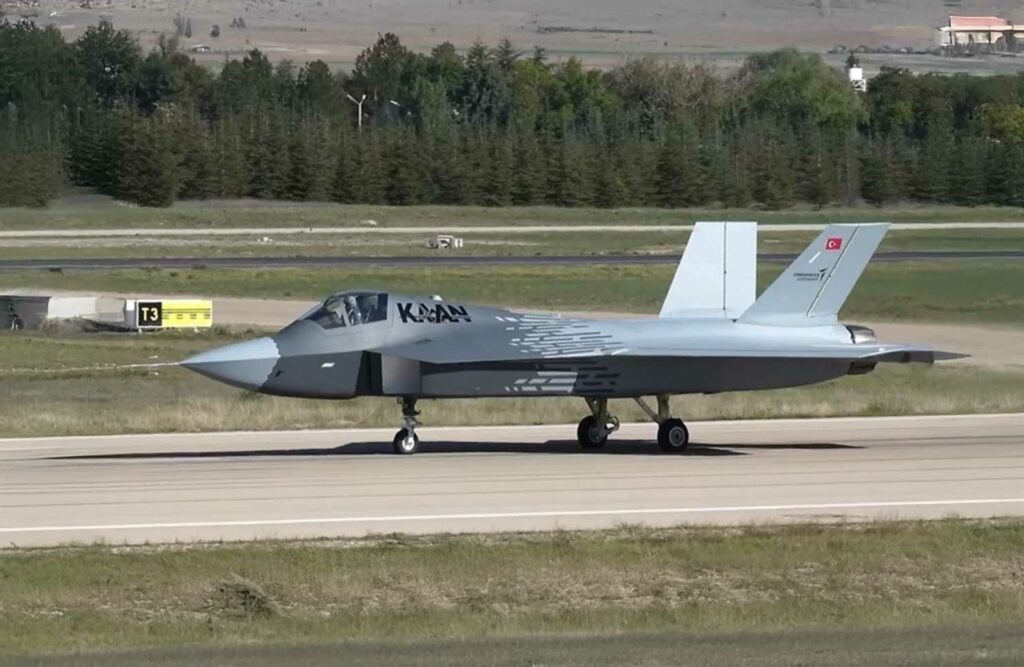
It is necessary to explain what KAAN is. It is a new-generation fighter jet developed to replace Turkey’s F-16s and for export. The prototype made its first flight in February 2024, on a short and cautious flight. The program calls for several prototypes, followed by successive blocks. Public schedules mention deliveries to Turkey in the late 2020s, with a ramp-up thereafter. In other words, the aircraft is real, but operational maturity still needs to be built.
Propulsion is a sensitive issue. The prototypes use American-made F110 engines. This helps them fly fast. But it also creates dependency. And this dependency could become a barrier to exports, as the re-export of American engines or critical parts may require authorizations.
This is a constraint that Riyadh is already familiar with, as a large part of its fleet is American. But in a KAAN deal, this issue arises in a different way: Riyadh is seeking industrial autonomy, but finds itself with a core component that is still linked to the United States. Turkey is working on a national engine for the longer term, but that is not what will power tomorrow’s aircraft.
Saudi Arabia’s reasons: air capacity, autonomy, diversification
Saudi Arabia does not have a problem with aircraft volume today. It operates a fleet structured around F-15s, Eurofighter Typhoons, and Tornados. The issue is more about the future: replacing aging platforms, ammunition availability, political dependence, and ongoing modernization.
The Tornado, for example, is nearing the end of its operational life. And any major replacement is as much a political negotiation as an industrial one.
There is also diversification. Riyadh has long been looking at the F-35. But an American program comes with conditions. It also involves political trade-offs in Washington, which are sometimes unpredictable. In this context, discussing KAAN also serves as leverage: it reminds us that there are alternatives, even if they are imperfect.
Finally, there is the industrial logic. A fighter jet is not just an aircraft.
It is an ecosystem: parts, test benches, MRO, training, simulators, software. Each stage can be localized. And each stage creates skilled jobs. This is exactly what Riyadh is looking for with its localization objectives.
Turkish reasons: financing, exports, and strategic status
Turkey has an obvious interest in attracting a Saudi partner.
First, money. A fighter program costs tens of billions of euros over its lifetime. Exports help finance testing, accelerate production, and smooth out unit costs.
Second, commercial credibility. A single national customer makes a program vulnerable. A second wealthy and visible customer changes perceptions. It reassures suppliers. It also reassures other prospects.
Finally, there is status. If KAAN becomes an exported product in the Gulf, Turkey will establish itself as a major supplier of high-tech military technology in an area where Western players have dominated.
Let’s be frank: this is also strategic revenge. Turkey has suffered restrictions and tensions with its Western allies. Developing and selling a “home-grown” fighter jet is a marker of autonomy.
The concrete industrial implications of cooperation in Saudi Arabia
If Riyadh chooses deep cooperation, we need to clarify what that could mean in practical terms.
Local production: what it really means
A final assembly line does not mean local design. It means that sub-assemblies arrive, are integrated, tested, and then delivered. The level of transfer varies. It can range from simple mechanical integration to the manufacture of structural parts, wiring, and even avionics components.
The most sensitive items are often excluded at the outset: mission software, electronic warfare libraries, and complete sensor fusion architecture. Transfers involving these components are more difficult. They require trust. And they create a risk of technology leakage.
Support and maintenance: a bigger issue than the purchase
In the life of a fighter jet, maintenance and support often cost more than the initial purchase. Saudi cooperation that includes a regional MRO center has strategic value. It reduces external dependence. It also makes it possible to offer services to other future customers, if KAAN sells.
But this requires a high level of industrial discipline. The quality standard on a fifth-generation fighter is unforgiving. Poor process control reduces availability. And availability is the true measure of power, not the number of aircraft on paper.
Geopolitical angles: Riyadh positions itself, Ankara emancipates itself
These negotiations can also be seen in the regional game.
For Riyadh, discussing KAAN strengthens its decision-making autonomy. It shows that it does not depend on a single supplier. It also sends a signal to Washington and Europe: “if you hesitate, others will move forward.”
For Ankara, the agreement would demonstrate that Turkey can produce high-level systems and sell them to strategic partners. This strengthens its influence in the Middle East, without going through Western mediation.
We must not idealize. A fighter partnership involves security, control, and training clauses, and sometimes restrictions on use. An aircraft is never “free.” It is always bound by contracts and dependencies. The question is: dependence on whom, and at what political cost?
The credibility test: volumes, timetable, and critical dependencies
The crux of the matter boils down to three questions.
First question: how many aircraft? A fleet of 20 aircraft is symbolic.
A fleet of 50 to 100 changes the game. That is the threshold that makes local industrialization logical.
Second question: what is the timeline? If Riyadh wants rapid capacity, KAAN is not an immediate answer. If Riyadh wants a structural capacity in ten or fifteen years, KAAN becomes relevant. The problem is that operational and political needs are immediate.
Third question: what are the critical dependencies? As long as the engine and certain components remain subject to authorization, the promised autonomy is only partial. This does not prevent a deal. But it changes the discourse. And it may change Riyadh’s requirements for industrial transfer.
This report says one simple thing: the fighter jet market is fragmenting. Middle powers no longer want to wait for Western decisions. They finance, they co-develop, they localize. If Saudi Arabia really does join KAAN, it will not be just to buy an aircraft. It will be to buy a place in an industry. And that is exactly the kind of shift that redraws industrial power relations, much more durably than the signing of an isolated contract.
War Wings Daily is an independant magazine.