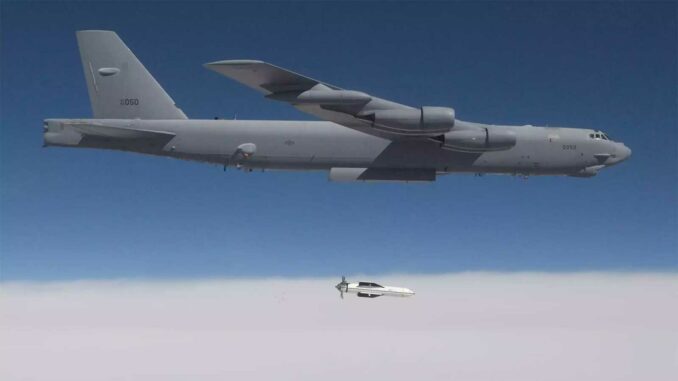
Contract worth over $100 million awarded to Boeing for new GBU-57s after Iran. Deliveries starting in 2028: deep strikes remain a priority.
Summary
The US Air Force has begun rebuilding its stockpile of GBU-57s after their first operational use in June 2025 strikes on Iranian nuclear sites, including Fordow. A sole-source contract worth more than $100 million has been awarded to Boeing to produce new units and subassemblies, with component deliveries scheduled to begin in January 2028. The message is clear: Washington wants to preserve a rare capability, that of destroying “hard and deeply buried” targets without resorting to nuclear weapons. But the decision also reveals a weakness: the industrial chain is narrow, lead times are long, and capacity depends on a very limited vector, the B-2 Spirit. At the same time, the Air Force is already preparing for the post-GBU-57 era with the Next-Generation Penetrator.
The decision to restock ammunition that has become strategic
The decision is less technical than it seems. Restocking the Massive Ordnance Penetrator is not simply a matter of “returning to stock levels.” It is an act of doctrine. The US Air Force is signaling that it considers conventional deep strike capability to be a top priority, on par with stealth and in-flight refueling.
The trigger is straightforward: GBU-57s were used in the June 2025 US strikes against Iranian facilities, including Fordow and Natanz. Several corroborating sources mention a total of 14 munitions delivered by seven B-2 stealth bombers in an operation officially described as having been planned for a long time.
In this context, a contract awarded to Boeing as the sole source is not surprising. It is even the only realistic option in the short term, because the weapon is atypical, produced in small quantities, and closely linked to an existing industrial and certification architecture.
The GBU-57, an extraordinary bunker-busting bomb
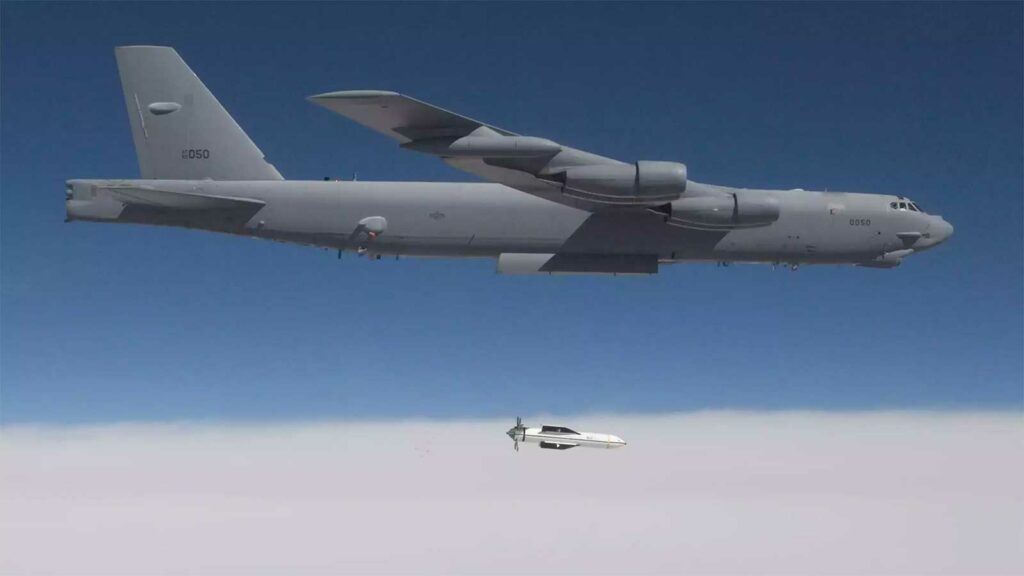
The bunker-busting bomb does not belong to the world of “mass munitions.” It is an exceptional weapon, designed for the hardest and deepest targets: command bunkers, production centers, reinforced tunnels, and facilities buried under rock.
Its dimensions explain everything. The GBU-57 weighs approximately 13,600 kg (30,000 lb). It measures around 6.2 m (20.3 ft) in length, with a diameter of approximately 0.8 m (31.5 in). It is not a “big bomb,” but rather a penetration projectile: its mass, speed, and rigidity are used to fracture successive layers before detonation.
Public literature remains cautious about actual penetration, as it depends on the material (concrete, rock), reinforcement, angle of impact, and drop profile. The most commonly cited orders of magnitude are around tens of meters of reinforced concrete or rock, which places the weapon in a category of its own, far ahead of “conventional” penetrators.
The choice of the B-2 Spirit: as much a constraint as an advantage
The GBU-57 imposes its own ecosystem. Today, operational delivery is associated with the B-2 Spirit, because it can carry the munition in its cargo bay while maintaining a stealth penetration profile. This reduces exposure to defenses and increases the probability of hitting a highly protected target.
But this dependence is a vulnerability. It means that the “deep bunker” capability relies on a small fleet that is costly to maintain and never fully available. In short: you may have the weapon, but you may not be able to deploy it when you need to if the maintenance cycle, overall posture, or theater priorities prevent it.
This is also why the debate surrounding the future B-21 Raider is so important. Recent sources on the successor to the GBU-57 already indicate a payload constraint: the future penetrator will have to be lighter in order to be compatible with the B-21 (often described as capable of carrying one unit, whereas the B-2 carries more). In other words, the bomb shapes the aircraft, and the aircraft forces the bomb to evolve.
The Boeing contract reveals delays and industrial dependence
The core of the February 13 announcement is the production contract, described as a commitment of more than $100 million, awarded to Boeing as a sole source, with deliveries starting in January 2028 for certain assemblies (notably tail kits).
Three lessons can be drawn from this.
Rebuilding stock takes years
Between operational attrition (2025) and the first deliveries (2028), we are talking about a cycle of almost three years. This is not just a matter of bureaucracy. It is the reality of heavy ammunition, produced in low volumes, with specific components, demanding quality controls, and aircraft/weapons system integration that leaves no room for approximation.
The single source says something about the industrial chain
A “sole source” contract is sometimes a political choice. Here, it seems more like a lack of credible alternatives in the short term. Putting such a specialized product out to tender would probably have added to the delay without creating a second supplier, as entry into this market requires data, experience, and validation that very few players possess.
The amount is high, but it does not indicate the volume
The figure “> $100 million” is striking, but it remains incomplete: the exact number of munitions or batches is unknown. For a weapon of this type, the total unit cost (body, explosive, guidance, rear kit, testing, storage, support) can quickly add up. Above all, the amount signals a firm intention: to restore capability, not simply to “study” an option.
The military logic behind deep strikes
Deep strikes against buried targets are not a technological whim. They are a response to a reality: adversaries have moved their critical assets underground, behind layers of physical protection and redundancy.
In the case of Iran, Fordow is often cited as the prime example: a deeply buried facility designed to withstand conventional strikes. Hence the idea, repeated for years, that a heavy anti-bunker capability is a strategic insurance policy: it gives policymakers an option “between” a symbolic strike and extreme escalation.
Let’s be frank: having this option changes the deterrence calculation. Even if the weapon is only used once in ten years, its existence weighs on adversarial planning, imposes costs (increased depth, hardening, dispersion), and complicates the protection of key infrastructure.
The announced transition to the Next-Generation Penetrator
One point is often underestimated: the replenishment of the GBU-57 also resembles a “bridge” to the next generation. Several public sources indicate that the Air Force is already working on a successor, the Next-Generation Penetrator, with the aim of improving accuracy, terminal effectiveness, and robustness in contested environments, particularly in the event of GPS jamming.
This is an implicit admission. The GBU-57 is formidable, but it belongs to a model: GPS, single platform, heavy logistics. The world of the future is pushing for greater flexibility: more “transportable” weapons, more resilient navigation, and compatibility with future platforms.
The paradox is that the GBU-57 remains necessary until its successor is ready. Hence this schedule: rebuild now, deliver from 2028, while preparing a replacement that will take years to develop.
The uncomfortable question: how long will this capability remain scarce?
If we read between the lines, the February 13 announcement is not just about an order. It tells the story of a race between three clocks.
The first is operational: maintaining an immediately credible capability, despite actual consumption in 2025.
The second is industrial: producing, qualifying, and delivering without interruption over a long timeframe.
The third is technological: switching to a new generation capable of surviving combat where GPS, communications, and “comfortable” routes are no longer guaranteed.
The interesting point, ultimately, is that the GBU-57 is not just a bomb. It is a barometer. When Washington chooses to put money and time back into it, it is saying that buried targets, hardened facilities, and war under the mountain are not a marginal scenario. These are planning assumptions that already structure weapons choices.
Sources
Defense News, “US Air Force buying more bunker-buster bombs after Iran nuclear strikes,” February 13, 2026.
Air & Space Forces Magazine, “Pentagon to Restock Massive Ordnance Penetrator Bombs Dropped by B-2s on Iran,” February 2026.
The Aviationist, “U.S. Air Force Moving to Replenish GBU-57 Massive Ordnance Penetrator Inventory,” February 13, 2026.
Defence Today, “US Air Force to restock inventory of GBU-57 MOP bunker buster bombs,” February 2026.
U.S. Department of Defense (DOD News), “‘Historically Successful’ Strike on Iranian Nuclear Site Was 15 Years in the Making,” June 26, 2025.
Al Jazeera, “Satellite images show damage from US strikes on Iran’s Fordow nuclear site,” June 22, 2025.
Le Monde (English edition), “The American GBU-57 bomb is the only weapon capable of reaching Iran’s Fordo nuclear site,” June 20, 2025.
Foundation for Defense of Democracies, “Bunker Buster: How the Massive Ordnance Penetrator (MOP) works,” June 19, 2025.
Business Insider, “The US Air Force is eyeing a new bunker-buster bomb… Next Generation Penetrator,” September 13, 2025.
War Wings Daily is an independant magazine.