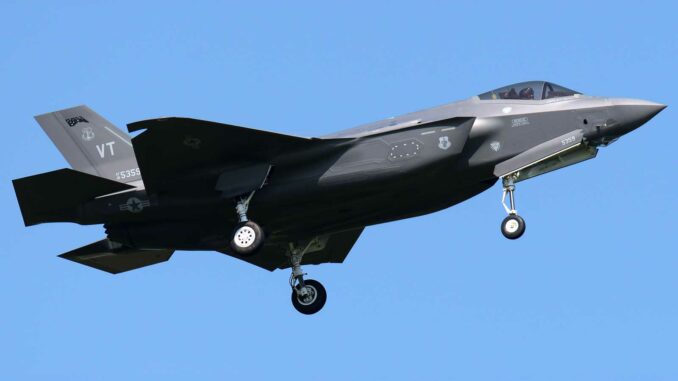
Berlin discusses a second batch of F-35s for nuclear sharing, while SCAF gets bogged down. Costs, trade-offs, and political turmoil.
Summary
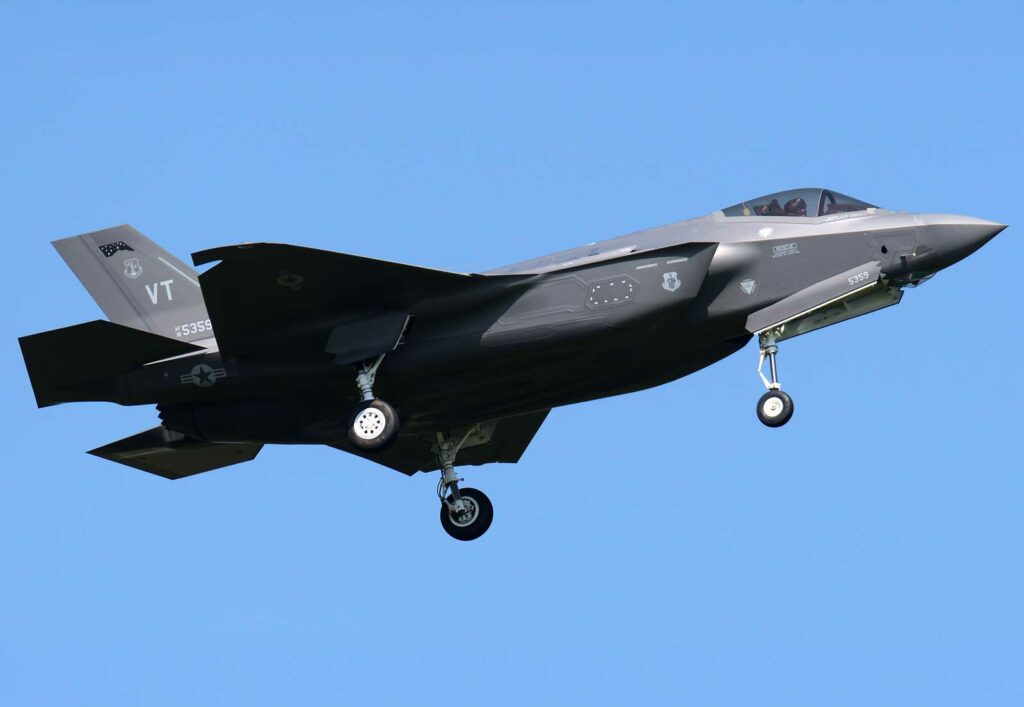
On February 19, 2026, sources indicate that Berlin is considering purchasing more than 35 additional F-35As, in addition to the 35 already ordered to replace the Tornados based in Büchel. Officially, the government says it has “no plans” in place. The debate remains logical: the NATO nuclear sharing mission requires an aircraft certified for the B61-12, while the SCAF/FCAS is bogged down in rivalries between Airbus and Dassault. A second tranche would bring the German fleet to around 70 aircraft and cost tens of billions, including support, armament, training, and infrastructure. It would secure the tactical nuclear posture, but would reduce the urgency of the FCAS and shift the balance with France: less dependence on the Franco-Spanish schedule, more technological dependence on the United States. The real issue is strategic: financing two future fighter aircraft in Europe, to the detriment of a common industrial base. And to now accept that interoperability takes precedence over autonomy in industrial choices.
Rumors of a second tranche and what they reveal about timing
The starting point is simple: according to Reuters, Berlin is discussing an order for more than 35 additional aircraft, in addition to the 35 already decided upon. On the same day, the German government publicly cooled the subject: “no plans,” “no decision.” This contradiction does not negate the information. It puts it into perspective.
In large arms purchases, exploratory negotiations often precede political arbitration. The important signal is therefore not “Germany is buying.” The signal is “Germany is seriously considering,” at a time when two timelines are colliding: that of the replacement of the Panavia Tornado, and that of the SCAF/FCAS program, which was supposed, on paper, to stabilize European industrial cooperation.
This sequence should be read as risk management. The risk is not only technical. It is also political: if the European program slips further, the Luftwaffe will find itself with a nuclear mission to fulfill and an aircraft to withdraw. The capacity gap is always more expensive than redundancy.
The German budget calculation behind a fleet of F-35As
The advertised cost does not tell the whole story
The first German order was presented as a global package. An industry source cited in 2022 mentioned €8.4 billion for 35 aircraft (financing authorized by the budget committee), while other public estimates rise to €10 billion when the entire ecosystem (support, training, parts, basic modernization) is added up . Both figures may be true, because they do not always cover the same scope.
In a second tranche, the bill is never limited to the “catalog” price.
Lockheed Martin sells a system, not just an aircraft. This includes simulators, software, updates, inventory, maintenance contracts, and often weapons integration. As a result, the difference between the “unit price” and the “cost of ownership” can be massive over 30 years.
The Büchel base and the infrastructure effect
The core of the issue is the transition of the nuclear mission to the future fleet, centered on Büchel Air Base. However, adapting a base to a fifth-generation aircraft is expensive, for reasons of security, system protection, and specific standards. Public estimates have suggested that modernization costs related to the F-35 will be close to €2 billion. A second tranche does not automatically double this bill, but it can increase it: more aircraft, more hangars, more maintenance capacity, more qualified personnel.
Germany can pay, but must make trade-offs
The German budget window is real. The 2026 defense budget is announced at €82.7 billion in the federal budget, and €108.2 billion including special funds, according to figures reported by Reuters. The rearmament trajectory is therefore solid. The debate is not “Germany doesn’t have the money.” The debate is “where to put the money”: in a larger American fleet, in a future European aircraft, or in both.
This is where the logic becomes brutal. An expanded fleet of F-35s consumes the investment budget, then the operating budget. Even with financing facilitated by the special fund, the mass of recurring expenses (support, MCO, software upgrades) always ends up squeezing other lines, particularly long-term R&D.
The mechanism of nuclear sharing and the time constraint
NATO’s “nuclear sharing” is not just a slogan. It is a concrete architecture: American weapons pre-positioned in Europe, under American control in normal times, and the ability, in the event of a crisis, to deliver them with “dual-capable” allied aircraft. This credibility rests on three pillars: the weapon, the aircraft, and the certification/training chain.
On the weapons side, the B61-12 modernization reached a key milestone at the end of 2024, with the announced end of the life extension program. Regarding the stockpile in Germany, the most widely cited estimates suggest there are 10 to 15 American bombs in Büchel. This figure is not anecdotal: it explains why Berlin thinks first in terms of “minimum credible capacity” rather than “prestige fleet.”
On the aircraft side, the F-35A is precisely the tool that ticks the DCA (Dual Capable Aircraft) box. Several analyses mention its B61-12 certification by the United States. This changes everything compared to the immediate European alternatives. Converting a Eurofighter into a DCA aircraft would be a separate program, politically sensitive, long, and very costly. In other words, for the nuclear mission, the American option is the only one that is already structured and planned.
Finally, there is the schedule. Deliveries of the first 35 German aircraft are set to begin in 2026.
Even if this schedule is met, operational ramp-up takes time: training, conversion, squadron qualification, doctrine, and NATO exercises. If Berlin wants to reduce the risk of an overly tense transition, increasing the number of aircraft is a simple solution: more airframes available, more rotation, less tension between training, alert posture, and maintenance.
The shock for SCAF/FCAS and long-term finances
A €100 billion program stalling on governance
SCAF/FCAS aims to replace the French and German combat fleets by 2040. The total cost is regularly cited as around €100 billion. Specifically, phase 1B (demonstrators) was the subject of a €3.2 billion contract notified at the end of 2022. These are serious amounts, but still far from the financial effort that a full development phase would require.
The problem is therefore not a lack of money at the outset. The problem is the decision-making process. When industrial sharing is contested, each milestone becomes a political negotiation. And when the milestone slips, there is a strong temptation on the German side to cover the need with a “ready-made” purchase rather than a “risky” development.
The real budgetary effect: less bankruptcy than loss of necessity
A second tranche of F-35s does not automatically “kill” the FCAS. It can even coexist, if Berlin agrees to pay for two trajectories. On the other hand, it weakens an essential driver of major programs: operational urgency.
If Germany has a fleet of around 70 F-35s, it is giving itself a long capacity bridge. This bridge can cover much more than the replacement of the Tornado. It can also encroach on the need to eventually replace some of the Eurofighters. And if this bridge exists, the FCAS negotiation is reversed: Berlin can say “we have a solid option,” where Paris says “we need a joint project.”
This is where the consequences for the FCAS budget become indirect but significant: a dilution of political pressure, and therefore a possible slowdown in future funding, or conditional support. The risk for France is that it will find itself having to finance more on its own, or accept a “two-aircraft” architecture, which Airbus has publicly opened up as a possibility if governments request it.
Germany’s stance towards France: frankness behind the rhetoric
The subject is sensitive because it touches on strategic autonomy. For years, Paris has defended the idea that Europe must design its own key combat systems to avoid technological, software, and political dependence. Berlin, on the other hand, often thinks in terms of “available capacity” and “NATO interoperability.” The two approaches do not overlap.
In this dossier, Germany is sending three messages to France, even if it does not formulate them as such.
First message: the nuclear mission is non-negotiable. It is carried out within a NATO framework. And it requires an apparatus that is already structured for this mission. The F-35 meets this requirement. The FCAS will not meet it for a long time.
Second message: industrial cooperation must be “pragmatic.” When the leadership of the piloted platform is contested, Berlin does not want to wait for the industrial balance of power to stabilize. It is seeking assurance.
Third message: Europe is not a substitute for the United States, it is a complement. This is a consistent position, but it has a political cost: it gives Washington lasting leverage over the German combat chain, from software to parts, including updates and certain authorizations for use. This is the price of extended deterrence and speed.
On the French side, the interpretation is more blunt: if Germany invests heavily in the F-35, it reduces its dependence on the FCAS. It therefore reduces France’s ability to impose a logic of architecture and industrial sovereignty. And it opens the door to a fragmented Europe, with the GCAP (United Kingdom, Italy, Japan) attempting to attract Berlin.
The question of political cost, beyond the price of the aircraft
One could argue that a second tranche of F-35s is rational because it reduces short-term risk and secures the nuclear mission. It can also be seen as a strategic error, because it weakens the European industrial base and makes it more likely that there will be two competing aircraft in Europe in the future, resulting in doubled costs, divergent standards, and scattered sovereignty.
The truth can be summed up in one sentence: Berlin is buying time. But this time is not neutral. The more time passes, the more a program like FCAS becomes an industrial battleground rather than a defense project. And the more difficult it becomes, politically, to explain to taxpayers why Europe is financing several “aircraft of the future” instead of a single coherent system.
If Germany ever confirms this second tranche, the key question will not be “how many aircraft.” It will be “what political contract” Berlin is offering Paris to ensure that the FCAS remains more than just a logo. Without this contract, the F-35 will not just be an aircraft. It will become the symbol of a discreet but profound Franco-German strategic decoupling.
Sources
Reuters, February 19, 2026, “Germany seeks more F-35 jets as European fighter program falters, sources say.”
Reuters, February 19, 2026, “Currently no plans to buy additional F-35 jets, Berlin says.”
Reuters, November 13, 2025, “German budget committee passes 2026 defense budget…”
Reuters, November 28, 2025, “Highlights of Germany’s 2026 budget.”
Breaking Defense, December 15, 2022, “Germany seals entry to F-35 club…”.
Airbus (press release), December 16, 2022, “FCAS Phase 1B contract… €3.2 bn”.
Reuters, February 20, 2026, “Airbus capable of developing a fighter jet alone…”.
Federation of American Scientists (PDF), November 7, 2023, “Nuclear weapons sharing, 2023” (Büchel: 10–15).
IISS, December 1, 2025, “Investment in nuclear sharing continues…” (certification and DCA dynamics).
Militarnyi, July 25, 2025, “Cost of upgrading German Air Base for F-35s… nearly €2B.”
War Wings Daily is an independant magazine.