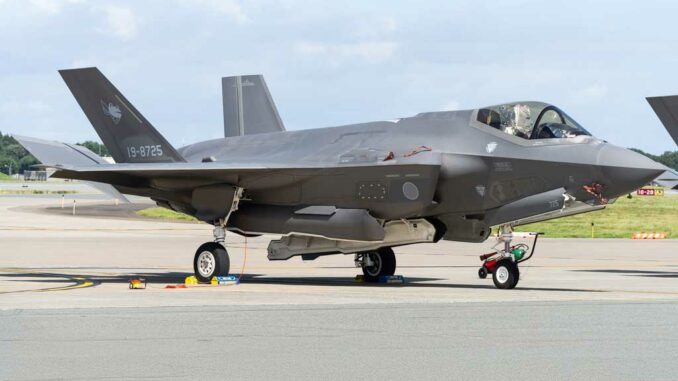
The US NGAD program is stumbling over costs. Lockheed is promoting a more affordable F-35+, designed to pilot combat drones and maintain air superiority.
In summary
The NGAD is not an aircraft, at least not only. It is a family of systems designed by the US Air Force to replace the F-22 with a 6th generation fighter, supported by combat drones called CCA. The concept promises air superiority in the most contested spaces. But the promise comes at a price. In 2024, the US Air Force froze and then re-examined the manned component of the program after seeing the unit cost drift toward $300 million per aircraft, about three times that of an F-35A. In 2025, the program resumed with Boeing, under the name F-47, but the dilemma remained: how to finance an elite aircraft without sacrificing volume, availability, and other Pentagon priorities. Lockheed Martin is filling this gap with the F-35+, a “boosted” version of the F-35, presented as a compromise: less ambitious than a true 6th generation aircraft, but much more sustainable.
The NGAD is first and foremost a combat system, not just a fighter jet
The Next Generation Air Dominance was designed to answer a specific question: how to maintain air superiority against a high-level adversary, particularly China, in an environment saturated with radars, long-range missiles, jamming, and distributed sensors. The program was intended to replace the F-22 Raptor with a more stealthy, more connected manned platform with more powerful sensors, better data fusion, and native networked combat capability. But this fighter is only the centerpiece. The NGAD is based on a comprehensive architecture in which the piloted aircraft operates with Collaborative Combat Aircraft, autonomous or semi-autonomous combat drones.
This logic changes the way we think about air superiority. Until now, the dominant model has been to send a high-performance aircraft with a pilot, sensors, missiles, and stealth capabilities. The NGAD adds a layer of distributed mass. The manned fighter becomes a conductor. The drones advance further, carry sensors, jam, serve as relays, fire, or absorb part of the risk. The idea is simple: a single aircraft, even an excellent one, ends up being too expensive to be exposed alone on the front line. A piloted aircraft + drone combination allows for risk sharing and increased tactical density.
On paper, the logic is sound. In practice, it drives up costs. Simultaneously designing a new air superiority aircraft, its software architectures, data links, engines, and drone ecosystem imposes an extraordinary technical and budgetary burden.
This is precisely what derailed the initial trajectory.
The first obstacle to NGAD remains a budgetary wall
In 2024, Air Force Secretary Frank Kendall publicly admitted that the program needed to be reevaluated. The main reason was brutal: the estimated cost of the manned fighter had risen to more than $300 million per aircraft, about three times the price of an F-35. For a program originally designed around 200 aircraft, the bill was becoming difficult to justify, even for the US military budget. Reuters reported a projected development cost of $28.5 billion through 2029, with a total bill potentially exceeding $100 billion for the planned fleet.
The problem is not just financial. An overly expensive aircraft automatically reduces volumes. But air warfare cannot be won with a few technological gems if the numbers, availability, and logistical endurance are not there. A $300 million aircraft pushes decision-makers toward smaller fleets, and therefore toward lower attrition capacity and greater dependence on each aircraft delivered. This is a real issue in an Indo-Pacific scenario, where distances are immense and the rate of wear and tear could be high.
The NGAD has also suffered from a crowding-out effect. The Pentagon is already funding heavy programs: B-21 Raider, nuclear modernization, long-range missiles, missile defense, space, cyber, and maintenance of an aging tactical fleet. When a fighter program absorbs too much capital, it competes directly with everything else. The temporary freeze on NGAD in 2024 was therefore less of an abandonment than a reality check: technological superiority only makes sense if it remains affordable.
The second obstacle is technological, but not for the reasons one might think
One might think that the main problem with NGAD is stealth or the engine. That is only part of the issue. The real difficulty is integration. A 6th generation fighter is not valued solely for its shape or propulsion. Its value lies in its ability to absorb, process, and redistribute massive volumes of data in real time, while remaining discreet and resilient in the face of jamming and network degradation. This requires extremely complex avionics, very high computing power, and growing needs in terms of energy, cooling, and software architecture.
The best indicator of this challenge is the F-35 program itself. The F-35 is not a 6th generation aircraft, but its delays on TR-3 and Block 4 show how difficult it is to evolve a combat platform when software, embedded computing, sensors, and thermal management become the core of performance.
In 2024, the United States even resumed deliveries with an intermediate version, while withholding part of the payments. In 2025, delays remained a sensitive issue. This is not a minor detail: if an aircraft already in service is struggling to absorb its modernization, designing a complete generational leap is even more risky.
There is also a doctrinal issue. In 2024, the US Air Force did not simply say that the NGAD was too expensive. It also re-examined the very form of the response: is such an “exquisite” fighter really necessary, or is a better balance between manned aircraft, drones, missiles, deception, and distributed mass needed? The review was therefore not only budgetary. It also addressed the operational relevance of the initial concept.
The relaunch of the F-47 program does not eliminate the underlying problem
In March 2025, the US administration relaunched the manned component of NGAD by awarding Boeing the contract to develop the future fighter, now named F-47. The initial contract is worth at least $20 billion. The US Air Force has reaffirmed that a manned fighter remains necessary and that NGAD is still the best solution for maintaining air superiority in a high-intensity environment. The program is therefore not dead. It was shelved, then relaunched.
But the dilemma remains. The House Appropriations Committee report mentions $3.194 billion in R&D&E for the F-47 platform in fiscal year 2026. This is a significant level of funding, and it is only the beginning. Even if Boeing manages to contain costs better than expected, the F-47 will remain a selective, expensive program, likely limited in volume and focused on the most demanding missions. It alone will not replace the need for mass production or the need to maintain the relevance of the existing fleet.
This is where the idea of an “F-35+” becomes politically and industrially astute. The Pentagon can pursue a breakthrough fighter with Boeing while, at the same time, looking at how to enhance a platform that is already in large-scale production. This is not contradictory. It is even consistent with a capacity portfolio approach.
Lockheed Martin’s F-35+ is first and foremost a very rational industrial maneuver
After its defeat by Boeing on the NGAD, Lockheed Martin quickly changed its tune. Rather than contesting the result, the group explained that it wanted to reinvest some of the technologies developed for its losing proposal into the F-35. The group’s CEO, James Taiclet, summed up the idea bluntly: offering 80% of the capabilities of the new generation for half the cost. His image was deliberately evocative: take the existing chassis and “turn it into a Ferrari.”
To be clear, the F-35+ is not, at this stage, an official US Air Force program.
It is an industrial proposal, a direction, a selling point. Lockheed is essentially saying: you won’t get a true 6th generation at the price of an F-35, but you can get a significant upgrade while staying on a platform that is already in production, already exported, and already supported. It’s a very American logic: if a complete revolution is too expensive, sell a credible evolution.
The group has hinted at several possible avenues. According to Reuters, the proposal presented to Donald Trump was based on an advanced engine, a redesigned nose, a reworked front fuselage, and a new suite of sensors. In other words, Lockheed is not talking about a simple software kit. It is talking about a visible leap in capability, but without starting from scratch. This is important because retaining the basic chassis preserves the industrial chain, training, much of the support, and a large international user base.
The performance targets for the F-35+ are less about speed than survivability
The F-35+ should not be thought of as a radically faster interceptor. At this stage, there is no credible indication of a major kinematic overhaul. The main challenge lies elsewhere: more computing power, more sensors, more energy, more cooling, and therefore a greater ability to see, decide, jam, cooperate, and command drones. This is less spectacular than a Mach number, but it is what determines the relevance of a modern aircraft.
The advanced engine mentioned by Reuters should be viewed in this light. A new engine, or a major evolution in propulsion, can certainly improve certain flight performance characteristics. But its main benefit is often to provide more electrical power and thermal margin for sensors, electronic warfare, and onboard processing. This is exactly the type of bottleneck already seen on the F-35 with Block 4. A credible F-35+ would therefore primarily aim to alleviate these constraints.
Lockheed also suggests that a modernized F-35 could be better positioned for CCO combat drone piloting. Here again, the gain is not symbolic. If the F-35 becomes a better drone “quarterback,” it can extend its tactical range, distribute the riskiest missions to unmanned vehicles, and partially compensate for the lack of a large number of high-end fighters. This point is central, as the U.S. Air Force already sees CCAs as a key part of its future air superiority.
Target missions and customers point to a high-end transition aircraft
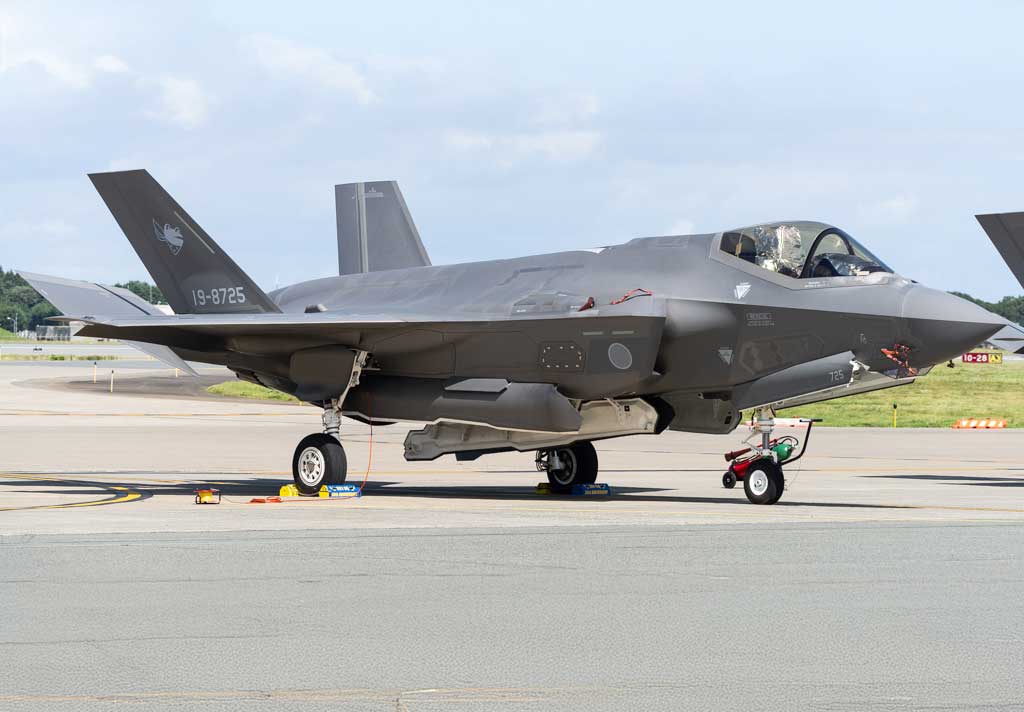
The F-35+ would primarily target missions where the standard F-35 remains relevant but shows its limitations in the face of the growing threat. This includes penetration into contested airspace, front-line fighter operations, long-range target designation, network warfare, and tactical drone command. It would be less a replacement for the NGAD than a reinforced transition aircraft, capable of extending the military value of the F-35 in the most challenging part of the spectrum.
For whom? First and foremost, for the United States. The US Air Force is already reducing its request for F-35As in the 2026 budget to 24 aircraft from the 48 previously planned, showing that it no longer wants to buy volume without increased relevance. An improved F-35 could therefore become politically saleable again if it is better suited to high-intensity combat. But the other obvious audience is the allies. Lockheed has a huge installed base: nearly 1,300 F-35s were in service worldwide in early 2026, according to industry data reported by Reuters. A higher standard, even if only partially exportable, would offer the group a massive growth driver.
However, there is one major limitation: technologies derived from NGAD may be highly controlled. Reuters reports that some of the components under consideration would make export more difficult. This means that the F-35+ could exist in several forms: a highly advanced version for US use and more restricted variants for foreign customers. This is a classic feature of military exports, but it reduces the promise of a single standard.
The budget for an F-35+ would be more sustainable, but there are no credible figures yet
Let’s be clear: there is currently no official consolidated budget for an F-35+. Lockheed is promoting an industrial slogan, not a quote approved by the Pentagon. The company talks about half the cost of a new-generation aircraft, but this ratio does not tell the whole story. If we take as a reference point an NGAD estimated at around $300 million per aircraft, the implicit message is that a highly advanced F-35+ could aim for a significantly lower cost range, potentially around $150 million per aircraft, but this interpretation remains an extrapolation, not an announced price.
On the other hand, we do know the baseline. The recently delivered F-35A costs an average of $82.5 million per aircraft for the batches covered by Reuters. This is already a high price, and it does not include the full cost of ownership. As soon as you add a more demanding engine, a partial redesign of the front airframe, new sensors, software, and advanced integration with drones, you inevitably exceed the cost of a standard F-35A. The real savings would therefore not come from a “cheap” aircraft, but from avoiding the massive non-recurring costs of an entirely new program.
This is at the heart of the debate. The NGAD/F-47 is the most ambitious response. The F-35+ would be the most sustainable response. The US Air Force does not necessarily oppose the two. It can finance a core of very high-end aircraft with the F-47, reinforce the payload with CCAs at $25 to $30 million per unit according to recurring estimates cited around the program, and maintain the bulk of its manned fleet around a modernized F-35. Strategically, this is probably the only truly financeable arrangement.
The real question is no longer whether to choose between disruption and economy, but how to combine them
The debate surrounding the NGAD and the F-35+ tells the same story: the age of “miracle” aircraft financed without constraint is over. The Pentagon still wants absolute air superiority. But it must now build it with tougher trade-offs, in a world where missiles, drones, software, and attrition matter as much as the platform itself.
The NGAD, now known as the F-47, remains the breakthrough tool. The F-35+ would be the capacity dissemination tool. The CCAs, meanwhile, are the distributed mass tool. Taken separately, none of these elements solves the problem. Together, they paint a more realistic picture: a few exceptional aircraft, more modernized aircraft, and enough drones to complicate the enemy’s life without ruining the US budget. It’s less elegant than a single comprehensive program. It’s also much more credible.
Sources
Reuters, July 20, 2024, US to take “hard look” at fighter project, top official says
Reuters, July 22, 2024, Next-generation U.S. jet fighter program may get hit by budget woes
Reuters, March 21, 2025, Trump to award U.S. Air Force’s next-generation fighter jet contract Friday, sources say
Reuters, May 15, 2025, Trump floats possible new F-55 warplane and F-22 upgrade
Reuters, June 9, 2025, Trump’s vision for a twin-engine F-55 fighter jet faces reality check
Reuters, June 11, 2025, Pentagon slashes in half its request for Air Force F-35s
Reuters, June 26, 2025, Trump wants more missiles and drones, fewer F-35s in $893 billion budget request
Reuters, August 29, 2024, Pentagon withholds $5 million per F-35 jet as deliveries resume
Reuters, July 14, 2025, Lockheed Martin delivers 72 F-35 jets facing upgrade delays
GAO, September 3, 2025, F-35 Joint Strike Fighter: Actions Needed to Address Late Deliveries, Cost Growth, and Modernization Delays
Department of the Air Force, FY26 posture and budget materials
House Report 119-162, Department of Defense Appropriations Act, 2026
AFMC, April 25, 2024, Air Force exercises two Collaborative Combat Aircraft option awards
War Wings Daily is an independant magazine.