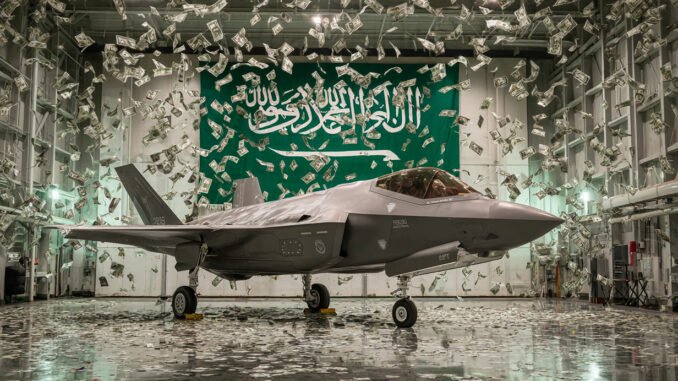
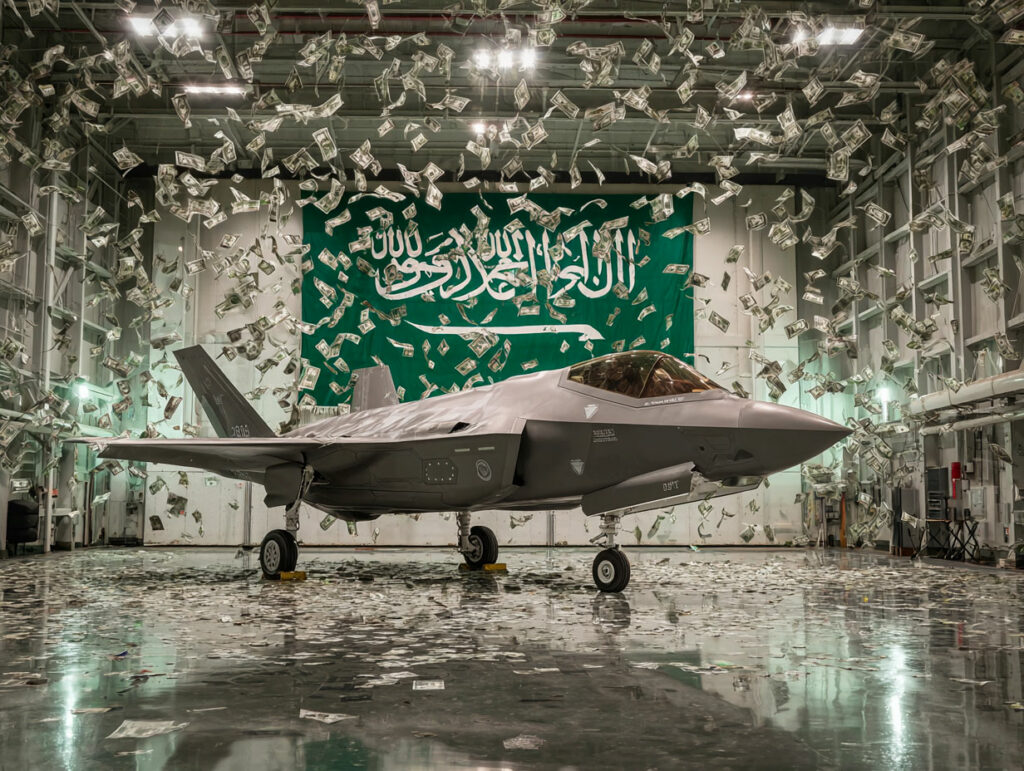
The planned sale of 48 F-35s to Saudi Arabia ($142 billion) is reviving fears of corruption and Chinese espionage via the RSAF.
Summary
A highly sensitive issue resurfaces in 2025: Saudi Arabia could purchase up to 48 F-35s for approximately $142 billion. Such a volume would represent one of the largest US arms contracts ever considered. But this prospect raises serious questions: a history of corruption in arms sales to Riyadh, US military equipment export laws tightened after the assassination of Jamal Khashoggi in 2018, and warnings that the risk of espionage via the Royal Saudi Air Force (RSAF) could open an indirect route for China into the Gulf. Beyond the technical aspects, the strategic balance in the Middle East, the role of the US, and the security of its allies are also at stake.
The context and outlines of the proposed agreement
The proposal to sell 48 F-35s to Saudi Arabia is mentioned in several sources as being under consideration by the Trump administration. According to Reuters on November 4, 2025, the Pentagon has reached a major milestone in its review of a Saudi request for 48 F-35 fighter jets. The amount of “$142 billion” (≈ €130 billion) is cited in critical analyses as a “global weapons package” including but not limited to the F-35s.
The amount is so high because it would cover not only the 48 aircraft, but also logistical support, ammunition, associated equipment, maintenance over several years, training, and probably related weapon systems. The figure of $142 billion is referred to as “the largest defense deal in history” by supporters.
However, no final contract has been made public at this time. Saudi Arabia must comply with the U.S. export procedure (FMS: Foreign Military Sales), and the agreement must be approved by the State Department, the Pentagon, the White House, and Congress.
Strategic importance for Saudi Arabia
For Riyadh, acquiring the F-35 would represent a major qualitative leap. The F-35 is a fifth-generation multi-role stealth aircraft capable of air-to-air and air-to-ground missions, as well as networked data collection and sharing. It would strengthen the Royal Saudi Air Force (RSAF) not only vis-à-vis Iran but also in its ambition to become a “global player” in defense in the Gulf.
Owning a fleet of F-35s would lend credibility to Saudi Arabia’s position as a “pivot” between America and the Arab countries, and would provide access to sensitive technologies (sensors, stealth, data links). This prestige effect is also important for Crown Prince Mohammed bin Salman (MBS), who intends to diversify alliances and assert the kingdom’s power.
In addition to prestige, this would provide a lasting tactical and strategic advantage. In a region where air fleets are being modernized (Emirates, Turkey, Israel, etc.), the F-35 would put Saudi Arabia on a par with the best. It could also open up opportunities for Saudi exports or cooperation with other Arab or African states.
Fears of corruption and Saudi Arabia’s track record
Such a massive amount immediately raises the question of corruption. Arms sales are a high-risk sector for corruption: according to Transparency International, the defense industry is “one of the most corrupt in the world.”
Saudi Arabia, in its own report by the NGO Human Rights Watch, is presented as having serious long-standing corruption problems. There is talk of more than $100 billion being embezzled or misused over several decades.
We can also recall historical cases such as the “Al-Yamamah” contract between the United Kingdom and Saudi Arabia in the 1980s and 2000s, which was marred by accusations of large bribes.
In the case of the F-35 agreement, several risks have been identified: kickbacks via intermediaries, opaque industrial offsets, political influence and active lobbying, and even indirect financing of networks. One note states: “The defense sector relies on a complex network of governments, industries, and lobbying in the Gulf countries.”
Clearly, when a country signs an arms contract of this type, it requires extreme vigilance: independent auditing, transparency, monitoring of “offsets,” and anti-corruption measures. In the EU and elsewhere, some states now impose strict rules on such sales.
US export laws and the impact of the Khashoggi affair
Since the assassination of Jamal Khashoggi in October 2018 at the Saudi Arabian embassy in Istanbul, the US Congress has stepped up its monitoring of arms sales to the kingdom. The key laws are:
- The Arms Export Control Act (AECA) of 1976, which gives the US president authority over arms exports and requires notification to Congress.
- The Foreign Corrupt Practices Act (FCPA), which primarily sanctions US companies and intermediaries, but not always foreign officials.
Following the Khashoggi affair, Senate resolutions attempted to block certain arms sales to Saudi Arabia. In July 2019, the Senate failed to override Trump’s veto, which allowed the administration to sell more than $8 billion worth of arms to Riyadh.
Even if a $142 billion F-35 deal is of interest, it will have to go through congressional notification, review of strategic implications, human rights, and risks of technology transfer or espionage. The handling of these issues shows that arms sales to Saudi Arabia remain fragile, dependent on a delicate balance between strategic priorities and ethical constraints.
The risk of Chinese espionage via the RSAF and China-Saudi Arabia ties
One of the aspects least discussed publicly but clearly highlighted by Pentagon sources concerns the increased risk of indirect espionage via a Saudi air force equipped with F-35s. The argument is as follows: if Saudi Arabia receives F-35s and operates them in conjunction with other systems (sensors, drones, satellites), this creates a technological “node” that is potentially vulnerable to cyber intrusion, reverse engineering, or the transfer of sensitive data.
China has strengthened its strategic ties with Saudi Arabia in recent years: energy cooperation, investments, technologies. The DoD’s “Military and Security Developments Involving the People’s Republic of China 2024” report mentions that China uses corruption, loans, and police cooperation to increase its influence.
In practice, two scenarios are of concern:
- A Chinese actor could gain access to F-35 data or maintenance/training networks through Saudi contracts or industrial partnerships.
- Deploying an F-35 fleet could require IT infrastructure and an ecosystem of partners (software, sensors, parts). If these partners have Chinese ties or are subject to espionage pressure, the risk is real.
Saudi Arabia also offers China a strategic market for its investments and technologies, creating an indirect channel: Riyadh could agree to co-productions or transfers of know-how, opening up a potential vector for China. The risk of a technological “rebound” to China via Saudi Arabia must therefore be taken into account.
Precedents of controversial sales and lessons to be learned
History is full of precedents of major arms deals that have led to corruption or unwanted technology transfer. The Al-Yamamah agreement (United Kingdom-Saudi Arabia) is often cited: accusations of bribes, slush funds, and pressure on British investigative services.
Similarly, a study by Transparency International suggests that Gulf states are “at very high risk” of corruption in the defense sector.
This history suggests that any large-scale agreement with Saudi Arabia requires robust control mechanisms: audits, transparency, accountability, restrictions on intermediaries, and strict compliance with US export laws. Unfortunately, “offsets” (industrial compensation) are often fertile ground for misappropriation.
Thus, the possibility of a sale of 48 F-35s for $142 billion must be examined in light of these precedents: the massive amounts involved, the complexity of the systems, and the high strategic stakes all create a high-risk environment.
The stakes for the United States, Israel, and regional stability
For the United States, such an agreement represents a strategic and political choice. On the one hand, it responds to the demand of a major ally in the Middle East and generates revenue for American industry (Lockheed Martin is the manufacturer of the F-35). On the other hand, it poses dilemmas: maintaining Israel’s “qualitative military edge,” preventing the region from erupting into conflict, and controlling sensitive technology transfers.
The press notes that the agreement would test the US definition of maintaining Israeli superiority in the region.
For Israel, seeing Saudi Arabia equipped with F-35s upsets the strategic and numerical balance (the F-35 shares networks, sensor data, etc.). This forces Jerusalem to strengthen its own defenses and even accelerate alternative programs.
In terms of regional stability, the arrival of F-35s in Saudi Arabia could alter the balance of power in the Gulf, prompt Iran and its allies to strengthen their position, and trigger a “cascade of air force modernization.” It could also create tensions with other Gulf states that also want access to fifth-generation aircraft.
The legal and procedural status of F-35 exports to Saudi Arabia
A contract of this type must comply with several legal and procedural steps. The FMS process requires notification to Congress via the Arms Export Control Act (AECA) and ITAR (International Traffic in Arms Regulations).
The United States must assess the impact of a major sale on national security, human rights, regional stability, and the end use of the equipment. The administration must also verify that the recipient country will not transfer the equipment, use it for violations, or engage in unauthorized technology transfer.
The sale of 48 F-35s for $142 billion would be subject to these reviews: Congress could request additional guarantees, control clauses, audits, re-export restrictions, or make the agreement conditional on reforms in Saudi Arabia.
Outlook and precautions
If this contract goes ahead, it will open a new chapter in US arms exports and in the dynamics of the Middle East. However, to limit the risks, several options should be considered:
- Impose transparency mechanisms on commissions, offsets, and Saudi intermediaries.
- Make the agreement conditional on measures to monitor technology transfers and cybersecurity.
- Provide for control of access to sensitive F-35 data and associated networks to prevent espionage or Chinese access.
- Maintain close coordination with Israel and all allies in the region to monitor the military balance.
- Include in the agreement provisions for periodic review, sanctions for non-compliance, and return of equipment in the event of incompatible use or crisis.
The question remains: if signed, will this agreement be a catalyst for modernization or a tipping point toward risks of espionage and instability? The stakes are high.
The proposed sale of 48 F-35s for $142 billion to Saudi Arabia is much more than just an aviation contract. It represents a strategic choice for the United States, a quest for prestige and power for Riyadh, but also a breeding ground for risks: potential corruption, technology transfers, and indirect espionage via China. The real challenge will be to exploit this potential without losing sight of the essential safeguards.
Sources
– Reuters, “Saudi Arabia’s request to buy F-35 jets clears key Pentagon hurdle,” November 4, 2025.
– NakedCapitalism, “Trump smoke and mirrors on claimed ‘$142 billion’ Saudi arms deal,” May 15, 2025.
– ArmyRecognition, “Saudi Arabia may buy up to 48 F-35 fighter jets after new U.S. defense talks,” November 2025.
– Transparency International / documents “The cases of Saudi Arabia & UAE” (2019).
– Wikipedia, Arms Export Control Act; International Traffic in Arms Regulations.
– HRW, “The Man Who Bought the World,” November 20, 2024.
War Wings Daily is an independant magazine.