
The Typhoon is testing the APKWS to destroy drones at low cost. This technical and industrial advancement could have a significant impact on the air defense market.
In summary
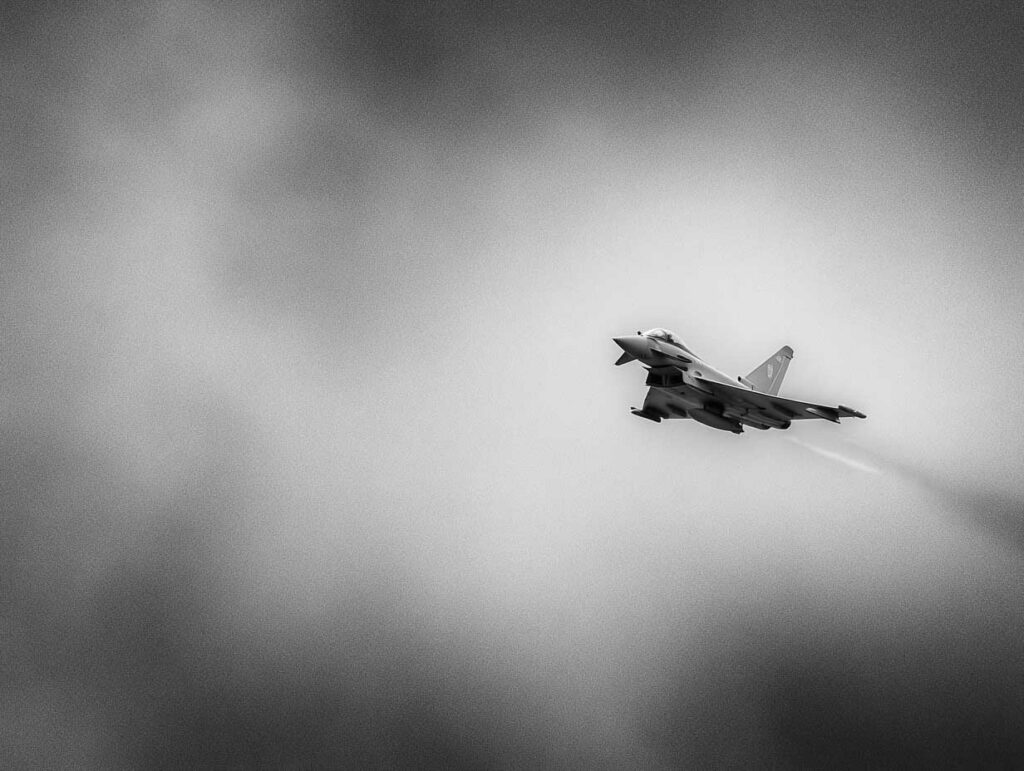
On April 8, 2026, BAE Systems announced a successful test of a low-cost anti-drone solution using an RAF Eurofighter Typhoon test aircraft. The weapon used was not a conventional air-to-air missile, but the APKWS, a laser-guidance kit that transforms a 70-millimeter rocket into precision munition. The test targeted a ground target, not a drone in flight. But the message is clear: the manufacturer wants to demonstrate that a fighter jet can carry a less expensive interception capability for low-value threats, particularly drones. In a context where unmanned aircraft costing a few tens of thousands of euros often still require the firing of missiles costing several hundred thousand, or even several million euros, the stakes are strategic. This test does not prove that the Typhoon already possesses an operational anti-drone defense capability. It does, however, demonstrate that a shift in thinking is underway, with concrete implications for doctrine, budgets, and the market.
The test that says more than meets the eye
The basic information is straightforward. BAE Systems successfully fired an APKWS from an RAF Eurofighter Typhoon test aircraft at a British firing range. The target was on the ground. It was therefore not an actual interception of a drone in flight.
Let’s be frank: from a strictly operational standpoint, this is not yet the final demonstration of a fully integrated air-to-air anti-drone capability. But it is not a minor detail either. This type of test validates several key elements at once: underwing carriage, weapon separation, aerodynamic compatibility, the firing interface, guidance stability, and the integration logic on an aircraft that was not originally designed for this role.
The signal sent to the market is crystal clear. The Typhoon can become a carrier of low-cost precision munitions to engage targets that offer no economic benefit when targeted with a high-end air-to-air missile. From Ukraine to the Red Sea and the Middle East, the issue is no longer theoretical. The central problem of modern air defense is that of cost-effectiveness.
The APKWS: Simple in Principle, Formidable in Application
The Advanced Precision Kill Weapon System, or APKWS, is not an entirely new missile. It is a guidance kit developed by BAE Systems that transforms 2.75-inch (70-millimeter) Hydra 70 rockets into laser-guided munitions.
The concept is clever because it leverages existing stock. Instead of manufacturing an entirely new weapon, a guidance section is inserted between the rocket’s motor and warhead. This section, called the WGU-59/B, adds semi-active laser guidance. The rocket thus retains much of its original architecture but gains a level of precision it previously lacked.
Technically, the APKWS uses the DASALS system, which stands for Distributed Aperture Semi-Active Laser Seeker. In practice, the laser sensors are integrated into the deployable front fins. This eliminates the need to place a seeker in the nose of the rocket. This architectural choice reduces complexity and allows for the continued use of widely available Hydra 70 components.
The published specifications provide a clear sense of scale. The complete rocket measures approximately 1.87 meters, weighs around 14.5 kilograms, and retains the standard diameter of 70 millimeters. On fixed-wing aircraft, the stated range starts at approximately 2 kilometers, with performance that depends heavily on altitude, firing speed, and attack profile. The stated accuracy is on the order of half a meter in reference documentation.
The other key point is cost. BAE Systems and NAVAIR present the APKWS as a weapon costing about one-third the cost and weight of other laser-guided munitions in the U.S. inventory. Publicly available sources estimate the unit cost of the APKWS at around $22,000, far below that of a modern air-to-air missile. Even using conservative comparisons, the difference is massive.
The Mechanism That Changes the Typhoon’s Operational Logic
The APKWS operates by using laser illumination of the target. Once fired, the rocket detects the reflected laser energy and corrects its trajectory. This requires a complete chain of operations: detection, identification, tracking, laser designation, and firing.
On a Typhoon, this can theoretically rely on a designation pod or on external designation provided by another platform. This is where things get interesting. In an anti-drone scenario, the fighter is not just a shooter. It becomes a node in a broader combat architecture, with ground-based radars, passive sensors, a data network, and possibly other aircraft for designation.
This is also why we must avoid oversimplifications. Destroying a drone with a laser-guided rocket from a fast aircraft is not as simple as striking a ground vehicle. A light aerial target may be small, slow, maneuverable, have a low signature, and be buried in a complex environment. The challenge is not just the weapon. The challenge is the detection and fire control chain.
BAE Systems had already demonstrated in 2021 that the APKWS could destroy Class 2 drones during tests at Yuma Proving Ground. In other words, the anti-drone concept isn’t improvised. Firing from the Typhoon adds a new layer: that of integration onto a major European fighter jet.
The application that targets a gaping hole in air defense
The most obvious application is countering tactical drones and certain kamikaze-type drones. Today, a fighter jet can shoot down this type of threat with missiles like the AIM-9X or AMRAAM. But economically, this often makes no sense.
Recent DSCA notifications show very high potential sales costs for modern air-to-air missiles, with budgets running into the hundreds of millions or billions of dollars for a few hundred weapons and their support. In contrast, Reuters reported in March 2026 that certain Shahed-type attack drones were estimated to cost between $20,000 and $50,000. The disparity is stark.
This is the whole rationale behind the APKWS on the Typhoon. The goal is not to replace air-to-air missiles in all missions. The goal is to add an intermediate layer to deal with low-value targets using a cheaper, lighter weapon that can potentially be carried in greater numbers.
This is a decisive point. The Typhoon has 13 hardpoints. A fighter configured with guided rocket pods can carry a significantly greater number of rounds than an all-missile loadout. This changes the available firepower depth when facing a saturation drone raid.
In other words, the Typhoon would no longer be just a very high-performance interceptor. It could also become a fast anti-drone munitions carrier, capable of covering a wide area and reacting quickly to a threat that overwhelms ground defenses.
The industrial gamble that could impact the market
In the market, this test has several possible consequences.
The first directly affects the Eurofighter Typhoon. The program must remain relevant in the face of the rise of drones, cruise missiles, and saturation attacks. Any new capability that improves its cost of operation and adaptability enhances its appeal. In January 2026, London already confirmed a contract worth £453.5 million for the ECRS Mk2 radar for British Typhoons. The addition of more cost-effective firing options is part of this ongoing modernization strategy.
The second consequence concerns BAE Systems. The manufacturer isn’t just trying to sell a weapon. It’s seeking to sell an architecture: sensors, integration, low-cost effects, and industrial ramp-up. This is significant given that BAE announced in February 2026 the delivery of its 100,000th APKWS kit. We are no longer dealing with a marginal prototype. We are talking about ammunition produced on a large scale.
The third consequence affects competitors.
If the Typhoon demonstrates that it can rapidly integrate a credible, low-cost anti-drone capability, pressure will mount on other Western fighter fleets. The market will demand the same for other platforms. Military forces no longer want to pay a high price to take down low-cost targets. This demand will weigh on the roadmaps of aircraft manufacturers, missile makers, and integrators.
Finally, this development could shift part of the industrial competition toward intermediate effectors: guided rockets, mini-missiles, light interceptors, and hybrid solutions combining laser, infrared, and network-based guidance. This is a less prestigious segment than that of air superiority missiles, but it could become much larger in volume.
The limitation that must not be overlooked
We must, however, keep a cool head. An air-to-ground test is not enough to prove a fully mature air-to-air anti-drone capability. Serious questions remain.
The first concerns laser designation against an aerial target. The smaller, more mobile, and farther away the target is, the more difficult the problem becomes. The second concerns rules of engagement and safety. Using a guided rocket from a fighter jet in congested airspace requires robust doctrinal and software integration. The third question is that of the actual performance envelope against different types of drones: quadcopters, fixed-wing tactical drones, faster suicide drones, and targets that are maneuvering or stationary.
We must therefore neither oversell nor downplay this. This test alone does not revolutionize air combat. But it reveals something more important: air forces are beginning to adapt their fighters to a war of attrition where quantity, cost, and reload speed matter almost as much as pure performance.
That is the crux of the matter. For thirty years, Western combat aviation has prioritized maximum quality per round. The return of high-intensity conflicts now imposes a different obsession: to shoot down more, faster, and cheaper. The Typhoon with APKWS fits perfectly into this shift.
The market will follow this reality, not slogans. Manufacturers capable of offering credible interception at low cost will win contracts. The others risk discovering that, when faced with a $30,000 drone, sophistication alone no longer impresses anyone.
War Wings Daily is an independant magazine.