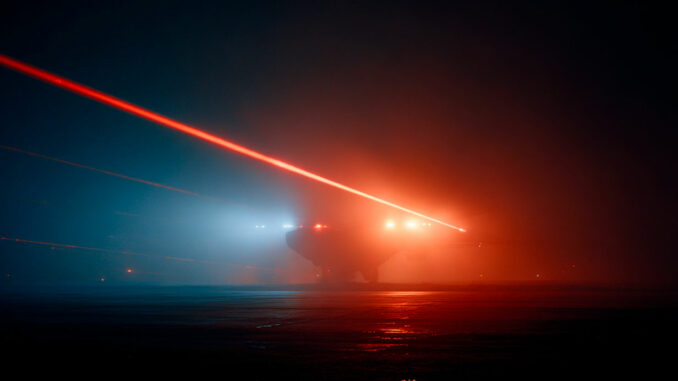
A deep dive into the controversy surrounding laser weapons—between drone neutralization and the risk of permanent blindness—and the legal challenges of international law.
In summary
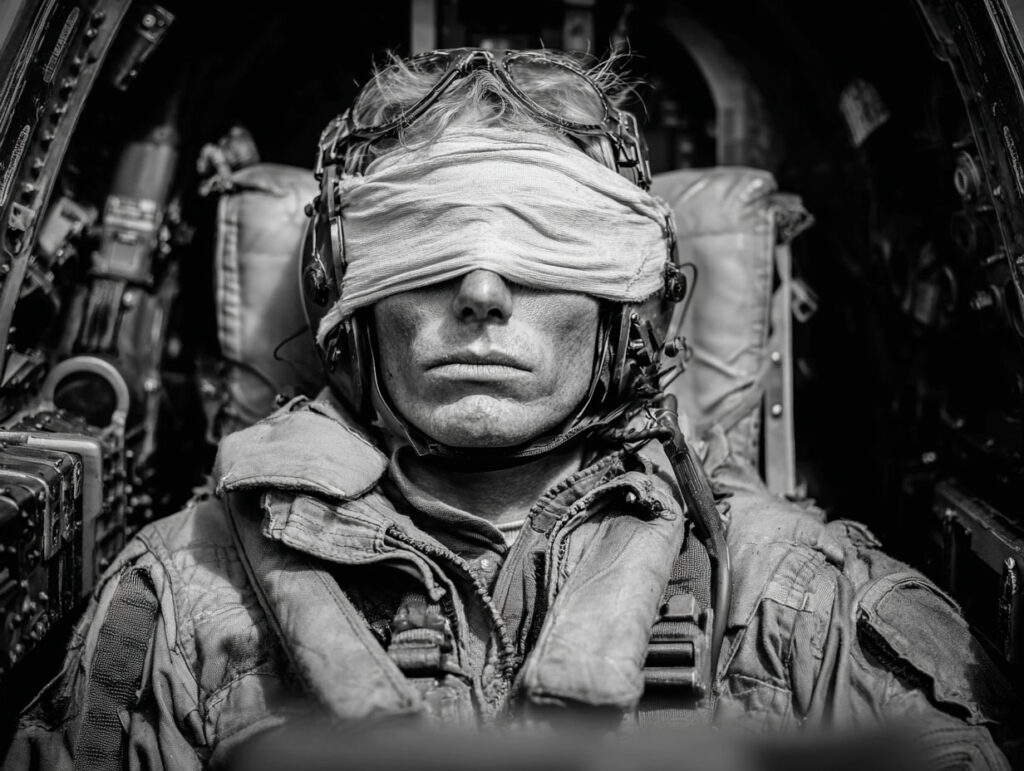
Directed energy weapons, and military lasers in particular, are the subject of intense ethical and legal debate due to the risk of permanent blindness. Protocol IV of the CCW clearly prohibits weapons specifically designed to blind, but it authorizes lasers intended to neutralize sensors, drones, or missiles, even if a side effect may affect human vision. This distinction, based on intent, is becoming difficult to maintain as systems become more powerful and accurate. Beams capable of destroying a drone several hundred meters away can, under certain conditions, cause irreversible eye damage to an operator. NGOs and lawyers denounce a gray area that undermines humanitarian protection. The central question now is whether international law needs to evolve to prevent any abuse and ensure the safe use of lasers in modern conflicts.
The context: from fictional laser weapons to real systems
In recent decades, technological advances have made directed energy weapons—high-power lasers, concentrated beams, missile or drone targeting systems—a reality. These weapons are of interest to armies because they can neutralize threats without resorting to explosive munitions, sometimes reducing collateral damage. A concrete example is the French HELMA-P project, designed to intercept drones or projectiles from a distance.
These systems also promise low engagement costs: a laser shot often costs much less than a missile, and logistics are simplified. Armies refer to it as a “clean weapon” that is fast, accurate, and relatively inexpensive to use. But this technological development raises major questions: what about the effects on humans, particularly if they can cause blindness?
The international legal framework: Protocol IV and its principles
Protocol IV, adopted on October 13, 1995, explicitly prohibits the use and transfer of laser weapons “specifically designed” to cause permanent blindness to unaided vision (naked eye or with corrective lenses).
- Article 1 stipulates the prohibition of the use, development, or transfer of these weapons when their combat function—whether sole or among others—is permanent blindness.
- Article 2 requires that, for any laser system used, all practicable precautions be taken to avoid permanent blindness. This includes training of armed forces and operational measures.
- Article 3 clarifies that blindness resulting from an incidental effect (collision with the eye during a material target, destruction of a missile, etc.) is not covered by the prohibition.
Furthermore, the protocol prohibits the transfer of these weapons to any state or non-state entity.
The Protocol entered into force on July 30, 1998, after ratification by a sufficient number of states. To date, more than 100 states are parties to it.
The heart of the controversy: anti-sensor use vs. blinding weapon
The central difficulty lies in the distinction—sometimes tenuous—between lasers intended to destroy material targets (missiles, drones, sensors) and lasers whose actual purpose is to impair human vision.
Proponents of anti-drone/anti-missile systems argue that the objective is to neutralize an object, not to harm people. Therefore, if a laser strikes a drone equipped with optics, or even destroys its sensor, it is not a blinding weapon within the meaning of the protocol. The possible blinding of a human operator would be a collateral effect—legally tolerated provided that precautions have been taken.
But this justification is problematic. With today’s high-energy lasers — sometimes capable of generating beams of several kilowatts — the line between neutralizing equipment and damaging the human eye is becoming increasingly blurred. If the energy strikes a drone from several meters away but passes through a window, a viewfinder, or even if the beam disperses, it can reach the retina of a human being with irreversible effects.
This technical and legal ambiguity is causing concern among NGOs and international law experts. At a seminar held in 2022, representatives of the International Committee of the Red Cross (ICRC) and NGOs emphasized the need to clarify the limits of Protocol IV in the face of modern technologies.
Why the distinction is difficult to maintain
Several factors make the interpretation of the Protocol uncertain:
- The absence of a precise technical definition of the term “laser weapon.” The Protocol does not describe the characteristics of the beam, its power, duration, or wavelength.
- The absence of a universally recognized threshold for the “dose” causing permanent blindness. The Protocol does not set a minimum energy level or biological criteria (phototherapy, duration of exposure, eye area, etc.) to characterize “permanent blindness.” This gap makes the treaty difficult to apply in the face of modern systems.
- The problem of verification and accountability: how can it be proven after a conflict that an individual’s blindness was caused by a laser whose primary target was a sensor or missile, and not the human eye directly? Intent—the core of the Protocol—is difficult to establish.
These technical and legal limitations create a gray area that certain states or manufacturers can exploit.
Contemporary uses of lasers: neutralizing drones and material targets
High-energy systems have recently been developed for air defense, missile interception, and drone neutralization. These include:
- The American HELIOS (High Energy Laser with Integrated Optical-dazzler and Surveillance) system, deployed since 2019 on US Navy ships. This 60 kW laser (modular version up to 120 kW) can be used to disarm, destabilize sensors, or destroy drones and missiles.
- The French HELMA-P system, developed since 2017 to counter hostile drones, missiles, or ammunition. It can be installed on the ground or on a vehicle, and depending on military ambitions, it could neutralize a variety of threats.
These systems are presented as precision weapons, capable of sparing civilian populations and reducing collateral damage. The stated objective is to neutralize equipment (radars, optics, drones), not to harm human beings.
However, the coexistence of potential effects on human operators—whether targeted or not—reignites the debate on the actual extent of protection offered by Protocol IV.
The ethical debate: rejecting a war of blindness
From an ethical point of view, the principle established by Protocol IV is based on a condemnation of deliberate permanent blindness. There are two arguments for this:
- Blindness deprives a person of their dignity, exposes them to disproportionate suffering and long-term disability. Neutralizing an enemy without killing them may be acceptable under humanitarian law, but depriving them of their sight for life, without any other decisive military advantage, poses a serious moral problem.
- The use of such weapons could promote asymmetric conflicts, encourage attacks on combatants or civilians from a distance, and trivialize non-lethal suffering—which many consider incompatible with the principles of “necessity” and “proportionality” in the law of war.
When NGOs, lawyers, and institutions such as the ICRC raise the dangers of a “war of the senses,” they call not only for the strict application of the Protocol, but also for its strengthening in the face of emerging technologies.
The legal challenge: adapting international law to technological developments
Protocol IV remains focused on intent: it prohibits weapons designed to blind, while tolerating collateral effects resulting from legitimate use. But this logic is showing its limits with the rapid evolution of directed energy systems. Several challenges arise:
- It would be necessary to technically define what a “blinding laser” is: beam type, power, duration, wavelength, threshold of eye damage, etc. Without this, states or actors could develop weapons that circumvent the ban while causing serious injury.
- Consideration should be given to broadening the legal framework: for example, prohibiting not only weapons designed to blind, but also those whose effect could reasonably cause permanent blindness, even if the primary objective is material.
- Mechanisms for transparency, verification, and accountability—audits, usage reports, inspection, medical monitoring of victims—should be established to ensure that any laser used remains consistent with humanitarian principles.
However, these issues remain widely debated. At the 2022 CCW meeting, experts suggested addressing the issue of dazzler lasers (temporary blinding) or collateral effects, without formally reopening the Protocol.
The risk of gradual circumvention
With the acceleration of military developments, there is a risk that some lasers designed to destroy drones or missiles could be misused against human beings. Several factors fuel this fear:
- The increasing power of lasers makes it possible to affect human targets even at a distance.
- Intentional ambiguity—difficult to prove or challenge—allows a state to claim anti-sensor use while targeting enemy operators.
- The absence of international monitoring or irrefutable evidence after use—eye injuries can be presented as accidental.
These dynamics could render Protocol IV meaningless if no enforcement measures are put in place.
Towards a necessary reform of international humanitarian law
The rise of directed energy weapons suggests that a more robust legal framework is essential. Several avenues are possible:
- Develop an additional protocol to the CCW to explicitly cover anti-sensor lasers and their blinding potential, with clear technical criteria.
- Introduce an obligation of transparency and reporting for any state using high-energy lasers: type of system, power, purpose, assessment of risks to human vision.
- Establish an independent monitoring mechanism—inspections, verification, damage assessment—to ensure compliance with humanitarian principles.
- Promote training, engagement protocols, and safety measures within the armed forces to minimize collateral effects, in accordance with the spirit of Article 2 of Protocol IV.
These developments require political will and international consensus, but the issue is urgent: the technologies are here, their use could spread rapidly, and the law must adapt before it is too late.
A useful but potentially dangerous weapon
Directed energy weapons offer real strategic value. They can neutralize drones, missiles, and other threats with high precision, low cost per shot, and without the use of explosive munitions. They can help reduce collateral damage and protect civilians.
But military interest must not obscure the serious and irreversible risk they pose to human beings: permanent blindness is a form of lasting suffering that is disproportionate to the objective of neutralization.
There is an urgent need to rethink the current legal frameworks so that the development of military lasers does not come at the expense of the fundamental principles of humanitarian law. Clear, reliable, and binding regulations are essential to prevent future wars from becoming wars of the senses.
Sources
Protocol on Blinding Laser Weapons (Protocol IV) — official text
International Committee of the Red Cross — historical and legal analyses
Public information on HELMA-P and HELIOS systems (defense industry)
War Wings Daily is an independant magazine.