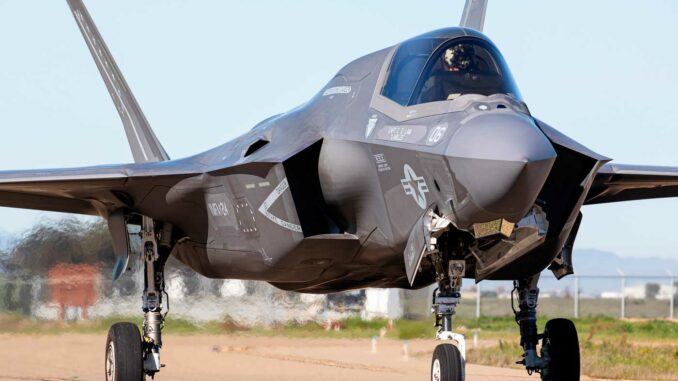
The price of the F-35A exceeds the approved budget. Bern wants to buy “as many as possible” for under CHF 6 billion, at the risk of cutting back on its air defense.
Summary
Switzerland is preparing to purchase fewer than the 36 F-35As initially planned because the acquisition budget approved by referendum—CHF 6 billion—is no longer sufficient. After a Federal Council meeting, Bern asked the DDPS to acquire as many aircraft as possible within this ceiling, while Washington is contesting the idea of a fixed price. The announced increases are due to inflation, supply chain tensions, and configuration adjustments. The debate goes beyond the order itself: it touches on the credibility of the Air2030 process, the sustainability of operating costs over 30 years, and the actual ability to fulfill the air policing mission when the F/A-18s reach the end of their service life. Switzerland is faced with three options: pay more, buy less, or reduce associated elements (simulators, equipment, weapons) at the cost of reduced capability.
The political and budgetary framework that constrains Bern
The Swiss decision is primarily a governance issue. The sum of CHF 6 billion is not an “indicative” figure. It comes from a vote, and therefore from an internal political agreement. When the Federal Council now announces that it is necessary to purchase “the maximum possible” within this ceiling, it implicitly admits that the “36 aircraft” plan is no longer tenable without additional funding.
The sticking point is the difference in interpretation of the price. On the Swiss side, the purchase was presented as compatible with a ceiling, with the idea that the agreement guaranteed a controlled amount. On the American side, subsequent exchanges contradicted this reading and raised questions about the true nature of the price cap. Simply put, Bern sold the public on budgetary security that Washington does not fully recognize. In a direct democracy, this type of discrepancy is toxic. It creates lasting suspicion: if the initial promise is not kept, the rest of the program becomes politically fragile, even if the aircraft is considered to be high-performing.
The immediate consequence is mechanical. If the “packaged” unit price increases, the quantity decreases. And since a fighter fleet is not a collection of aircraft, reducing the number impacts operational availability (maintenance, training, alerts), not just the display.
The technical and industrial reasons behind the cost increase
The explanations put forward are consistent: rising raw material and energy costs, inflation, industrial disruptions, and calendar effects. On paper, this seems trivial. In reality, on a program like the F-35, these factors quickly add up to a heavy burden, because everything is interconnected: airframe, engine, avionics, software, cybersecurity, supply chains, and certification standards.
The first driver is inflation and the implicit indexation of production and subcontracting costs. The United States has pointed to increases related to overall costs and the supply chain. Even though the F-35 is now being produced at an industrial rate, it remains dependent on an international network of parts and components, some of which have been in short supply since the post-COVID period.
The second driver is the actual configuration delivered. A fighter jet is not “complete” without its mission equipment, communications, electronic warfare suites, simulation capabilities, and, above all, its weapons. Part of the Swiss debate focuses precisely on what is and is not included in the purchase price, and what will be deferred to future purchases. Here, honesty is useful: if the aircraft arrives “bare” in certain segments, the expense does not disappear, it is only postponed, and it comes back to haunt us when the aircraft needs to be actually deployable.
The third driver, more insidious, is time. The longer a program drags on, the more it is necessary to manage obsolescence, software updates, equipment requalification, and the integration of standards. With regard to the F-35, recent modernization developments (particularly issues relating to upgrades and the delivery of full capabilities) serve as a reminder that the aircraft is as much a software platform as it is an airframe. Software is expensive, and it remains so for a long time.
The orders of magnitude: acquisition, operation, and maintenance over 30 years
Regarding acquisition, Switzerland had announced in 2021 a purchase budget below the ceiling and a total cost over 30 years estimated at around CHF 15.5 billion for the purchase and operation of the system (i.e., around €16 to €17 billion depending on the exchange rate). This long-term projection is key, as the main expense for a fighter jet is not the purchase, but keeping it in operational condition and running (fuel, parts, labor, spare parts, repairs, upgrades).
In the US, public figures also give an idea of the scale of the costs: in 2024, the GAO reported that the DoD estimated the cost of operating and supporting an F-35A in the US Air Force at around $6.6 million per year. This is not Switzerland, and the cost structure is not the same, but the order of magnitude highlights a reality: the aircraft is expensive to fly and maintain, even after years of optimization efforts.
We must therefore distinguish between three lines that always end up converging:
- Acquisition (aircraft, simulators, infrastructure, initial support).
- Annual operation, linked to operating costs: flight hours, scheduled maintenance, spare parts, personnel.
- Modernization, which is the often underestimated “fourth term”: software updates, adaptations, new threats, new ammunition, cybersecurity.
Finally, there is the cost per flight hour. The figures vary depending on the method used (direct cost vs. full cost), but the important thing is not the exact figure: it is the trend. The US authorities have been seeking to reduce this cost for years, precisely because it determines the volume of training and therefore the level of preparedness. For a small country, the sensitivity is even greater: if each hour costs too much, we fly less, and if we fly less, our skills decline.
The operational consequences for the Swiss Armed Forces
Reducing the fleet affects three specific capabilities.
First, the alert posture. The air policing mission requires armed aircraft, ready with trained crews, 24 hours a day if the situation demands it. A smaller fleet means fewer aircraft available at any given time, as some are always grounded (for maintenance, inspections, updates). Switzerland can compensate by flying less or accepting windows of vulnerability. These are political choices, but they must be named: “buying less” is not neutral.
Then there is training. With fewer aircraft, there is a tendency to concentrate activity on a few aircraft, which accelerates wear and tear and increases dependence on industrial support. Some real flight time can be replaced by simulation, but this does not solve everything: certain skills (stress management, weather, incidents, real integration) require flight time.
Finally, there is the credibility of deterrence. Switzerland is not in a position to project power, but it must guarantee the integrity of its airspace. If the fleet falls below a critical threshold, a potential adversary (or even an opportunistic actor) may conclude that there are times when coverage is weaker. Deterrence also relies on continuity.
Another consequence, rarely mentioned, is the planning of future purchases. Recent sources suggest that Switzerland’s long-term needs could exceed the single batch of 36, with broader considerations regarding air defense. If this is the case, reducing the order now would mean either postponing part of the need or preparing a second order later, in an even more tense political context. This would delay the problem without eliminating it.
The crux of the scandal: trust between public promise and actual contract
This issue is becoming explosive for one simple reason: Switzerland did not just buy an aircraft, it “sold” an equation to the country. The message in 2021 could be summed up in one sentence: best value for money, within the budget. If, four years later, the government explains that the budget no longer allows for the purchase of the announced number of aircraft, some people will conclude that the assessment was too optimistic, or that the communication was deliberately reassuring.
We must be direct: in this type of program, ambiguity about price is a political mistake. Either the price is truly fixed, legally enforceable, and must be respected, or it is not, and this should have been stated from the outset, assuming that there is a risk of increase. The “misunderstanding” is a gray area that destroys trust, because it looks like a pirouette: everyone can claim to be right.
And this debate has a strategic extension: dependence on the United States for supply, updates, part of the support, and trade policy dynamics (episodes of tariff tensions have fueled the unease). Even though the Swiss army is not aligned with NATO as a member, it is increasingly part of a European environment where interoperability matters. The F-35 provides compatibility, but it also brings structural dependence. It is a trade-off, not a foregone conclusion.
Realistic scenarios for Bern and what they imply
Bern has, in practice, three paths forward.
The first: pay more. This is the simplest path technically, but the hardest politically. It requires returning to Parliament and, above all, admitting to the country that the referendum ceiling is no longer sufficient. In the current context, this will be interpreted as a failure of leadership.
The second: buy less, which is the option that has been announced. This preserves the political rule of the ceiling, but reduces capacity. It can be temporarily masked by simulation and careful management of availability, but it will eventually become apparent: fewer aircraft means less margin.
The third: reduce associated elements. Fewer simulators, less inventory, postponed options, weapons purchased later. This is often the preferred “accounting” compromise because it allows a number of aircraft to be displayed. But it is also the riskiest: we end up with a fleet that exists on paper but lacks logistical depth or ammunition, and therefore cannot withstand a crisis scenario.
The worst thing would be to choose an unassumed mix: buy less, cut back on the ecosystem, and promise that “everything will be fine.” Fighter aviation is an area where half-measures are paid for in cash, because technology and training are unforgiving.
Sources
- Reuters dispatches dated June 25, 2025, August 13, 2025, and December 12, 2025, on the price dispute, the risk of cost overruns, and Switzerland’s decision to reduce its purchase.
- Official press release from the Federal Council (DDPS/VBS) dated June 30, 2021, on Air2030: selection of the F-35A and estimated total cost over 30 years.
- Breaking Defense, December 12, 2025: estimated increase of approximately $610 million and explanations (inflation, raw materials, supply chain).
- GAO, April 2024: report on the sustainability of the F-35, operating and support costs, and total cost trajectory.
- CBO, June 2025: analysis of F-35 operating and support costs and spending trends.
War Wings Daily is an independant magazine.