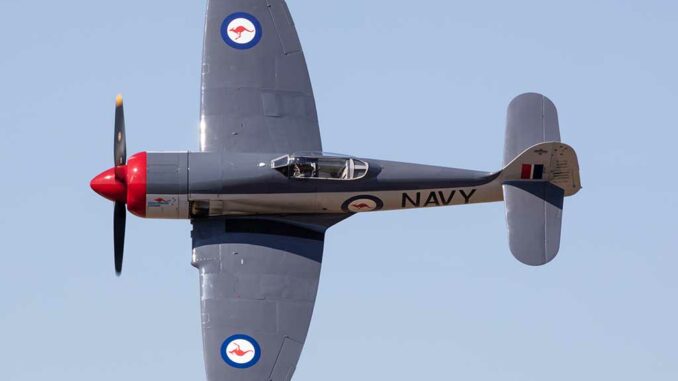
In Korea, the Hawker Sea Fury proved that a well-piloted piston-engine fighter could still beat a jet. A detailed look back at a duel that has become legendary.
Summary
The Hawker Sea Fury occupies a special place in military history. Designed at the end of World War II, it arrived too late to have an impact on that conflict, but early enough to serve at a time when aviation was shifting to jet engines. This Royal Navy carrier-based aircraft was fast for a piston-powered aircraft, robust, powerful, and above all, very stable in turns. During the Korean War, it was used primarily as a fighter-bomber: ground attack, rockets, bombs, armed reconnaissance, and fleet protection. On August 9, 1952, in British chronology, a Sea Fury flight engaged MiG-15s near the Korean coast. One MiG was shot down. The victory was officially attributed to Lieutenant Peter “Hoagy” Carmichael, although subsequent research has seriously revived the theory that Brian Ellis fired the decisive shot. Beyond the controversy, this battle tells us one simple thing: speed alone does not always win a dogfight.
The Royal Navy’s last great piston-engine fighter
The Sea Fury was a transitional aircraft. It was born out of a need during World War II for a fighter lighter than the Hawker Tempest, and was then navalized to meet the needs of the British naval air force. Its first flight took place in February 1945, but it did not enter operational service until 1947. This changed everything: it already belonged to the post-war era, when jets were beginning to take over.
The Sea Fury was therefore not a makeshift relic. It was a modern aircraft for a piston-engine plane. It was equipped with a 2,480 hp Bristol Centaurus, an 18-cylinder radial engine, and a five-blade propeller. Depending on the version and technical specifications, its maximum speed is given as between approximately 700 km/h (435 mph) in operational configuration and 740 km/h (460 mph) in manufacturer or museum data. Its service ceiling is cited as between 10,360 m (34,000 ft) and 10,910 m (35,800 ft). Its range also varies depending on the load, with values in the order of 1,090 to 1,130 km (680 to 700 mi) . These variations are not unusual: an armed and loaded carrier-based aircraft does not fly like a clean, lightweight prototype.
What matters is its overall balance. The Sea Fury is fast, but above all very maneuverable for its size, stable on its flight path, structurally sound, and capable of operating from an aircraft carrier thanks to its folding wings and arrestor hook.
The Canada Aviation and Space Museum presents it as one of the fastest piston-engine aircraft ever built and the last piston-engine fighter used by the Royal Navy.
The Sea Fury in Korea was not a parade interceptor
Let’s be honest: in Korea, the Sea Fury was not sent to hunt down the MiG-15 on a regular basis. Faced with a jet like the MiG-15, which easily exceeds 1,000 km/h in top speed depending on the configuration, the Sea Fury is objectively inferior in speed, climb, and available energy. The duel is only favorable to the piston if the combat closes, breaks, or turns into a tight turn at low or medium altitude. This is precisely what makes the episode famous.
In the Korean War, British and Australian Sea Furies were initially used for ground attack, armed reconnaissance, local escort, and patrol missions. They struck North Korean railways, bridges, depots, coastal positions, and logistics routes. The Australian Sea Power Centre points out that the aircraft, originally designed as a fighter, proved to be very well suited to the support role thanks to its robust airframe and offensive payload. It carried four 20mm Hispano cannons and could carry rockets or bombs under its wings.
The figures confirm this operational reality. On the Australian side, the Sea Fury aircraft carried by HMAS Sydney flew 2,366 sorties between October 1951 and January 1952. Eight aircraft were lost or damaged beyond repair during this campaign, reminding us of an often-forgotten truth: in Korea, the main threat to these aircraft was not always enemy fighters, but also anti-aircraft fire, landing accidents, and mechanical wear and tear from carrier service.
The battle of August 1952 that made the aircraft legendary
The most famous action took place in August 1952, when a flight of Sea Furies from 802 Naval Air Squadron was operating from HMS Ocean. The most widely cited British sources place the engagement on August 9, 1952. Other compilations indicate August 8, reflecting a discrepancy in the dates given in some secondary sources. The essence of the story remains the same: four Sea Furies were surprised by MiG-15s over North Korea while on an armed reconnaissance mission over railway lines and logistical crossing points.
The Royal Aeronautical Society’s account is precise. The Sea Furies were flying low, at around 1,220 m (4,000 ft), as the patrol approached a coastal area. The formation spread out to better detect threats. Then the alert came: MiGs were approaching from behind, higher up. At that moment, the jets had the theoretical advantage. They were faster, could choose the moment of attack, and then climb away. But this advantage became a trap if they agreed to a tight dogfight.
This is what happens. According to the subsequent testimony of Brian “Schmoo” Ellis reported by the RAeS, a MiG-15 arrives too fast, deploys its air brakes to break its speed, loses energy, and falls into the firing range of a Sea Fury. In this type of combat, the Sea Fury becomes dangerous again: its controls remain responsive, its turn is tighter, and its four 20 mm cannons deliver a heavy salvo at short range. One MiG-15 is hit and destroyed. The entire engagement lasts only a few minutes.
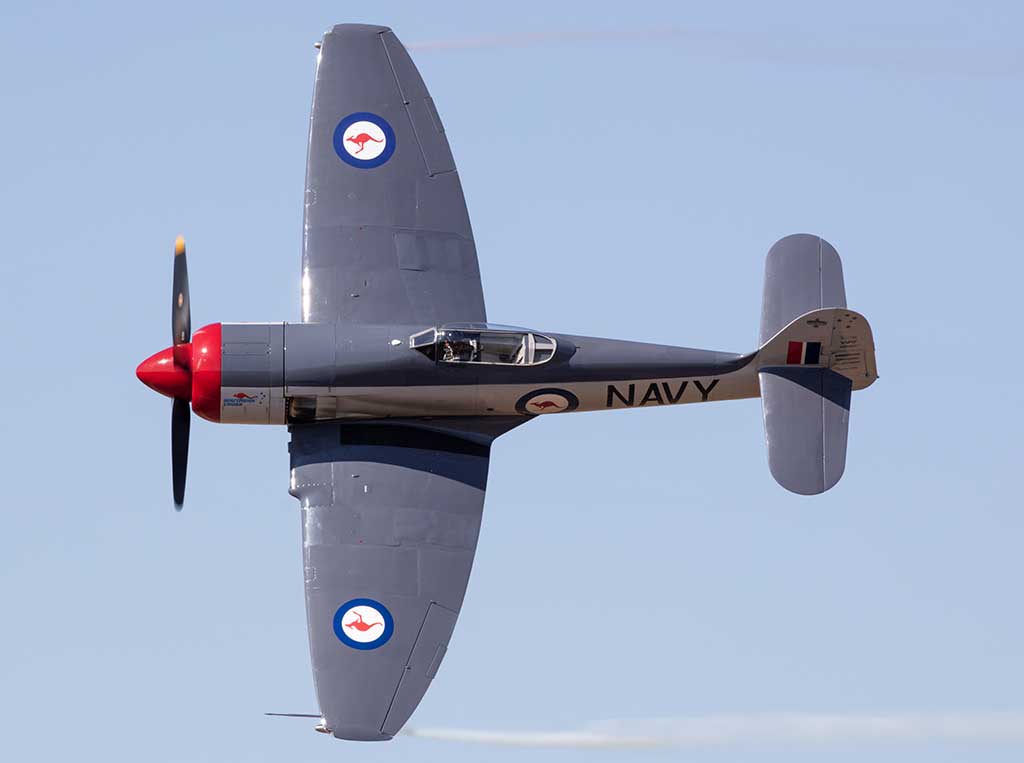
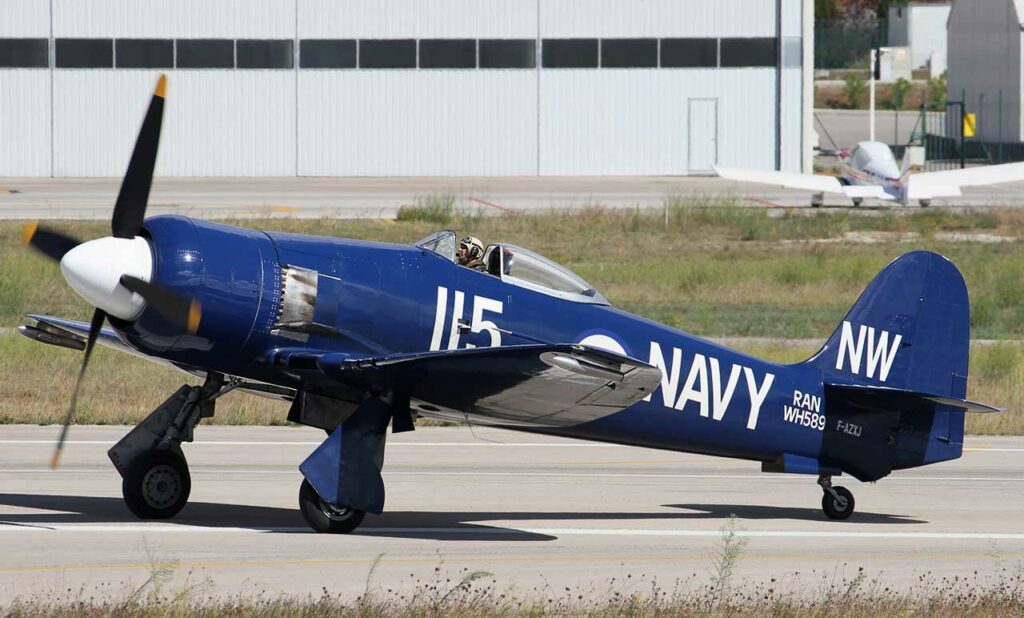
The official attribution to Carmichael and the controversy over the decisive shot
Popular history remembers the name of Peter “Hoagy” Carmichael. He is officially credited with the victory on the Royal Navy side. This is how the episode has long been passed down in naval aviation memory. The Sea Fury thus became one of the very few piston-engine aircraft to have shot down a jet in aerial combat, and the most frequently cited British case after 1945.
But the real story is less clear-cut. Paul Beaver’s article for the Royal Aeronautical Society raises the question again. Brian Ellis claims to be the one who scored the hits, and his technical account is credible: he describes a MiG in overspeed breaking its energy, passing through the gyroscopic sight, and then receiving the burst of fire. The RAeS also notes that the official attribution has been disputed internally for years. Elements reported in historical summaries even indicate that Ellis may have used up all his ammunition during the engagement, while Carmichael may have retained most of his.
The honest formulation is therefore as follows: the victory was officially credited to Carmichael, but the probability that the decisive shot was fired by Brian Ellis is now taken seriously by several British aviation historians. To say otherwise would be to oversimplify a case that is not simple.
The true qualities of the Hawker Sea Fury in action
It would be a mistake to reduce the Sea Fury to this single feat. Its true military value lies in its versatility. It is a carrier-based aircraft capable of withstanding the stresses of the deck, taking off fully loaded, attacking with cannons, rockets or bombs, and then returning to the aircraft carrier. Its standard armament included four 20 mm cannons. Depending on the version and operator, it could carry up to 16 rockets or 454 kg (1,000 lb) bombs under its wings. For a piston-powered aircraft of this generation, it was a serious strike force.
Its airframe also gives it an essential tactical advantage: it remains stable in low-altitude combat, where absolute speed is less important than the ability to hold a turn, aim accurately, and regain power without stalling too quickly.
The Sea Fury was not “stronger” than a MiG-15. That would be false. However, in a fight that the jet had entered into poorly, it could exploit its opponent’s mistakes with brutal efficiency. This is exactly what makes the difference between performance on paper and performance in war.
We must also remember its production volume. Museum and historical sources generally cite 860 to 864 units built, depending on how certain variants are counted. This is not a marginal aircraft. It is a true post-war program, exported and used by several navies and air forces, from the Commonwealth to other foreign operators.
The legacy of an aircraft that reminded us of a forgotten truth
The episode of the Sea Fury facing the MiG-15 remains famous because it contradicts an overly simplistic reading of aviation history. No, the arrival of the jet did not instantly render all piston-powered aircraft useless in every situation. Yes, the jet engine changed the strategic hierarchy. But in a matter of seconds, in close combat, a well-piloted, more maneuverable, and better positioned aircraft can still punish a more modern but poorly used opponent.
The Sea Fury did not “dominate” the jet age. It did better than that: it demonstrated, once and for all, that technology never completely erases the tactical factor. That is why it still fascinates. Not because it changed the course of history, but because it showed, in a single encounter, that technical superiority is never automatic when combat becomes human, close, and imperfect.
Sources
Royal Aeronautical Society, “Sea Fury vs MiG-15 – the true story.”
Canada Aviation and Space Museum, “Hawker Sea Fury FB.11.”
Sea Power Centre – Australia, “Hawker Sea Fury Mark 11.”
Art UK, “Sea Fury, MiG Encounter.”
Historical reference summary on the Hawker Sea Fury.
War Wings Daily is an independant magazine.