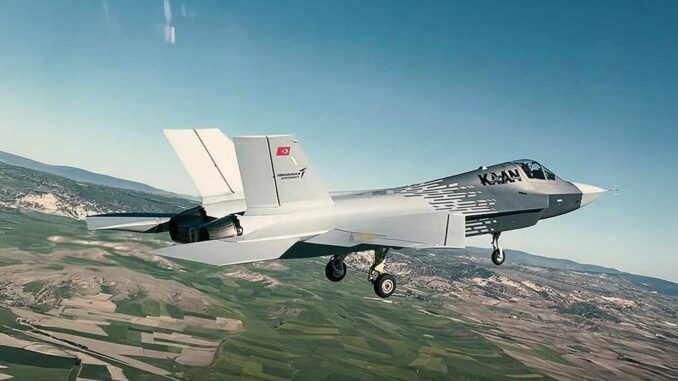
Ankara is betting on GaN with the MURAD-600A on the KAAN fighter: power, range, ECCM, and the real limitations compared to the F-35.
In summary
Turkey wants to make the KAAN fighter more than just an industrial symbol: an aircraft designed around cutting-edge electronics, with a new-generation AESA radar. The core message is clear: move directly to gallium nitride, which is better suited to high power and heat, where many operational radars remain in gallium arsenide. On paper, this paves the way for greater range, more simultaneous modes, and better resistance to jamming. But the key point lies elsewhere: ASELSAN says it wants to merge radar, electronic warfare, and communications into an integrated RF system, an ambitious choice that can reduce drag, improve stealth, and speed up detection-to-fire cycles. One often-forgotten reality remains: power does not automatically translate into “five times more range,” and the gap with the F-35 is as much about software, data fusion, and industrial maturity as it is about transistor materials.
The KAAN and the priority given to electronics
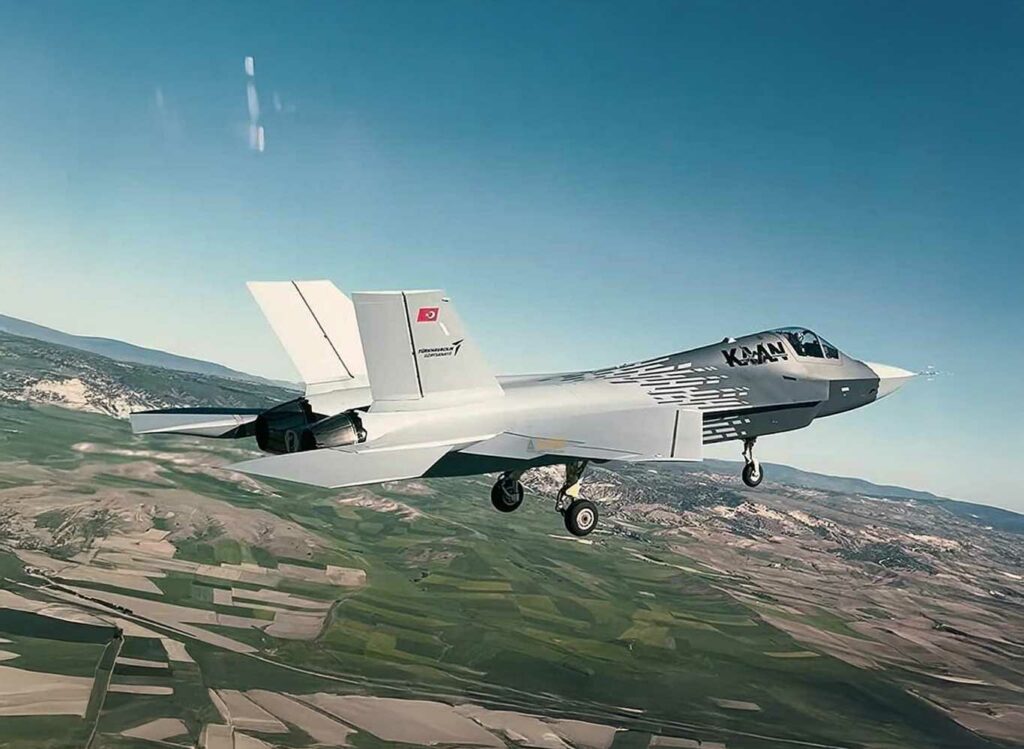
The KAAN program is progressing at a pace that is no longer theoretical. The prototype made its first flight on February 21, 2024. It remained in the air for 13 minutes, reaching 2,438 m (8,000 ft) and a speed of 426 km/h (230 kn). A second flight followed on May 6, 2024, with an announced altitude of 3,048 m (10,000 ft). These figures do not reveal anything about the final performance, but they do confirm one key point: Turkey has launched a “fifth-generation” aircraft and is entering the most costly phase, that of systems integration, testing, and then industrialization.
This stage is decisive because modern aircraft are no longer dominated by pure kinematics. The difference lies in the sensor, processing, electronic warfare, and software architecture. In other words: what the aircraft “sees,” what it understands, and how quickly it transforms a detection into a decision.
The shift from GaAs to GaN and what it really changes
Many operational AESA radars still rely on Gallium Arsenide (GaAs) transceiver modules. This is a mature, efficient, industrial technology. But it has its limits, especially when pushing power and trying to dissipate heat in an aircraft nose where every centimeter counts.
The leap forward promoted by Ankara is the use of gallium nitride (GaN), a material that can handle higher power density and withstands temperatures better. In concrete terms, with comparable architecture, GaN often makes it possible to either increase the power output, reduce thermal constraints at equal power, or improve overall efficiency.
The expected result: greater effective range, better stability in hot environments, and more leeway to run multiple modes in parallel (air-to-air, air-to-ground, SAR mapping, multi-target tracking).
But we must be honest about one point that marketing presentations often obscure: “more power” does not translate linearly into “more range.” In a simplified version of the radar equation, the maximum range varies approximately with the fourth root of the power. So even if a technological leap forward actually made five times more power available for transmission, the theoretical range would not increase fivefold, but by about 1.5 times (5^(1/4) ≈ 1.5), all other things being equal. However, nothing is “all else being equal”: antenna size, frequency, losses, signal processing, waveforms, LPI discretion, and above all, the quality of the algorithms are just as important as the material.
The MURAD-600A and what is publicly known
ASELSAN combines the KAAN with an AESA radar known as MURAD-600A. Public information places the radar at an advanced stage of design (moving into the detailed/critical design phase, as reported in the trade press). The other important piece of information is not a range figure: it is the architecture.
Turkey is not presenting this radar as a simple nose sensor. It describes it as part of a larger RF system, with advanced integration logic. And that’s where the gamble becomes interesting: a modern GaN radar can be very good, but the integration of “sensors + effects” can change the way we fight.
IRFS or the idea of an aircraft with an integrated “RF surface”
The most ambitious concept put forward for the KAAN is the Integrated Radio Frequency System (IRFS). The idea is to bring together, or even merge, functions that were historically separate. The radar detects and tracks. The electronic warfare system listens, classifies, jams, and deceives. Communications exchange data, sometimes over discrete and directional links.
In an IRFS approach, the aim is to pool antennas, processing, and part of the RF transmission, sometimes via openings integrated into the airframe. On paper, it’s a winner:
- fewer protruding antennas, therefore better stealth and less drag,
- greater angular coverage if the aircraft has several apertures,
- the ability to switch very quickly from “detecting” to “jamming,” because the same hardware is orchestrated by the software.
But it’s also an industrial trap. Pooling resources means increasing complexity. Functions that inherently interfere with each other must be isolated: a radar that emits strongly can blind a broadband listening device if the architecture is poorly controlled. Exceptional thermal management is required. Permanent calibration is required. And above all, high-level software engineering is required, because the hardware is only useful if the system decides, in real time, which wave to transmit, in which direction, with what power, and with what compromise between discretion and efficiency.
Jamming resistance and the true meaning of ECCM
The promises associated with GaN and AESA often include better jamming resistance, summarized by Electronic Counter-Countermeasures (ECCM). Here again, power helps, but it is not everything.
Modern ECCM is a combination of:
- frequency agility and scalable waveforms,
- reduced side lobes and fine-grained pattern management,
- passive modes and exploitation of enemy signatures,
- digital processing to separate a weak echo from deliberately injected noise.
GaN offers more energy margin. This margin can be “spent” on discretion (more complex waves, distributed power, shorter emissions) or robustness (better resistance to jamming). The choice depends on doctrine. A country that anticipates combat in an environment saturated with drones, missiles, and jammers will often seek the ability to maintain stable tracks, even when the electromagnetic situation becomes dirty.
Comparison with the F-35 and why the slogan is risky
The hook “eyes more powerful than those of the F-35” is appealing, but it needs to be put into context, otherwise it misleads the reader.
The F-35 entered service with the AN/APG-81 radar, generally described as GaAs-based. But the program calls for a new radar, the AN/APG-85, and Northrop Grumman has touted it as the “next generation” of the F-35. In 2026, several trade press articles reported that aircraft intended to receive this new radar had experienced delays in delivery of the system, to the point of creating a much-discussed temporary situation: F-35s delivered “wired” for the APG-85 but without a fully available radar.
In other words, if the angle is “the KAAN surpasses the F-35 because it is switching to GaN,” the argument weakens, because the F-35 is also in transition to a next-generation radar, and the difference will come down to:
- the maturity of the software and threat libraries,
- multi-sensor fusion capability,
- integration with electronic warfare and data links,
- mass production and fleet reliability.
A very modern radar in an aircraft that is still maturing does not automatically beat an older system that has been supported by twenty years of industrialization, feedback, and updates.
The real challenge for Ankara: autonomy and the pace of updates
The most solid strategic benefit of this trajectory is not a range figure. It is industrial and operational autonomy.
A country that masters its radar, RF modules, computers, electronic warfare, and integration can update faster. It can adapt its waveforms. It can respond to new threats without depending on a foreign schedule. In recent conflicts, this has become central: advantage is often gained through rapid iterations, countermeasures, reprogramming, and adaptation to drones or missiles that change profiles every month.
If KAAN delivers on its IRFS promise, it would therefore aim for a model close to what all air powers are looking for: a platform designed to evolve, where superiority is measured by the ability to modify software and tactics faster than the adversary.
The gray area between promise and performance: what remains to be proven
There remains an incompressible element of uncertainty. Modern radars are classified. Public range figures are rarely comparable because they depend on the target (radar cross section), altitude, weather, antenna configuration, and modes used.
What we can observe, however, are indirect signals:
- the integration schedule for future prototypes,
- the stability of flight tests, especially in a busy electromagnetic environment,
- the ability to perform simultaneous modes and guide missiles beyond visual range,
- the consistency between radar, electronic warfare, and data links.
This is where Turkey will be judged. Not on a slogan like “GaN = five times more,” but on a complete chain: detecting, identifying, resisting jamming, engaging, and updating the system at the pace of modern conflict.
The final stretch: the battle of the sensors becomes an industrial battle
The KAAN does not need to be “better than the F-35” to be a strategic success for Turkey. It must be credible, industrializable, and scalable. The choice of GaN and an integrated RF architecture shows an ambition: not to catch up, but to try to bypass through technology and integration.
The final test will be brutal and simple: the ability to deliver stable avionics, maintain those avionics in service, and then evolve them quickly. In the real world, air superiority does not reward the most spectacular announcement. It rewards the system that learns faster than the enemy, even when its own promises run up against the friction of industrialization and testing.
Sources
Reuters, “Turkey’s KAAN fighter jet conducts first flight,” February 21, 2024.
Breaking Defense, “Turkish 5th-gen fighter KAAN completes maiden flight,” February 21, 2024.
TÜBİTAK MAM, “National Combat Aircraft KAAN Makes Its First Flight,” information page, 2024.
Aviation Week, “Turkey Releases Imagery Of Second Prototype Of Kaan Fighter,” February 13, 2026.
Aviation Week, “Turkey Fighter Prototype’s First Flight Delayed Toward Summer,” January 23, 2026.
TurDef, “ASELSAN Displays Its Payloads for TUSAŞ’s KAAN Fighter,” June 22, 2025.
Northrop Grumman (press release), “Developing the Next Generation Radar for the F-35 Lightning II,” January 11, 2023.
The War Zone, “Are F-35s Being Delivered To The USAF Without Radars? Sure Seems Like It,” February 2026.
The Aviationist, “Reports Suggest F-35s Are Being Delivered Without Radar…”, February 2026.
Opex360, “The US Air Force has reportedly received F-35As temporarily without radar”, February 12, 2026.
War Wings Daily is an independant magazine.