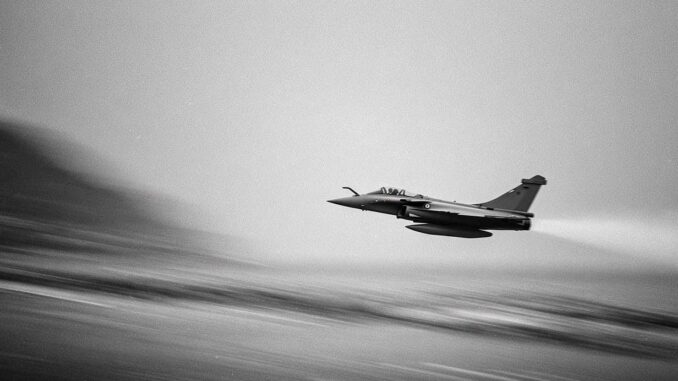
Scheduled for 2030, the Rafale F5 is changing in nature. Ultra-connected and data-centric, it is becoming a hub for air combat rather than a simple fighter jet.
In summary
The Rafale F5, expected in 2030, is not just an incremental upgrade. It marks a doctrinal and technological breakthrough. Whereas previous standards improved on existing components, the F5 repositions the Rafale as a system of systems, focused on data, connectivity, and human-machine cooperation. Sensors, data links, electronic warfare, combat cloud, and accompanying drones converge toward a single goal: to accelerate decision-making and strike further, faster, with less exposure. The cockpit is undergoing a profound evolution, not to display more information, but to filter, prioritize, and contextualize data. This transformation is also part of a French strategic choice: to preserve credible military autonomy while remaining interoperable with allies. The Rafale F5 is therefore not just a modernized aircraft. It is becoming a connected combat platform, designed for a high-intensity environment dominated by information.
The Rafale F5: a change in nature, not just a change in standard
The Rafale program has always evolved in stages. From the F1 to the F4, each standard added capabilities, often major ones, but without calling into question the logic of the aircraft. The Rafale F5 breaks with this continuity. According to the guidelines set by the Directorate General of Armament, it is no longer just a question of improving aerodynamic performance or adding new weapons, but of transforming the aircraft into a digital combat platform.
This approach responds to an operational reality. In a high-intensity conflict, survival no longer depends solely on maneuverability or relative stealth, but on the ability to see before the adversary, to share information in real time, and to act in a coordinated manner. The Rafale F5 is designed to operate at the heart of this ecosystem. It no longer fights alone. It orchestrates.
From a budgetary perspective, France has taken note of this shift. The 2024-2030 Military Programming Law allocates more than €13 billion to the modernization of combat aviation, including the development of the F5 standard and associated capabilities, particularly combat drones.
Connectivity as the backbone of the Rafale F5
The key concept behind the F5 is native connectivity. The Rafale becomes an active node in the combat network, capable of receiving, processing, and redistributing massive volumes of data.
This connectivity is based on several complementary layers. Existing data links, such as Liaison 16, are retained for NATO interoperability. But they are supplemented by sovereign high-speed links with a low probability of interception and jamming. These links enable near-continuous data exchange between aircraft, drones, naval vessels, and command centers.
The F5 is also part of the French concept of collaborative combat, sometimes referred to as combat cloud. Data from the Rafale’s sensors, as well as from other platforms, is shared. Each actor no longer sees only what they detect, but what the overall system understands about the situation.
In concrete terms, this means that a Rafale F5 can fire an air-to-air or air-to-ground missile at a target that it does not detect directly, but which is being tracked by another sensor in the network. This principle, already partially operational on the F4, becomes central to the F5.
Sensors and data fusion as a decision-making engine
The Rafale F5 relies on a profound evolution of its sensors. The RBE2 AESA radar remains the cornerstone, but its operation is changing. Its maximum range already exceeds 200 kilometers against large air targets. The challenge is no longer just to detect further away, but to qualify faster.
The OSF front optronic system has been upgraded to offer better long-range discrimination, both day and night. The SPECTRA electronic warfare system, often described as one of the most powerful in the world, is evolving towards a predictive approach. It no longer just alerts. It anticipates.
All this data converges in a multi-sensor fusion engine enhanced by advanced algorithms. The objective is clear: to reduce the time between detection and decision-making. In modern air combat, this delay is measured in seconds, sometimes fractions of a second.
The Rafale F5 thus becomes both a producer and consumer of data. It enriches the network as much as it depends on it. This approach profoundly changes the way missions are conducted.
The Rafale F5 cockpit faces information overload
One of the major risks of this hyper-connectivity is cognitive overload. The Rafale F5 responds to this with a redesign of the human-machine interface.
The cockpit does not seek to display more information, but to display less, better. The screens become contextual. Priority information is highlighted according to the flight phase and the threat. The pilot no longer analyzes raw data. He validates proposals.
The onboard intelligence acts as a tactical assistant. It suggests trajectories, target priorities, and engagement options. The pilot retains the final decision, but is no longer alone in facing the complexity of modern combat.
This development is crucial. According to several military studies, a modern fighter pilot can be exposed to more than 1,000 information signals per minute in complex combat situations. Without intelligent automation, this mass of information becomes counterproductive.
The Rafale F5 therefore assumes a change in the pilot’s role. He moves from being a systems operator to a tactical conductor.
Combat drones as an extension of the Rafale F5
The Rafale F5 is designed to operate with collaborative combat drones, often referred to as Remote Carriers. These drones, which are simpler and less expensive than fighter jets, can fulfill several roles: reconnaissance, electronic warfare, decoy, or strike.
A Rafale F5 could simultaneously control several drones, each with a specialized role. This approach allows for risk mitigation. Drones can enter a heavily defended area first, detect threats, and saturate enemy defenses.
From an industrial standpoint, this approach also paves the way for the transition to the SCAF program, while providing operational capability before it enters service, which is expected after 2040.
In terms of cost, a collaborative combat drone is estimated to cost several million euros, compared to more than €90 million for a new Rafale. Cost-effectiveness becomes a determining factor in long and intense conflicts.
Overall effectiveness for the French combat ecosystem
The Rafale F5 should not be analyzed in isolation. It is part of a coherent French military ecosystem. It communicates with frigates, ground-to-air defense systems, satellites, and command centers.
This approach reinforces joint forces coherence. Information detected at sea can be exploited in the air in a matter of seconds. The decision-making chain is shortened. Responsiveness is increased.
Operationally, this coherence improves the actual availability of forces. Better informed, the command engages fewer resources for the same military effect. It is a force multiplier.
French strategic autonomy in the face of digital dependence
The issue of dependence is central. A hyper-connected aircraft is potentially vulnerable if it depends on foreign technologies. The Rafale F5 was designed to limit this risk.
Critical components, including data fusion algorithms, sovereign links, and electronic warfare systems, remain under French control. This autonomy ensures that the aircraft can operate without third-party authorization, unlike certain systems that are subject to extraterritorial constraints.
This does not mean isolation. The Rafale F5 remains interoperable with its allies. But France retains control over the use of its military assets. In a context of growing international tensions, this independence is not a luxury. It is a condition of credibility.
An aircraft designed for tomorrow’s combat
The Rafale F5 is not a fixed end point. It is designed as an evolving platform, capable of integrating new algorithms and new capabilities without a complete overhaul.
This software approach allows the aircraft to be adapted to emerging threats. In an environment where technologies evolve faster than aircraft airframes, this flexibility becomes crucial.
The Rafale F5 thus embodies a clear vision of future air combat. Less focused on raw performance and more on information mastery, it reflects a strategic reality: air superiority is now as much about data flows as it is about the skies.
Sources
Ministry of the Armed Forces – Military Programming Law 2024-2030
Directorate General of Armament – Presentations on the Rafale F5 standard
Dassault Aviation – Institutional communications
Air and Space Force – Doctrinal documents
French parliamentary reports on collaborative combat and SCAF
War Wings Daily is an independant magazine.