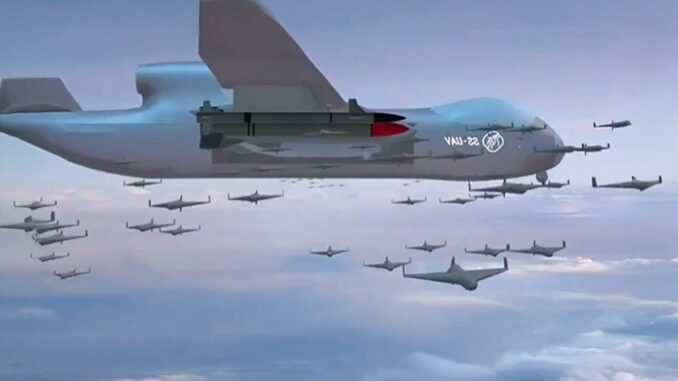
The Jiutian inaugurates the mother ship drone: a modular cargo hold for dropping mini-drones, creating tactical noise, and wearing down defenses.
In summary
The Jiutian (also known as Jetank) is not a MALE “shooter” drone. It is designed as a carrier: an unmanned aircraft weighing around 16,000 kg, with a payload of 6,000 kg, and a modular cargo hold presented as a hive. The idea is simple: produce mass at the right moment. By releasing dozens, or even more than a hundred targets, the attacker imposes saturation. Radars have to track too many leads, fire control centers fire in a hurry, and interceptor missiles are quickly exhausted. The Jiutian does not win through stealth, but through the cognitive pressure it inflicts on the defender. Faced with this model, the West is already working on “swarms,” decoys, and airborne launchers, while accelerating countermeasures: electronic warfare, distributed sensors, and inexpensive interceptors. The question becomes industrial: who can produce and pilot low-cost, expendable effectors?
The Jiutian, a drone carrier rather than a conventional MALE drone
The Jiutian (often associated with the name Jetank) does not copy the logic of an MQ-9 Reaper-type MALE drone. Where a MALE patrols and then fires a few rounds of ammunition, the Jiutian is designed to carry a set of effectors and release them at the chosen moment. This is the logic of the mother ship drone: the carrier reduces its exposure, and it is the small drones that take the risk.
The available data places the aircraft in an unusual class for an armed UAV: approximately 16.35 m long, 25 m wingspan (82 ft), a maximum takeoff weight of close to 16,000 kg (35,300 lb), and a payload of 6,000 kg (13,228 lb). The reported transport distance is 7,000 km (3,780 nm), endurance up to 12 hours, and ceiling 15,000 m (49,213 ft). The published maximum speed is approximately 700 km/h (378 kn). These figures do not tell the whole story, but they explain the promise: fly high, carry heavy loads, position yourself far away, then deliver a salvo.
The turbojet engine: useful but not magical
The choice of a turbojet engine serves a simple purpose: to quickly replace a heavy carrier. It does not transform the Jiutian into a stealth platform. Its main advantage is therefore in “edge” use: it is protected by fighter aircraft, kept in a relatively safe area, and attacks are launched via the swarm.
The hive module and swarm architecture
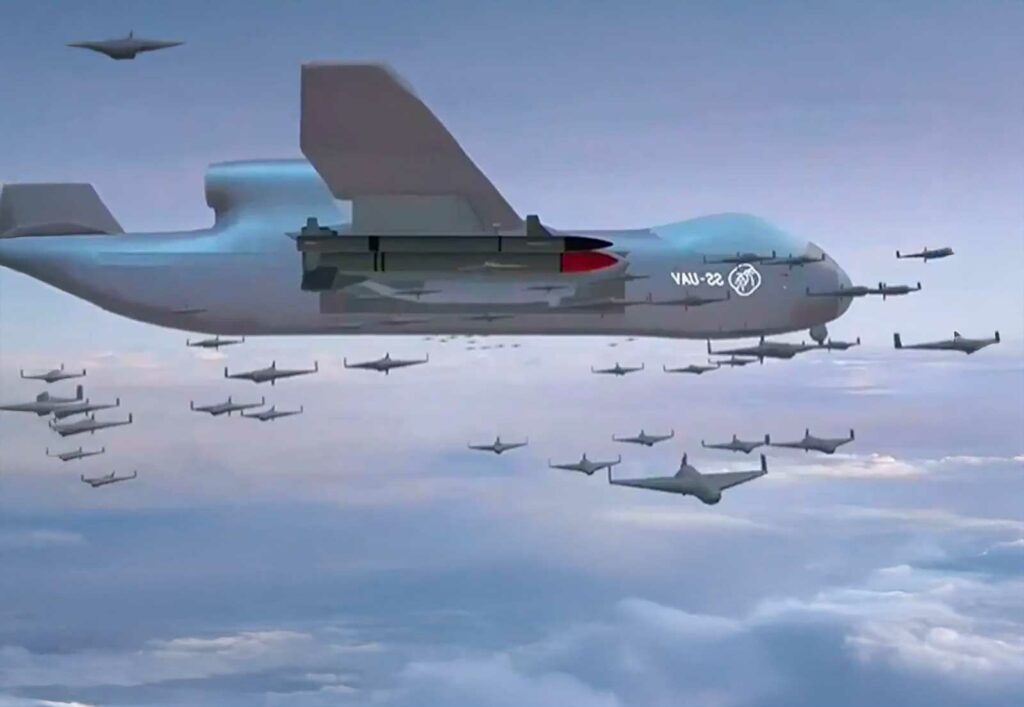
The central point is a modular cargo hold presented as a “hive.” The inscription Isomerism Hive Module seen on visuals is probably a clumsy translation, but the intention is clear: an internal bay capable of ejecting various effectors. The most cautious sources speak of “dozens” of small drones. Others mention “more than 100” units, which corresponds to the marketing narrative.
The modular nature is an operational message. The same section can, in theory, accommodate racks of reconnaissance drones, jammers, decoys, or loitering munitions. The swarm becomes a menu. The attacker composes a heterogeneous salvo to complicate the defense.
What a release of 100 effectors represents in terms of payload
With an announced payload of 6,000 kg, a salvo of 100 effectors becomes plausible if we remain within unit masses of several tens of kilograms. Subtracting racks and mechanisms, we obtain a rough average of around 50 kg per drone. This corresponds to small motorized loitering munitions or more massive decoy drones, not light quadcopters. This is typically the domain of swarming: many objects, each limited but coordinated.
Cognitive saturation, the mechanism that frightens defenders
Jiutian does not seek “power” in the traditional sense. It aims to exhaust sensors, operators, and stocks. It is cognitive saturation: too many leads to follow, too many decisions to make, too many firing windows to manage, especially if the attack combines decoys, jamming, and impact vectors.
“Tactical noise” arises because a defense does not deal with a single target, but with a complete chain of engagement: detection, correlation, classification, attribution, firing, and damage assessment. A salvo of 100 drones can waste precious minutes and force a defense to reveal its radars, priorities, and weak areas. Even if a large number are shot down, a few remaining drones can target what matters: radars, antennas, firing vehicles, or optronic sensors.
The cost and stock trap
A defense may be tempted to fire high-end weapons at everything. However, missile defense interceptors are rare and expensive. Recent contracts for PAC-3 MSE put the unit cost in the range of several million dollars. When faced with cheap drones, the asymmetry is brutal. Even Patriot and Iron Dome eventually suffer if the attacker imposes volume, and especially if they force the defense to waste its best missiles. The mother ship then turns a battle in the sky into a battle of ammunition.
Credible scenarios for use if the swarm is kamikaze
If the Jiutian releases a hundred “one-way” drones, the objective is not surgical precision. It is disorganization.
Above a coastline, part of the swarm can be used as decoys and jammers to force the activation of radars, while other drones seek to strike sensors and launchers. Neutralizing a radar, even temporarily, may be enough to open a window for a cruise missile or anti-radar missile strike.
At sea, the mechanism is similar. A multi-axis swarm forces a naval group to fire quickly, manage varied trajectories, and reload. All it takes is one attribution error or local saturation for a drone to reach a sensor or sensitive area.
Western responses converging on the same mass effect
The West is not starting from scratch. It is assembling building blocks that also aim to project volume and shift risk.
DARPA Gremlins has explored the launch and recovery of drones in flight from a carrier. The goal is reuse and density of effects (ISR, electronic warfare) without exposing the crew. LongShot aims for a different approach: a drone launched by a fighter approaches and fires air-to-air missiles to keep the fighter at a distance.
At the same time, the West is already practicing saturation via dedicated decoys and effectors. MALD is used to simulate radar signatures and, depending on the version, to jam. Rapid Dragon pushes the idea of an “air arsenal” by mass-deploying munitions from transport aircraft. The forms differ, but the logic is the same: to overwhelm the defense.
Realistic countermeasures against a mothership
The most cost-effective defense remains to neutralize the carrier before the cargo bay is opened. A drone of this size, flying high, is a target for hunting or area air defense. Shooting down the carrier can save dozens of secondary engagements.
Next, electronic warfare targets communications and navigation. The goal is not to take out the entire swarm, but to disrupt its coordination and reduce its accuracy. This is a pillar of modern counter-UAS.
Finally, the decisive layer is that of less expensive defensive effectors, produced in large quantities. Anti-drone interceptors such as Coyote or Roadrunner illustrate the search for a sustainable response to avoid using rare missiles on expendable targets. Jiutian’s message is clear: defense will not win with better radars alone, but with stocks, reliable automation, and available defensive mass.
Sources
- FlightGlobal, “Chinese Jetank swarm carrier drone completes maiden flight” (December 15, 2025).
- The War Zone (TWZ), “China’s High-Flying Swarm Mothership Drone Has Flown” (December 11, 2025).
- People’s Daily Online, “China unveils heavy ‘swarm carrier’ UAV at airshow” (November 18, 2024).
- DARPA, “Gremlins Program Demonstrates Airborne Recovery” (2021).
- DARPA, “DARPA Initiates Design of LongShot Unmanned Air Vehicle” (February 8, 2021).
- U.S. Air Force Materiel Command, “Rapid Dragon conducts first system-level demonstration of palletized munitions” (August 20, 2021).
- RTX Raytheon, “Coyote” (system sheet).
- Anduril, “Roadrunner” (product sheet).
- Reuters, “Lockheed Martin wins $9.8 billion Patriot missile contract” (September 3, 2025).
- Encyclopaedia Britannica, “Iron Dome” (updated November 6, 2025).
- Army Recognition, “…internal bay for one hundred mini UAVs” (December 12, 2025).
War Wings Daily is an independant magazine.