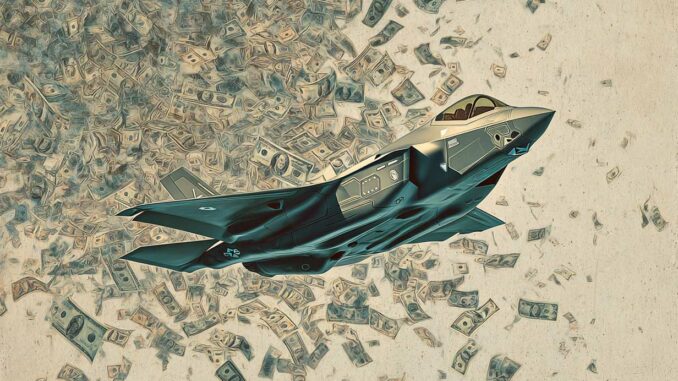
Trump strikes hard: an executive order links share buybacks to arms deliveries. The top five defense contractors have paid $18 billion to shareholders.
In summary
The Pentagon is preparing to publish a list of defaulting defense contractors who will be subject to restrictions on share buybacks and dividend payments. This measure stems from an executive order signed on January 7, 2026, by Donald Trump, which directly links payments to shareholders to weapons delivery schedules. The five largest defense contractors have paid out approximately $8 billion in dividends and repurchased $10 billion in shares over the past twelve months. Trump criticizes the industry for its slow production and high costs, specifically targeting RTX and its subsidiary Raytheon. The designated companies will have 15 days to submit remediation plans approved by their boards of directors.
The presidential decree that is shaking up Wall Street
On January 7, 2026, Donald Trump signed an executive order entitled “Prioritizing the Warfighter in Defense Contracting.” The text states that after years of misplaced priorities, many defense contractors have been incentivized to prioritize returns for investors over the nation’s warfighters. This directive marks a radical shift in the relationship between Washington and the arms industry.
The order stipulates that, effective immediately, contractors are not allowed in any way, shape, or form to pay dividends or buy back shares until they are able to produce a superior product, on time and on budget. The tone is unequivocal. Trump leaves no room for maneuver for manufacturers.
The executive order declares a policy that major defense contractors should not engage in stock buybacks or dividend payments to the detriment of the War Department’s procurement requirements or necessary increases in defense production capacity. The Trump administration believes that the United States is not producing enough military equipment quickly enough to meet current needs.
The president has also demanded a cap on executive pay. Trump has said that until these companies build new production facilities, no executive should be allowed to earn more than $5 million. This measure is aimed directly at the exorbitant compensation packages of CEOs in the sector.
The eagerly awaited blacklist
Defense contractors are preparing for the Pentagon to release a list of companies on Friday that would be subject to potential restrictions on stock buybacks and dividend payments, nearly a month after President Donald Trump signed an executive order linking shareholder payments to weapons delivery schedules. The announcement was originally scheduled for February 6, 2026, 30 days after the executive order was signed.
Defense Secretary Pete Hegseth said defense contractors have been notified and informed that today marks the beginning of an extended review period during which the Pentagon will make determinations of noncompliance. The final publication was ultimately postponed to allow for further negotiations.
The list, which industry leaders say has been shrouded in secrecy, will identify contractors that the Pentagon deems to be underperforming on their contracts while distributing profits to shareholders, according to three people familiar with the matter. Questions remain about the inclusion of subcontractors and the exact definition of the term “defense contractor.”
Hegseth and his team have been tasked with working with each company to remedy the problems and, if that fails, taking immediate action to seek redress through various legal and regulatory channels, such as the Defense Production Act. The Pentagon has a considerable legal arsenal at its disposal to force manufacturers to comply with the new rules.
The five giants in the crosshairs
For the five largest defense companies—Lockheed Martin, Northrop Grumman, General Dynamics, L3Harris, and RTX—the stakes are high: they have paid out approximately $8 billion in dividends over the past 12 months and repurchased approximately $10 billion in shares, according to Morgan Stanley data. These figures place these groups at the center of the president’s concerns.
Lockheed Martin perfectly illustrates the strategy criticized by Trump. Lockheed spent $2.25 billion on share buybacks in the nine months ending September 28, while paying out $2.33 billion in dividends. The leading U.S. defense contractor is therefore spending considerable sums on shareholder compensation.
Northrop Grumman follows the same logic. Northrop Grumman spent $1.17 billion on share buybacks in the nine months ending September 30 and paid $964 million in dividends to shareholders during that period. The manufacturer of the B-21 Raider bomber also favors financial returns.
Shares of General Dynamics, Lockheed Martin, and Northrop Grumman each fell about 3% following Trump’s comments. The financial markets immediately punished these announcements. Uncertainty now weighs on the stock market valuation of the entire sector.
RTX and Raytheon in turmoil
Donald Trump specifically targeted RTX and its subsidiary Raytheon. Trump claimed that Raytheon was the least responsive to the needs of the Department of War, the slowest to increase its volume, and the most aggressive in spending on its shareholders rather than on the needs and demands of the U.S. military. The presidential attack is direct and unprecedented.
He said the Pentagon will cut its business ties with Raytheon unless it steps up its investment in factories and equipment, adding that under no circumstances can the company make any further share buybacks in the meantime. The threat is explicit. RTX risks losing a substantial portion of its revenue.
The Department of Defense has awarded RTX a 20-year, $50 billion master contract to provide a wide range of military needs, including systems and finished goods production, spare parts, services, and other types of support. This massive contract puts RTX in a position of dependence on the federal government.
Based in Virginia, the company has announced sales exceeding $80 billion in 2024. RTX is one of the largest defense contractors in the world. Its ability to maintain these revenues now depends on its compliance with new presidential requirements.
Shares of RTX, Raytheon’s parent company, slipped another 2% in after-hours trading after falling 2.5%. Investors anticipate major turbulence for the industrial group.
The control and sanction mechanism
The Secretary shall, within 30 days of the date of the executive order and on an ongoing basis thereafter, identify contractors for critical weapons, supplies, and equipment that have made any share repurchases or corporate distributions during an alleged period of underperformance or insufficient investment or production speed.
The identification process is ongoing and not limited to a one-time exercise.
Once a contractor is identified, the Secretary must notify the contractor and, if necessary, engage with the contractor to resolve the issues identified in the notification. Dialogue remains the preferred approach initially. The administration wants to achieve voluntary changes before resorting to coercion.
Where permitted by existing law, the contractor will have the opportunity to submit a remediation plan within 15 days of notification. Any remediation plan must be approved by the contractor’s board of directors. The involvement of the board of directors is intended to ensure commitment at the highest level of governance.
The executive order also authorizes the Secretary, within 60 days, to ensure that future defense contracts, including renewals, include provisions prohibiting stock buybacks and corporate distributions during periods of underperformance. The new contract clauses will institutionalize these restrictions.
Executive compensation under scrutiny
Within 60 days of the executive order, the Secretary of Defense must ensure that any future contract with any new or existing defense contractor, including a renewal, stipulates that executive incentive compensation be tied to certain performance measures, such as on-time delivery and increased production, among others. Bonuses will no longer be indexed to short-term financial performance.
The executive order also states that future contracts must authorize the Secretary, upon determining that a contractor is experiencing such problems, to cap executive base salaries at current levels with adjustments for inflation permitted. The salary freeze is a powerful deterrent to compel companies to change their behavior.
The executive order directs the Secretaries of State and Commerce to consider and cease advocating for the participation of any identified contractor in foreign military sales or direct commercial sales. Delinquent companies could lose U.S. diplomatic support for their exports.
For any publicly traded company so identified by the Department of Defense, the executive order directs the chairman of the Securities and Exchange Commission to consider amending Rule 10b-18 to prohibit the use of the relevant regulatory shelter by such identified companies. The SEC could remove the legal protections usually afforded to share buybacks.

Industry and Congressional Reactions
Stan Soloway, president and CEO of Celero Strategies and an expert in federal procurement, said the executive order seems to assume that any cost overrun is the contractor’s fault without recognizing that not all cost overruns are created equal. Experts point to the complexity of defense programs.
The executive order is full of vagueness and ambiguity. It will be very interesting to see how they measure adequate investment, prioritization, and so forth. The evaluation criteria remain unclear. Companies do not have a clear framework for self-assessment.
Representative Ken Calvert of California, the top defense appropriations official in the House, predicted that it would be a long list, saying that the days of underperformance and overbilling are over. Republican lawmakers overwhelmingly support the presidential initiative.
Senator Elizabeth Warren said that defense contractors have been ripping off American taxpayers for decades and that we will have to see what happens at the end of the week and whether Hegseth really delivers. The Democratic opposition surprisingly shares the criticism of the defense industry.
Senator Deb Fischer of Nebraska said that knowing the reasons why companies are on the list could dictate congressional action in the National Defense Authorization Act. The legislature could extend the measures in the executive order by law.
Legal and practical gray areas
The government already has a comprehensive set of tools in its toolbox to incentivize, reward, or penalize companies based on their performance, and the executive order builds in part on mechanisms the Department of Defense already uses. Legal experts believe that the existing legal framework already allows for government action.
What is different, however, are the remedies the administration is focusing on—and the main challenge in implementing this executive order will be defining the key metrics to which contractors will be held accountable. Defining performance thresholds will be the central issue in the coming months.
The executive order specifically envisions leveraging existing enforcement mechanisms under the Defense Production Act, which includes criminal and civil penalties. Recourse to the DPA gives the government extraordinary powers usually reserved for times of war.
Questions remain about whether subcontractors will be named and how broadly the Pentagon will define the term “defense contractor.” The term could potentially encompass commercial companies with limited work with the Pentagon. Amazon or Microsoft could theoretically fall under the decree.
The impact on financial markets and shareholders
Contractors have sought legal advice on the restrictions, which could affect billions of dollars in shareholder payments. Law firms specializing in public contract law have been busy since the executive order was signed.
Executives at RTX, General Dynamics, Northrop Grumman, and L3Harris all affirmed their commitment to dividends as they unveiled their financial forecasts for 2026. Companies are trying to reassure investors about the sustainability of payments.
Seth Seifman of JP Morgan said that the amount of cash these companies expect to generate should allow them to pay their dividends and invest more in the business, and if anything has to give, it will be share buybacks, as they are considered more discretionary. Analysts anticipate that dividends will be maintained at the expense of buybacks.
Institutional investors hold massive stakes in these companies. BlackRock, Vanguard, and State Street are among the largest shareholders. These index funds are concerned about the impact of the decree on future returns. Pressure on stock prices could continue for several quarters.
U.S. public pension funds, which are heavily invested in the defense sector, are already suffering unrealized losses. The volatility of the sector complicates the management of their portfolios. Some asset managers are considering reducing their exposure to defense stocks.
The future outlook for the industry
Defense contractors should consider conducting proactive self-assessments of their contract performance and updating internal compliance programs to align with the new restrictions on share buybacks, dividends, and executive compensation. Legal departments are working hard to anticipate the consequences.
Given the rapid turnaround times for identification and remediation, defense contractors should consider conducting proactive self-assessments of their contract performance. The 15-day deadline for submitting a remediation plan requires maximum responsiveness.
The executive order states that after years of misplaced priorities, traditional defense contractors have been incentivized to prioritize returns for investors over the nation’s warfighters. The Trump administration wants to fundamentally reorient the industry’s economic incentives.
In December, some experts wrote that implementing an executive order targeting defense companies could lead to a series of regulatory and legal issues, including whether companies such as Amazon or Microsoft could be considered defense contractors because of their contracts with the U.S. military and intelligence agencies. The scope of application remains unclear.
The Trump administration is profoundly reshaping the rules of the game between Washington and the defense industry. The January 7, 2026 executive order is not a mere declaration of intent. It is accompanied by powerful coercive mechanisms that can hit recalcitrant companies hard. The five giants of the US arms industry—Lockheed Martin, Northrop Grumman, General Dynamics, L3Harris, and RTX—face a strategic dilemma. Continuing to prioritize shareholders risks costing them their most lucrative contracts. Massively redirecting investments toward production capacity will require painful trade-offs and will hurt stock prices in the short term.
The imminent publication of the list of non-compliant companies will be a test of credibility for the Pentagon. If the list proves too short, the administration will be seen as weak. If it includes too many companies, it risks destabilizing the entire defense industrial base. The coming weeks will determine whether this policy is a lasting revolution or a media stunt. One thing is certain: the balance of power between the state and the arms industry has just shifted radically.
War Wings Daily is an independant magazine.