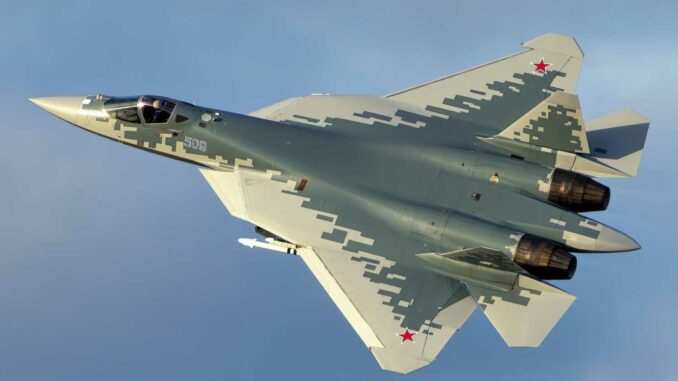
New batch delivered, engine still in transition, components under sanctions: why the Su-57 remains a promising fighter but is produced in dribs and drabs.
In summary
Russia did indeed deliver a new batch of * Su-57 Felon* in early 2026, with an official announcement highlighting a modernized weapons system. But behind this show, the underlying problem persists: the program is still struggling to achieve a true industrial production rate. The obstacle is not singular. It is twofold. On one hand, the next-generation engine , long designated Izdeliye 30 and now also referred to as Izdeliye 177 in recent communications, has not yet been clearly and widely deployed on production aircraft. On the other hand, Russia remains hampered by its dependence on components, materials, machine tools, and specialized equipment that sanctions complicate or make more expensive. The result is simple: Moscow can deliver aircraft, but not at a pace capable of shifting the global balance. The Su-57 exists. It is making progress. But it remains a program produced in too small a volume to carry strategic weight like the American F-35 or even the Chinese J-20.
The new batch delivered does not resolve the central issue of production rate
In February 2026, Russia announced the delivery of a new batch of Su-57s to the Ministry of Defense, emphasizing improvements to onboard systems and weaponry. This is a fact. The program continues to move forward. We must not pretend otherwise.
But we must look at what Moscow is not saying: the exact number of aircraft delivered has not been made public, which remains a constant feature of the program. This lack of transparency is politically useful, but it masks an industrial reality far more modest than the image being projected.
The contract signed in 2019 covered 76 aircraft to be delivered theoretically through 2027, with production ramping up by the middle of the decade. On paper, the trajectory was supposed to become much more ambitious starting in 2025, with *18 aircraft per year * in 2025, 2026, and 2027. However, open-source observations, specialized analyses, and public announcements do not indicate production capacity at that level. On the contrary, they show deliveries in small, irregular batches that are difficult to quantify precisely.
This is the crux of the matter. A 5th-generation fighter only influences the balance of power if it is produced in large numbers, properly supported, and deployed in a fleet large enough to make a lasting impact. A few additional aircraft, however sophisticated they may be, do not by themselves change a strategic equation. The Su-57 Felon is therefore not stalled in the strict sense. It is stalled in its ability to become a mass-produced system. And that is far more detrimental.
The final engine remains the symbol of a program that is not yet fully stabilized
For years, one of the major criticisms leveled against the Su-57 concerned the absence of its “second-stage” engine, long known as Izdeliye 30. Production aircraft initially flew with a derivative version of older engines, which limited the notion of a true, comprehensive technological leap. In December 2025, an important milestone was nevertheless reached: UAC and Rostec announced the first flight of a Su-57 equipped with the new fifth-generation engine, designated in this announcement as Izdeliye 177. This means that the new-generation engine is no longer a myth. It has indeed begun flight testing on the platform.
But we must be precise. A first test flight does not mean mass production. Nor does it mean that all recently delivered batches are already using this engine. The most cautious open-source reports indicate precisely that this point has not been proven. In other words, the program may have reached a technical milestone, but not yet an industrial one. There is a considerable gap between a maturity demonstrator and stable integration on every production aircraft.
This gap is crucial. The final engine is no minor detail. It determines thrust, fuel consumption, thermal signature, maintenance, and, ultimately, the aircraft’s credibility against its rivals. Without this engine deployed on a large scale, the Su-57 remains perceived as an aircraft in transition, not yet fully meeting the standard that was supposed to be its strength.
Russia may dispute this interpretation. It cannot erase the fact that the next-generation engine has officially only been in the flight test phase since December 2025.
Sanctions Hit the Industrial Supply Chain Harder Than Public Perception
The second, more structural obstacle concerns the impact of sanctions and export controls. We must avoid oversimplifications here. Sanctions have not halted Russian production. Nor have they completely deprived it of foreign components. Russia continues to circumvent, substitute, and reconfigure its supply chains and to use intermediaries. But specialized reports show that Russian aircraft production—and in particular the Sukhoi ecosystem—remains affected by delays in , dependencies on imported materials, machine tools, specialized equipment, and foreign industrial tools.
The RUSI report on the vulnerabilities of Sukhoi production is particularly clear. It explains that Russian fighter jet production has indeed increased slightly since the large-scale invasion of Ukraine, but that it continues to face disruptions due to delays in the delivery of subsystems and foreign dependencies in the second and third tiers of the supply chain . The same document highlights that import substitution has had limited success in the aerospace sector. This point is fundamental. Building a modern fighter jet is not just about assembling an airframe. It requires a dense network of reliable, precise, and repeatable suppliers. This is where sanctions really hurt.
The issue of microelectronics is even more sensitive. As early as 2022, Reuters reported that more than 450 foreign components had been identified in Russian weapons systems recovered in Ukraine. In September 2025, the same agency reported that Ukraine was observing an increase in Russian and Belarusian components in certain missiles, a sign that Moscow is managing to replace some of what it previously imported. This demonstrates a certain degree of adaptation. But it does not mean complete self-sufficiency. Rather, it means improvisation, partial substitution, and rising costs. For an aerospace program as demanding as the Su -57, this adaptation is not enough to ensure smooth and abundant production.
The Su-57 also suffers from a problem of wartime priorities
There is another factor, less spectacular but very concrete: the war in Ukraine has shifted Russia’s industrial priorities. Moscow must produce missiles, drones, ammunition, proven tactical aircraft, helicopters, surface-to-air systems, and repair capabilities.
In this context, a complex and costly stealth fighter is not necessarily the easiest program to ramp up abruptly. It requires rare expertise, advanced materials, and a production line more delicate than that of a conventional fighter jet.
This explains why Russia also continues to highlight the Su-34 and ** Su-35S**, which are delivered more regularly and are more useful in the short term for the war effort. Rostec and UAC often mention the Su-34, Su-35, and Su-57 together when discussing increased production, which clearly shows that the Su-57 is not isolated at the top of a priority list. It is competing with other immediate needs. And in a wartime economy, priority rarely goes to the most sophisticated program if it is also the slowest to industrialize.
We must therefore be frank: the Su-57 Felon also serves as a showcase. It supports the Russian narrative regarding the modernity of its air force, its capacity for innovation, and its resilience to sanctions. This political role is real. But a showcase is not a mass fleet. The Kremlin can display an advanced fighter, market it for export, and feature it in its strategic narratives. As long as production rates remain low, the overall military impact remains limited.
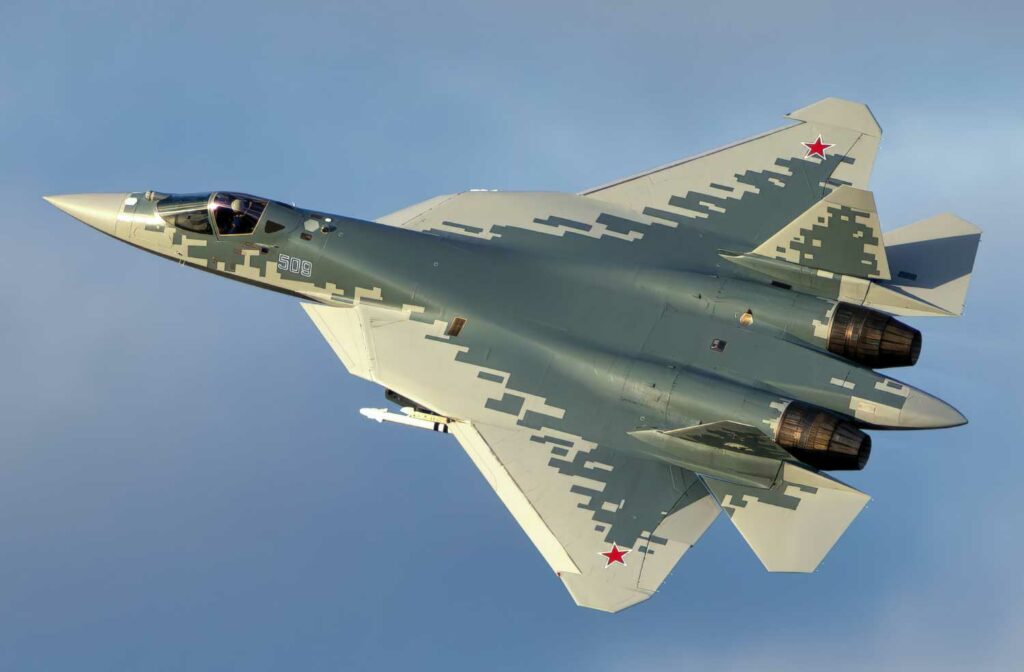
The military consequences remain modest in the context of the conflict and the overall balance of power
The concrete result is simple: even if the Su-57 continues to improve, its current production volumes remain too low to reshape the balance of power. The United States has delivered hundreds of F-35s to various forces and allies. China, too, has placed the J-20 in a more visible growth trajectory. Compared to these programs, the Su-57 remains a rare aircraft. It can be used on an ad hoc basis, particularly for firing certain long-range weapons, but it does not constitute an operational force capable of overwhelming, sustaining, and imposing a new regional standard.
This lack of volume also has consequences for training, maintenance, and doctrine. The smaller a fleet is, the more difficult it is to increase the number of qualified crews, accumulate flight hours, test different operational scenarios, and build up a sufficient stock of airframes for rotation, breakdowns, upgrades, and losses. A small fleet may look impressive at trade shows and in press releases, but it carries far less weight in a protracted war.
Finally, there is an industrial and commercial consequence. If Russia fails to demonstrate robust production capabilities, it undermines the credibility of its export offering. Potential customers will look not only at the promised performance but also at the actual ability to deliver, maintain, modernize, and supply parts over the long term. RUSI also points out that the tightening of sanctions on the Sukhoi supply chain could highlight the risks for foreign customers who would become dependent on Russian maintenance and supplies. This
is a strategic point that is often underestimated.
The real problem with the Su-57 is not its existence, but its inability to become the standard
We must avoid two symmetrical errors. The first would be to say that the Su-57 is a total failure. That would be wrong. The aircraft flies, it is being delivered, it is evolving, and the next-generation engine has begun flight testing. The second would be to believe that each new batch heralds an imminent industrial shift. This has not been proven. The program is moving forward, but it is moving too slowly to bring about a clear strategic breakthrough.
The main obstacle is therefore not merely technical. It is systemic. It stems from a combination of a weakened supply chain, a persistent dependence on certain foreign inputs, imperfect substitution, an engine still in the testing phase for its next-generation standard, and a war environment that imposes other industrial priorities. Taken separately, none of these elements kills the program. Together, they prevent it from scaling up.
What the Su-57 demonstrates in 2026 is ultimately quite stark. Russia still knows how to design and produce advanced fighter jets. But producing a sophisticated aircraft in small batches is not the same as building a comprehensive new-generation air power. Until this gap is bridged, the *Russian Su-57 * will remain more a sign of technological persistence than a decisive lever in the global balance of power.
War Wings Daily is an independant magazine.