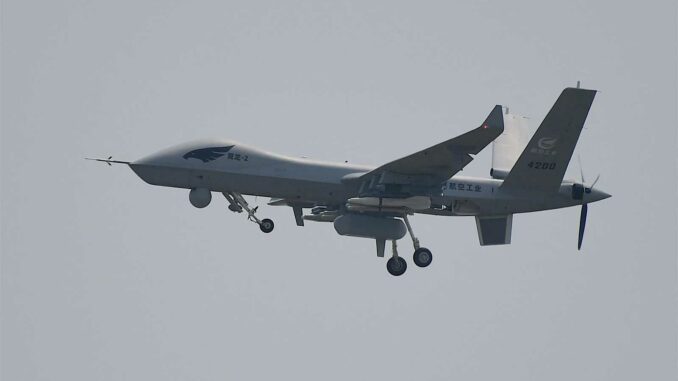
In the Sahel and East Africa, Turkish and Chinese drones are gaining ground. Behind their success lies a simple reality: they cost less than a complete fighter aircraft fleet.
In summary
The trend is clear, even if some figures circulate faster than verifiable contracts. In Africa, Turkish and Chinese armed drones are establishing themselves as the most accessible aerial tool for armies under budgetary pressure and engaged in counterinsurgency conflicts. Turkish models, particularly the Bayraktar and now Akıncı families, are gaining ground in the Sahel and the Horn of Africa. Chinese systems, notably Wing Loong and CH-4, maintain a strong presence, with reports of their use in around ten African countries according to specialist press reports. At the same time, the continent is no longer content with simply buying: local industrialization is progressing, from Egypt to Morocco, from South Africa to Nigeria. The real shift is strategic. For many countries, drones are no longer a complement to aviation: they are becoming the primary solution where “all-jet” aircraft are too expensive, too heavy to support, and often oversized for surveillance, targeted strikes, and attrition missions against armed groups.
Africa’s shift towards drones is no longer a marginal trend
The African continent has become a priority area for expansion for drone exporters. In January 2024, Le Monde reported that Turkey, China, and Israel were taking advantage of African armies’ growing appetite for armed UAVs, with a marked acceleration in purchases and deployments. According to this survey, Ankara has sold more than 40 drones to around ten African countries since 2019, although the exact figures remain unclear as not all contracts are public.
China, for its part, retains significant commercial depth. The same Le Monde survey indicated that the Chinese Wing Loong and CH-4 were being marketed in “some ten African countries.” China’s dominance is not limited to technology. It also dominates through its commercial flexibility, the availability of its platforms, and a lesser political reluctance to export to sensitive theaters.
The phenomenon is not only commercial. SIPRI notes that the use of armed UAVs is now confirmed in at least six conflicts in sub-Saharan Africa: Burkina Faso, Ethiopia, Mali, Nigeria, Somalia, and Sudan. The institute adds that more than 940 civilians were killed between November 2021 and November 2024 in strikes linked to these systems. This figure changes the nature of the debate. Drones are no longer a secondary tool. They have become a central instrument of warfare in several African theaters.
Turkey’s success is based on a combination of efficiency, price, and influence
Turkey understood before others that in Africa, selling a drone is not just about selling an aircraft. It means selling a complete chain: training, ammunition, maintenance, sometimes intelligence, sometimes diplomatic proximity. Le Monde summed up this mechanism in a straightforward manner: Ankara uses the sale of drones as a political gateway to the continent, with a long-term approach rather than simply immediate profitability.
This success was initially based on the Bayraktar TB2, which became the most visible entry-level armed drone. But the game changed with Akıncı, which plays in a heavier weight class. On its official website, Baykar presents the Akıncı as a MALE/HALE drone with an autonomy of 24 hours or more, a ceiling of 12,200 meters (40,000 ft), an operational range announced at 6,000 kilometers, and line-of-sight and beyond communication capabilities. Clearly, this is no longer a light tactical drone. It is a system capable of prolonged surveillance, strike, and long-range deployment.
There are increasing signs of expansion in Africa, even though the exact contracts remain difficult to document publicly. Reuters confirmed that a Malian military drone crashed near Tin Zaouatine in April 2025, after Algiers said it had shot down an “armed surveillance drone” that had entered its airspace. Reuters did not identify the model, but this episode clearly shows that Sahelian armies are now integrating armed platforms into their border and counterinsurgency systems.
The Akıncı is also appearing in other African theaters further east. In early February 2026, Reuters reported the deployment of a powerful Turkish drone model on Egypt’s southwestern border in the context of the war in Sudan, a sign of a regional upgrade. This does not prove a direct African purchase in each case, but it shows that the high-level Turkish platform is already circulating in the continent’s regional security equations.
China’s influence remains significant, especially where speed takes precedence over doctrine
China retains a simple advantage: it knows how to deliver armed drones without imposing the same political constraints as Western suppliers. In Africa, this point remains decisive. A country engaged in an internal war or border crisis is primarily looking for a system that is available, affordable, and can be quickly integrated. Beijing knows how to meet this demand.
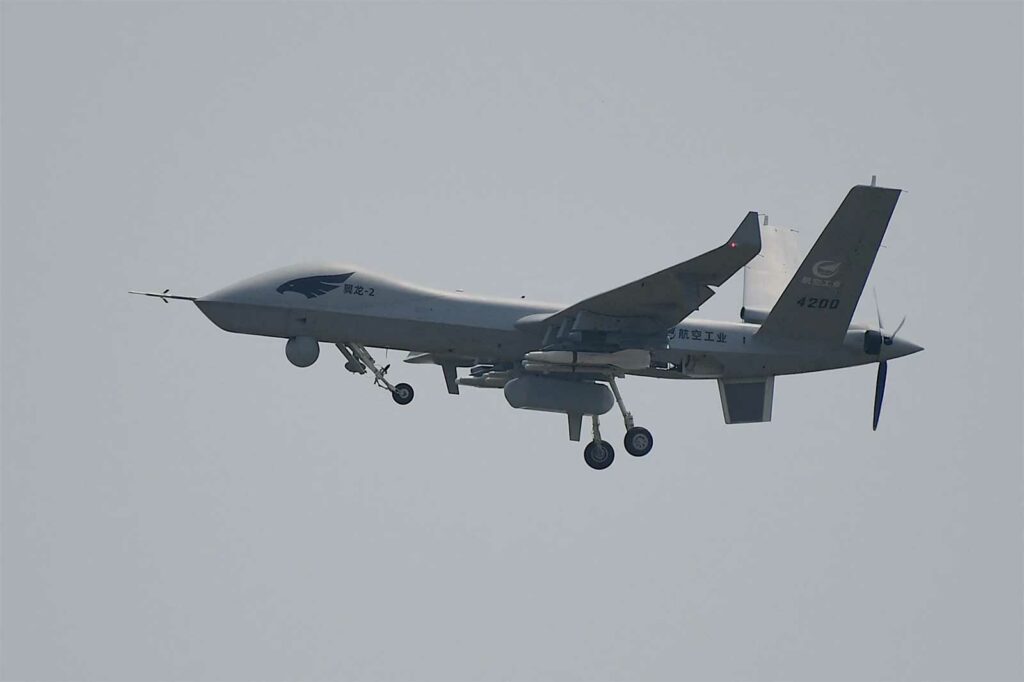
The Wing Loong II fits precisely into this logic. The available technical data describe it as a MALE drone capable of carrying up to 480 kilograms of weapons on several hardpoints, with an endurance of approximately 32 hours according to available technical reference sources. This makes it a platform suited to the missions sought by many African states: persistent surveillance, opportunistic strikes, support over large areas, and cost-effective demonstrations of power.
The Nigerian case illustrates this portfolio logic well. Reuters reported in October 2024 that the Nigerian Air Force was purchasing 24 Italian M-346s and 10 AW-109 Trekkers, while also having deliveries pending for Chinese Wing Loong IIs.
This combination is revealing: a major military player on the continent is not relying on a fleet of Western-style heavy fighters to do everything. It is dividing missions between light attack aircraft, helicopters, turboprops, and armed drones.
China is winning where many African states want operational availability first and foremost. A Wing Loong does not offer the symbolic value of a modern fighter jet. On the other hand, it offers permanence above the area, strike capability without exposing pilots, and easier integration into conflicts where the enemy generally does not have sophisticated air defenses.
Drones are replacing “all-jet” aircraft because the reality of the war economy dictates it
The idea of gradually replacing conventional fighter jets in certain African missions is not ideological. It is a budgetary decision. SIPRI estimates Africa’s total military spending at $52.1 billion in 2024, up 3% year-on-year. On a continental scale, this may seem high. On the scale of dozens of states facing simultaneous needs for personnel, armored vehicles, intelligence, borders, logistics, and debt, it is a quickly constrained budget.
The overall financial situation remains tense. On February 24, 2026, Reuters reported, based on S&P and IMF data cited in the article, that more than 20 African countries face a high risk of over-indebtedness or significant vulnerabilities. This automatically weighs on heavy military purchases. Modern fighter aircraft are never limited to the purchase price of the airframes: they require pilots, parts, engines, support, runways, ammunition, and high-level maintenance. Many states simply do not have the budgetary depth to support this entire structure.
Le Monde highlighted a brutal but useful point: Turkish and Chinese MALE drones sold in Africa cost “just over €3 million,” which is about six times less than their American equivalents, according to the article and the experts cited. Even if this figure varies depending on the weaponry, ground station, and support, the order of magnitude explains a large part of the shift. With a few drones, a state acquires surveillance, strike capability, and endurance. With a modern fighter jet, it also acquires a hefty life-cycle bill.
So it is not that African armies are “giving up” on jets because of doctrinal weakness. They are prioritizing their needs. To strike a pickup truck, monitor a column, track a desert area, support a battalion engaged in counterinsurgency, or monitor a border corridor, drones often respond better to real needs than supersonic fighters.
Drones are changing strategy because they are suited to the wars that are actually being fought
Most of the conflicts in which these systems thrive are not symmetrical air wars. They are campaigns of counterinsurgency, border security, hunting down armed groups, decapitation strikes, and persistent surveillance.
In this environment, the speed of a fighter jet or its air-to-air combat capability matters less than its continuous presence above the area.
This is where drones such as the Akıncı or Wing Loong have the advantage. Their purpose is not to “dominate the skies” in the traditional sense. Their purpose is to stay aloft for long periods of time, to film, to transmit, to track a moving target, and to strike without delay. Traditional fighter jets still have a role to play if the aerial threat increases. But in a theater where the enemy moves around on motorcycles, in pickup trucks, or in small, scattered groups, drones are better suited to the tactical economy of the conflict.
The problem is that this logic also makes war easier to wage and sometimes more relaxed in its use. SIPRI directly links the rise of armed UAVs in sub-Saharan Africa to a high level of civilian casualties. The lower cost of entry and the reduced risk to the operator can lead to more frequent strikes, sometimes with insufficient verification chains. Drones are not just a force multiplier. They can also become an error multiplier if doctrine, intelligence, and political control do not follow.
Manufacturers gain a market, but above all a lasting dependency
For Turkish and Chinese manufacturers, Africa is not just a volume market. It is a market of strategic dependence. An exported drone creates a lasting link: crew training, ammunition supply, maintenance, updates, software support, and sometimes rapid replacement of losses. This dependence is as important as the initial sale.
Turkey plays this card explicitly. Its drone opens up broader cooperation, including diplomatic and military cooperation. China plays differently, often with a more transactional supply logic, but the result is similar: the customer country enters into an ongoing technical relationship with the supplier. For states on a tight budget, this dependency may seem acceptable in the short term. In the medium term, it reduces decision-making autonomy, as a fleet of drones without parts, compatible ammunition, or software support quickly loses its military value.
The paradox is therefore clear. A small budget makes drones attractive because it lowers the entry price. But that same small budget can lock the buyer into greater dependence, as it does not leave enough margin to quickly build a fully sovereign industrial and support base. Access is cheaper. Exit, however, is more difficult.
Africa is no longer just buying drones, it is starting to manufacture them
The narrative of Africa as a pure importer is no longer accurate. At the EDEX exhibition in Cairo in December 2025, Reuters showed that African players now want to produce drones themselves. Egypt signed a protocol with Norinco to manufacture rocket-armed drones, while a local manufacturer, Amstone, exhibited its own kamikaze drones and announced contracts with at least three unidentified customers. The message is clear: some countries now want to move from being buyers to integrators, or even exporters.
The movement extends beyond Egypt. In 2024, Le Monde already cited South Africa as the first African country to produce a MALE attack drone with the Milkor 380, while Morocco was setting up assembly capabilities for Israeli drones and Nigeria was reviving its local ambitions.
Other industry sources mention at least six to seven African countries with visible capabilities in drone production, assembly, or development, depending on the definition used. The threshold of “ten producing countries” put forward in some discussions is therefore plausible if assembly and small carriers are included, but it is not firmly established by a single, indisputable public source.
This distinction is important. There is indeed an African move upmarket. But we are still often talking about assembly, integration, sub-assemblies, or lighter drones, not always complete autonomy in terms of engines, sensors, data links, and ammunition. Industrialization is progressing, but technological sovereignty remains partial.
This shift weakens the position of the traditional fighter jet, without completely erasing it
To say that drones are “replacing” fighter jets is accurate when referring to many internal security missions, targeted strikes, and armed surveillance. To say that they are replacing them everywhere would be an exaggeration. A MALE drone does not replace an interceptor, does not guarantee air superiority against an equipped army, and does not fulfill the symbolic and strategic functions of a real fighter fleet.
On the other hand, for a large part of the real needs of several African armies, it makes the purchase of heavy combat aircraft less of a priority. This is already a major break for Western manufacturers who were banking on light attack aircraft, entry-level fighters, or second-hand offers. The market is not disappearing, but it is shrinking in the most expensive segments.
Perhaps the most profound shift is this: in Africa, the question is no longer “which aircraft to buy?” but “which sustainable air system can produce an immediate effect?” As long as conflicts remain largely irregular, debt remains heavy, and Turkish and Chinese suppliers continue to offer available and affordable options, the answer will often continue to be summed up in one word: drone.
Sources
Reuters, Big hopes for Africa: Defense firms scramble for drone market at Egypt arms expo, December 8, 2025
Reuters, Nigerian air force expands fleet with 34 Italian jets, helicopters, October 14, 2024
Reuters, Algeria, Mali report downed drone in border area but differ on details, April 1, 2025
Reuters, African nations turn to multilateral lenders for diversification, S&P says, February 24, 2026
Reuters, Egypt’s drone deployment to border raises stakes in Sudan’s civil war, February 3, 2026
SIPRI, Trends in World Military Expenditure 2024, April 2025
SIPRI Yearbook 2025, Proliferation and use of missiles and armed uncrewed aerial vehicles
Le Monde, Africa, the new playground for drone exporters, January 5, 2024
Baykar, Bayraktar AKINCI, official technical data sheet
ADF Magazine, Made in Africa Drones Take Off, January 27, 2025
Military Africa, Steady growth of African-made drones recorded, May 10, 2024
War Wings Daily is an independant magazine.