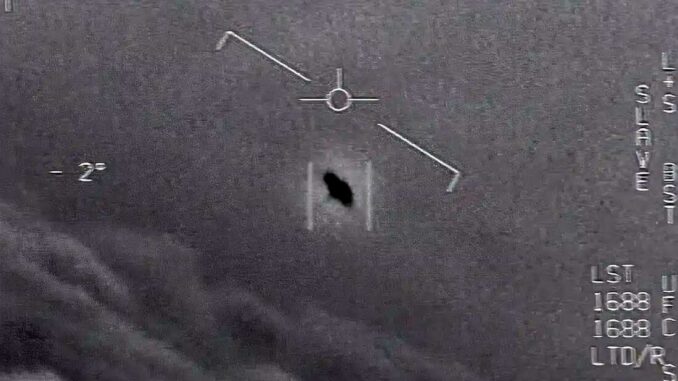
Former Pentagon executive Lue Elizondo claims that the government is withholding data on UAPs. The debate shifts to methodology and evidence.
Summary
A former official associated with the AATIP program (Luis “Lue” Elizondo) claims that unidentified aerial phenomena regularly enter US military airspace, including near strategic assets. His central argument is not about “aliens,” but rather a national security issue: objects observed, sometimes by military crews, are not reliably attributed, creating an operational blind spot. The political consequence is measurable: the creation and strengthening of official mechanisms (including AARO) and the rise of a more structured approach to collection, analysis, and public reporting, with some information necessarily classified. The dividing line remains clear: on one side are those who demand immediate public proof; on the other are those who believe that useful data is mainly found in sensor networks and intelligence, and therefore rarely publishable in plain text.
The shift from folklore to a security issue
Interest in “UFOs” has been around in American culture since 1947. The source text recalls the chronology: multiple reports, investigation programs, then a long period during which the subject was relegated to the margins. The recent shift comes from a simple point: sightings are no longer just civilian accounts. They involve the military, training areas, controlled corridors, bases, and sensors. In other words, we are no longer talking about a parlor debate, but about “contacts” in areas where tactical aviation and air defense require rapid and traceable identifications.
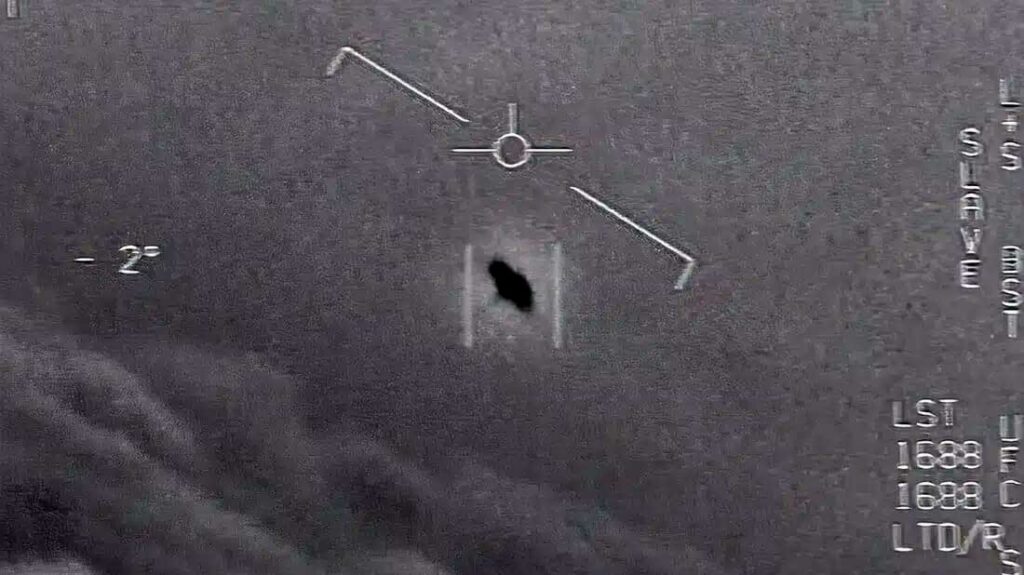
The most influential case cited is that of the carrier strike group around the USS Nimitz in November 2004, with testimonies from crews and shipboard personnel, and an object described as oblong, with no trail or clearly visible propulsion signature, associated with a strong surface disturbance. In the accounts, the sequence is particularly problematic for a modern military for a very pragmatic reason: it combines sensors (radar, electro-optical, infrared), qualified witnesses, and an exercise context where one normally knows what is flying and why. The ODNI, for its part, has documented an increase in the volume of reported events: the unclassified “Annual Report” published at the end of 2022 lists 366 additional reports, adding to a previous base, for a total of 510 cataloged to date within their scope. Of these 366, a significant proportion are described as “mundane” (balloons, drones, “clutter”), but the political point remains: even if many cases are prosaic, the system must be able to sort quickly and isolate the residual.
The cold reading is as follows. A state that accepts that a stream of unidentified objects crosses training areas or approaches sensitive sites accepts a risk: collision, fratricide, mission cancellation, or exploitation of posture flaws. This is not a theoretical hypothesis: the articles and documents cited in the Navy guidelines show that the concern for “flight safety + intelligence” has ultimately taken precedence over the fear of ridicule. Where the subject becomes less comfortable is when public debate confuses ‘unattributed’ with “non-human.” The two are not synonymous. The residual may be nothing more than a mixture of instrumental limitations, artifacts, incomplete data, rare atmospheric behaviors, or adversarial platforms operating at the edge of detection.
Elizondo’s logic and the Pentagon’s bureaucratic knot
The source text makes Elizondo a pivotal figure because he connects three dimensions that coexist poorly: defense secrecy, public communication, and politics. His thesis is that part of the federal apparatus knows more than it says, and that internal inertia has created a blind spot. His career provides a narrative coherence: counter-espionage, intelligence culture, then a move to a program dedicated to “advanced aerospace threats” (created at the initiative of the Senate, with a mission formulated in terms of “far-term” threats). In this reading, the main enemy is not an object in the sky, but the administrative machine: silos, rapid turnover of officials, and negative incentives to take on a subject that is “toxic” for one’s career.
This is where the argument deserves to be treated as a methodological issue. If you are in the Pentagon and you want to exist, you either bring a solution or a capability. Arriving with “we have a poorly defined, potentially huge problem, and I can’t show you the essentials because it’s classified” is a recipe for getting buried. The source text also emphasizes a classic mechanism: the fear of “losing control of the narrative.” It’s human and bureaucratic, but it’s also an operational weakness, because an unaddressed issue doesn’t go away; it moves to external communities, often more vocal than rigorous.
The “whistleblower” aspect is part of this tension. Elizondo claims to have suffered a form of retaliation and internal discredit after his resignation, and he filed a complaint with the Inspector General. The point here is not to judge intentions, but to note the effects on governance: if staff fear for their careers, they under-report, and the data deteriorates. However, on a subject where statistics are essential (multiplication of cases, profiles, signatures, sensor correlations), missing data is more dangerous than “strange” data.
We must also look at economic and media incentives, without naivety. The “starification” of a former defense executive automatically raises suspicion: monetization, books, TV appearances, audiences. The critics have a point: without accessible evidence, the field is open to speculation. But the supporters also have a point: access to the most compelling data is rarely public in nature (classified sensors, listening capabilities, radar parameters, operational contexts). The debate, in essence, is about the level of evidence acceptable for action. An army often acts before it has complete “scientific” certainty, because the mission requires risk reduction.
In this gray area, the realistic requirement is a doctrine: how to qualify, how to archive, how to correlate, how to share between services. And above all: how to prevent the conversation from being captured by extremes, between total belief and automatic denial.
The institutional response: structures, rules, and data
The source text describes a shift of the subject to the official sphere starting in 2017, then an acceleration in 2021–2023. This is the most measurable element. First, in 2019, the Navy confirmed that it had updated its event reporting procedures, specifically to reduce stigma and improve data collection. This administrative gesture may seem minor, but in aviation risk management, it is central: a good form and a clear processing chain are sometimes worth more than ten speeches.
Second, the creation of successive organizations has led to AARO, which has been formalized and expanded to all domains (air, sea, space, “transmedia”), with a mission of interagency synchronization. The DoD’s official announcement in July 2022 spells out the intention: to end silos, harmonize collection, and structure analysis. The ODNI, in its unclassified report, also specifies the size of the recent corpus and the existence of a sorting process between “unremarkable” cases and cases that remain unattributed.
The most interesting part, technically, is the tension between transparency and efficiency. Public reports are useful for providing orders of magnitude and categories. They are not designed to reveal signatures, modes of operation, or sensor parameters. As a result, they frustrate everyone: those who want “proof” see them as evasive; those who want “security” see them as containing too much information. Yet this is precisely the compromise expected in a modern state: to publish enough to justify public action, without providing adversaries with manuals on how to circumvent it.
Finally, NASA’s entry into the debate, via an independent study group and a final report in 2023, serves a useful purpose: to bring part of the subject back to standards of open science, data quality, and reproducibility. The report emphasizes the lack of standardized data and the importance of new methods of acquisition and analysis, including through AI, but it does not conclude that the origin is extraterrestrial based on the unclassified evidence examined. This is an important point: it cuts short the argument that “scientists refuse to talk about it,” while reminding us of a cold truth: without calibrated data, we are mostly telling stories.
At the same time, this issue is part of a broader market: that of detection systems, data fusion, and intrusion prevention. According to several firms, the “counter-UAS” and military radar markets are showing strong growth trajectories, driven by the proliferation of drones, the defense of sensitive sites, and multi-sensor integration. It would be dishonest not to say it: the infrastructure needed to “see” better is expensive and creates industrial interests. This does not disqualify the need; it just requires robust metrics and audits.
The consequences: doctrine, industry, and collective mental hygiene
The consequences of the UAP issue go far beyond the question of “what is it?” The first consequence is the doctrine of sovereignty over low and medium altitude airspace. The proliferation of drones, balloons, light objects, and poorly understood atmospheric phenomena makes detection more confusing. The flow of “mundane” cases is not noise to be ignored: it is noise to be reduced, because it overloads the alert chains. The ODNI report shows that many reports end up being attributed to ordinary objects. That’s good. It proves that the method works when there is sufficient data. But it also means that the residual data becomes more expensive to process, as it requires detailed correlations and sometimes classified resources.
The second consequence is the need to standardize data collection, otherwise communication breaks down. A pilot describes a light; a radar operator describes a trail; an IR system detects a hot spot. Without a protocol, everything gets mixed up and unfounded certainties are created. Critics such as Mick West insist on the possibility of artifacts, angles, and instrumental limitations. This skepticism is useful, provided it does not become a reflexive mockery. Conversely, some of the “ufology” communities demand full disclosure, immediately, without accepting the constraints of national security. This is an emotional rather than a technical position. And this is where honesty is necessary: when a public debate becomes an economy of indignation, it attracts profiteers, mythomaniacs, and people seeking social status. In this arena, the state almost always loses, because it cannot say everything, and its silences become imaginary evidence.
Third consequence: the subject serves as a revelation of the culture of intelligence. When the federal apparatus is unable to quickly attribute an intrusion, two hypotheses dominate, and neither is reassuring: either the observation capacity is insufficient, or the organization is too slow to exploit what it observes. In both cases, investment is needed in data fusion, inter-agency sharing, and training. This is not exotic: it is the same logic as for anti-drone defense, anti-missile warfare, or maritime surveillance. Market estimates for “counter-UAS” and military radars, with very high growth predicted by some players, illustrate the general direction: more objects, more sensors, more algorithms, and therefore more budgets. The risk, of course, is funding programs with vague terminology and soft KPIs. If the UAP topic is just used to grease budget lines, we’ll mostly end up with bureaucratic theater.
Fourth consequence: politics. The source text emphasizes the “Overton Window,” i.e., the transition from a topic considered marginal to one that can be addressed by elected officials. This transition does not guarantee the truth; it only guarantees that the question can be asked without career suicide. Here again, we must be clear-headed: Congress can use the subject as a weapon to control the Pentagon, or as a media stage. Both sometimes happen. What matters is the concrete result: protected reporting mechanisms, regular reporting, and science and technology plans. The rest is posturing.
Ultimately, the UAP file is a test of institutional maturity. Either the state treats the phenomenon as a data and risk issue and moves forward without promising the impossible, or it allows the subject to dissolve into belief and hostility, condemning itself to an endless war of narratives. Elizondo, whether you like him or not, has at least forced a useful question: “Who knows what, and how do we prove it?” As long as the answer remains partially classified, frustration will remain. But frustration is not proof. The only serious solution is method.
Sources
- Office of the Director of National Intelligence (ODNI), 2022 Annual Report on Unidentified Aerial Phenomena (data from 366 additional reports, total 510).
- Department of Defense, official announcement of the creation/expansion of the All-domain Anomaly Resolution Office (July 2022).
- AARO official website (definition, multi-domain scope).
- NASA, UAP Independent Study Team – Final Report (September 2023).
- TIME (April 2019), update on Navy UAP reporting procedures.
- Smithsonian Magazine (January 2023), summary for the general public of the figures and categories in the ODNI report.
- DoD (comptroller), National Defense Budget Estimates for FY2024 (budget framework and spending rationale).
- Frost & Sullivan, C-UAS market page (2023 valuation and 2024–2029 projection).
War Wings Daily is an independant magazine.