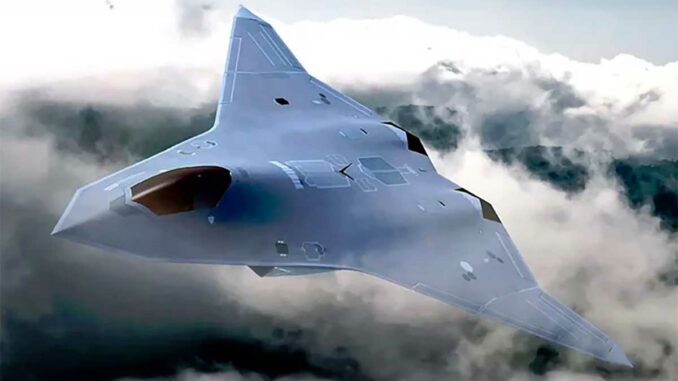
A study published in early February judges the USAF’s plans to be too weak to counter Beijing: 500 additional fighter jets would be needed by 2030.
Summary
A study by the Mitchell Institute, published on February 9, 2026, and widely discussed in mid-February, puts forward a stark figure: the US Air Force should add around 500 combat aircraft to its fleet in order to maintain a credible advantage over China by 2030. The idea is not to “build volume” for the sake of it, but to avoid an operational impasse: a fleet that is too small and too unavailable cannot sustain a campaign in the Western Pacific, especially if China protects its territory behind dense defenses and missile salvos. The authors call for at least 300 F-47 fighters and 200 B-21 Raider bombers, instead of the current plans (185 F-47s and “at least” 100 B-21s). The crux of the matter is twofold: air superiority depends on the actual deployable mass, and this mass is expensive. The report mentions a need for a budget increase of around $40 billion per year to accelerate the pace.
The recommendation for 500 aircraft and what it reveals
The phrase “500 additional aircraft” is deliberately shocking. In the Mitchell Institute report (“Strategic Attack: Maintaining the Air Force’s Capacity to Deny Enemy Sanctuaries,” dated February 9, 2026), it refers to the gap between U.S. strategic ambitions and the current projected procurement trajectory.
The core of the recommendation is clear. A sufficient penetration force is needed to strike deep into enemy territory, including mainland China, in order to disrupt the rhythm of air and missile attacks. The report proposes a minimum of:
- 200 B-21s, to provide a fleet of stealth bombers capable of lasting over time.
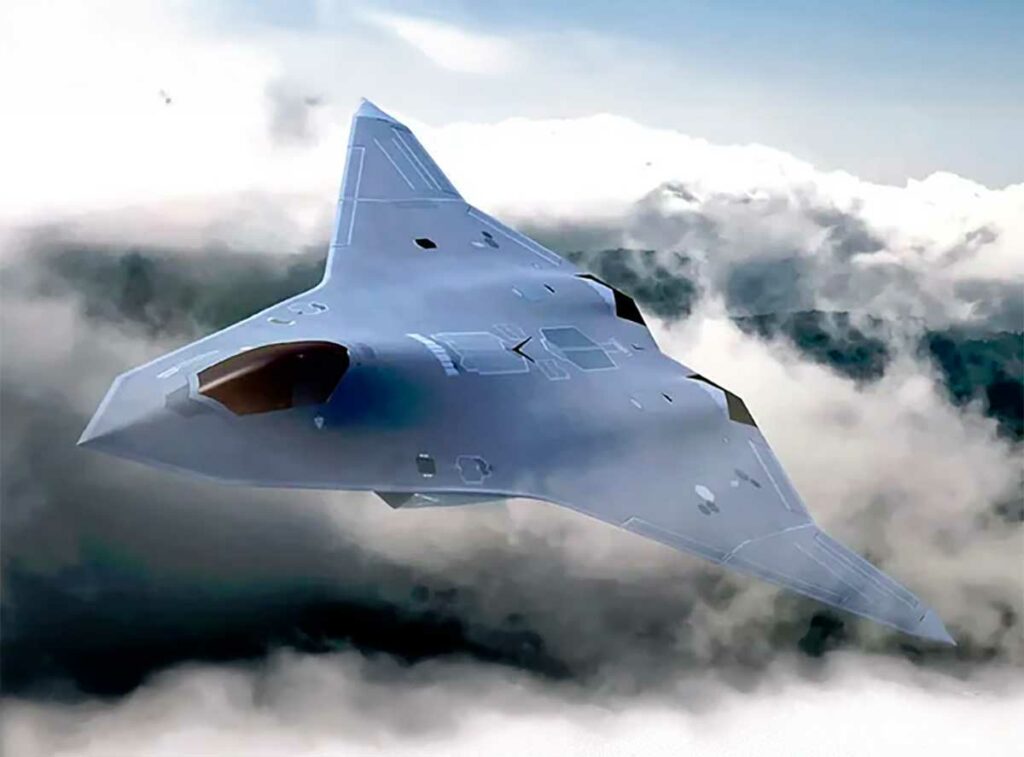
- 300 F-47s, to build a fleet of new-generation fighters that are truly “campaign-compatible.”
The diagnosis is less spectacular than the figures, but more worrying. The authors describe an air force that knows how to carry out exceptional raids, but which may not be able to withstand a prolonged confrontation. They contrast a “raid force” with a “campaign force.” In other words: a fleet calibrated for a single operation, not for a lasting war.
The reality of the USAF format and the availability trap
Public debate often confuses inventory with actual power. But power is what takes off, what can be regenerated, and what can be lost without ruining the strategy.
The US Air Force has a total fleet of approximately 5,025 aircraft.
But an average mission availability rate of around 62% has been cited as a worrying level by the American trade press. At this level, it means that around 1,900 aircraft may be unavailable at any given time. The figure has serious consequences in an Indo-Pacific scenario, where distance, pace, and wear and tear eat into margins.
For combat aircraft, orders of magnitude are useful. The “total force” inventory includes approximately 2,027 fighters (all components) and a bombing force of around 124 aircraft (B-1, B-2, B-52). But these totals include training, conversion, heavy maintenance, and airframes that are not immediately deployable.
This is where the constraint becomes political. When the fleet is small, every decision to withdraw “to finance the future” reduces the available mass in the short term. And when the mass decreases, the strategy becomes more rigid: we avoid risking rare platforms, we keep our distance, we accept that the adversary will fire from protected areas.
This is precisely the central argument of the report: without attrition reserves and without projectable volume, we are condemned to caution… in the face of an adversary who is betting on rapid aggression.
China’s rise and the logic of sanctuary
The Mitchell Institute report focuses less on “how many Chinese aircraft” and more on an operational reality: China is organizing an environment in which its mainland serves as a protected rear base.
This sanctuary is based on a combination of factors:
- Modern, dense, and integrated ground-to-air defenses.
- Long-range strike capabilities (ballistic, cruise, hypersonic) to threaten bases, ports, and runways in the region.
- An expanding fighter and bomber fleet, supported by detection and command capabilities (AEW&C) and electronic warfare capabilities.
The US Department of Defense’s official report on China also highlights ongoing technological momentum: the promotion of air-to-air weapons such as the PL-15, advances in missiles, and the presentation of new platforms in Zhuhai, including the J-35A and J-15D. This type of signal is significant because it reflects an industrial ambition: to produce, iterate, and deploy.
Estimates on the J-20 vary depending on the source, but there is consensus on the trend: the fleet is growing and production is accelerating. At the same time, the Pentagon recognizes that the combination of “geographic depth + A2/AD” is designed to prevent US forces from operating freely in the first island chains. It is a lockdown strategy, not just a race for aircraft.
The necessary aircraft and the reason for the F-47 and B-21 duo
Why does the report emphasize the F-47 and B-21, rather than simply “more F-35s”?
Because the problem is not just stealth. It is operational endurance in a vast space, facing dense threats, with bases under threat.
The B-21 is presented as the linchpin of long-range penetrating strikes. The idea is simple: strike deep, quickly, and repeatedly, even if the adversary attempts to block access with missile salvos and air defenses.
The report notes that a force of 200 B-21s, combined with the retained B-52s, would multiply the long-range strike capability compared to the current force.
The F-47, meanwhile, is described as a fighter designed for “inside” warfare, not just for shooting from a distance. The report attributes to it a combat radius of more than 1,000 nautical miles (≈ 1,852 km, 1,000 NM), a larger internal payload than other Western fighters, and wideband stealth. The goal is not to replace an F-22 with an F-47, period. It is to bring back volume to penetration fighters, those that escort, open corridors, destroy defenses, and set the tempo.
The logic of attrition and tempo
The report asks a question that many avoid: how many aircraft can be lost without losing the war?
A niche fleet may be brilliant, but it is fragile. With only 20 B-2s in the inventory, each loss is a strategic trauma. The report cites the example of a recent operation that mobilized all available B-2s to highlight the limitation: you can succeed once, but you cannot repeat a campaign at that pace.
The same logic applies to fighter aircraft: if 185 F-47s are only replacing F-22s, no surplus is created. No reserve is created. No rotation capacity is created. Modern warfare requires continuous pressure. And continuous pressure requires a mass of aircraft, pilots, parts, and ammunition.
The role of “bridge” platforms and combat drones
The report does not say “bet everything on the future.” It assumes a need for transition. It recommends keeping certain fleets longer and purchasing available platforms at maximum rate, notably the F-35A and the F-15EX, to avoid a capability gap.
It also promotes the idea of collaborative systems: combat drones working alongside piloted aircraft. They do not replace fighter jets, but they increase density, complicate enemy defenses, and limit the use of very expensive platforms on risky missions.
The budget wall and the truth about costs
This is where the debate becomes uncomfortable, and where we need to be clear.
The report estimates that budget increases of at least $40 billion per year would be necessary to accelerate acquisitions, in particular by doubling the pace of B-21 purchases. It also points out that adding a hundred B-21s and a hundred additional F-47s represents massive initial costs. Other public estimates suggest an order of magnitude “beyond $100 billion” for the additional effort.
The problem is not just “finding the money.” It is accepting a hierarchy. If air superiority is a prerequisite for American maneuvering in the Pacific, then the fleet must cease to be a budgetary adjustment variable.
Otherwise, the country is implicitly choosing a circumvention strategy: more missiles fired from a distance, more dependence on targeting chains, more reliance on networks that can be jammed, destroyed, or saturated. The report emphasizes this point: stand-off has its place, but it is not enough. And it can be very costly per effect produced, especially if the adversary breaks the intelligence and communication links.
Realistic levers between now and 2030 and limits that must not be ignored
A distinction must be made between what is desirable and what is possible.
By 2030, it is unlikely that 200 B-21s and 300 F-47s will already be delivered and fully operational. Industrial cycles and ramp-up take time. The report itself refers to an effort to be undertaken “as quickly as possible,” which amounts to acknowledging that the schedule is tight.
On the other hand, several levers are credible in the short term:
- Slow down the withdrawal of critical aircraft until replacements are available in sufficient numbers.
- Stabilize the purchase rates for the F-35 and F-15EX to avoid a collapse in volume.
- Investing in maintenance and the supply chain to increase availability rates, because a single point of availability gained can sometimes be equivalent to dozens of aircraft “created” without purchase.
- Strengthening the resilience of bases (hardening, dispersion, rapid runway repair), because a modern fleet grounded is useless.
- Accelerate the integration of collaborative combat drones to increase the impact without waiting for hundreds of piloted aircraft.
But there is a limit that must be stated frankly. If the US Air Force remains on a trajectory that barely replaces what already exists, it can maintain technological excellence while losing operational ascendancy in a campaign. China does not need to “dominate everywhere.” It needs to make the Western Pacific too costly, too risky, too uncertain. A US fleet that is too small helps it do that.
The strategic question facing Washington
The Mitchell Institute report pushes Washington to choose, without hesitation, between two visions.
The first is to accept a massive effort: more penetration aircraft, more stocks, more endurance. It’s expensive, but it’s consistent with the goal of deterrence.
The second is to stick with a “small but sophisticated” model, hoping that technology will compensate for volume. It’s appealing on paper. It is also a classic recipe for running out of options when the crisis becomes real.
Air superiority is not a trophy. It is a balance of power, measured in sorties, acceptable losses, and the ability to strike and take a hit. A study that talks about 500 “missing” aircraft is not being poetic. It says, very concretely, that an advantage can disappear not through tactical defeat, but through structural under-sizing.
Sources
Defense News, “US Air Force needs 500 next-gen fighters, bombers to beat China, think tank says,” February 9, 2026.
The Mitchell Institute for Aerospace Studies, “Strategic Attack: Maintaining the Air Force’s Capacity to Deny Enemy Sanctuaries” (Policy Paper Vol. 64), February 2026.
Air & Space Forces Magazine, “New Report: Air Force Needs 200 B-21s, 300 F-47s to Deny Enemy ‘Sanctuaries’,” February 4, 2026.
Business Insider, “Air Force Needs 500 Sixth-Gen Fighters, Bombers for China Fight: Report,” February 12, 2026.
Defense News, “Air Force aircraft readiness plunges to new low, alarming chief,” March 6, 2025.
Air & Space Forces Magazine, “2025 USAF & USSF Almanac: Equipment,” 2025.
U.S. Department of Defense, “Annual Report to Congress: Military and Security Developments Involving the People’s Republic of China 2025,” published December 23, 2025.
War Wings Daily is an independant magazine.