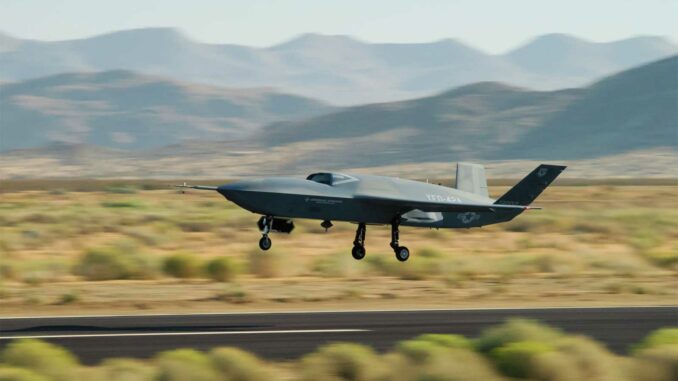
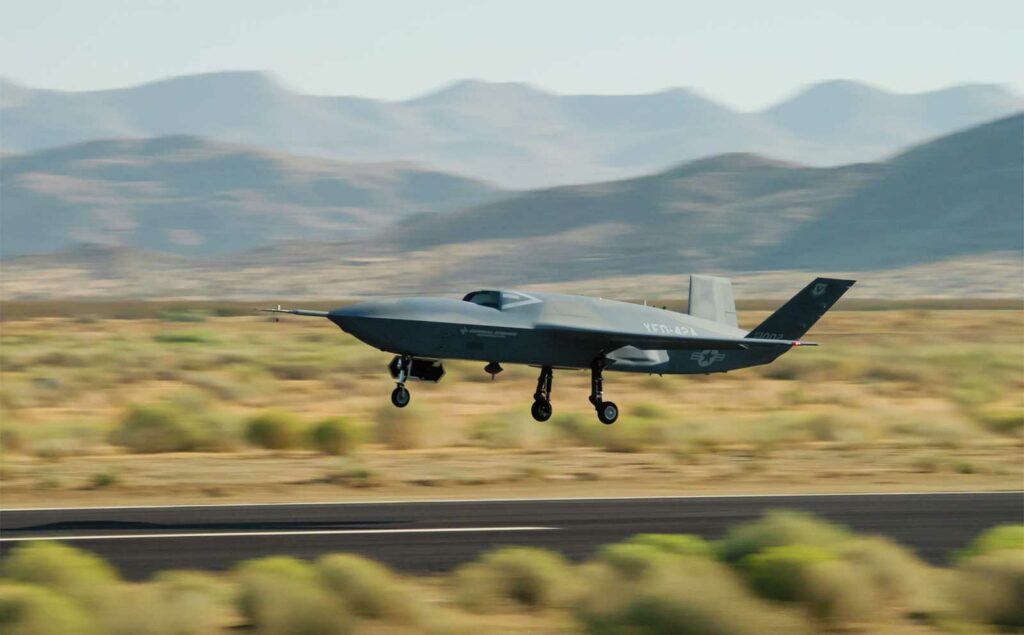
General Atomics has named its YFQ-42A “Dark Merlin.” Behind the name lies a key milestone: testing mission autonomy and USAF integration.
Summary
On February 23, 2026, General Atomics Aeronautical Systems (GA-ASI) officially named its YFQ-42A, a future collaborative combat drone for the US CCA program, “Dark Merlin.” This naming is not just a marketing detail: it comes as the demonstrator changes scale, moving from “platform” flights to mission autonomy tests that are more representative of operational use. Several aircraft have already flown since August 2025. In February 2026, GA-ASI and the US Air Force highlighted a key point: the open A-GRA (Autonomy Government Reference Architecture) architecture, designed to avoid industrial lock-in and allow the integration of autonomy software from different suppliers on different drones. The challenge is clear: to transform a promise (unmanned “teammates”) into a credible, interoperable, and industrializable capability at a sustainable cost. The coming months will tell whether Dark Merlin is a force multiplier… or a program that is becoming too complex too quickly.
The choice of name and what it really says about the program
On February 23, 2026, GA-ASI announced that its YFQ-42A would now be known as “Dark Merlin.” The symbolism is clear: the merlin is a small falcon known for its speed and group hunting, a direct analogy to the idea of drones operating in close proximity to piloted aircraft. But let’s be clear: at this stage, this name is not an official “popular name” assigned by the US Air Force. Specialized media outlets point out that the Air Force follows a procedure and that names are usually assigned when a system is likely to enter service in the near future. In other words, the naming gives narrative consistency to a prototype… without prejudging the Air Force’s final choice for production.
This point is important because the CCA program is still in a phase where structural decisions remain open: industrial selection, production rate, software standard, degree of autonomy authorized in operation, and budgetary arbitration. Naming the aircraft “Dark Merlin” amounts to fixing its identity at a time when the US Air Force is testing, comparing, and seeking to lock in a more “modular” approach than its past combat aircraft programs.
The role of the collaborative combat drone in US doctrine
The core of the CCA is simple to formulate but difficult to execute: to give the air force mass, range, and tactical options without endlessly multiplying the number of piloted aircraft, which are rare and expensive.
The logic is part of Next Generation Air Dominance: a set of systems where drones accompany 5th generation fighters (such as the F-35A) and, eventually, 6th generation platforms.
The US Air Force is aiming for a fleet of at least 1,000 CCAs in various configurations, with an initial focus on air-to-air for the initial increment. The expected uses are numerous: weapons carriage (the “missile truck” drone), extension of the sensor network, electronic warfare, decoys, and reconnaissance. The operational benefit is clear: shifting risk to unmanned systems, overwhelming the enemy, and keeping piloted aircraft where human decision-making is most critical.
But let’s be honest: the challenge is not to create a “cheaper F-35.” The challenge is to create a human-machine duo (or trio) capable of outperforming a single aircraft, with rules of engagement, data links, and sufficient autonomy to survive jamming, loss of connection, and the chaos of modern air combat.
The YFQ-42A and what we know about its test trajectory
On the calendar, GA-ASI is highlighting very concrete milestones. The YFQ-42A began flying in August 2025, and the manufacturer claims to have built and flown several aircraft in less than six months. The most revealing element is not the takeoff itself, but the increase in sophistication: automated takeoff and landing tests, followed by the integration of third-party software for mission functions.
On February 12, 2026, GA-ASI announced a “semi-autonomous” flight lasting more than four hours, during which a human operator on the ground activated an autonomous mode via a console and then sent mission commands that the aircraft executed with precision. The message is clear: we are moving away from “the airframe flies” to “the system executes a mission intent via a standardized software chain.”
At the same time, the US Air Force announced the integration of the A-GRA architecture, with a clear objective: to prove that mission autonomy components from different suppliers can be connected to different drones. On the YFQ-42A, the Air Force cites RTX Collins as the mission autonomy supplier, while Shield AI is mentioned on the other prototype, the YFQ-44.
The critical boundary between flight autonomy and mission autonomy
A common misconception in public debate is that “autonomy” means the same thing in all contexts. In reality, the industry distinguishes between two layers.
On the one hand, there is flight autonomy: taking off, maintaining a trajectory, managing the flight envelope, landing, recovering from a failure, and avoiding collisions. This is already complex, but it is an aircraft problem.
On the other hand, there is mission autonomy: understanding high-level instructions, planning an action, coordinating a maneuver, prioritizing a target, managing uncertainty, and integrating into a chain of command. This is where military value—and risk—come into play.
The February 2026 communications emphasize this point: the integration tested on the YFQ-42A focuses on the mission, via Collins’ Sidekick software, connected to the aircraft’s system through A-GRA. The promise is mission autonomy that is “decoupled” from the platform: if the architecture holds up, the Air Force can replace a software brick without redesigning the entire aircraft.
But there is a trade-off: the more open you make the architecture, the more you need to master cybersecurity, software validation, and the assurance that two bricks put together will not create unexpected behavior. In a fighter jet, the unexpected is not an “anomaly,” it is potentially a loss.
A-GRA architecture as a weapon against “vendor lock-in”
The US Air Force presents A-GRA as a “Modular Open System Approach” whose central objective is to avoid industrial lock-in: not depending on a single supplier to develop autonomy. In its February 12, 2026 communication, the Air Force explicitly cites the idea of breaking vendor lock-in, increasing competition, and accelerating the integration of algorithms from traditional and non-traditional players.
On paper, this is a break with historical programs where software and hardware often end up married for decades. In practice, it is a change in procurement method: the Air Force wants to prove that a government architecture can serve as a common interface and that teams can iterate quickly, “software-first.”
Let’s be blunt: if A-GRA works as advertised, the Air Force gains strategic freedom. If A-GRA becomes a new millefeuille of standards, it creates an additional bottleneck. The year 2026 is precisely the year when this kind of promise will be fulfilled or shattered.
The figures behind the industrial and budgetary gamble
The CCA program is not just about technology, it’s about volume and budgetary sustainability. In recent years, the Air Force has communicated a target of 1,000 aircraft, with constant pressure to maintain the logic of “affordable mass.”
On the financing side, the budget request for fiscal year 2026 is $804 million for the CCA, while legislation passed in 2025 allocated nearly $680 million to accelerate the program, in a context where the full budget had not yet been finalized at the time of the early 2026 analyses.
The Air Force also mentioned a budget of around $6 billion to be spent on CCAs until 2028, while a budget document estimated $9 billion until fiscal year 2029.
These discrepancies are not anecdotal: they signal the classic risk of any modern military aviation program. As soon as survivability, stealth, sensors, electronic warfare, and software certification requirements are added, the “cheap drone” can become a mini-fighter… with a mini-price that is no longer mini.
The operational risks that Dark Merlin will have to take on
Dark Merlin comes at a time when the US Air Force must answer three tough questions.
The first: how much autonomy do we really accept in combat? Saying “semi-autonomous” is comfortable. Defining precisely who authorizes what, when, and with what traceability is much less so.
The second: what happens when the link is degraded? A useful CCA will have to operate in a contested, jammed, and deceived environment, sometimes without GPS, sometimes without a network.
The third: how do we test human-machine interaction realistically? Flight tests validate building blocks. Operational use requires tactical confidence: a pilot must be able to “quarterback” a drone without losing their own situational awareness. This is a learning process, and it is also a cognitive burden.
The program is progressing, but the danger zone is the accumulation of “small” decisions: one more requirement, one more safety feature, one optional sensor, one more redundancy. This is how costs rise and volumes fall. However, CCA only makes sense if quantity follows.
The strategic reading behind the February 23, 2026 announcement
The name “Dark Merlin” can be read as a signal to three audiences.
To operational personnel, GA-ASI is saying: the aircraft is not a concept, it flies, it is being industrialized, and it is entering a phase where mission autonomy is becoming the main focus.
To the US Air Force, the company is saying: we are aligned with your “open architecture” vision, and we can integrate third-party components via A-GRA.
To Congress, the implicit message is: the program is progressing rapidly, so it deserves budgetary stability. Without stability, a “software-first” program quickly becomes a “stop-and-go” program, which is the best recipe for increasing unit costs.
The Dark Merlin will not earn its place based on a name. It will earn it based on a very concrete capability: flying with fighters, executing useful missions, remaining controllable, and being produced in large numbers. If these conditions are met, the CCA will change the way air power is counted. If they are not, it will be further proof that autonomy is easy to promise and difficult to certify.
Sources
- General Atomics Aeronautical Systems, “GA-ASI Announces YFQ-42A Dark Merlin,” February 23, 2026
- Air & Space Forces Magazine, Greg Hadley, “General Atomics’ YFQ-42A CCA Gets a Nickname: ‘Dark Merlin’,” February 23, 2026
- U.S. Air Force (AFNS), “Air Force validates open architecture, expands Collaborative Combat Aircraft ecosystem,” February 12, 2026
- General Atomics Aeronautical Systems, “GA-ASI Achieves New Milestone With Semi-Autonomous CCA Flight,” February 12, 2026
- Aerospace Testing International, “Collins demos CCA drone software with four-hour test flight,” February 23, 2026
- Aerospace America (AIAA), Jen Kirby, “2026 will test U.S. Air Force’s bet on drone wingmen,” January 14, 2026
- Defense One, “How drone warfare fares in the 2026 budget,” June 12, 2025
- Reuters, “Drone makers battle for air dominance with ‘wingman’ aircraft,” June 19, 2025
War Wings Daily is an independant magazine.