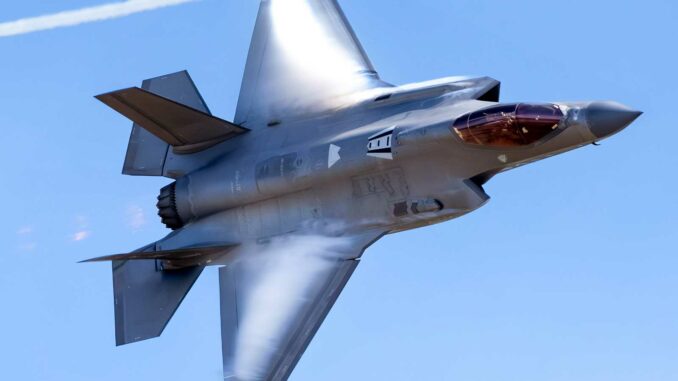
Bases, training, NORAD, the Arctic, budget: Canada is accelerating its transition to the F-35 to strengthen its air defense in the face of tensions in the North.
In summary
Canada is entering a very concrete phase of its transition to the 5th generation. The debate over the choice of the F-35 is not entirely closed politically, but the aircraft is already shaping the work, budgets, and future organization of the Royal Canadian Air Force. Ottawa still plans to acquire 88 F-35As, with an initial delivery from the United States in 2026 to begin training, followed by arrival in Canada in 2028. This transition is not merely about replacing aging CF-18s. It requires rebuilding part of the military infrastructure: hangars, computer networks, maintenance facilities, squadron headquarters, rapid-response systems, simulation capabilities, logistical support, and integration with a modernized NORAD. This is the crux of the matter: a 5th-generation aircraft is worthless without a base, without data, without training, and without an appropriate command architecture. In the Arctic, where distances are immense and the threat more pressing, this transformation is not a luxury. It is a belated catch-up.
Canada isn’t just changing aircraft; it’s changing its combat system
Canada’s Future Fighter Capability Project involves 88 F-35As intended to replace the fleet of CF-18 Hornets. The agreement finalized in January 2023 was presented as the largest investment in the Royal Canadian Air Force in over thirty years, with an initial announced cost of 19 billion Canadian dollars for the acquisition. Since then, government documents have expanded the actual scope of the program: when you add up the aircraft, associated equipment, initial weapons and ammunition, support services, and new squadron facilities, the project is now presented in official documents at around 27.7 billion Canadian dollars.
This apparent increase is not merely a rhetorical slip. It reflects a reality often obscured in political announcements: an F-35 is not an isolated purchase. It is a complete system architecture. Canada is not just paying for aircraft. It is paying for a doctrinal, logistical, and digital transition. The F-35 requires more robust networks, enhanced cyber protections, specific maintenance tools, a sophisticated simulation environment, and bases capable of supporting high-intensity operations in a highly demanding climate. To say that Canada is “buying an aircraft” would therefore be a misleading oversimplification. It is buying a new combat ecosystem.
New infrastructure is the true prerequisite for entering the 5th generation
The Canadian Department of Defence states it plainly: the Defence of Canada Fighter Infrastructure project must provide the infrastructure necessary to accommodate up to 88 F-35s. The two main bases involved are 4 Wing Cold Lake in Alberta and 3 Wing Bagotville in Quebec, which are the country’s two main fighter bases. Official documents indicate that Canada is building new permanent squadron facilities at these two sites and modernizing existing infrastructure for operations, maintenance, and support.
Why is new infrastructure needed? Because the F-35 is not a modernized CF-18. It is a more demanding aircraft in terms of data, system security, maintenance, and ground support. Canadian budget documents explicitly mention IM/IT upgrades, including increasing bandwidth to 10 Gb at Bagotville and Cold Lake and the creation of new “communications packages.” This may seem secondary. It is not. A 5th-generation aircraft relies on data: mission preparation, sensor fusion, predictive maintenance, threat library management, and coordination with allied networks. Without a digitally modernized base, the F-35 loses some of its value.
We must also consider alert, technical support, and rapid deployment facilities. Canadian authorities have indicated that design work on the Quick Reaction Alert facilities at Cold Lake is set to begin in 2024. This is a critical factor for NORAD’s posture. Canada is not merely preparing hangars; it is preparing sites capable of enabling rapid sorties within a continental air defense environment. This directly relates to the mission of policing the skies over northern Canada and the Arctic approaches.
Pilot training is becoming the most tangible bottleneck
The immediate challenge is not just pouring concrete or laying fiber-optic cables. It is training the crews. The official website of the Future Fighter Capability Project states that the first aircraft will be delivered in 2026 to the F-35A Pilot Training Center at Luke Air Force Base in Arizona, to begin training Royal Canadian Air Force pilots while Canadian infrastructure is being finalized. The most recent documents indicate that training for Canadian pilots and crews is set to begin in late 2026, with the first F-35s arriving in Canada in 2028.
This decision makes sense. Training a 5th-generation pilot isn’t just about teaching them to fly a new aircraft. It involves transitioning them to a different combat paradigm: information management, networked operations, stealth utilization, sensor-to-effect fusion, and integration into a multi-domain architecture.
Training time automatically increases, and ramp-up also depends on mechanics, systems specialists, mission planners, and support structures. In short, the shortage isn’t just about aircraft. It could become a skills shortage.
This point deserves to be stated frankly: Canada has long delayed its transition. The risk is not just budgetary. It is generational. A fighter fleet does not rely on new aircraft sitting on a tarmac. It relies on a continuous human pipeline. If Ottawa does not replenish the ranks of pilots, technicians, and instructors quickly enough, the transition to the F-35 will inevitably be slower than the official schedule. Infrastructure can be built. Skills, however, cannot be acquired on an emergency basis. This constraint is not unique to Canada, but it is more acute there due to distances, the small size of the fleet, and the centrality of a few key bases.
Integration into the modernized NORAD accounts for a large part of the timeline
The Canadian F-35 program must be viewed in the context of the modernization of NORAD. In June 2022, Ottawa announced a 20-year plan worth 38.6 billion Canadian dollars to modernize its capabilities related to the North American Aerospace Defense Command. The government describes this plan as Canada’s largest investment in NORAD in a generation. Areas covered include surveillance, command and control, infrastructure, operational support, and scientific and technological capabilities.
The link to the F-35 is direct. A 5th-generation fighter only makes sense if it fits into a modernized detection and decision-making chain. In the Arctic, Canada aims to improve its early warning capabilities through the Arctic Over-the-Horizon Radar, with initial operational capability currently targeted for around 2028 according to the official project brief, and full operational capability to follow later. The Ministry of Defense’s quarterly financial report published in late February 2026 also mentions an increase of 160.1 million Canadian dollars to advance this Arctic radar in coordination with U.S. solutions.
Why is this critical? Because the threat is evolving. It is no longer limited to the old scenario of a penetrating bomber spotted far to the north. Canada and the United States are now looking at more complex approaches: cruise missiles, polar trajectories, long-range platforms, jamming, and hybrid activities. The F-35 can contribute to detection, identification, and interception, but it is not a flying strategic radar capable of single-handedly compensating for gaps in continental coverage. A coherent chain is therefore required: ground-based sensors, NORAD command, reaction bases, fighter aircraft, and logistical support. It is this coherence that Canada is trying to build, albeit belatedly but no longer in secret.
The Arctic gives the Canadian F-35 a justification that is more strategic than symbolic
Canada explicitly justifies its F-35 program on the grounds of defending its territory, sovereignty, and its NORAD and NATO obligations. This framework takes on a particular significance in the Arctic.
The National Defense planning documents for 2025–2026 and 2026–2027 both mention the strengthening of Arctic infrastructure and the ramp-up of northern surveillance projects. Ottawa now presents the North as an area of growing strategic competition, which aligns Canada’s posture with U.S. analyses.
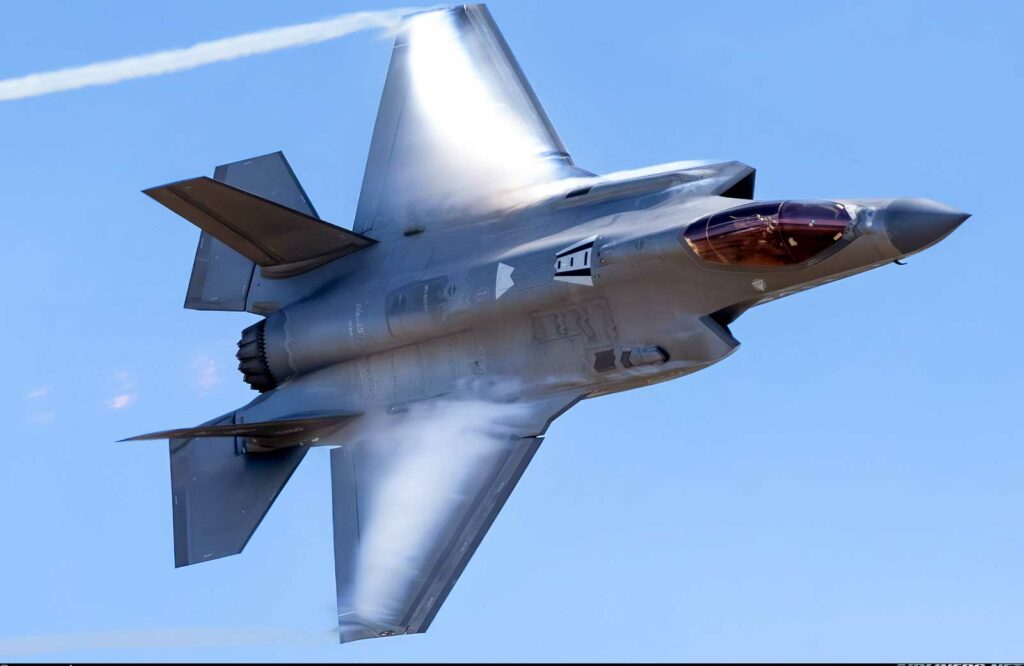
The F-35 brings several useful capabilities to this context. First, improved situational awareness thanks to its sensors and data fusion. Second, greater survivability against advanced threats. Finally, native interoperability with the United States, which is central to the NORAD framework. This last aspect is crucial. A fifth-generation aircraft is not only useful for its own performance. It is useful because it speaks the same operational language as its main ally. For Canada, which cannot defend its vast northern territory alone, this alignment is almost as valuable as the aircraft’s raw performance.
But we must avoid the opposite illusion. The F-35 does not “solve” the Arctic issue. It does not eliminate the problem of distances, the harsh climate, the dependence on a few logistical routes, or the vulnerability of forward infrastructure. Canada maintains three Forward Operating Locations in the North: Yellowknife, Inuvik, and Iqaluit. These sites remain essential for rapid deployment to northern approaches. The challenge is therefore twofold: to have a better fighter jet, but also to maintain credible northern bases. Without this, the 5th generation may remain too concentrated in the south to respond quickly enough.
The budget says one simple thing: Ottawa is first paying to catch up
The official figures paint a rather grim picture. The F-35 program is estimated at 27.7 billion Canadian dollars for its initial phase, while the modernized NORAD represents 38.6 billion over twenty years. Meanwhile, the 2023 budget documents had already requested 154.7 million to begin certain construction projects at Canadian bases, including Bagotville and Cold Lake. More recent reports show that work is continuing, studies are progressing, and additional investments are being made in radars, networks, and industrial support, particularly regarding a potential future aircraft depot with L3Harris MAS.
This budget may seem massive. It is. But above all, it reflects decades of relative underinvestment in the Canadian side of North America’s air defense. Ottawa is not funding a technological whim. It is funding a strategic catch-up that the deteriorating security environment now makes impossible to postpone. The real question is therefore no longer “why spend so much?” The real question is rather: how much would another delay cost, given that the CF-18 fleet is aging, the Arctic is becoming more contested, and NORAD is scaling up?
The transition to 5th generation will judge Canada on execution, not on announcements
Canada now has a relatively clear path forward: first aircraft at Luke AFB in 2026, training to begin that same year, continued infrastructure development at Cold Lake and Bagotville, arrival of the first aircraft in the country in 2028, gradual integration with the modernized NORAD, and strengthening of the Arctic posture.
On paper, the plan holds up. In reality, it will be judged on its execution.
That is where everything hinges. The F-35s will give Canada a more credible, more interoperable, and better-suited combat aviation force for the current strategic environment. But the aircraft itself is not the main challenge. The challenge lies in simultaneously succeeding in base construction, training, sustainability, integration with NORAD networks, and ramping up capabilities in the North. Canada no longer really lacks a clear understanding of the situation. What it still lacks is time. And in the Arctic, lost time often ends up costing more than the initial investment.
Sources
Government of Canada, Future Fighter Capability Project.
Government of Canada, Announcement regarding the F-35 acquisition, January 9, 2023.
Government of Canada, Delivering Canada’s Future Fighter Jet Capability, February 4, 2026.
Government of Canada, 2026-27 Departmental Plan.
Government of Canada, Status report on transformational and major capital projects, 2026-27.
Government of Canada, Procurement notes, Main Estimates and Supplementary Estimates, 2023-2025.
Government of Canada, NORAD modernization project timelines.
Government of Canada, National Defence announces progress on the Arctic Over-the-Horizon Radar project, July 17, 2025.
Government of Canada, Quarterly Financial Report, quarter ended December 31, 2025.
Government of Canada, Organizational structure of the Royal Canadian Air Force.
Government of Canada, Defence 101 – NORAD.
War Wings Daily is an independant magazine.