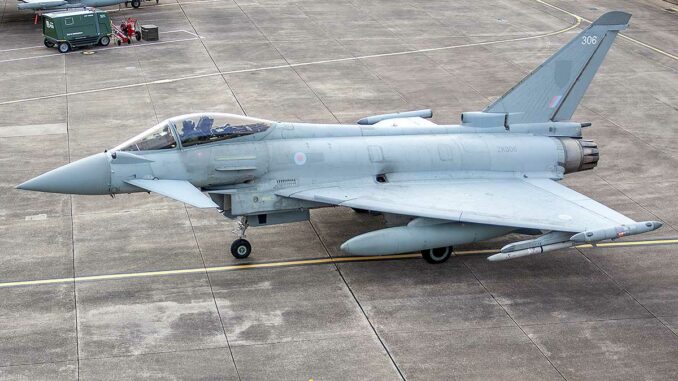
The Typhoon has surpassed one million flight hours. This major industrial milestone confirms its strengths, but also its limitations when compared to the Rafale and the Gripen.
In summary
The Eurofighter Typhoon has crossed the symbolic threshold of one million cumulative flight hours. The announcement, made by Eurofighter Jagdflugzeug GmbH in 2026 and since reported by several specialized media outlets, marks an important milestone for one of Europe’s major military programs. The figure matters. It proves that the Typhoon is no longer just an air superiority fighter designed at the end of the Cold War. It has become an everyday tool for air defense for the United Kingdom, Germany, Italy, and Spain. According to Eurofighter, it handles approximately 80% of the operational air missions of the four partner nations. But this success does not solve everything. Compared to the French Rafale, the Typhoon remains less integrated in deep multi-role capabilities. Compared to the Swedish Gripen, it is more powerful but more expensive. It is therefore excellent in its core mission, but not superior in every aspect.
The million-hour milestone confirms the Typhoon’s maturity
Reaching the one-million-hour flight milestone is more than just a marketing slogan. In military aviation, such a threshold measures an aircraft’s true maturity. It indicates that the aircraft has moved beyond the stage of industrial promise. It has accumulated years of training, alerts, deployments, air policing missions, and overseas operations.
The Eurofighter Typhoon entered operational service in the early 2000s. At the time, it was primarily designed as an air superiority fighter. Its main role was to intercept quickly, climb high, and dominate air-to-air combat. The context has changed. Russia has rearmed. NATO has strengthened its posture on the eastern flank. Quick Reaction Alert missions, Baltic Air Policing, and surveillance over the Black Sea have taken on new importance.
In this context, the Typhoon has found its natural home. It is a fast, powerful, and highly responsive aircraft. It is designed to take off quickly, climb rapidly, and intercept a target at range. This capability explains its central role in the British, German, Italian, and Spanish air forces.
The one-million-hour milestone also demonstrates the robustness of the ecosystem. Behind every flight hour are mechanics, spare parts supply chains, simulators, software, weapons, test centers, and industrial teams. The Typhoon is not an isolated aircraft. It is a robust, dynamic, and now proven European system.
The 80% figure reveals an aircraft that has become indispensable
Eurofighter states that Typhoons currently carry out approximately 80% of operational air missions for the four partner nations: the United Kingdom, Germany, Italy, and Spain. This figure speaks volumes. It means that the Typhoon is not a prestige aircraft reserved for special occasions. It is an everyday aircraft.
These missions cover a range of scenarios. The most visible is air defense. A Typhoon can scramble to identify a Russian aircraft approaching NATO airspace.
It can patrol over the Baltic Sea. It can escort, deter, monitor, or intercept. It can also participate in more complex combat missions, particularly with air-to-ground weapons, as was the case during operations in the Middle East or Libya.
This versatility is important, as the Typhoon was not initially the best European aircraft for ground attack. The Rafale was designed from the outset as a highly integrated multirole aircraft. The Typhoon, on the other hand, evolved in successive phases. Recent versions have been equipped with improved air-to-ground capabilities, precision-guided munitions, cruise missiles, modernized sensors, and electronically scanned radars.
The result is effective, but it remains shaped by its history. The Typhoon excels at interception and air superiority. It has become multi-role. But it was not originally designed with the same overall balance as the Rafale.
The EJ200 engine gives the Typhoon its kinetic advantage
The Typhoon is powered by two Eurojet EJ200 engines. The aircraft’s milestone of one million flight hours is accompanied by another figure: the EJ200s have surpassed 2 million engine hours, since each aircraft has two engines. This is an important indicator of industrial reliability.
The EJ200 is one of the Typhoon’s key strengths. Each engine delivers approximately 60 kilonewtons of thrust in dry mode and over 90 kilonewtons with afterburner. This powerplant gives the aircraft exceptional acceleration capabilities. It also allows it to climb rapidly to high altitudes. Airbus highlights the Typhoon’s ability to reach approximately 11,000 meters in two minutes, which is particularly useful for air patrol missions.
This power gives the Typhoon an advantage in air-to-air combat. The more energy an aircraft retains, the more it can maneuver, accelerate, climb, and assert its position. The Typhoon is therefore a formidable opponent against modern non-stealth fighters. With the Meteor missile, it also possesses one of the most capable long-range air-to-air weapons in Europe.
This capability comes at a price. Two engines mean more thrust, but also more maintenance, higher fuel consumption, and more complex logistics than a single-engine aircraft like the Gripen. The Typhoon is a high-end fighter. It offers a lot, but it demands a lot.
The Typhoon vs. the Rafale: Two European Philosophies
The comparison with the Rafale is inevitable. Both aircraft are European. Both are twin-engine jets. Both use a delta wing with canard wings. Both can employ the Meteor missile. Both are regularly touted as the best European fighter jets still in production.
But their philosophies differ. The Typhoon was designed as an air superiority fighter that evolved into a multi-role aircraft. The Rafale was designed from the outset as an all-role aircraft, capable of switching from an air-to-air mission to an air-to-ground or reconnaissance mission during a single sortie. This is a structural difference.
The Rafale has a lower maximum speed, at Mach 1.8, compared to approximately Mach 2 for the Typhoon. But it is highly integrated.
Its RBE2 AESA radar, its SPECTRA electronic warfare system, its forward-looking optronics, its French nuclear capability, its naval version (the Rafale M), and its varied armament make it a highly coherent aircraft. It is also supported by a single decision-making chain: Dassault Aviation, Safran, Thales, and the French Defense Procurement Agency (DGA) operate within a national framework that is simpler than that of the Eurofighter consortium.
The Typhoon retains the advantage in pure interception. It is very fast, very powerful, and highly suited for air defense. The Rafale retains the advantage in multi-role coherence, carrier-based operations, and French sovereign integration. The choice between the two therefore depends on the mission. To defend European airspace against intrusions, the Typhoon is formidable. To conduct a comprehensive air campaign, including strike, reconnaissance, deterrence, and naval projection, the Rafale is often more flexible.
The Typhoon vs. the Gripen: Power vs. Cost-Effectiveness
The Swedish Gripen plays in a different league. It is lighter, single-engine, and designed to operate with limited resources. Saab emphasizes its rapid maintenance, low operating costs, ability to take off from roads, and capacity to function within a dispersed defense network. This philosophy aligns with Sweden’s needs: an air force capable of surviving an attack on its main bases.
The Gripen E features a GE F414G engine, an AESA radar, an IRST infrared system, ten hardpoints, and modern avionics. It is therefore far from being a basic small aircraft. But it lacks the raw power, payload, and operational presence of the Typhoon.
The comparison is clear. The Typhoon is better for heavy air superiority, rapid intercepts, armed patrols, and missions where engine power matters. The Gripen is better for countries that want a modern aircraft that is simpler to operate, requires less infrastructure, and is better suited to limited budgets.
This is why the Gripen appeals to air forces that cannot or do not want to bear the cost of a heavy twin-engine jet. It does not replace the Typhoon in its most demanding role. It offers a different solution: less power, but greater budgetary and operational flexibility.
The Typhoon versus older European aircraft
The comparison must also include older European aircraft: the Tornado, Mirage 2000, Spanish F/A-18 Hornets, Italian AMXs, or MiG-29s still in use by some European countries prior to their retirement. In this regard, the Typhoon has no real direct rival.
Compared to the Tornado, it is more modern, more agile, better suited for air-to-air combat, and capable of being upgraded with new sensors. The Tornado had remarkable capabilities for low-altitude penetration and certain specialized missions, but it belongs to a bygone era. Germany, in fact, plans to deploy a Typhoon EK electronic warfare variant to take over some of the Tornado ECR’s missions.
Compared to the Mirage 2000, the Typhoon offers superior power, avionics, and modernization potential. The Mirage 2000 remains an elegant and effective aircraft, but its airframe and room for growth are more limited.
Compared to the Spanish F/A-18s, the Typhoon offers a clear modern edge, particularly with the Halcon I and Halcon II programs designed to replace some of the Hornets.
Within European forces, the Typhoon is therefore one of the few aircraft capable of lasting until the arrival of next-generation combat systems. It is not stealthy. It is not as integrated as the F-35 in terms of data fusion. But it remains a solid platform for the 2030s, especially with E-Scan radars, new weapons, and electronic upgrades.
The program remains hampered by its industrial complexity
The Typhoon is an operational success. But it also remains an example of a complicated European program. The consortium brings together the United Kingdom, Germany, Italy, and Spain, with BAE Systems, Airbus, and Leonardo. This structure has preserved expertise in Europe. It has supported thousands of jobs. Eurofighter highlights more than 100,000 skilled workers and over 400 companies involved in the program.
But this structure has also slowed down certain decisions. Successive variants, differing standards, national schedules, and fragmented modernization efforts have at times complicated the aircraft’s evolution. The Rafale, designed within a French national framework, has benefited from a more direct decision-making chain. This partly explains its consistent capabilities and its export success since the 2010s.
The Typhoon is thus paying the price for its European DNA. It is politically valuable and industrially vast, but technically less straightforward to develop than an aircraft led by a single state and a clearly identified prime contractor. This lesson carries significant weight today in debates over the SCAF and the GCAP. Europe knows how to build excellent aircraft, but it often struggles to manage its programs with discipline.
New orders show that the Typhoon is not at the end of its life cycle
The one-million-hour milestone comes at a particular moment. The Typhoon could have appeared to be an aging program, caught between the Rafale, the F-35, and future sixth-generation aircraft. Yet recent orders show the opposite.
Germany has ordered 38 Quadriga aircraft and approved a new batch of 20 aircraft. Spain has ordered 20 Eurofighters under the Halcon I program, followed by 25 additional aircraft under Halcon II. Italy has signed an order for up to 24 new aircraft. In 2025, Turkey signed a major agreement with the United Kingdom for 20 Eurofighters, with the aim of rapidly strengthening its fighter fleet.
These orders are not merely industrial in nature. They reflect an immediate European need: to replace aging fleets, strengthen air defense, and maintain an active industrial base before the arrival of future systems. In short, the Typhoon is becoming a bridge. It must hold the line until the 2040s.
This position is strategic. If the SCAF falls behind schedule and the GCAP is delayed, European air forces will need modernized aircraft for longer than expected. The Typhoon can fulfill this role, provided its upgrades keep pace with evolving threats.
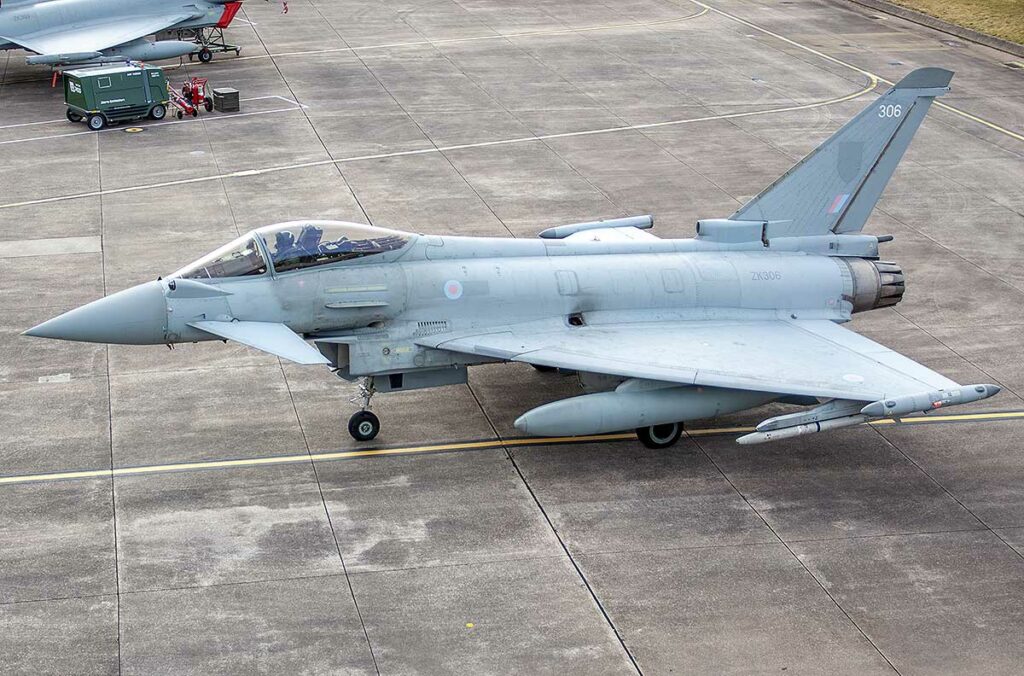
The comparative assessment is clear: excellent, but not universal
The question “is it better or worse?” calls for a precise answer. The Typhoon is better than the Rafale in some areas, but not in all. It is better than the Gripen in raw power, but falls short in terms of cost and ease of use. It is superior to older European aircraft, but lacks the stealth capabilities of the F-35.
Its strongest area remains air defense. For taking off on alert, climbing quickly, intercepting, patrolling with long-range missiles, and playing a central role in NATO, the Typhoon is one of the best European aircraft. Its power, modernized radar, IRST, defensive system, and integration of the Meteor make it a very formidable fighter.
Its relative weakness is complexity. Industrial complexity, complexity of standards, operating costs, and dependence on multiple nations for certain upgrades. It is not a lightweight aircraft. Nor is it the simplest tool for a small air force. It shines when supported by a well-structured air force.
The Rafale remains the more balanced choice for a power seeking to do everything with a single aircraft: air defense, strike, reconnaissance, nuclear operations, naval operations, and sovereign export. The Gripen remains the best European choice for an air force seeking a modern yet lighter solution. The Typhoon, meanwhile, remains Europe’s premier interceptor, having become multi-role out of necessity and through modernization.
The Million-Hour Milestone Offers a Lesson for European Defense
Reaching the one-million-hour flight milestone gives the Typhoon a legitimacy that is hard to dispute. An aircraft does not survive more than twenty years of active service and one million cumulative flight hours by chance. It requires a solid industrial base, real operational demand, and armed forces that continue to place their trust in it.
But this milestone also tells a more political story. Europe already has a powerful, mature fighter jet produced by several major nations. Yet it remains fragmented between the Typhoon, Rafale, Gripen, F-35, and future competing programs. This fragmentation weakens production volumes, complicates standards, and reduces the collective impact against the United States.
The Typhoon proves that Europe knows how to produce a top-tier fighter jet. It also proves that European cooperation can work when sustained over the long term. But it highlights a limitation: cooperation is not just about sharing a program. It means accepting clear leadership, common standards, and rapid modernization.
The one million flight hours milestone therefore does not close the debate. It opens it. The Typhoon is an operational success. It is not the answer to all of Europe’s needs. Its future will depend on its ability to rapidly integrate AESA radars, electronic warfare, long-range weapons, and connected architectures. In the European skies of the 2030s, performance will no longer be measured solely by speed. It will be measured by the ability to survive, share information, and strike before the adversary.
War Wings Daily is an independant magazine.