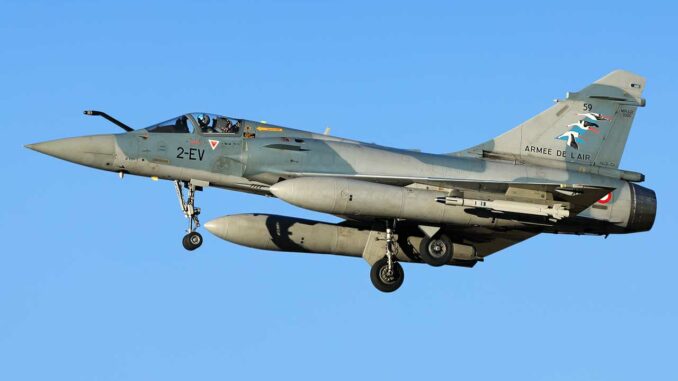
Paris is offering Athens the chance to send its Mirage 2000s to Kyiv in exchange for cheaper Rafales. A useful military deal, but one that is costly and risky.
In summary
France has reportedly proposed a strategic exchange to Greece: transferring its entire fleet of Mirage 2000s—43 aircraft, including 24 Mirage 2000-5s—to Ukraine in exchange for preferential terms to purchase a comparable number of Rafales. The idea makes military sense. Athens wants to streamline its air force around the Rafale, the F-16V, and the future F-35. Kyiv lacks Western aircraft to defend its airspace against missiles, drones, and Russian aircraft. Paris seeks to support Ukraine without further depleting its own stockpiles. But the operation raises real questions. Who will pay for the discount granted to Greece? Will the Mirage aircraft be donated, purchased, or traded? What condition are the oldest aircraft in? And above all, will French taxpayers indirectly finance a new Rafale order to enable a transfer to Ukraine? The arrangement is clever. It doesn’t come for free.
The proposed deal turns Greece’s old Mirage aircraft into strategic currency
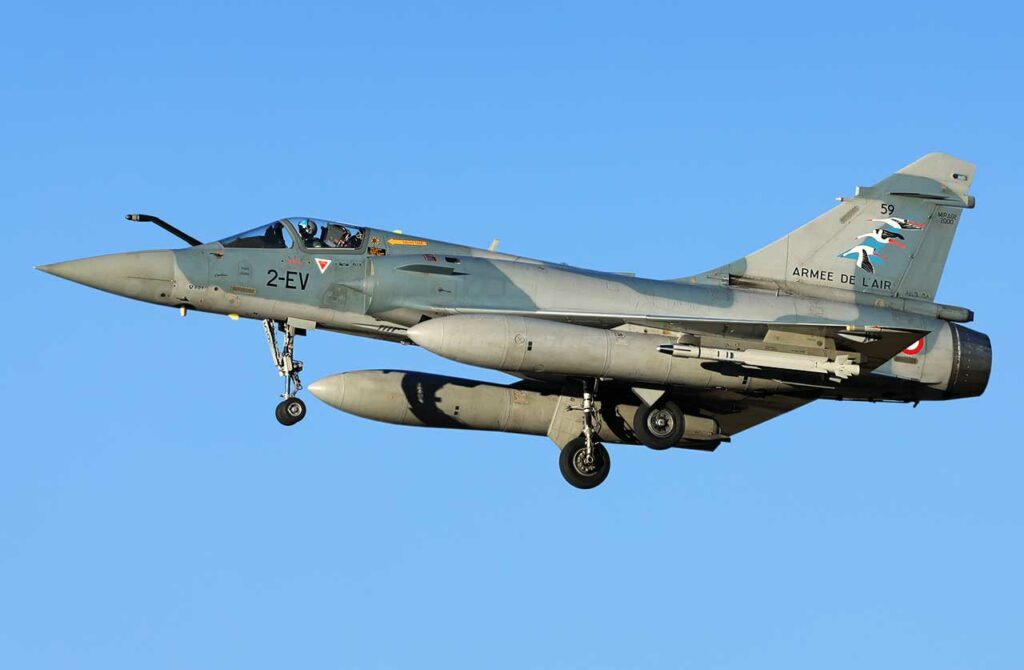
The deal is based on a simple idea. Greece still possesses a fleet of Mirage 2000s inherited from several waves of acquisitions. It reportedly includes 43 aircraft, comprising 24 Mirage 2000-5s and 19 older Mirage 2000 EGM/BGMs. Not all of them are necessarily operational. The EGM/BGM versions have already been retired or placed in reserve as part of the Hellenic Air Force’s rationalization.
The French proposal would involve removing these aircraft from the Greek fleet and redirecting them to Ukraine. In exchange, Athens would receive additional Rafales at a reduced price, potentially in a configuration close to the standard Rafale F4.3. The arrangement looks elegant: Greece modernizes its air force, Ukraine receives aircraft that are ready for use more quickly than brand-new Rafales, and France strengthens Dassault Aviation’s role as a major supplier in Europe.
But we must be precise. At this stage, this is not a finalized government contract. The proposal was reported by the French press and picked up by several specialized media outlets. It comes in the context of Emmanuel Macron’s visit to Athens on April 24 and 25, 2026, and the renewal of the Franco-Greek strategic partnership concluded in 2021.
The issue is therefore political before it is industrial. Paris is testing a formula for supporting Ukraine that does not rely solely on French stockpiles. Athens is exploring whether it can accelerate its transition to higher-tier aircraft. Kyiv is seeking additional aircraft. The crux of the matter is financial.
Greece Wants to Move Away from an Overly Fragmented Air Force
The Hellenic Air Force has long operated with a highly heterogeneous fleet: Mirage 2000s, F-16s of various models, F-4 Phantom IIs, and later Rafales. This diversity provides flexibility under normal circumstances. It becomes costly during periods of modernization.
Each type of aircraft requires its own pilots, mechanics, parts, simulators, weapons, maintenance contracts, and supply chains. For a country that must monitor the Aegean, maintain a posture against Turkey, and invest in air defense, this dispersion is expensive.
Greece has already ordered 24 Rafale F3R aircraft. The first contract, signed in 2021, covered 18 aircraft, including 12 used ones sourced from French stocks and 6 new ones. Its value was close to 2.5 billion euros, including weapons, support, training, and infrastructure. A second contract, signed in 2022, added 6 new Rafales, for approximately 1.09 billion euros according to several public estimates.
Athens is therefore not starting from scratch. The Tanagra base already hosts the Rafale. Greek pilots are trained. The technical infrastructure is in place. Purchasing more Rafales would allow for the replacement of the Mirage, the simplification of the fleet, and an increase in long-range strike capability.
Greece is also looking toward the American F-35. It plans to acquire 20 F-35As, with an option for 20 additional aircraft. Its future air force could therefore rest on three pillars: the F-16V, the Rafale, and the F-35. In this scenario, the Mirage 2000 no longer really has a place.
The Mirage 2000-5 remains useful for Ukraine, but it’s no miracle worker
For Ukraine, the Mirage 2000-5 offers immediate value. It is not a Rafale. It is not an F-35. But it is a credible Western aircraft, already designed for air defense, equipped with an RDY or RDY-2 radar depending on the version, capable of employing MICA missiles and carrying out interception missions.
The Mirage 2000-5 can detect multiple targets, track them simultaneously, and fire modern air-to-air missiles. The RDY radar allows for the tracking of numerous targets and the firing of multiple MICA missiles. In the Ukrainian context, this can be used to intercept drones, cruise missiles, tactical bombers, or Russian aircraft operating from a distance.
France has already delivered Mirage 2000-5s to Ukraine in 2025. The first aircraft arrived in February 2025, following several months of training for Ukrainian pilots in France. This alleviates part of the problem. Ukraine already has a nascent Mirage fleet. It would not have to start from scratch with the aircraft.
But the limitations are real. The Mirage 2000-5 lacks the range, avionics, data fusion, and versatility of a Rafale. Its MICA missiles remain effective, but their practical range is shorter than that of the best latest-generation Western air-to-air missiles. In a war where Russian fighters sometimes fire from long distances, this gap matters.
The Mirage 2000-5 would therefore be most useful for air defense, protecting sensitive areas, intercepting drones and missiles, and certain strike missions if the aircraft are adapted. It will not single-handedly change the balance of air power. But it can add depth to a Ukrainian air force that is still too limited.
The transfer of the Mirage jets would likely not be paid for directly by Kyiv
The issue of payment is central. Ukraine does not have the means to finance the purchase of a fleet of Mirage jets, their maintenance, training, spare parts, and armaments on its own. Since 2022, Western air support has primarily relied on donations, offset transfers, allied funding, or European mechanisms.
In the scenario described, it is unlikely that Kyiv would pay the full value of the Greek Mirages directly. The arrangement would more closely resemble a triangular compensation deal. Greece would transfer its Mirage jets. France would offer a discount on new Rafale jets. Ukraine would receive the aircraft along with logistical support and likely associated armaments. The financial burden would be shared among Athens, Paris, possibly European funds, and perhaps aid mechanisms for Ukraine.
There is currently no basis for asserting that the transfer would be profitable for Ukraine in the traditional commercial sense. The most realistic scenario is that of a politically funded transfer: the Greek aircraft would be sent to Kyiv, while Greece would receive compensation in the form of a preferential price on Rafale jets.
The real question, then, becomes: who absorbs the discount? If Dassault Aviation agrees to reduce its margin, the direct impact on the French taxpayer is limited. If the French government compensates for the reduction, finances weapons, supports the modernization of the Mirage fleet, or accelerates deliveries by replacing aircraft, the public cost becomes higher.
Let’s be frank: this type of agreement is never free. Even when presented as an exchange, it involves commercial discounts, industrial support, training, parts, ammunition, technical adaptations, and political guarantees.
French taxpayers can benefit, but only under certain conditions
The benefit for French taxpayers depends on the exact structure of the contract. Without transparency regarding discounts, we must consider various scenarios.
The first scenario is favorable. Greece purchases a large number of Rafales at a reduced but still profitable price. Dassault, Safran, Thales, and MBDA benefit from a major order. The Rafale production line runs faster. Industrial jobs are sustained. Ukraine receives Mirage jets without France having to draw heavily from its own fleet. In this case, the French taxpayer is primarily financing a diplomatic and industrial effort. The cost is real, but it also supports the national defense economy.
The second scenario is more ambiguous. France grants Athens a significant discount and indirectly offsets the cost through public financing, guarantees, military support, or aid funding for Ukraine. If the discount amounts to several hundred million euros, or even more, the operation becomes disguised public spending. It can be justified by support for Kyiv and by the strengthening of the Franco-Greek partnership. But it must be treated as such.
The third scenario would be bad for taxpayers. France would finance a large portion of the cost difference, cover the refurbishment of the Mirage jets, supply weapons, train the Ukrainians, and accept manufacturing delays that disrupt its own orders. In this case, the industrial benefit could be partially offset by the budgetary cost.
To give an order of magnitude, the first 18 Greek Rafales cost approximately 2.5 billion euros, including weapons, support, and training. The six additional Rafales were valued at around 1.09 billion euros. A package involving several dozen Rafales could therefore easily reach 7 to 9 billion euros depending on the equipment included. A 15% discount would already amount to over one billion euros on a contract of this size.
The French taxpayer may therefore find strategic and industrial value in this. But only if the government does not turn a commercial discount into a massive, unaccounted-for subsidy.
The timeline would be fast for the Mirage, slow for the Rafale
The transfer of the Mirage could proceed faster than the arrival of new Rafale. This is one of the benefits of the operation.
The Greek Mirage 2000-5s already exist. They have a maintenance chain, spare parts, and operational experience. Ukrainian pilots have already begun training on French Mirage 2000-5s. France is familiar with the aircraft and can play the role of technical integrator. If a political agreement were signed quickly, the first aircraft could theoretically reach Ukraine within a few months.
But transferring 43 aircraft does not mean delivering 43 operational aircraft. The 19 older Mirage 2000 EGM/BGMs could primarily serve as a parts reserve, training aircraft, or a source for cannibalization. Refurbishing them would be costly and time-consuming. The 24 Mirage 2000-5s are the most promising, but their availability, remaining service life, equipment, compatible weaponry, and suitability for Ukrainian needs would need to be verified.
For the Rafales, the timeline would be longer. Dassault’s production line is already fully booked with French and export orders. Deliveries to Greece could not happen immediately, unless Paris agreed to draw aircraft from its own stockpiles once again. This option would be politically sensitive, as the French Air and Space Force has already transferred used Rafales to Greece and Croatia.
A realistic timeline could therefore be asymmetrical: Greek Mirages to Ukraine fairly quickly, followed by Rafales to Greece gradually over several years. This is effective for Kyiv, but delicate for Athens. Greece will not want to part with still-useful aircraft too soon if it has no firm guarantee of replacement.
The Rafale F4.3 standard would give Athens a significant capability boost
The Rafale F4.3, if selected, would represent a clear capability upgrade for Greece. The F4 standard is designed to improve connectivity, electronic warfare capabilities, the use of modern weapons, predictive maintenance, and integration into collaborative combat operations.
The DGA certified the F4.1 standard in 2023. The next steps are intended to extend this modernization. The F4.3 is presented as an evolution preparing the Rafale for the transition to the future F5 standard, which is expected to incorporate more advanced capabilities, particularly in cooperation with drones and new weapons.
For the Hellenic Air Force, having more Rafales upgraded to the F4.3 standard would better align with Greece’s defense ambitions. Depending on the configuration, the Rafale can employ the Meteor air-to-air missile, the SCALP cruise missile, AASM guided bombs, and Exocet anti-ship weapons, and benefit from the SPECTRA electronic warfare system. In the Aegean environment, this combination matters.
Faced with Turkey, which is modernizing its air force, developing its drones, seeking to strengthen its air defense, and pursuing its own fighter programs, the Rafale remains a sign of qualitative superiority. Athens is not merely seeking to replace Mirages. It is seeking to maintain a technological advantage.
The deal would therefore be very attractive to Greece if the price is truly competitive and the delivery timelines are credible.
France Seeks to Build a Mirage Coalition for Ukraine
France no longer has enough Mirage 2000-5s available to meet Ukrainian needs on its own. This is the underlying reason for the arrangement with Greece. Paris wants to expand its supplier base, as the United States and several European countries have done for the F-16s.
Ukraine needs a more robust Western air force. The F-16s provide an initial capability. The Mirage 2000-5s add another option. The future Rafales mentioned in a Franco-Ukrainian letter of intent are part of a longer-term plan. In the short term, the Greek Mirages would be a more realistic option than brand-new Rafales.
Why do this? First, to strengthen Ukraine’s air defense. Russian attacks combine cruise missiles, Shahed drones, glide bombs, and remotely piloted aircraft. Second, to spread the load on the F-16s. Finally, to provide Kyiv with aircraft capable of using certain Western weapons and better integrating into its defense systems.
The risk is fragmentation. Ukraine already operates Soviet aircraft, F-16s, Mirages, and potentially other Western systems in the future. Each new fleet adds complexity. Pilots, mechanics, armament specialists, simulators, and spare parts become harder to manage.
The Greek Mirage fleet can help. But it must be accompanied by a real logistics plan. Otherwise, it will become a symbolic fleet—politically useful but difficult to maintain.
The deal reveals France’s new arms diplomacy
This proposal illustrates a shift in French policy. Paris is no longer content to simply deliver equipment directly. It seeks to organize triangular deals: an allied country offloads equipment useful to Ukraine, receives compensation or modernization, and French industry secures an order.
The logic is sound. It allows for supporting Kyiv, preserving French stockpiles, and strengthening the national industry. It can also give France a role as an architect of European security.
But it carries a risk of misperception. If the operation is seen as a way to sell Rafale jets at a discount by using Ukraine as a justification, it will be criticized. If it is clearly presented as a mechanism for military support to Kyiv and Greek modernization, it can be defended.
Transparency will therefore be essential. French and Greek taxpayers will need to understand who is paying for what. The Ukrainians will need to know how many aircraft will actually be operational. Manufacturers will need to explain the timelines. And governments will need to acknowledge that the war in Ukraine is costly, even when the cost is incorporated into broader contracts.
The real test will be operational value, not the elegance of the deal
The Mirage-Rafale swap has all the makings of an attractive deal. It streamlines the Greek fleet. It strengthens Ukraine. It supports Dassault Aviation. It consolidates the Franco-Greek partnership. It gives Paris an active role in arming Kyiv.
But the value of the deal will be judged on three points.
The first is the number of aircraft that are actually operational. If Ukraine receives only a few airworthy Mirage 2000-5s, the impact will be limited. If it obtains a coherent fleet, complete with parts, missiles, training, and support, the effect will be more significant.
The second is the actual cost to France. A moderate commercial discount may be acceptable. A massive disguised subsidy would be more questionable, especially in a tight budgetary context.
The third is the timeline. An aircraft delivered in six months can change an air defense campaign. An aircraft delivered in three years follows a different logic.
This proposal shows one thing: Europe is entering a phase where aging fleets are becoming strategic resources. The Greek Mirages are no longer just aircraft nearing the end of their service life. They are becoming diplomatic levers, bargaining chips, and tools of war. The true cost of the deal will not be found solely in the Rafale bill. It will be measured by Kyiv’s ability to transform these aircraft into a useful air defense capability, and by Paris’s ability to finance its ambition without hiding the bill from taxpayers.
War Wings Daily is an independant magazine.