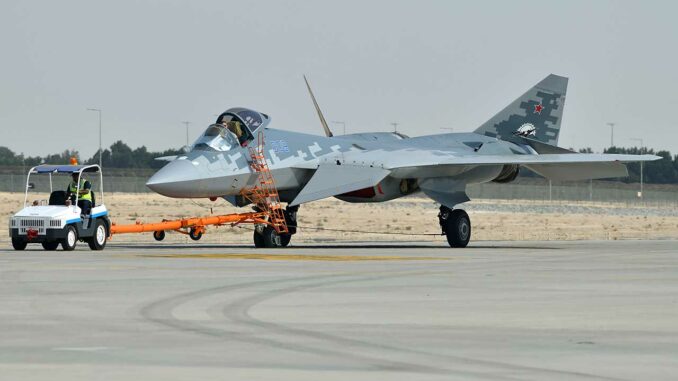
RCS, “0.1 to 1.0 m²” versus “0.0001 m²”: the controversy surrounding the Su-57’s stealth capabilities sheds light on its real value in combat and on the market.
Summary
The Su-57 Felon is presented by Moscow as a 5th generation fighter. The most viral criticism targets its stealth and radar cross section (RCS). Analysts estimate the Su-57’s RCS to be between 0.1 and 1.0 m², while the F-35 is often credited with an order of magnitude around 0.0001 m² in clean configuration and at certain angles. While these figures are debated, the difference suggests a potentially more detectable aircraft than its American rivals. The controversy is not limited to a duel of numbers: it touches on design (air intakes, nozzles, coatings), Russian doctrine (multiple sensors, supercruise, maneuverability), and exports. In combat, stealth is not everything, but it does affect engagement distance and survivability. In the marketplace, perception counts as much as performance.
The definition of stealth that is more than just a slogan
Stealth is not invisibility. It aims to reduce the probability of detection, identification, and engagement. At the heart of the debate is radar cross section (RCS), expressed in square meters. It depends on the shape of the aircraft, its materials, its absorbent coatings, the angle of illumination, and the radar frequency band.
An RCS of 0.0001 m² for the F-35 corresponds to a very low signature, often cited for optimized frontal angles and a configuration without external loads. Public estimates for the Su-57 range from 0.1 to 1.0 m². These are orders of magnitude derived from open analysis, not certified data. But the difference is significant: a difference of three to four orders of magnitude can translate into significantly longer detection distances, all other things being equal.
The relationship is not linear, but the detection range of a radar increases approximately with the fourth root of the RCS. In other words, multiplying the RCS by 10 does not increase the range by 10, but it does make it significantly greater. In a theater saturated with sensors, those extra kilometers matter.
The design of the Su-57 and the technical choices that fuel criticism
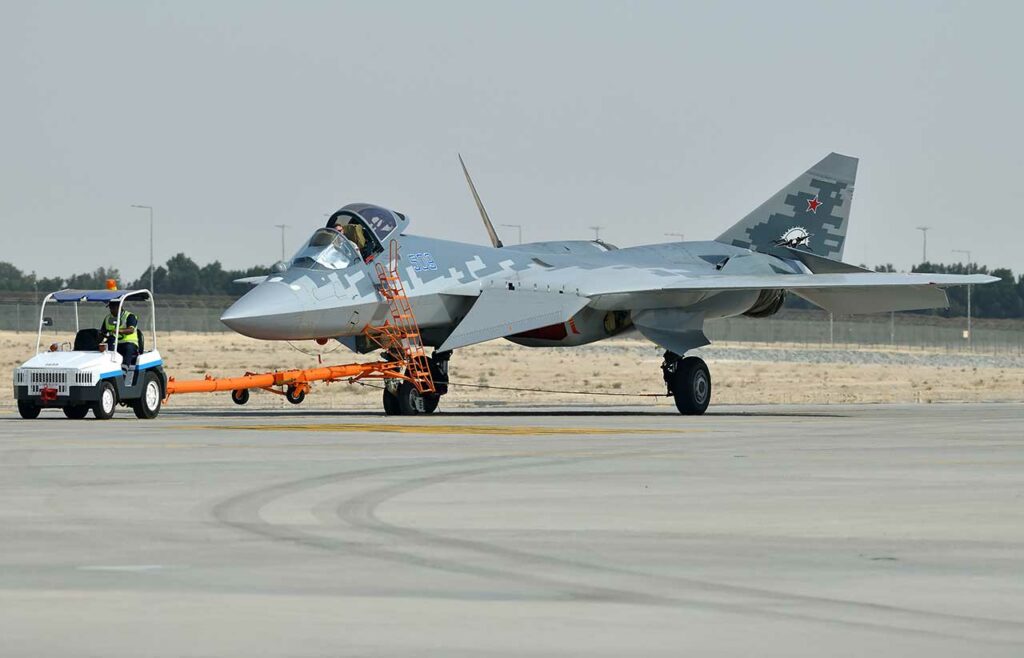
The Su-57 features angular lines, slanted air intakes, and internal fuel tanks. It ticks several boxes for a low-signature aircraft. However, certain technical choices are regularly criticized.
First, the circular nozzles of the early engines. Fifth-generation American aircraft have invested in solutions to reduce infrared and radar signatures at the rear. The Su-57 retained conventional nozzles for a long time, before the gradual arrival of the “Izdeliye 30” engine. Even with this engine, the reduction in rear signature remains a matter of debate.
Next, the geometry of the air intakes and the absence of certain internal devices to mask the compressor blades, which are highly reflective to radar. Observers have also noted that the hatches and joints are less optimized than on the F-22 and F-35, where the alignment of edges and continuity of surfaces are taken to extremes.
Finally, there are the absorbent coatings. Stealth is not just about shape. It depends on specific layers and materials that are expensive and require a lot of maintenance. The United States has invested heavily in these technologies since the 1980s. Russia has developed its own solutions, but their industrial maturity and durability in service remain less well documented.
The initial perception of a “stealth” fighter and the announcement effect
Why did we initially believe in equivalent stealth? First, because the Su-57 was presented as a “5th generation” aircraft. In military language, this label includes stealth. Secondly, because the first images and demonstrations highlighted super-maneuverability, supercruise, and an in-bunkers arsenal, all elements associated with this generation.
Russia also communicated about an AESA radar (N036 Byelka) and a set of distributed sensors, including L-band side sensors integrated into the leading edges. These sensors can detect stealth targets at certain frequencies. This doctrinal choice suggests a different approach: accepting partial stealth, but compensating with a variety of sensors and high maneuverability.
There has therefore been a mixture of publicity, terminology, and quick comparisons with the F-22 and F-35. The industrial reality is more nuanced. The Su-57 fleet remains limited, with only a few dozen aircraft produced at this stage. The program has experienced delays, particularly with the final engine.
The operational impact of higher RCS
In modern combat, early detection offers a decisive advantage. If an aircraft is detected earlier, it can be tracked, targeted, and engaged at longer ranges, particularly with long-range air-to-air missiles.
An estimated RCS of between 0.1 and 1.0 m² does not make the Su-57 as vulnerable as a 4th generation fighter loaded under the wing. It remains more discreet than a Su-35 or an F-15 in external configuration. But when faced with an F-35 with an extremely low signature, the difference can reduce the element of surprise.
This does not mean that the Su-57 would be “lost” in advance. Air warfare is not just about RCS. It includes electronic warfare, data links, coordination with ground-to-air systems, and missile quality. Russia is promoting missiles such as the R-77-1 or the future K-77M, as well as jamming capabilities.
Actual engagement would depend on many parameters.
However, if the signature gap is real, it could influence the distance at which a Western AESA radar would detect the Su-57, and therefore the engagement window. In a duel between stealth aircraft, a few dozen kilometers can make all the difference.
The impact on the export market and industrial credibility
In the international market, perception matters. Customers investing tens of billions of euros over 30 years are looking for technological assurance. The F-35 benefits from a large user base in Europe and Asia, which creates a network effect.
The Su-57, on the other hand, has struggled to attract partners. India has withdrawn from the FGFA program. Algeria is regularly cited as a potential customer, but public confirmations remain limited. If the controversy over the Su-57’s stealth capabilities continues, it may slow down purchasing decisions.
A potential customer compares not only the advertised performance, but also maturity, serial production, and integration into a coalition. In this context, the perceived RCS gap may weigh more heavily than aerodynamic qualities.
Comparison with the F-35 and the limitations of public figures
Caution is needed. The RCS figures published in the press are estimates. Actual values vary depending on angle, radar frequency, and configuration. An F-35 with external loads sees its signature increase. A Su-57 in “clean” configuration can reduce its signature.
The comparison “0.1 to 1.0 m² versus 0.0001 m²” is striking, but it simplifies a multidimensional problem. Effective stealth also depends on mission discipline, radar emission management, and network integration.
That said, if we accept these orders of magnitude, the theoretical advantage in detection remains on the American side. The United States has spent decades refining signature reduction, starting with the F-117 and then the F-22. The F-35 benefits from this legacy.
The Russian strategy behind “sufficient” stealth
Russia seems to have adopted a pragmatic approach. Rather than aiming for extreme stealth, which is costly and difficult to maintain, it has sought a compromise: partial signature reduction, super-maneuverability, multiple sensors, and long-range missiles.
This choice may be consistent with a doctrine focused on integrated air defense. In an environment covered by ground-based radars and S-400 or S-500 systems, the Su-57 does not operate alone. It is part of a network.
But this model assumes a defended airspace and solid coordination. In long-range projection or limited coalition operations, the advantage of highly advanced stealth once again becomes central.
The reality of an “illusion” that is more political than technical
To speak of an “illusion” of stealth is an exaggeration. The Su-57 is not a non-stealth aircraft. It incorporates signature reduction elements. The question is whether it achieves the level of stealth of the F-22 and F-35. Public estimates suggest that it does not.
The issue goes beyond technology. It touches on strategic credibility and industrial competition. In an image war, a viral figure can influence political decisions. In a real war, stealth remains a multiplier, not a guarantee.
This debate reminds us of a simple truth: the 5th generation is not a magic label. It is based on a balance between signature, sensors, network, and logistics. While the Su-57 offers partial stealth combined with high aerodynamic performance, it remains an advanced aircraft. But if the RCS gap is as wide as some estimates suggest, the advantage of first detection will remain a key asset for its Western rivals.
Sources
US Air Force Fact Sheet F-35A Lightning II
US Air Force Fact Sheet F-22 Raptor
RAND Corporation public analyses on stealth and radar detection
Jane’s Defense Weekly, files on the Su-57
CSIS Missile Defense Project, publications on modern air warfare
War Wings Daily is an independant magazine.