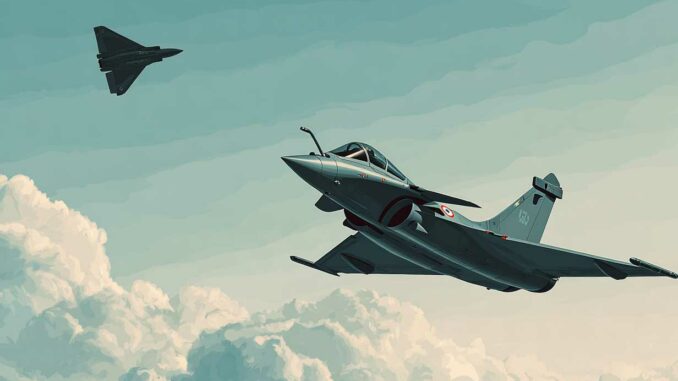
France is accelerating the Rafale F5 and its stealth combat drone. Behind the announcement lies an industrial, nuclear, and strategic choice in response to the F-35 and the SCAF deadlock.
In summary
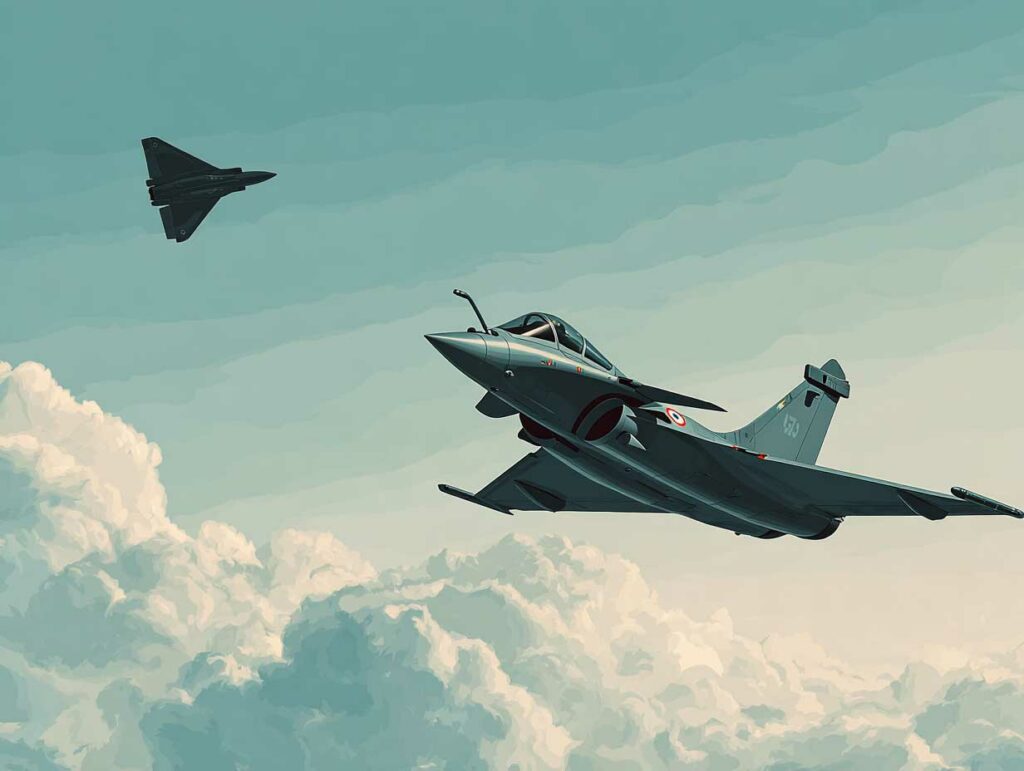
The Rafale F5 is not just a simple update. It is a turning point. Paris has confirmed that this standard, expected from 2030, will incorporate a stealth combat drone derived from the nEUROn program. The objective is clear: to bring French combat aviation into a collaborative combat mindset, where a piloted fighter acts with an unmanned vector capable of penetrating further, faster, and with less human risk. The signal is also industrial. France wants to maintain a sovereign technological base at a time when the SCAF/FCAS is bogged down between increasingly divergent French and German requirements. The issue is therefore not only technical. It is doctrinal, budgetary, and political. The Rafale F5 serves as a response to the F-35, a bridge to the post-2040 era, and a safety net if the Franco-German-Spanish program continues to fragment.
France’s decision to accelerate the Rafale F5 is not simply a matter of timing
The official framework already exists in French law. The 2024-2030 military programming law explicitly states that the Rafale F5 standard will be developed over the period, with, in black and white, an escort drone based on the work of the nEUROn demonstrator. This point is important: it is no longer just an idea or a marketing concept. It is a capability orientation enshrined in national planning.
The Ministry of the Armed Forces then reinforced the message in 2025. Its official communication on the Rafale F5 explains that this standard, expected in 2030, should “increase tenfold” operational capabilities and that it will be accompanied by a stealth combat drone. In other words, Paris is not only preparing an improved Rafale; it is preparing a broader combat system, centered around a manned aircraft, sensors, weapons, and a more penetrating unmanned vehicle.
The formal launch of the drone program was announced on October 8, 2024, by Sébastien Lecornu, during the 60th anniversary of the Strategic Air Forces in Saint-Dizier. Dassault presented it as a complement to the future Rafale F5 “after 2030,” contributing to the technological and operational superiority of the Air and Space Force by 2033. The timeline is therefore clear: Rafale F5 around 2030, stealth drone around 2033.
The French “Loyal Wingman” drone marks a change in doctrine
The term “Loyal Wingman” is convenient, but we need to be precise. The future French drone is not simply a remotely piloted wingman designed to serve as a decoy.
Dassault says it will be designed for collaborative combat, with stealth capabilities, internal cargo capacity, and autonomous control with a human in the loop. This means that the machine will be able to carry out part of the mission with a high degree of local decision-making autonomy, but under human supervision for critical decisions.
This is where the breakthrough lies. Until now, the dominant logic has been that of the piloted multirole fighter, even enhanced by data fusion. With the Rafale F5 + UCAV tandem, France is shifting to an architecture where survivability and effectiveness also come from risk distribution. The pilot retains overall tactical decision-making authority. The drone, meanwhile, can advance into areas with the densest ground-to-air defenses, capture, jam, strike, or open a passage. The gain is not only offensive. It reduces the pilot’s exposure in the first minutes of a raid.
The A2/AD issue is central. Modern access denial zones combine long-range radars, multi-layered surface-to-air missiles, electronic warfare, data links and, increasingly, passive detection. Faced with this, sending a manned aircraft alone becomes costly in terms of risk and resources. An autonomous stealth drone, more expendable than a piloted fighter, can saturate, probe, or disrupt this defensive bubble. This is precisely the logic that the major air powers are seeking today. The French announcement is in line with this trend, but with a sovereign ambition and not under American dependence.
The future aircraft inherits the nEUROn, but changes scale
The nEUROn was only a demonstrator, but a serious one. The program was launched in 2003, led by Dassault with six European countries, and its first flight took place in December 2012. According to Dassault, more than 170 test flights were carried out. It is this foundation that now serves as the technological basis. It is important to remember this because it changes everything: France is not starting from scratch. It is capitalizing on more than 20 years of real work in stealth, aerodynamics, system architecture, and UCAV integration.
However, the new aircraft is not a renamed nEUROn. Several specialist sources indicate that it will be similar in size to a Mirage 2000, and therefore much larger than the initial demonstrator. Aviation Week describes it as an aircraft similar in size to the Mirage 2000, and other analyses converge on a takeoff weight significantly higher than the nEUROn, similar to that of the first Mirage 2000s. This suggests a UCAV designed not for demonstration purposes, but to carry fuel, sensors, and internal weapons with real tactical endurance.
Another strong clue: several technical sources mention the use of a Safran M88, the Rafale’s engine. If this architecture is confirmed, the industrial logic is clear. Reusing an engine that is already in production, already supported, and already known to the forces reduces development risk and speeds up production.
This is a classic French approach: innovate on the overall architecture, while limiting unnecessary risks on critical components when the schedule is tight.
Industrial launch poses a very real problem of pace
Talking about “industrial launch” means looking at factories, not just models. In this area, France has already secured a production base: the DGA has ordered 42 Rafales for delivery at the end of 2023, the fifth tranche known as “tranche 5.” Dassault has stated that this order guarantees production activity for the next decade. According to official communications, the first aircraft in this tranche is due to be delivered in 2027.
But that is not enough. The Rafale industry is now under pressure to maintain production rates. Reuters reported in March 2025 that Dassault was aiming for 25 Rafale deliveries in 2025, following a sharp rise in sales and with a very full order book. Other information published subsequently shows that the group delivered 26 Rafales in 2025, while maintaining a production rate of less than three aircraft per month. The bottleneck is therefore not demand. The bottleneck is the ramp-up of the entire chain: structures, engines, electronics, subcontracting, and testing.
The stated target is higher. Industry communications from 2025 indicate planned production rates of four aircraft per month. The political signal in March 2025 was along the same lines: Emmanuel Macron announced an acceleration of Rafale orders, while Reuters and Le Monde noted that Dassault should increase its current rate to four aircraft per month by 2028. If the Rafale F5 arrives at the same time, the pressure on the French industrial base will be twofold: to continue delivering F4/F4.x aircraft, then to gradually switch to the F5 without breaking stride.
The future drone adds another layer of complexity. A stealth UCAV is not just another product. It requires specific processes, stricter tolerances, advanced materials management, critical software, and a different test chain. So the real question is not “can we develop it?” France has already proven that it can do it. The real question is: can it produce it at a useful rate while maintaining Rafale exports, Rafale France, and preparation for the F5 standard? This is where the credibility of the industrial launch will be played out.
Technological sovereignty is the real driving force behind the program
Dassault’s official line is clear: the Rafale F5 + UCAV combination must guarantee France’s independence and its superior capabilities for decades to come. This vocabulary is not decorative. It reflects a harsh reading of the market: the F-35 is not just a high-performance aircraft, it is an ecosystem of software dependency, support, and interoperability centered on the United States. For Paris, maintaining a first-rate national combat system is a choice of sovereignty, not a simple purchasing decision.
The Rafale F5 will also have a role to play in deterrence. Public documents indicate that it will be equipped with the ASN4G, the future airborne nuclear missile set to replace the ASMP-A. In March 2025, Emmanuel Macron also announced approximately €1.5 billion to upgrade the Luxeuil base, which is set to host two Rafale F5 squadrons by 2035. This directly links the F5 to France’s nuclear posture. Few aircraft in Europe carry such a level of strategic sovereignty.
This is also what distinguishes the F5 from the abstract European debate on the “6th generation.” The F5 standard is not a complete substitute for the fighter of the future, but it is a credible bridge. It extends the Rafale into the 2060s according to some analyses, modernizes the nuclear component, introduces collaborative combat, and gives France room for maneuver if the next program derails. Seen from this angle, the F5 is not a plan B. It is strategic life insurance.
The SCAF deadlock pushes Paris to secure its own pace
Let’s be frank: the SCAF/FCAS crisis is no longer a simple temporary industrial dispute. The tensions between Dassault and Airbus over the governance of the future fighter have never really been resolved, and they are now exacerbated by a fundamental political divergence between Paris and Berlin. France wants an aircraft capable of carrier-based operations and nuclear missions. Germany does not have this need. From this point on, the common specifications become increasingly artificial.
In recent days, several converging sources have reported that Berlin is openly questioning the value of a future joint fighter in the current context. Reuters reports that internally, one scenario is now being considered: abandoning the development of a joint fighter aircraft while possibly maintaining cooperation on drones and combat cloud. In other words, the FCAS could survive as a systems architecture, while losing its initial political core: the single fighter.
At the same time, the possibility of Germany joining the GCAP led by the United Kingdom, Italy, and Japan is no longer marginal. Le Monde reported on February 20, 2026, that London, Rome, and Tokyo are considering bringing Germany on board. Reuters had already indicated in December 2025 that Rome cited Berlin among the countries interested. Nothing has been decided, but the mere existence of this scenario changes the equation. Paris can no longer suspend its planning on the basis of a European consensus that is slipping away.
This is where the Rafale F5 comes into its own. It gives France a timetable that it controls. It protects Dassault’s industrial continuity. It preserves a sovereign base of key technologies. And it prevents French combat aviation from entering the 2030s with a capability gap at a time when American, British, and Asian competition is accelerating. The implicit message is simple: if Europe wants to cooperate, fine; if it is divided, France will move forward anyway.
The next battle will be fought less on the announcement than on the execution
France’s gamble is consistent. The Rafale F5 and its stealth drone respond to a real operational need, a specific nuclear requirement, and a European crisis that is now structural. On paper, the logic is sound. In the workshops and design offices, it will be much tougher. Deadlines will have to be met, production rates increased, software complexity absorbed, subcontractors secured, and the promise of sovereignty prevented from being slowed down by industrial bottlenecks.
What is at stake goes beyond the Rafale alone. If France succeeds, it will prove that it can still develop, alone or almost alone, an advanced combat system combining manned aircraft, stealth UCAVs, supervised autonomy, and deterrence. If it fails, the European market will close even further around American solutions or competing coalitions. The challenge is therefore not just to produce a new aircraft. It is to determine whether Paris can still set the pace in the air warfare of the next quarter-century.
Sources
Ministry of the Armed Forces, “Rafale standard F5: at the cutting edge of technology,” June 17, 2025
Légifrance, Law No. 2023-703 of August 1, 2023 on military programming for 2024-2030
Dassault Aviation, “Unmanned combat aerial vehicle program kicks off as part of the Rafale F5 standard,” October 8, 2024
Dassault Aviation, “Dassault Aviation receives an order for 42 Rafales for the French Air and Space Force,” January 12, 2024
Reuters, “Macron says France will order more Rafale warplanes than planned,” March 18, 2025
Reuters, “France’s Dassault Aviation reports strong sales growth,” March 5, 2025
Reuters, “Merz questions German need for future manned fighter jet amid FCAS trouble,” February 18, 2026
Reuters, “Germany seeking more F-35 jets as European fighter program falters,” February 19, 2026
Le Monde, “Italy, the UK, and Japan hope to bring Germany on board their next-generation fighter jet project,” February 20, 2026
Aviation Week, “French UCAS Due For Service Entry With Rafale F5,” June 16, 2025
War Wings Daily is an independant magazine.