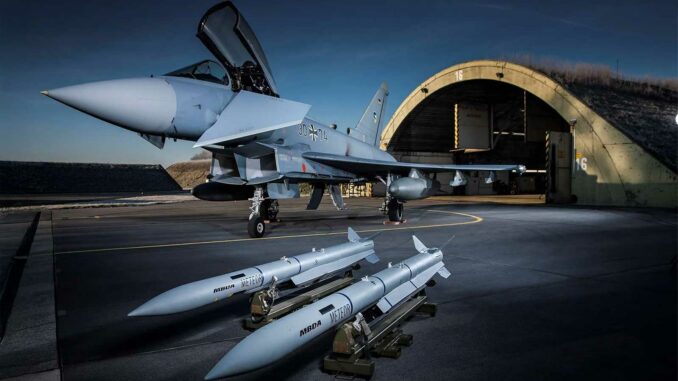
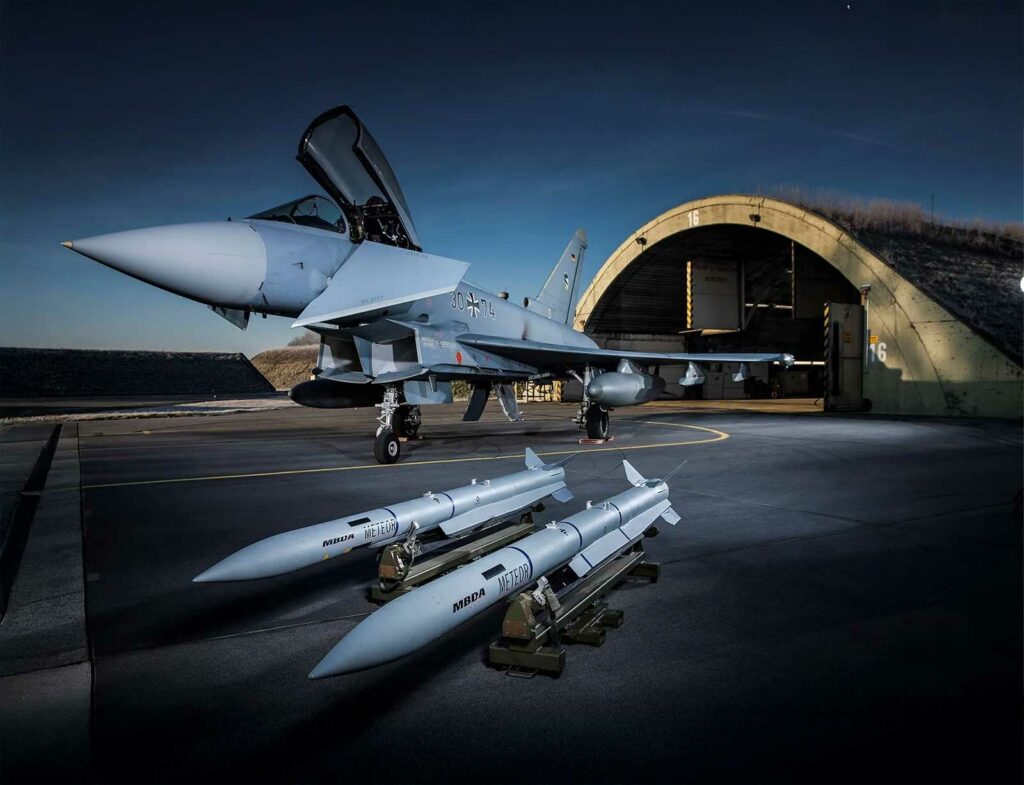
The integration of the Meteor missile on Ukrainian fighter jets could break Russian air superiority thanks to its ramjet technology.
In summary
The possible supply of the Meteor long-range air-to-air missile to Ukraine marks a major turning point in the conflict with Russia. Developed by the European consortium MBDA, the Meteor is widely considered to be the most powerful air-to-air missile in the world. Its superiority lies in its ramjet propulsion, which allows it to maintain high speed throughout its trajectory, unlike traditional missiles. This technology offers a “No-Escape Zone” three times greater than that of its competitors. However, integration poses a colossal technical challenge. The Meteor is designed for modern platforms such as the Rafale or Gripen, while Ukraine mainly operates F-16 Block 20s. The unit cost of over €2 million and the complexity of sensitive technology transfers require rigorous logistics. If this project is successful, Kiev could finally effectively challenge Russian fighter patrols operating at a safe distance.
The announcement of a technological breakthrough
The news has sent shockwaves through defense circles. Discussions are underway to equip Ukraine with the Meteor missile, the jewel in the crown of European air defense. Until now, Ukrainian forces have relied on AIM-120 AMRAAM missiles supplied by the United States. Although effective, these missiles are reaching their limits in the face of Russian tactics of firing from very long ranges.
The arrival of the Meteor would change the geometry of the battlefield. This missile is not a simple incremental improvement. It represents a paradigm shift. Russia currently uses its MiG-31BMs and Su-35Ss to fire R-37M missiles at ranges exceeding 200 kilometers (124 miles). Ukraine needs a weapon capable of responding to this range to protect its infrastructure and ground troops.
The revolutionary ramjet technology
The Meteor is distinguished by its unique propulsion system: the solid-fuel ramjet, or ramjet. A conventional air-to-air missile uses a solid-fuel rocket motor that burns all of its fuel within seconds of launch. Once the engine is shut down, the missile continues on its trajectory by inertia, losing speed and maneuverability as it approaches its target.
The Meteor’s ramjet works differently. It uses ambient air as an oxidizer, compressed by the missile’s own speed. This allows it to regulate its thrust in flight. Instead of running out of fuel quickly, the Meteor can accelerate in the final phase of interception. This ability to modulate power ensures that the missile retains maximum kinetic energy at the moment of impact, making evasive maneuvers by the target aircraft virtually impossible.
The decisive advantage of the no-escape zone
In military jargon, this is referred to as the No-Escape Zone (NEZ). This is the volume of space in which a target can no longer escape the missile by simple kinetic maneuvers. Thanks to its ramjet engine, the Meteor has an estimated NEZ of over 60 kilometers (37 miles), which is about three times that of a conventional AIM-120C-7.
The missile’s total operational range officially exceeds 100 kilometers (62 miles), but many experts estimate that it actually reaches 200 kilometers (124 miles) under optimal high-altitude conditions. The missile weighs 190 kilograms (419 pounds) and is 3.65 meters (12 feet) long. Its cruise speed of over Mach 4 allows it to catch up with any current airborne vector, even the most agile ones.
The complex challenge of integration on Ukrainian platforms
This is where the main obstacle lies.
The Meteor was designed for the latest generation of European fighters: the French Rafale, the Eurofighter Typhoon, and the Swedish Saab Gripen. However, Ukraine is currently receiving F-16 Fighting Falcons from Denmark, the Netherlands, and Norway. Although these aircraft have been modernized, they are not natively compatible with the Meteor.
Integrating such a missile requires a major modification of the aircraft’s fire control software. The aircraft’s radar must also be able to communicate with the missile via a two-way data link in order to make mid-course corrections. Adapting the Meteor to Ukrainian F-16s would require months or even years of development. An alternative solution would be to supply Kiev with Gripen aircraft, which are already pre-equipped for this weapon, but negotiations on this point remain politically sensitive.
The strategic impact on Russian air supremacy
If the Meteor enters service in Ukraine, the Russian Air Force will lose its immunity in its own border airspace. Currently, Russian aircraft fire guided gliding bombs (KAB) from a distance of 60 to 70 kilometers (37 to 43 miles), beyond the range of Ukraine’s current defenses.
With the Meteor, Ukrainian pilots could engage these tactical bombers well before they drop their munitions. This would force Russian aviation to retreat its patrol areas, thereby reducing the effectiveness of its strikes and relieving pressure on the front lines. The psychological effect on Russian crews would also be massive, knowing that a missile could swoop down on them with unstoppable terminal energy.
Financing and technology transfer stakeholders
The Meteor program is the result of cooperation between six nations: the United Kingdom, Germany, Italy, Spain, France, and Sweden. Any export to a third country such as Ukraine requires the unanimous consent of these members. MBDA, the industrial prime contractor, must also obtain strict guarantees on the protection of technological secrets.
Funding would likely come from European facilities, such as the European Peace Facility (EPF), or from British and German bilateral funds. The cost of a single Meteor missile is estimated at around €2.5 million ($2.7 million). By comparison, a US AIM-120D costs around $1.8 million. This is a heavy investment that requires careful selection of targets so as not to waste already limited stocks in Europe.
Logistics and sensitive data security
A transfer of this nature involves much more than simply delivering metal boxes. Ukrainian armourers must be trained in the storage and handling of complex ammunition. Above all, the Meteor’s data link is one of NATO’s best-kept secrets.
The main fear of Western chancelleries is that one of these missiles could fall into Russian hands, either after a crash or following the shooting down of a Ukrainian aircraft. Analysis of the ramjet and active radar seeker by Russian engineers would be a strategic disaster for the West. This is the “catch” that observers are talking about: how can Ukraine be given the power of the Meteor without risking compromising Europe’s defense for the next 20 years?
The prospect of sovereign air defense
Beyond the urgency of the conflict, the adoption of the Meteor could anchor Ukraine in the European defense ecosystem for the long term. It is a strong political signal. Kiev is no longer content with surplus equipment, but aspires to use the cutting-edge technologies of its allies.
The evolution of the conflict shows that quantity is no longer enough; it is the superiority of sensors and range that dictates the rules. The Meteor embodies this desire to transform the Ukrainian Air Force into a force capable of standing up to a major power. There is still a long way to go before we see a Ukrainian cockade on a ramjet missile, but the process is underway, already changing the calculations of the general staff in Moscow.
Technological innovation as a response to attrition
The balance of power in Eastern Europe increasingly depends on the ability to innovate under fire. The Meteor project for Ukraine symbolizes this technological race, where every kilometer of range gained can mean the survival of a city or a brigade. The technical challenge is immense, but the strategic stakes far outweigh it. By seeking to integrate the world’s best missile into such an intense theater of operations, the West is also testing its own industrial capacity and responsiveness to evolving threats.
Sources:
The War Zone, Meteor Long-Range Air-To-Air Missile In The Works For Ukraine But There’s A Catch, 2024.
MBDA Systems, Meteor Beyond Visual Range Air-to-Air Missile Technical Datasheet, 2025.
Royal Air Force, Weapons: Meteor, 2024.
International Institute for Strategic Studies (IISS), Air-to-air missile performance and the ramjet advantage, 2023.
Defense News, Integration of European missiles on US-made fighters, 2024.
Jane’s Weapons: Air-Launched, Meteor program updates and export controls, 2025.
Air & Cosmos, Le Meteor: l’arme de supériorité aérienne européenne, 2024.
War Wings Daily is an independant magazine.