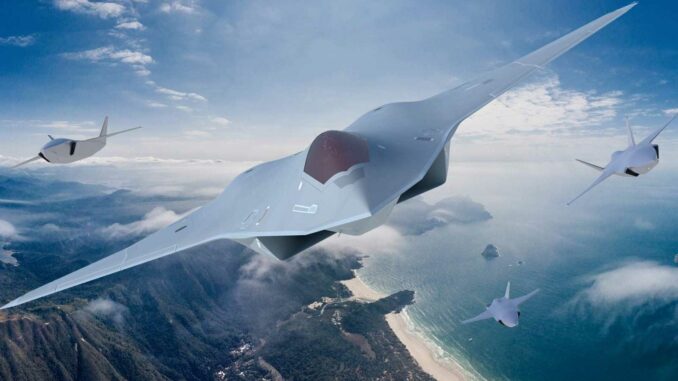
Behind the term “6th generation,” major powers are seeking a fighter that is more stealthy, more connected, and capable of piloting drones.
In summary
The race for the *6th-generation fighter jet * is not a contest for prestige. It is a response to a concrete military problem: today’s fighters, even the most advanced ones, must now survive in an environment saturated with radars, long-range surface-to-air missiles, jamming, cyberattacks, drones, and hypersonic strikes. The future fighter is therefore no longer conceived as an isolated platform. It is becoming the center of a broader *air combat system*, combining piloted aircraft, escort drones, distributed sensors, secure data links, electronic warfare, and massive data processing. The United States has already launched the *F-47* as part of the NGAD program. The United Kingdom, Italy, and Japan are pursuing the GCAP. Continental Europe continues to champion the *SCAF/FCAS *, despite its internal tensions. The real question is not merely whether this technological leap is possible. It is whether it remains decisive in a world where cheap drones and hypersonic missiles are already reshaping the battlefield. The answer is less straightforward than it seems.
The term “6th generation” primarily refers to a shift in methodology
We must start with a clarification. There is no universal, official standard that precisely defines what a 6th-generation fighter is. The term is mainly used to describe a new family of combat aircraft designed to go beyond the 5th generation, embodied by the F-22, the F-35, the J-20, or the Su-57. What is changing is not just stealth. It is the entire architecture of air combat. The aircraft is no longer just a sensor, a missile carrier, and a piloted platform. It becomes a conductor capable of managing drones, fusing data from multiple sources, jamming the enemy, sharing information in real time, and surviving in a highly contested electromagnetic space.
In other words, talking about the fighter jet of the future only makes sense if we understand that the future aircraft is no longer conceived in isolation. American, British, Japanese, and European programs all speak, using different terms, of collaborative combat, remote carriers, combat cloud, advanced human-machine interfaces, and cooperation with unmanned aircraft. This technical vocabulary may seem abstract. Yet it describes something very simple: a human pilot can no longer see everything, process everything, and make every decision quickly enough when faced with multiple threats.
They need remote sensors, algorithmic assistants, and additional effectors.
The current race pits three major program families against each other
The United States is currently the most advanced in official terms. In March 2025, the U.S. Air Force awarded Boeing the EMD contract for the Next Generation Air Dominance Platform, now designated *F-47 *. The Air Force explicitly presents it as the first *sixth-generation fighter aircraft*. The U.S. objective is not merely to replace the F-22. The goal is to establish integrated air superiority with collaborative combat drones. Reuters reported that the Air Force plans for more than *185 aircraft* for its piloted component, alongside associated drones.
The second major group is the GCAP, which brings together the United Kingdom, Italy, and Japan. This program aims for entry into service around 2035, although Reuters reported in 2025 that Japan had doubts about whether the timeline could be met. The project remains structured, however: the three countries have established a joint government organization and, in June 2025, announced Edgewing, the industrial joint venture responsible for development. GCAP also aims for a next-generation fighter integrated into an ecosystem of sensors, communications, and unmanned effectors.
The third bloc is the Franco-German-Spanish SCAF/FCAS. On paper, it aims for a comprehensive air combat system centered on the New Generation Fighter, drones, and a Combat Cloud, with a target date often set around 2040. Airbus continues to to highlight this objective, and its documents mention NGF and Remote Carrier demonstrators around 2028–2029. But the political reality is more complicated: Reuters has repeatedly documented industrial deadlocks and governance tensions between Dassault and Airbus, to the point that the program’s continuation in its initial format became much less certain by late 2025.
The technologies being developed show that the fighter is changing in nature
The primary technological focus remains stealth, but not in the simplistic sense of the term. It is no longer just about reducing the frontal radar signature. Work must also be done on the infrared signature, thermal management, electromagnetic stealth, and the ability to remain difficult to detect despite the intensive use of sensors and communications. An aircraft that is highly connected but too “talkative” electromagnetically becomes an easier target. Stealth in the 2030s will therefore be more comprehensive and demanding than it was in the 1990s.
The second area is that of sensors and data fusion. The problem in modern combat is not a lack of information. It is receiving too much of it. The pilot of a 6th-generation fighter will have to sort, prioritize, and process data streams from radar, electronic warfare, infrared sensors, other aircraft, satellites, drones, and command centers. Manufacturers therefore speak of adaptive cockpits, digital assistants, immersive interfaces, and algorithms capable of suggesting options rather than overwhelming the pilot with alerts.
Airbus, for example, describes a cockpit where the pilot can delegate tasks to an unmanned platform via an advanced interface and an augmented visualization system.
The third area is electronic warfare and resilient connectivity. In a war between major powers, communications will be jammed, disrupted, deceived, or targeted. A 6th-generation fighter jet must therefore continue to fight even in a degraded environment. War reports analyzed by CSIS also remind us that superiority in the electromagnetic spectrum is no longer a secondary advantage. It is becoming a condition for survival.
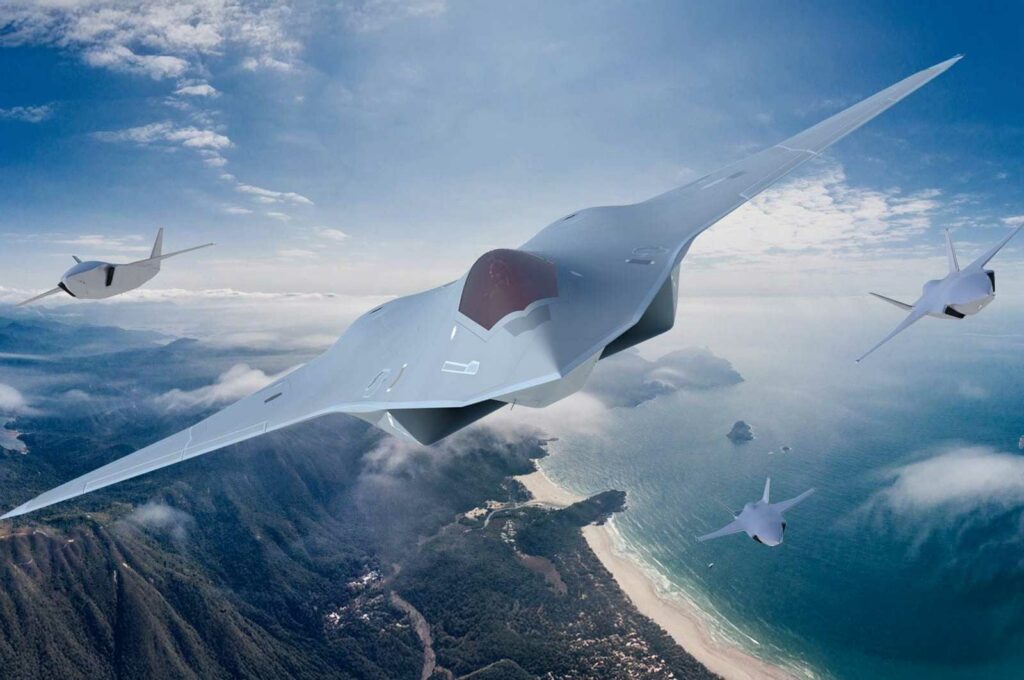
The fourth pillar, likely the most important, is that of *collaborative combat . Escort drones, often referred to as *loyal wingmen* or Collaborative Combat Aircraft, are not intended to replace piloted fighters in the immediate future. They are meant to support them. They can fly ahead, serve as decoys, carry munitions, jam radar, detect threats, or accept a level of risk that would be unacceptable for a human pilot. The US Air Force has already begun flight testing its CCAs, and its budget documents clearly state that these systems are intended to augment current and future platforms while reducing the risk to piloted aircraft.
Industrial and strategic logic explains why this race continues
One might think that with cheap drones, loitering munitions, and hypersonic missiles, investing tens of billions in a 6th-generation fighter would be absurd. That would be jumping to conclusions. The major powers continue to invest for one simple reason: a high-end piloted fighter remains today the most versatile platform for penetrating, detecting, coordinating, firing, withdrawing, and repeating these actions in a complex war. A drone alone cannot yet replace all these functions at the same level, especially in a cluttered and dynamic environment.
We must also consider the issue of decision time. Hypersonic missiles are formidable, but they do not replace air superiority. They are used to strike quickly and from a distance. They do not provide air policing, sustainable air superiority, escort, or area control. A modern fighter jet, on the other hand, remains a reusable, adaptable system that can be piloted in real time. As long as no other family of systems offers this combination of mobility, on-board human judgment, payload capacity, sensors, and tactical flexibility, the fighter jet will remain central.
Finally, there is an industrial and diplomatic argument. Developing a 6th-generation fighter jet helps preserve national expertise in engines, radars, critical software, stealth materials, cybersecurity, and systems integration. For nations, this is not just a military program. It is a tool for technological sovereignty. The British, in fact, explicitly refer to GCAP as an industrial lever, while European documents present FCAS as a major leap forward for the defense technology base.
Yet drones are changing the hierarchy of priorities
We must now be frank: the discourse on the 6th generation sometimes tends to mask a less glamorous truth. On the actual battlefield, the systems that kill and overwhelm the fastest are not always the most sophisticated. Ukraine has brutally reminded us of this. Relatively simple drones, produced in large numbers, have upended intelligence, attack, harassment, and attrition. This does not prove that the piloted fighter is obsolete. It proves that military value no longer depends solely on technological sophistication, but on the balance between cost, weight, survivability, and speed of adaptability.
This is precisely why 6th-generation programs integrate drones rather than ignoring them. The true competitor to the piloted fighter is not the drone alone. It is the hybrid system that combines a high-end aircraft with several less expensive drones. In this model, the piloted aircraft retains the role of decision-making hub and premium platform, while the drones provide mass, dispersion, and risk tolerance. This model is expensive, but it is better suited to the contemporary battlefield than a lone fighter or an unsupervised swarm.
Hypersonic vehicles do not render the fighter obsolete, but they force them to evolve
Hypersonic weapons greatly complicate air and missile defense. They reduce reaction time, complicate trajectory prediction, and can target bases, radars, depots, or command centers. But they do not render air superiority useless. On the contrary, they make an air force capable of surviving, dispersing, collaborating, and continuing to operate after an initial strike all the more valuable. In a major conflict, the side that loses its air networks and coordination capabilities quickly becomes blind and inflexible.
The 6th-generation fighter is designed precisely to address this pressure. It must be more versatile in its deployment, have more distributed sensors, be less dependent on a single radar or base, be better able to work with drones, and be more resilient in terms of information. The breakthrough, therefore, lies not only in aerodynamics. It lies in the resilience of the combat system. This is why manufacturers talk as much about the cloud, networks, cryptography, AI, and interfaces as they do about speed or pure maneuverability.
The true importance of this race will depend less on promises than on scale
That leaves the most uncomfortable question. Is this race truly important? Yes, but not in every sense attributed to it. It is important because it shapes the military hierarchy of the years 2035–2050. It is important because it structures the defense aerospace industries. It is important because it determines a state’s ability to remain credible in the face of technologically comparable adversaries. But it is not so important as to overshadow everything else. A country that invests solely in a few ultra-modern fighters while neglecting ammunition, drones, surface-to-air defense, stockpiles, maintenance, and electronic warfare will commit a classic mistake: believing that the pinnacle of the system is the entire system.
The truth is therefore harsher than industrial marketing. The 6th-generation fighter will not replace drones, missiles, space sensors, or networks. It is only valuable if it is integrated into all of these. The U.S. program has understood this with the F-47 and its associated drones. The GCAP and FCAS also say so, each in their own words. The winner of this race will not necessarily be the one who flies first. It will be the one who can produce a coherent, sustainable, connected system in sufficient numbers to survive real war—not just industrial presentations.
War Wings Daily is an independant magazine.