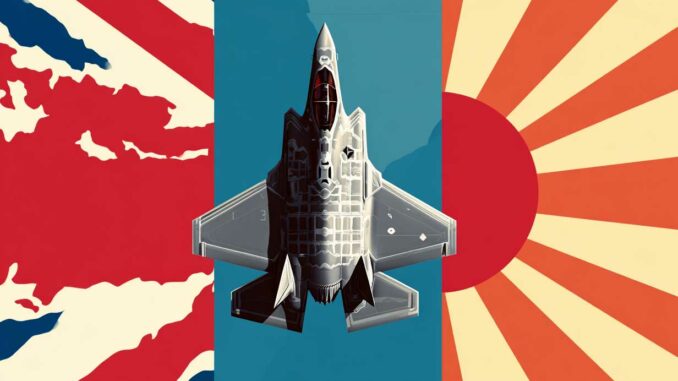
GCAP has reached a major milestone with Edgewing. Japan, the UK and Italy are making progress where SCAF remains at a standstill.
In summary
The Global Combat Air Programme has just reached a major political and industrial milestone. The GCAP’s intergovernmental agency has awarded Edgewing a contract worth £686 million, or approximately $900 million, to unify the design work for the future Japanese, British and Italian 6th-generation fighter. This contract does not yet fund the entire development phase. But it changes the nature of the programme. Work is no longer conducted solely under three national frameworks. It is moving into a common structure, with a dedicated industrial authority and an official deadline: entry into service in 2035. The contrast with the SCAF is stark. Whereas France, Germany and Spain remain deadlocked over the governance of the central fighter programme, the GCAP is moving forward through a clearer division of responsibilities, a more direct arbitration culture and a shared strategic objective in the Indo-Pacific and Euro-Atlantic regions.
The Edgewing contract transforms the GCAP into an integrated programme
The GCAP is no longer merely a political declaration between three industrial powers. With the contract awarded to Edgewing, it becomes an integrated programme. This distinction matters. In major combat aviation programmes, ministerial announcements are never enough. The real turning point comes when funding, governance and technical authority converge within a structure capable of making decisions.
The contract signed by the GCAP Agency with Edgewing is worth £686 million, or approximately $900 million according to the conversion rates used by industry and specialist sources. It funds design, engineering and technical maturation activities. Above all, it places the work within a single international framework. Activities previously carried out under national contracts are beginning to be merged into a joint programme.
Edgewing is the joint venture formed by BAE Systems, Leonardo and Japan Aircraft Industrial Enhancement Co. Ltd., or JAIEC. Its structure is balanced: each shareholder holds 33.3% of the capital. This equality does not resolve all future disagreements. But it provides a clear framework. Everyone knows their place. The company is based in the UK but must operate in all three countries. It is responsible for the design and development of the future aircraft.
This is precisely what the SCAF lacks. The Franco-German-Spanish programme remains mired in a dispute over the aircraft’s core. Dassault Aviation is demanding clear authority over the New Generation Fighter. Airbus Defence and Space refuses a role perceived as subordinate. Within the GCAP, the debate has not disappeared. But it was absorbed earlier by a common, contractual structure driven by three manufacturers who know they must deliver quickly.
Governance gives the programme a real political edge
The GCAP is based on a relatively simple institutional architecture. The states have created an intergovernmental organisation, the GCAP International Government Organisation, often referred to by the acronym GIGO. This organisation represents the defence ministries of Japan, the United Kingdom and Italy. Opposite it, Edgewing embodies the industrial authority.
This face-to-face arrangement is clearer than the traditional jumble of committees, pillars, work packages and national compromises. GIGO defines the political and military requirements. Edgewing organises the design. National manufacturers, including BAE Systems, Leonardo, Mitsubishi Heavy Industries and their supply chains, retain their roles in production, subsystems and assembly.
This method does not guarantee success. It merely reduces one source of paralysis. A 6th-generation fighter requires rapid trade-offs. Decisions must be made regarding the level of stealth, the size of the weapons bay, electrical power, cooling, sensors, propulsion, interfaces with drones, maintenance costs and export capability. If every decision becomes a matter of national power politics, the programme will run out of steam before the first flight.
The GCAP also benefits from a tighter timeline. The programme was launched in December 2022. The treaty between the three countries was signed in December 2023. The industrial joint venture was formalised in 2025. The first joint contract was awarded in April 2026. This pace is not spectacular by civilian standards. But it is rapid for a high-tech fighter aircraft.
Japan is driving the schedule
Japan is playing a central role in this acceleration. Tokyo does not view the GCAP as a prestige industrial programme. It sees it as an operational necessity. The Japan Air Self-Defence Force must replace the F-2, an aircraft derived from the F-16 and developed with the United States in the 1990s. The phased withdrawal of the F-2 is set to begin around 2035. The timetable is therefore not abstract. It corresponds to a potential capability gap.
This Japanese pressure is changing the dynamics. The United Kingdom and Italy must replace their Eurofighter Typhoons in the 2040s. Japan, for its part, watches China’s rise in power on a daily basis. It observes the J-20s, the J-35As, ballistic missiles, carrier strike groups, high-altitude drones and the tensions surrounding Taiwan. For Tokyo, the GCAP is not a symbol of cooperation. It is a tool for strategic survival.
This difference explains Japan’s firm stance on the 2035 deadline. British delays in budgetary decisions have already raised concerns in Tokyo. The Edgewing contract offers some reassurance. It shows that the three countries are moving towards a unified design. But it does not settle the budget debate. The development of a 6th-generation fighter requires tens of billions of euros over several decades.
Italy has already sent a strong signal. Its Parliament has approved a commitment of €8.77 billion for the initial phases, to be spent up to 2037. Italian estimates now put the initial costs of the programme at €18.6 billion, compared with around €6 billion in the initial 2021 projections. This threefold increase illustrates a simple truth: the GCAP is moving forward, but it is becoming expensive. The difference with the SCAF is not the absence of difficulties. It is the ability to tackle them without bringing the whole machine to a standstill.
The sensor system becomes the strategic heart of the GCAP
A 6th-generation fighter will not be judged solely on its speed or manoeuvrability. It will be judged on its ability to see, understand, communicate and survive. This is why the GCAP’s sensor system is central.
The GCAP Electronics Evolution consortium, or G2E, brings together Mitsubishi Electric for Japan, Leonardo UK for the United Kingdom, and Leonardo and ELT Group for Italy. Its mission focuses on Integrated Sensing and Non-Kinetic Effects and Integrated Communications Systems, often summarised as ISANKE & ICS. Behind these acronyms lies an essential function: merging sensors, communications, electronic warfare and non-kinetic effects into a coherent architecture.
This means that the future aircraft will need to detect targets at long range, process massive data streams, jam or deceive certain enemy systems, communicate with drones, and share information with ships and allied forces, all whilst remaining stealthy. Radar will no longer be a simple sensor; it will become part of a combat network.
Japan has a clear interest in ensuring this architecture is compatible with the US Pacific ecosystem. The Japan Maritime Self-Defence Force operates Aegis destroyers. Japan cooperates closely with the US Navy. Mitsubishi Electric also supplies components related to Raytheon’s SPY-6 radar for US ships. This industrial and operational proximity is driving Tokyo to demand genuine interoperability with US networks, without making the GCAP an aircraft subject to US restrictions.
This is where the project gets tricky. Japan wants to be able to fight alongside the United States. But it does not want to be entirely dependent on the United States to modify, maintain, export or upgrade its future aircraft.
Independence from ITAR is a major selling point
One of the benefits of the GCAP is to produce an advanced fighter aircraft less exposed to US restrictions such as ITAR. These rules govern the export, maintenance, modification and transfer of technology relating to US equipment. They protect Washington’s interests. But they sometimes limit the freedom of buyers.
Japan is familiar with this dependency. The F-2 was developed through cooperation with Lockheed Martin based on the F-16. The F-35 offers exceptional capability, but it remains a US aircraft. Updates, certain software access, sensitive parts and export regulations are largely dependent on Washington. For a country like Japan, a close ally of the United States but concerned about industrial sovereignty, this limitation is becoming increasingly apparent.
The GCAP therefore aims for a balance. It must be interoperable with US forces, yet exportable under the control of the three partners. This is a crucial distinction. An aircraft incompatible with the US Navy would be useless in the Pacific. An aircraft entirely dependent on ITAR would lose some of its industrial and commercial appeal.
Japan has already relaxed its export rules to allow for the future sale of the GCAP to third countries under certain conditions. Sales remain regulated. They must be approved on a case-by-case basis. They exclude countries involved in active conflicts. They target states with defence transfer agreements with Tokyo. But this development is historic. It shows that Japan is willing to become a more proactive player in the global defence market.
The propulsion system illustrates cooperation without a visible hierarchy
Propulsion is one of the most sensitive areas of the GCAP. The future aircraft will require an engine capable of delivering high thrust, significant electrical power and sufficient cooling for energy-intensive sensors.
It must also remain reliable, sustainable and compatible with a stealth airframe.
The propulsion consortium brings together Rolls-Royce in the UK, Avio Aero in Italy and IHI in Japan. This distribution is politically significant. No country can accept being entirely dependent on another for the engine of a strategic fighter aircraft. The engine is sovereignty within sovereignty. It determines the aircraft’s performance, availability, maintenance and evolution for fifty years.
The GCAP therefore adopts a genuine sharing approach for critical subsystems. Edgewing oversees the overall architecture. Specialised consortia are making progress on propulsion, sensors, communications and weapons. This method avoids turning every component into an existential conflict.
The contrast with the SCAF is stark, but useful. In the SCAF, the debate over the prime contractor for the core fighter absorbs political energy. In the GCAP, the partners seem to have accepted a more pragmatic rule: everyone must have enough to remain committed, but no one must block the system to preserve a fiction of perfect equality.
The GCAP is also making progress because the doctrines are compatible
The good rapport between Japan, the United Kingdom and Italy stems not only from better governance. It also stems from more compatible needs. All three countries want an advanced air superiority aircraft that is stealthy, connected, exportable and capable of working with drones and allied networks.
Japan wants to counter China. The UK wants to retain a sovereign combat air force after the Eurofighter and maintain its standing within NATO. Italy wants to remain among the powers capable of designing and producing an advanced fighter. These objectives are not identical, but they do not directly contradict one another.
The SCAF faces a different problem. France needs a naval aircraft compatible with its airborne nuclear deterrent. Germany does not have this need. Berlin has chosen the F-35 for its NATO nuclear mission and has no aircraft carriers. Spain is primarily concerned with preserving its industry and gradually replacing its Eurofighters. The result is a programme in which each country brings very different requirements to the table, whilst claiming to be building a single aircraft.
The GCAP is avoiding this pitfall for the time being. It does not have to resolve the issue of French navalisation. It does not have to incorporate a sovereign nuclear mission as a central constraint. It does not have to contend with an industrial rivalry as intense as that between Dassault and Airbus. This does not make the programme easy. It makes it more manageable.
The programme can attract new partners without losing its focus
The GCAP is already attracting interest from other countries. Italy has raised the possibility of opening up to new partners. Germany and Australia have been mentioned in several political and industrial discussions. Saudi Arabia is regularly cited as a potential partner, particularly due to its financial resources and defence market.
This openness is an opportunity, but also a risk. The more partners a programme welcomes, the more it can share its costs, expand its market and strengthen its industrial base. But it also increases the risk of dilution. National requirements pile up. Export rules become more complex. Timelines become more fragile.
The GCAP, however, has an advantage at this stage: its core is already in place. The original trio established the GIGO. Edgewing exists. The industrial shares are defined. The sensor and propulsion consortia have been launched. This provides the programme with a backbone before any expansion. This is the right approach. It is better to open up a structured programme than to attempt to structure a programme that has already been expanded.
This is yet another difference from the SCAF. The SCAF does not need new partners. It needs a clear decision among its current partners. Without this, any expansion would only add complexity to an already unstable architecture.
The 2035 timeline remains ambitious, but credible
The target of entering service in 2035 is very ambitious. A 6th-generation fighter requires a stealth airframe, new avionics, advanced sensors, modern propulsion, networked weapons, a scalable software architecture and integration with drones. Ten years is a short time for such a programme.
But the GCAP has two strengths. Firstly, it is not starting from scratch. The UK has built up experience through the Tempest programme. Japan has carried out its F-X project and worked on the X-2 demonstrator. Italy brings its expertise in the Eurofighter, the F-35, defence electronics and systems integration. Secondly, strategic pressure makes the timetable more credible. The three countries know that time is against them.
The main risk remains budgetary. The Edgewing contract funds only one phase. The sums required to achieve full development, certification, production and support will far exceed current estimates. The UK will need to confirm its long-term funding. Italy has already revised its estimates upwards. Japan cannot accept a major delay beyond 2035 without jeopardising the replacement of its F-2s.
The GCAP is therefore not a programme that has been saved. It is a programme that has passed the point where it can begin to succeed. The distinction is important.
The GCAP delivers a sobering lesson to the SCAF
The GCAP is moving forward because it has accepted three simple principles. A joint agency must speak on behalf of the states. A joint undertaking must lead the design. Critical subsystems must be shared without undermining overall authority.
The SCAF, for its part, remains trapped in a classic European contradiction. The nations want a joint aircraft, but they do not always want the same thing. Industry wants to cooperate, but not to lose control of its core capabilities. Governments talk of European sovereignty, but national doctrines remain sovereign. This is where the programme gets bogged down.
It would be too simplistic to present the GCAP as a perfect model and the SCAF as a definitive failure. The GCAP will have its crises. Costs will rise. Technological choices will be painful. Exports will pose political problems. Interoperability with the United States will create tensions with the independence sought. But the programme has a quality that the SCAF no longer really possesses: it gives the impression of moving forward.
In combat aviation, this impression is already an advantage. It attracts engineers. It reassures the armed forces. It lends credibility to budgets. It appeals to potential partners. It carries weight in export markets. The GCAP has not yet won the race for the 6th-generation fighter. But it has just taken a clear political lead.
The question facing Paris, Berlin and Madrid is therefore becoming more pressing. Can continental Europe still build a joint combat aircraft, or will it have to content itself with watching the UK, Italy and Japan demonstrate that cooperation first requires a simple rule: decide before communicating?
Sources
Edgewing, Global Combat Air Programme Agency places contract with Edgewing, 2 April 2026.
Leonardo, Global Combat Air Programme Agency places contract with Edgewing, 2 April 2026.
Janes, Governments award Edgewing first GCAP contract, 7 April 2026.
Reuters, Italy’s parliament approves 8.8 billion euros for GCAP jet fighter programme, 12 February 2026.
Reuters, Japan frets over fighter rollout target and weighs stopgap options, 30 May 2025.
Reuters, Japan relaxes military export curbs for planned jet fighter, 26 March 2024.
Royal Air Force, UK, Japan, and Italy sign international stealth fighter jet programme treaty, 14 December 2023.
GOV.UK, Convention on the Establishment of the Global Combat Air Programme – GCAP International Government Organisation, 19 December 2024.
Leonardo, GCAP partners launch Edgewing joint venture to deliver next-generation combat aircraft, 20 June 2025.
Leonardo, Industry partners form GCAP Electronics Evolution consortium to deliver sensing and communications for next-generation fighter, 9 September 2025.
Mitsubishi Electric, Industry partners form GCAP Electronics Evolution consortium, 9 September 2025.
IHI, GCAP Consortium Expands Partnership Toward First Flight, 10 September 2025.
Rolls-Royce, GCAP Power & Propulsion, industry documentation.
Reuters, Airbus reports progress on systems despite FCAS fighter row, 20 May 2026.
Reuters, Dassault CEO says FCAS fighter project dead if Airbus refuses to cooperate, 4 March 2026.
War Wings Daily is an independant magazine.