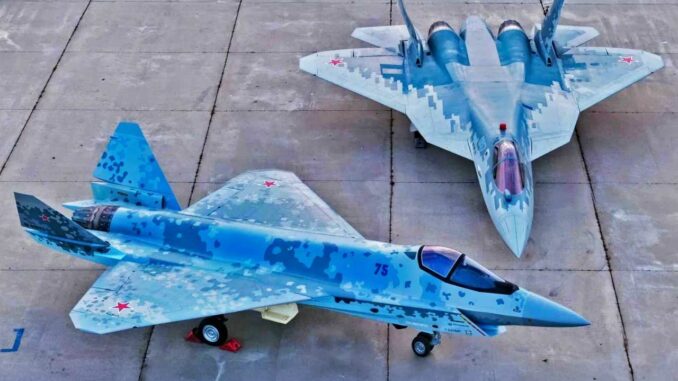
Su-34M, Su-57, Su-30MKA: Algeria is accelerating its aerial modernization, but operational realities remain nuanced.
Executive Summary
Algeria is entering a new phase of aerial modernization. The first Russian Su-34Ms have reportedly been delivered or are currently being delivered, while the integration of the Su-57E places Algiers at the center of military attention in Africa. If the presence of the Su-57 is fully confirmed, Algeria would become the first African nation to operate a fifth-generation stealth fighter. However, a distinction must be made between strategic display and operational reality. The country does not currently possess a large fleet of Su-57s. The most credible reports indicate at least one or two aircraft observed or delivered, while announcements regarding a contract for 14 aircraft remain partially opaque. Modernization is genuine, particularly with the Su-30MKA, Su-35, Su-34M, and a dense air defense network. Yet its effectiveness will depend on maintenance, aircrews, munitions, and systems integration.
The Algerian Qualitative Leap Rests on a Deliberate Russian Strategy
For more than twenty years, Algeria has built a military air force structured almost entirely around Russian systems. This choice is not new. It dates back to the Cold War, was reinforced after the 2000s, and remains at the heart of the strategic relationship between Algiers and Moscow today. The novelty lies in the technological sophistication of the platforms now being discussed.
The country already operates a robust combat force centered on the Su-30MKA, a variant derived from the Indian Su-30MKI and tailored to Algerian requirements. This aircraft forms the backbone of the Algerian fighter fleet. Open-source estimates suggest approximately 60 to 70 Su-30MKAs are in service or delivered, depending on the sources and available airframes. This is supplemented by modernized MiG-29s, Su-24 strike aircraft, Yak-130 trainers, and a fleet of Russian and Western helicopters.
The announced arrival of the Su-34M primarily changes strike depth. The Su-34 is not a conventional multirole fighter. It is a heavy tactical bomber designed to strike far, featuring a substantial payload, high endurance, and a side-by-side seating arrangement for the crew. It is better suited than the Su-24 for modern strikes, precision navigation, attacks against military infrastructure, and low-to-medium altitude penetration missions.
The Su-57E, meanwhile, alters strategic perception. Even in small numbers, it gives Algeria significant visibility. A stealth fighter’s value is not measured solely by quantity. It modifies political calculations, complicates adversary planning, and forces neighbors to invest more heavily in detection, electronic warfare, and air defense.
The question is therefore not whether Algeria is modernizing its air force. It is. The real question is whether this modernization produces lasting operational superiority or primarily a symbolic advantage.
The Su-34M Replaces an Aging Su-24 Fleet
The Su-34M meets a clear need: the gradual replacement of Algerian Su-24M/MKs. These aircraft long provided Algiers with a serious tactical strike capability. However, they belong to an older generation. Their airframes, avionics, maintenance requirements, and survivability impose limitations against modern defenses.
Open sources have for several years mentioned an order of approximately 14 Su-34s or Su-34Ms destined for Algeria. First deliveries reportedly began in 2026 after years of delay. This point must be stated with caution. Algiers communicates very little regarding its sensitive acquisitions. Moscow also maintains deliberate ambiguity, particularly since the invasion of Ukraine and Western sanctions.
The military gain is nevertheless easy to understand. The Su-34M brings a heavy strike capability that few African countries can field. The aircraft can carry guided bombs, air-to-ground missiles, anti-ship missiles, or precision weaponry depending on available configurations. It possesses a substantial operational range, useful for a country as vast as Algeria, whose territory covers more than 2.38 million square kilometers.
The Su-34M also allows Algeria to extend its operational reach into the Mediterranean, the Sahel, and toward Saharan approaches. It is not just about striking. It is about demonstrating that Algeria can project a credible threat at a distance, monitor its borders, protect its energy infrastructure, and influence the regional balance of power.
But this modernization has its limits. The Su-34M remains a Russian aircraft designed according to a heavy-strike doctrine. It is not stealthy. It remains vulnerable to a modern air defense network if the environment is well-covered by radars, surface-to-air missiles, and advanced fighters. Its value will therefore depend on the quality of intelligence, electronic warfare, planning, and the munitions actually delivered to Algeria.
The Su-57 Delivers a Shift in Image, Not Yet a Shift in Mass
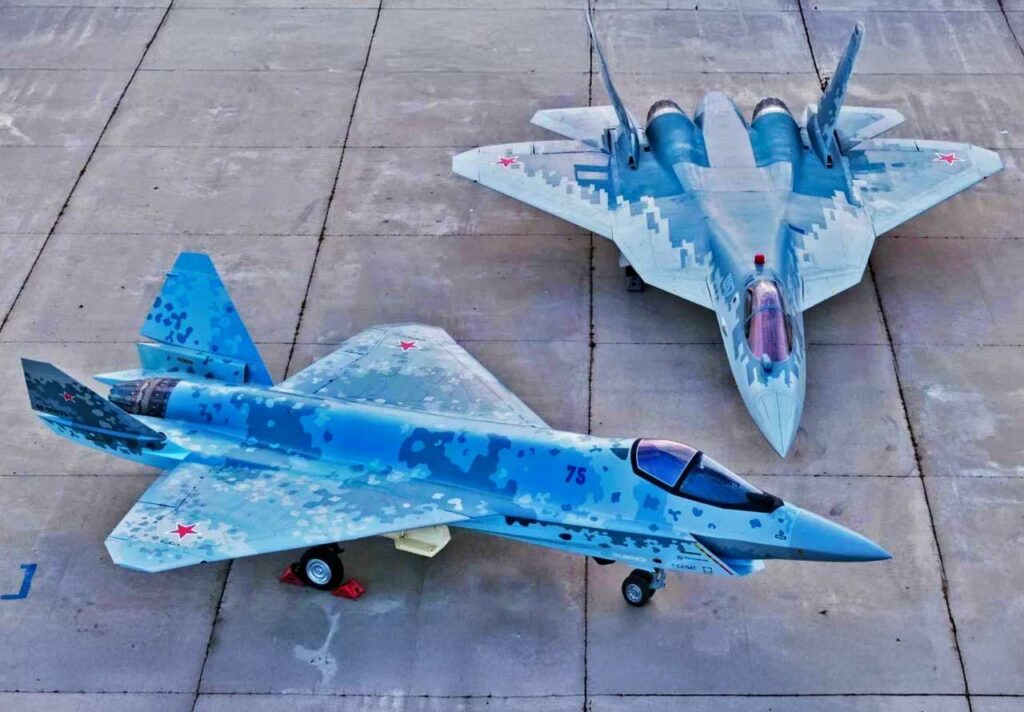
The case of the Su-57 is more sensitive. The most ambitious announcements mention a contract for 14 Su-57Es. Some sources speak of six aircraft delivered, others of two, and still others of a initial aircraft observed in flight. The most reliable assessment at this stage is more cautious: Algeria appears indeed to be the first export customer for the Su-57, but the number actually operational remains highly limited.
Russia confirmed in 2025 that it had delivered Su-57s to an unnamed foreign customer. Most observers point to Algeria. Images circulated in early 2026 subsequently showed an aircraft presented as a Su-57E in Algerian skies. This strengthens the hypothesis. However, it does not prove that an entire squadron has already been formed.
It is necessary to be direct: Algeria likely does not possess 14 fully operational Su-57s today. It is rather in an introduction, training, progressive reception, and operational conditioning phase. Even if the contract for 14 aircraft is accurate, effective military capability is built over several years.
The Su-57E nonetheless brings important elements. Its low-radar-cross-section airframe, internal weapon bays, advanced sensors, and capability to operate with long-range missiles can enhance the Algerian posture. The aircraft is designed to detect, engage, and survive better than a previous-generation fighter. It also gives Algeria a unique status on the continent if its operation is confirmed.
Yet its actual effectiveness remains debated. The Su-57 does not possess the same level of industrial maturity as the American F-35. It is produced in small quantities. Its stealth is frequently judged inferior to that of American fifth-generation aircraft. Its definitive engine, often associated with the Russian Izdeliye 30 program, is not yet widespread. The export version may also be less capable than the Russian version regarding certain sensors, software, or electronic warfare modes.
The Algerian Su-57 is therefore a political breakthrough. It is not yet a quantitative revolution.
The Algerian Air Force Remains One of the Most Powerful in Africa
Algeria can legitimately claim the status of a major aerial power in Africa. Its military budget provides an initial indication. According to SIPRI, Algerian military expenditures reached approximately $25.4 billion in 2025, an 11% increase. The country is thus the largest military spender in Africa and North Africa.
This budgetary mass allows Algiers to maintain a heavier air force than most of its neighbors. It also allows for investment in air defense, missiles, radars, transport aircraft, attack helicopters, and training. Aerial power is not limited to fighters. It relies on an entire ecosystem.
Algeria possesses a very dense ground-based air defense network, featuring long-, medium-, and short-range systems of Russian origin. This combination is vital. A country that operates modern aircraft but fails to protect its bases remains fragile. Algiers understood long ago that territorial defense must combine aircraft, radars, surface-to-air missiles, and surveillance.
Compared to other African powers, Algeria distinguishes itself by the weight of its heavy fighters. Egypt also possesses a very substantial air force, featuring Rafales, F-16s, MiG-29M/M2s, and numerous helicopters. Morocco is heavily modernizing its F-16s to the F-16V standard and reinforcing its capabilities with American and Israeli systems. However, Algeria retains an advantage in the domain of heavy Russian platforms and multi-layered air defense.
If the Su-57E effectively becomes operational, Algeria will be able to claim a unique distinction: being the first African country to integrate a stealth fighter. But uniqueness must not be confused with absolute dominance. An air force is judged on availability, sortie rates, pilot quality, maintenance, missiles, tankers, sensors, and interoperability.
The Modernization is Real, But Remains Incomplete
Algerian modernization is real on three levels. It renews platforms, increases strike depth, and enhances the deterrence posture. The Su-34M replaces an aging aircraft. The Su-35, already spotted or announced in several sources, would reinforce aerial superiority. The Su-57E introduces a stealth dimension. The Su-30MKA remains a robust, powerful aircraft well-suited to long distances.
However, this modernization is not complete. Algeria remains heavily dependent on Russia. This dependence provides technical coherence, but it also creates a risk. Since 2022, the Russian defense industry has operated under constraints. It must support the war in Ukraine, replace its losses, bypass sanctions, and preserve its exports. Timelines, spare parts, engines, electronic components, and software updates may become more difficult to guarantee.
The issue of munitions is also central. A Su-57 without modern missiles in sufficient quantities remains a symbol. A Su-34M without guided bombs, anti-ship missiles, electronic warfare assets, and precise intelligence loses part of its value. An aircraft’s performance depends on its combat environment.
The other limitation concerns command and control systems. The most advanced militaries do not merely align good aircraft. They possess airborne early warning aircraft, secure data links, electronic warfare assets, satellites, surveillance drones, and command centers capable of fusing information. On this point, Algeria is progressing, but public data remains limited.
Algerian modernization is therefore solid, but not magical. It does not automatically transform every aircraft into a superior capability. It provides powerful tools. Their return will depend on doctrine.
The Actual Number of Su-57s Remains the Most Uncertain Point
The figure of 14 Su-57Es is frequently mentioned. It would be consistent with the logic of a small squadron capable of handling training, operational ramp-up, and an initial operational capability. However, this figure corresponds more to a presumed order than to an actually visible inventory.
To date, the most credible elements allow for three assertions. First, Russia announced an initial export of the Su-57 to a foreign customer. Second, Algeria is the most likely candidate for this customer. Third, open-source imagery suggests the presence of at least one Su-57E in Algeria.
For the rest, caution is required. Two delivered aircraft would be a reasonable hypothesis if one follows certain Russian declarations regarding the first export delivery. Six delivered aircraft represent a more ambitious hypothesis, repeated by several media outlets, but difficult to confirm. Fourteen operational aircraft are not demonstrated.
This distinction is essential. In a defense article, writing that Algeria “possesses 14 Su-57s” would be too affirmative. It is more accurate to write that Algeria is associated with a contract frequently presented as covering 14 Su-57Es, but that the number of aircraft effectively delivered and operational remains likely much lower in 2026.
The difference between “delivered,” “received,” “undergoing trials,” “in training,” and “operational” is capital. An aircraft can be physically present without being fully integrated into a combat unit. Pilots, mechanics, controllers, armorers, and planners must be trained. Stocks of parts and munitions must be created. Bases must be adapted. It is this invisible work that transforms a delivery into military power.
Real Effectiveness Will Depend on Network-Centric Warfare
The Su-57E can be effective if it is integrated into a coherent architecture. Its value is not just flying more discretely. It must detect, share data, guide missiles, and operate with other platforms. In an Algerian force centered on the Su-30MKA, the Su-35, and the Su-34M, it could play the role of an advanced sensor, an opening fighter, or a localized air superiority platform.
The Su-34M, for its part, can become a deep-strike tool. It can replace the Su-24 in penetration, interdiction, and attack missions against hardened targets. However, it will require aerial protection, precise intelligence, and a credible electronic warfare capability.
The Su-30MKA remains the pivot. It is what will provide mass, training, permanence, and versatility. A small number of Su-57s will not replace this fleet. It will complement it. This is often where overly dramatic analyses go wrong. Algerian aerial power will not rest on the Su-57 alone. It will rest on the association between heavy aircraft, a dense air defense, and a regional doctrine.
The primary vulnerability remains maintenance. Russian aircraft are robust, but they require a regular technical pipeline. Sanctions can complicate electronic parts, engines, and certain modernizations. Algeria has experience with Russian maintenance, which is an advantage. However, the simultaneous introduction of the Su-34M, Su-35, and Su-57 increases complexity.
Every new type of aircraft imposes simulators, parts, engines, procedures, and skills. Modernization then becomes a problem of industrial management, not just purchasing.
The Regional Balance of Power Evolves, But Does Not Fully Shift
Algeria is sending a clear message to its neighbors. It wants to maintain qualitative aerial superiority in the Maghreb. Morocco is modernizing its F-16s, reinforcing its air defense, and relying on the United States, Israel, and France for certain segments. Egypt maintains a large and diversified air force. In this context, Algiers refuses to lose its standing.
The Su-57E serves this purpose as well. It responds to the Moroccan F-16V with a different category. It signals that Algeria is not content with merely modernizing an old fleet. It wants to enter the stealth generation. Even if the aircraft are few, they have a deterrent effect.
But the balance of power does not come down to a spec sheet. The Moroccan F-16V features a modern AESA radar, American integration, Western weaponry, and a solid logistics chain. Egyptian Rafales offer excellent versatility and capable armaments. Algerian aircraft are powerful, but heavily dependent on Russia. Every model has its strengths and limitations.
Algeria is likely becoming the most advanced aerial power in Africa in certain segments: heavy Russian fighters, multi-layered air defense, possible stealth, and strike depth. But it is not necessarily superior in every domain. Sensors, data links, airborne early warning aircraft, tankers, drones, and training quality weigh just as heavily as the prestige of the aircraft.
The Russian Choice Remains a Strategic Gamble
The relationship with Moscow has provided Algeria with an aerial power that few African countries can finance or maintain. It has allowed access to hardware that Western nations would not necessarily have delivered. It also offers relative political freedom, as Algiers does not depend on American ITAR-type authorizations.
But this choice comes at a price. Russia is today a supplier under pressure. Its industry works for its own war. Its exports have sharply declined since 2022. Traditional clients observe Russian performances in Ukraine with more distance. Questions of quality, timelines, parts, and support have become more sensitive.
For Algeria, the gamble consists of capitalizing on the privileged relationship with Moscow while avoiding technological lock-in. The country already possesses some European equipment, notably in helicopters, transport, or certain dual-use technologies. However, its primary combat force remains Russian.
In the short term, this choice yields power. In the long term, it imposes a dependency. If Russia sustains its deliveries, provides parts, and maintains software updates, Algiers can consolidate a genuine lead. If Moscow slows down, Algeria could find itself with a prestigious fleet that is difficult to sustain.
Algerian modernization is therefore neither a simple publicity effect nor an absolute guarantee of dominance. It is a serious upgrade, driven by a high budget and a coherent strategy. But its real effectiveness will be played out in the hangars, missile stocks, simulators, and command centers. The Su-57 draws attention. True aerial power is built far from the cameras.
Sources
SIPRI, Trends in World Military Expenditure 2025, April 2026.
SIPRI, Trends in International Arms Transfers 2025, March 2026.
Defense News, Investigation: Russian shadow airlines use Algeria as base for secretive missions, April 2026.
The Aviationist, Algeria’s First Su-57E Reportedly Captured in Flight, February 2026.
Aerospace Global News, Russia confirms first Su-57 export as speculation centres on Algeria, November 2025.
Militarnyi, Su-57E in Algeria: The Country Likely Receives Its First Russian Fifth-Generation Fighters, February 2026.
Defence24, Algeria gets Russian Su-34, May 2026.
Defence Blog, Russia may begin Su-34 deliveries to Algeria, August 2025.
Defence UA, Algeria to receive first Su-34 fighter-bomber from Russia after six-year wait, August 2025.
Eduard Info, Algerian Air Force, March 2026.
IISS, The Military Balance 2026, general data on air forces and military inventories.
Reuters, Europe now world’s biggest arms importer, think tank says, March 2026.
Reuters, World military spending hits record levels, SIPRI data, April 2025.
War Wings Daily is an independant magazine.