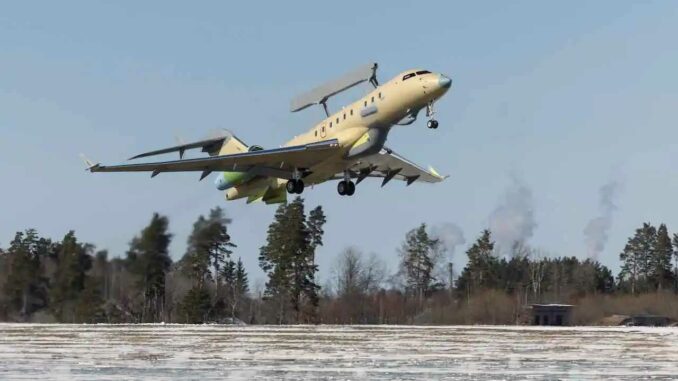
NATO is entering into negotiations for ten Saab GlobalEye aircraft. The choice is shaking up the radar aircraft market and weakening the Boeing E-7.
In summary
NATO has chosen the Saab GlobalEye to replace part of its fleet of fourteen E-3A AWACS aircraft. Eleven allied nations plan to jointly acquire up to ten GlobalEye aircraft, in a programme estimated to cost $4.5 billion. The first deliveries could take place in 2030. However, caution is warranted: Saab has entered into negotiations with the NATO Support and Procurement Agency and no contract has yet been signed. This decision reverses the choice made in 2023 in favour of six Boeing E-7A Wedgetails. The US withdrawal from the E-7 programme subsequently deprived the European project of its financial and industrial base. For Saab, this selection could establish GlobalEye as the new Western benchmark for aerial surveillance. For Boeing, the setback is significant. It reduces the potential order volume for the Wedgetail and weakens its position in the export market. However, it does not demonstrate that the E-7 is technically inferior in every respect. Above all, NATO has prioritised a programme deemed to be more stable and readily available.
The choice of Saab reverses the decision taken in 2023
On 7 July 2026, at the NATO summit in Ankara, eleven Allies announced their intention to jointly acquire up to ten Saab GlobalEye aircraft. Belgium, Canada, Denmark, Germany, Latvia, Lithuania, Luxembourg, the Netherlands, Norway, Romania and Sweden are participating in the project. The aircraft are to replace some of the fourteen Boeing E-3As operated collectively by the Alliance.
The announcement remains a preferred selection. Saab must now negotiate with the NATO Support and Procurement Agency. The final number of aircraft, the contract price, the timetable, support arrangements and the exact configuration have therefore not yet been finalised. Saab’s CEO, Micael Johansson, estimates the unit price at between 400 and 450 million dollars. He suggests that the first deliveries could take place in 2030, provided the contract is signed swiftly.
This decision marks a dramatic U-turn. In November 2023, NATO had opted for a strategy based on the purchase of six Boeing E-7A Wedgetails. The first aircraft was due to be ready in 2031. At the time, the E-7 seemed to offer a logical solution. It was already in service with several allied nations and was also due to be procured in large numbers by the US Air Force.
The plan collapsed in 2025. The US administration decided to abandon the planned purchase of 26 E-7As, citing delays, rising costs and concerns about the survivability of large radar aircraft in a contested environment. The European partners then concluded that the strategic and financial basis for their own procurement had disappeared. They abandoned the plan to acquire six Wedgetails in November 2025.
The GlobalEye therefore did not simply win a technical comparison. It benefited from the industrial and political destabilisation of the US programme.
The GlobalEye replaces the flying radar with a multi-sensor system
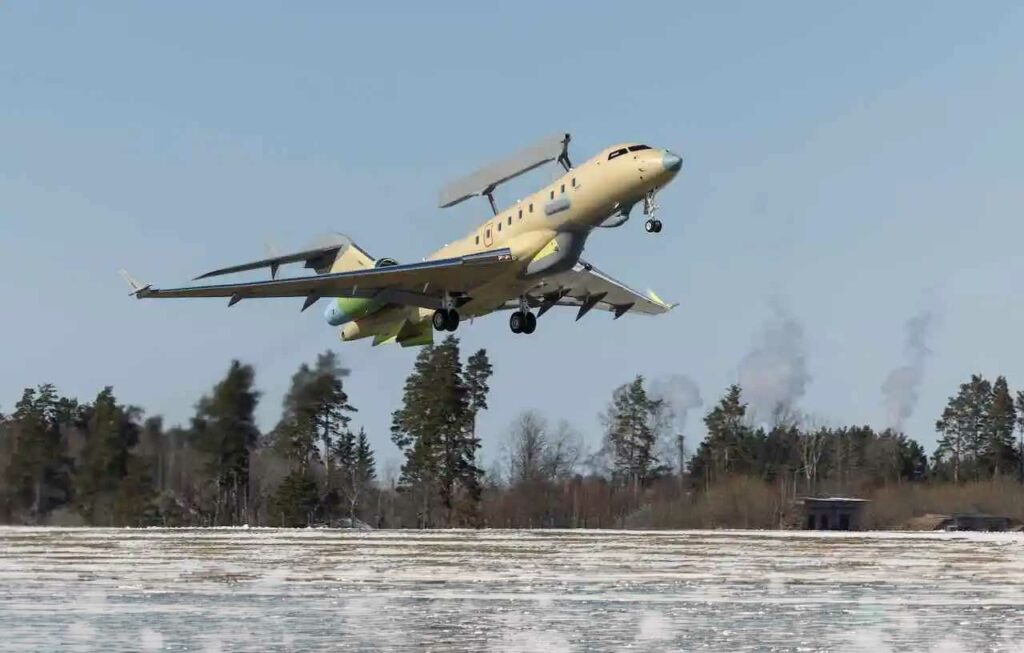
The GlobalEye is built around the Bombardier Global 6500. This Canadian business jet has been extensively modified by Saab. It has been fitted with a new power supply, operator consoles, military communications systems, self-protection capabilities and several additional sensors.
Its most visible feature is the Erieye Extended Range radar. Its ten-metre antenna is housed in the rectangular structure situated above the fuselage. Unlike the rotating radome of the E-3A, this antenna remains stationary. It scans the surrounding area electronically using AESA (Active Electronically Scanned Array) technology.
The Erieye ER radar focuses its energy on threats
An AESA radar contains numerous transceiver modules. The beam is directed without any mechanical movement. The system can therefore monitor a vast area whilst concentrating more energy on a specific target.
This architecture offers high refresh rates. It enables the rapid tracking of manoeuvring aircraft, cruise missiles or drones operating at low altitude. Saab states that the Erieye ER is designed to operate in an environment cluttered with ground reflections and disrupted by electronic jamming.
The manufacturer states an instrumented range of over 650 kilometres (350 NM). At an altitude of 10,668 metres (35,000 ft), the GlobalEye could detect a threat flying at approximately 61 metres (200 ft) at a distance of over 458 kilometres (247 NM). These distances are based on manufacturer’s specifications. The actual range depends on the target’s size, altitude, orientation, radar signature and the electromagnetic environment.
The GlobalEye does not merely monitor the skies. It combines the Erieye ER with a maritime surveillance radar, electro-optical systems, identification receivers and electronic emissions detection capabilities. It can track ships, small craft and moving ground targets. It can also produce a radar image of the terrain in adverse weather conditions.
This multi-domain capability directly addresses NATO’s current requirements. Threats are no longer limited to bombers and fighter aircraft. The Alliance must monitor swarms of drones, ballistic missiles, cruise missiles, ships and ground movements within the same operational space.
The Bombardier Global 6500 reduces the operational footprint
Saab announces an endurance of more than twelve hours. The GlobalEye can also use runways of approximately 1.98 kilometres (6,500 ft). It can therefore be deployed across a large number of bases, whereas large military aircraft often require more extensive infrastructure.
Opting for a business jet also offers a modern pressurised cabin, controlled fuel consumption and potentially lower maintenance requirements than those of an older four-engine platform. A direct comparison with the E-7 remains difficult, however. NATO has not published a comprehensive study on the operating costs of the two solutions.
The GlobalEye also has one weakness. NATO’s first aircraft are not expected to be capable of in-flight refuelling. This capability could be integrated at a later stage. The current E-3A can be refuelled in flight, enabling it to remain in the area for very long periods during surveillance missions on the eastern flank.
The Wedgetail remains a technically strong contender
The Boeing E-7A Wedgetail is based on the 737-700 airframe. Its Northrop Grumman Multi-role Electronically Scanned Array radar is mounted on a fixed structure above the fuselage. Like the Erieye ER, it uses electronic scanning and does not rely on a rotating antenna.
The E-7 can carry a total crew of 21, including two pilots. Its cockpit features ten mission consoles. Boeing states a ferry range of 6,482 kilometres (3,500 NM) without refuelling and a service ceiling of 12,497 metres (41,000 ft).
Its main advantage is its command capability. The Wedgetail has a large internal volume for operators, communications equipment and computers. It was designed as a fully-fledged airborne command post, rather than simply a radar carrier.
Boeing also highlights the 737’s global support network. Thousands of aircraft from this family are in service worldwide. The manufacturer lists 30 repair centres and 250 service centres capable of supporting the platform.
Saab’s selection does not, therefore, imply that the Wedgetail is obsolete. The E-7 is operational in Australia, Türkiye and South Korea. The United Kingdom is also continuing with its own programme. NATO’s selection appears to have been based as much on availability and timing as on sensor performance.
Industrial stability was just as important as performance
The joint purchase of six Wedgetails made sense as long as the United States was planning a fleet of 26 aircraft. This order would have supported a significant industrial base. It would have spread the costs of development, production, certification and modernisation across several dozen aircraft.
The US Air Force’s withdrawal changed the equation. European countries would have been left with a limited fleet of six aircraft, dependent on a programme whose main customer had just withdrawn. Unit costs, long-term support and the availability of upgrades became more uncertain.
Saab presented a more stable situation. Five GlobalEye aircraft have already been delivered to the United Arab Emirates. Sweden has ordered its own aircraft. In December 2025, France signed a contract worth 12.3 billion Swedish kronor for two aircraft, with two additional options. Canada has also designated Saab as its preferred supplier for its future aerial surveillance fleet.
The commercial momentum has therefore shifted. Boeing was offering a recognised military platform, but one weakened by Washington’s decision. Saab was offering a smaller programme, but one backed by a growing number of customers.
The industrial architecture also facilitated the political decision.
The GlobalEye combines a Canadian aircraft, Swedish radars and mission systems, as well as several American components. Mark Rutte thus presented the programme as a transatlantic success rather than an exclusively European procurement.
The victory could transform Saab’s industrial scale
For Saab, this is a landmark victory. The potential value of 4.5 billion dollars corresponds to approximately 40 to 44 billion Swedish kronor, depending on the exchange rate used. This figure represents more than half of the 79.1 billion kronor in turnover generated by Saab in 2025. The revenue would naturally be spread over several years.
The contract has not yet been included in the order book. The order book already stood at 274.5 billion kronor at the end of 2025, rising to around 318 billion by 30 June 2026. Saab must therefore finance a ramp-up in production capacity whilst its factories are already stretched by orders for missiles, radars, Gripen aircraft and submarines.
The commercial impact, however, extends beyond the ten aircraft. Selection by NATO serves as a global benchmark. It reassures countries wavering between GlobalEye and an American solution. It also facilitates interoperability among future European users.
A shared fleet will generate several decades of revenue from maintenance, training, software support and modernisation. Radars will need to evolve to counter new forms of jamming, hypersonic missiles and low-signature drones. Communications will need to remain compatible with the Alliance’s new combat networks.
Saab could thus become one of Europe’s leading architects of air command systems. This marks a change in status. The company is no longer merely a Swedish national supplier or a specialist competitor. It is becoming the potential supplier of one of the few military systems directly owned and operated by NATO.
The setback reduces Boeing’s international prospects
For Boeing, the decision represents a strategic setback. The company is losing a direct opportunity worth up to $4.5 billion. Above all, it is losing the support, training and modernisation contracts that would have accompanied the fleet for several decades.
The financial impact will remain limited at the Boeing Group level. The manufacturer generates tens of billions of dollars in annual turnover across civil aviation, defence and services. The industrial impact on the Wedgetail, however, is more serious.
Every order helps to sustain the engineering teams, radar suppliers, integration specialists and the 737’s modification capabilities. The loss of the NATO contract reduces the potential number of platforms sharing the same standard. It therefore undermines economies of scale.
The commercial damage is also significant. NATO is a particularly influential benchmark. A country purchasing a radar aircraft generally seeks to share procedures, training and upgrades with its allies. The choice of the GlobalEye may therefore draw other customers to Saab.
Boeing nevertheless retains a foothold. The E-7 remains in service with several air forces. The United Kingdom is continuing with its procurement programme. The company also remains the prime contractor for the latest modernisation of NATO’s E-3As, a programme worth around one billion dollars aimed at maintaining the fleet until 2035.
The Wedgetail is therefore not doomed. But its accessible market is narrowing. Boeing will have to demonstrate that the platform can still be produced, supported and modernised at a competitive cost without the major US order that was intended to shape its future.
The transition will require several generations to coexist
The E-3As will not disappear in 2030. NATO plans to phase them out shortly after 2035. The first GlobalEye aircraft will therefore need to be integrated whilst the current AWACS are still in service.
This period of coexistence will be essential. Multinational crews will need to be trained. Secure communications will need to be validated. The GlobalEye will need to exchange data with fighter aircraft, warships, air defence batteries and command centres in thirty-two countries.
NATO will also need to decide how to deploy a smaller fleet. Ten GlobalEye aircraft will not automatically replace fourteen E-3As in terms of operational readiness. The new aircraft should be easier to maintain, but the Alliance will need to demonstrate this operational readiness during prolonged operations.
The issue of in-flight refuelling capability will be particularly important. Without it, the GlobalEye aircraft will have to return to base more frequently or be positioned closer to their surveillance area. This constraint may be acceptable in peacetime. It becomes more critical during a major crisis.
The final contract will determine the true extent of the victory
The decision announced in Ankara marks a turning point for the industry. It does not yet resolve all the issues.
NATO must determine the number of aircraft, the delivery schedule, the funding and the division of tasks amongst the eleven countries. It must also specify the configuration of communications, self-protection, in-flight refuelling and the system’s upgrade rights.
For Saab, the challenge lies in transforming a political decision into regular production. For Boeing, it is a matter of preserving an E-7 programme that has now lost two major customers: the United States and NATO.
The real winner will not necessarily be the aircraft with the most impressive technical specifications. It will be the one whose manufacturer can deliver the aircraft, maintain the software, train the crews and guarantee availability for thirty years.
At this stage, Saab has won the competition. The final contract will determine whether it has also won the programme.
War Wings Daily is an independant magazine.