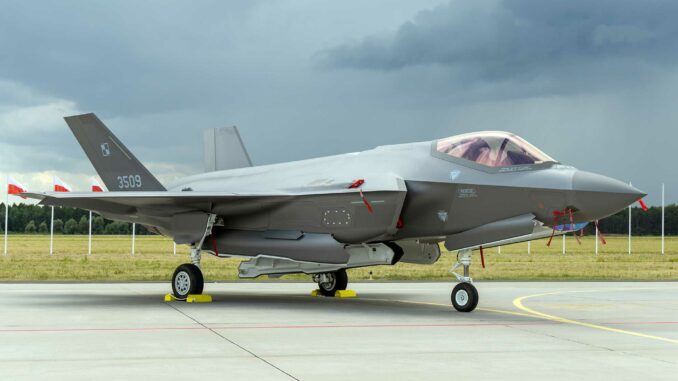
The first Polish F-35A assembled in Cameri made its maiden flight on July 22, 2026. This represents an Italian industrial success, albeit without a full transfer of American technology.
In summary
The first F-35A destined for Poland and assembled in Cameri, Italy, completed its inaugural flight on July 22, 2026. Bearing tail number 3517, it marks the beginning of the second phase of the Polish Husarz program. The first sixteen aircraft originated from Fort Worth, Texas. The subsequent sixteen are slated for assembly at the Italian site operated by Leonardo in partnership with Lockheed Martin.
Consequently, this flight represents more than just a milestone for Warsaw. It underscores Italy’s established position within the European industrial supply chain for the F-35. Cameri oversees final assembly, wing production, testing, and heavy airframe maintenance. This activity brings rare industrial competencies alongside a long-term operational workload.
However, precision is necessary. Italy is acquiring know-how, but not full technological mastery of the F-35. Core software, mission architectures, and essential design rights remain firmly under American control.
The flight of 3517 opens the second half of the Husarz program
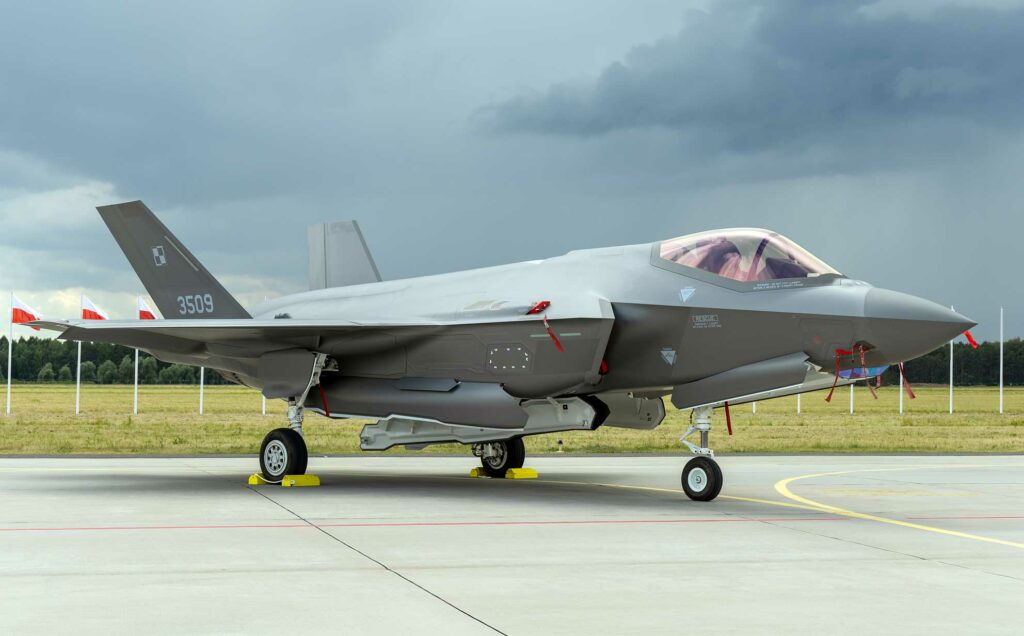
F-35A tail number 3517 completed its first functional flight from Cameri on July 22, 2026. It marks the first Polish F-35A assembled in Italy and the lead aircraft of the second batch of sixteen fighters destined for Poland.
The number 3517 identifies it as the seventeenth aircraft in the Polish series. This distinction is important: this flight was not the first flight of a Polish F-35 overall. Previous aircraft were assembled by Lockheed Martin in Fort Worth, Texas. Three of those jets arrived at the 32nd Tactical Air Base in Łask on May 22, 2026, and were officially welcomed into the Polish Armed Forces in June.
A initial functional flight represents an industrial milestone. It takes place after airframe assembly, equipment integration, and ground testing. It serves to verify the performance of the engine, flight controls, electrical systems, hydraulics, and onboard avionics.
It does not yet constitute operational delivery. Further checks, acceptance flights, and administrative processes must follow. The aircraft must also be formally accepted by program authorities and the customer prior to its final transfer.
Nevertheless, this flight demonstrates that the Italian assembly line has successfully integrated a new national configuration. While the F-35 remains broadly standardized, each national fleet features unique markings, configuration data, modernization schedules, and specialized equipment. Notably, Polish aircraft are fitted with a drag chute, essential for operations on cold, wet, or contaminated runways.
The Polish program rapidly transforms the country’s combat aviation
In January 2020, Poland signed a contract for 32 F-35A fighters under the Harpia program. The aircraft were designated Husarz, referencing the winged hussars of the Polish-Lithuanian Commonwealth.
The contract is valued at $4.6 billion. It encompasses the aircraft, engines, training, ground equipment, spare parts, simulators, and initial logistical support. At the time of signing, the Polish Ministry of National Defense estimated the net price of a single F-35A, including its engine, at $87.3 million.
Deliveries are scheduled between 2024 and 2030, with the initial timeline planning for four to six aircraft per year. The first jets were temporarily retained in the United States to facilitate the training of Polish pilots and maintainers. The contract provides for the training of 24 pilots and 90 technicians in the U.S., along with the supply of eight full-mission simulators.
Poland’s objective extends beyond simply replacing legacy Soviet-era MiG-29s and Su-22s. The F-35A is designed to operate as an advanced sensor node, capable of detecting, tracking, and sharing data with F-16s, Patriot air defense systems, and other North Atlantic Treaty Organization assets.
Stealth capability reduces the range at which the aircraft can be detected and tracked, though it does not render it completely invisible. Its primary utility lies in the combination of a low radar cross-section, passive sensors, an active electronically scanned array (AESA) radar, automated data fusion, and secure datalinks.
For Warsaw, the strategic imperative is clear: to maintain situational awareness and striking capability within an environment heavily defended by enemy radars, surface-to-air missiles, and electronic warfare assets. Proximity to the Russian enclave of Kaliningrad, Belarus, and Ukraine gives this capability immediate operational relevance.
The Cameri facility becomes a strategic asset for Italy
The Cameri facility, located near Novara, is owned by the Italian Ministry of Defense and operated by Leonardo in partnership with Lockheed Martin. It stands as the sole European Final Assembly and Check-Out (FACO) facility for the F-35.
Spanning approximately 41 hectares (101 acres), the site comprises 22 buildings with a covered surface area exceeding 93,000 square meters. It features eleven assembly stations and five bays dedicated to maintenance, repair, overhaul, and upgrades (MRO&U). As early as 2017, Lockheed Martin noted that over 800 skilled personnel were involved in assembling F-35A and F-35B aircraft, as well as manufacturing wing sets.
Cameri does not produce aircraft exclusively for Italy. The facility previously manufactured F-35As for the Netherlands and is now assembling the second half of the Polish order. Its capacity can also serve other European customers, subject to decisions made by the F-35 Joint Program Office and the U.S. government.
For Rome, every international order optimizes the utilization of an expensive industrial infrastructure. An aerospace production line remains competitive only through steady operational output: assembly teams must maintain their qualifications, procedures must be continually executed, equipment maintained, and suppliers guaranteed sufficient volume to preserve their own specialized skill sets.
Consequently, the sixteen Polish aircraft deliver benefits beyond a single commercial transaction. They extend the plant’s workload, mitigate the risk of underutilization, and sustain an industrial base ready to meet future European requirements.
Italy thus captures a portion of the industrial value generated by a Polish purchase executed with the United States. This represents the precise return Rome envisioned when it opted to participate in the Joint Strike Fighter program from its development phase.
Industrial learning extends far beyond final assembly
Characterizing Cameri as a mere assembly plant would be inaccurate. The final assembly of a stealth aircraft demands far stricter industrial discipline than that of a conventional airframe.
Major structural components must be mated with extremely tight tolerances. The exterior geometry directly dictates the aircraft’s radar signature; any misalignment, imperfect seam, or improper fastener can degrade both aerodynamic performance and low-observable characteristics.
Italian teams are also learning to operate within an exceptionally controlled digital framework. Every component is fully traceable, every maintenance or assembly action must be logged, and any variance must be analyzed, corrected, and validated according to standardized program protocols.
Leonardo notes that personnel at Cameri also actively contribute to optimizing manufacturing processes, quality control, and cost efficiency. This dimension is crucial: industrial learning goes beyond replicating American technical instructions. It involves identifying inefficient procedures, recurring defects, or improvable assembly sequences, and subsequently proposing solutions compatible with the certified baseline configuration.
Furthermore, the facility manufactures complete wing sets for the F-35A. Composite and metallic structural elements originate from Leonardo facilities in Foggia, Nola, and Venegono. Cameri was designated as a second source for wing production, supplementing the primary U.S. assembly line.
The program originally envisioned the production of several hundred complete wing sets in Italy, with a target of up to 835 units. This responsibility integrates Italian industry directly into the global F-35 supply chain, including for aircraft ultimately assembled in the United States.
This expertise is transferable. Proficiency in advanced composites, precision assembly, quality assurance, digital manufacturing workflows, and structural repair can be leveraged across future aerospace programs. Notably, it feeds into the core competencies Leonardo will require for the Global Combat Air Programme (GCAP) conducted alongside the United Kingdom and Japan.
Technology transfer remains real, but carefully bounded
The phrase “technology transfer” should be applied with caution. In the case of Cameri, the transfer is industrial and procedural; it does not equate to a full transfer of the F-35’s underlying intellectual property.
Italy participated in the System Development and Demonstration (SDD) phase of the program, with Leonardo citing an Italian contribution of approximately 4.1% to that phase. This investment secured long-term operational responsibilities in aerostructures, final assembly, and in-service support.
As a result, Rome commands the expertise required to assemble structural sub-assemblies, manufacture wings, perform quality inspections, restore airframe coatings, and execute approved modifications. It trains specialized engineers, technicians, quality managers, and heavy maintenance experts.
Conversely, nothing in the public domain indicates that Italy possesses independent access to the source code, sensor fusion algorithms, full mission systems architecture, or technical specifications for the Pratt & Whitney F135 engine.
System modifications continue to be managed exclusively through the F-35 Joint Program Office. Technical data remains strictly compartmentalized, with access governed by specific job functions and stringent U.S. military export control rules.
Cameri is therefore not a sovereign European F-35 facility. It is a European center fully integrated into an American-led multinational program. This distinction is fundamental.
Italy can maintain and modify the aircraft within the parameters of authorized tasks. It cannot independently redesign the airframe, alter software algorithms, or export a national derivative without explicit approval from U.S. authorities.
Poland gains aircraft, but limited industrial participation
The Polish case clearly illustrates the distinction between an industrial program partner and a customer nation. Poland purchases the F-35 via the U.S. Foreign Military Sales (FMS) framework, receiving aircraft, training, simulators, and access to the global logistics system, but without securing a comparable share in design or manufacturing.
The Polish Ministry of National Defense acknowledges that the F-35 industrial program is largely closed to nations that did not participate in its original development phase. Warsaw evaluated an industrial offset agreement but ultimately abandoned the initiative, as it would have added an estimated $1.1 billion to the procurement cost for returns deemed insufficient.
The fact that sixteen Polish jets are being assembled in Italy does not alter this reality. The primary industrial value accrues to Cameri, Leonardo, and the established base of qualified suppliers. Poland’s focus remains concentrated on building operational and base-level maintenance capabilities.
While this outcome may appear unbalanced, it stems from structural choices made years prior to the Polish procurement. Italy funded its early participation in the program’s development, invested in local facilities, and absorbed the costs associated with qualifying its domestic industry—an investment from which it now yields benefits.
Heavy maintenance could prove more valuable than assembly
The long-term outlook for Cameri depends on more than just building new airframes. Its primary economic engine will likely reside in maintenance, repair, overhaul, and upgrading (MRO&U).
An operational fleet of F-35s requires continuous support over decades. Airframes require periodic structural inspections, low-observable radar-absorbent coatings must be restored, structural repairs executed, and aircraft updated with incoming equipment and hardware retrofits associated with the Block 4 standard.
Cameri has been designated as the European MRO&U hub for F-35 airframes. Italy, the Netherlands, and Norway already leverage this capability. On March 24, 2025, a United States Air Forces in Europe (USAFE) F-35A became the first American aircraft to enter the Euro-Mediterranean depot at Cameri for maintenance.
The arrival of a U.S. airframe carries notable political and industrial weight. It demonstrates American confidence in assigning depot-level work to a facility located in Italy, while confirming that Cameri serves more than just European fleets—it has become an integral component of U.S. operational readiness in Europe.
Maintenance generally offers a more stable long-term activity than initial assembly. While aircraft production runs eventually conclude, sustainment spans the entire operational lifespan of the fleet. With several hundred F-35s ordered or operating across Europe, the potential long-term market demand remains substantial.
Italy’s true return will be measured on the next generation
The flight of Polish F-35A tail number 3517 represents a visible success, proving that Cameri can seamlessly integrate new customer configurations while adhering to program standards. Yet, the facility’s most significant strategic impact is less overt.
Italy is cultivating a workforce of technicians and engineers accustomed to the stringent demands of modern stealth aircraft. The nation is building expertise across composite manufacturing, digital assembly processes, configuration management, low-observable maintenance, testing, and heavy structural repair.
These capabilities do not grant Rome full autonomy over the F-35 platform. Technological dependence on the United States remains. This dependency encompasses mission software, software updates, critical proprietary components, mission systems, and baseline configuration decisions.
Even so, Cameri provides Italy with an industrial standing shared by few European nations. Rome is not merely an operator of an advanced American fighter; it is an active participant in its global manufacturing and regional sustainment.
The ultimate test will come with the next-generation fighter developed under the Global Combat Air Programme. If Italy successfully translates the competencies acquired at Cameri into independent sovereign design capabilities, the F-35 will have served as a valuable industrial incubator. Otherwise, Cameri will remain a highly efficient manufacturing facility, bound to a technological architecture it does not control.