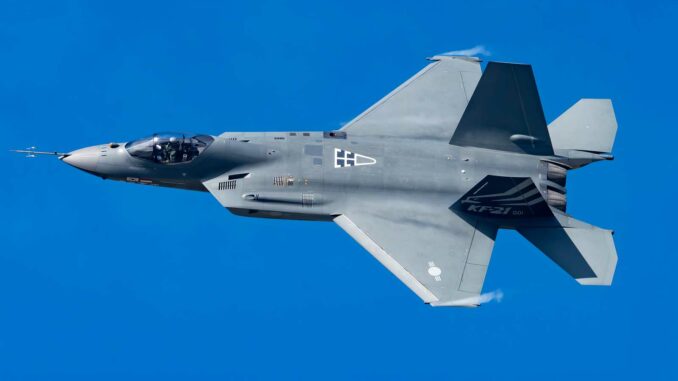
At Farnborough, KAI presents a KF-21 commanding twelve drones—an ambitious architecture that highlights both South Korea’s progress and its limitations.
In summary
At the Farnborough International Airshow 2026, Korea Aerospace Industries presented an air combat formation centered on a single KF-21 Boramae, four MUCCA collaborative combat drones, and eight lighter SUCA air vehicles. The arrangement forms a two-tier architecture: the crewed fighter would command the four larger drones, which in turn could deploy or coordinate the lighter air vehicles.
While this presentation is technologically ambitious, it does not constitute a live flight demonstration of a thirteen-aircraft formation. KAI has separately tested an uncrewed demonstrator powered by its K-AI Pilot artificial intelligence system, but the MUCCA and SUCA platforms remain under active development.
South Korea is not the first nation to pursue Collaborative Combat Aircraft (CCA)—the United States and Australia are further along in flight testing. However, South Korea’s two-tier architecture demonstrates that Seoul no longer aims merely to manufacture a domestic fighter. The country is building a fully networked air combat system.
The concept presented at Farnborough goes beyond a simple “loyal wingman”
Korea Aerospace Industries, better known as KAI, used the Farnborough International Airshow 2026 to showcase its vision for the future of air warfare. The formation on display pairs one KF-21 with four MUCCAs and eight SUCAs.
The KF-21 Boramae occupies the apex of this operational structure. The pilot would not directly control every movement of the twelve uncrewed platforms. Instead, the pilot would assign broad mission objectives: conducting area reconnaissance, locating radar sites, covering an approach vector, or engaging a designated target.
The four Medium Unmanned Collaborative Combat Aircraft, or MUCCA, represent the first uncrewed tier. These jet-powered platforms would accompany the fighter, operating ahead of it in high-threat sectors. Each MUCCA could then deploy Small Unmanned Collaborative Aircraft, or SUCA, which are lighter vehicles.
KAI is thus outlining a hierarchical force structure: the KF-21 provides overall mission command; the MUCCAs deliver operational range, sensor coverage, and firepower; and the SUCAs offer mass, dispersion, and a willingness to accept higher risk.
This framework differs from a conventional concept in which a crewed aircraft is paired with just one or two comparable wingman drones. Instead, it aims to create an entire uncrewed squadron centered on a single human crew.
The operational rationale is clear. A KF-21 carries a finite payload of sensors, missiles, and hardpoints. Integrating uncrewed platforms extends its surveillance reach and available ordnance while allowing sensors to be placed closer to adversary air defenses without exposing the human pilot to immediate danger.
The formation remains a concept rather than an operational demonstration
The Farnborough presentation should be interpreted accurately. KAI did not fly a KF-21 alongside four MUCCAs and eight SUCAs simultaneously. The company exhibited an architecture, scale models, and a technological roadmap.
This distinction is essential. Operating a single autonomous drone along a flight path is already a complex task; coordinating thirteen air vehicles in contested airspace is an entirely different challenge.
Nevertheless, KAI has moved beyond mere digital renderings. Its Adaptable Aerial Platform serves as a testbed for the K-AI Pilot system. During trials conducted in 2025, this system demonstrated the ability to follow flight plans, navigate around simulated surface-to-air missile engagement zones, and identify specific target categories.
The testbed is incrementally learning new tactical behaviors, with KAI focusing development on automated target recognition, obstacle avoidance, and multi-platform coordination.
While these flight tests provide a credible baseline, they do not yet prove the ability to manage dynamic air-to-air combat. In a real-world scenario, an uncrewed platform must distinguish friendly from hostile aircraft, interpret tactical orders, avoid mid-air collisions, and adapt to jamming or loss of communications, all while mitigating cyber threats and deceptive tactics.
The primary hurdle lies in the software, rather than the physical airframe.
The MUCCA must balance stealth, sensors, and firepower
The MUCCA is the primary collaborative combat drone in the formation. KAI projects a maximum takeoff weight of 5,420 kg (11,950 lbs). It is designed to be powered by a turbofan engine delivering approximately 1,860 kg (4,100 lbs) of thrust.
Its advertised payload capacity is roughly 545 kg (1,200 lbs). An internal weapons bay is intended to carry ordnance without compromising the platform’s radar cross-section, supplemented by optional underwing hardpoints.
KAI cites an operational range of 926 to 1,111 km (500 to 600 nautical miles). However, final specifications are subject to change, as the MUCCA remains a system in development rather than a qualified production platform.
The aircraft is designed with a modular nose section. Depending on mission requirements, it could be fitted with an Active Electronically Scanned Array (AESA) radar, an Infrared Search and Track (IRST) system, or electro-optical sensors. This modularity would allow KAI to manufacture multiple operational variants from a single baseline airframe.
A radar-equipped MUCCA could hunt for adversary aircraft, while another passively monitors emissions without revealing its location. A third configuration could carry electronic warfare systems to jam adversary air defenses.
The drone would also serve as a strike platform, capable of employing air-to-air or air-to-surface weapons. Positioned ahead of the KF-21, these platforms would force an adversary to engage multiple threats simultaneously.
The term “attritable,” frequently applied to this class of aircraft, does not mean disposable. The MUCCA is too sophisticated to be routinely sacrificed on every mission. It is intended to return to base, though it remains far more expendable than a crewed fighter jet and its pilot.
The SUCA adds a lighter, higher-risk second layer
The SUCA represents the lower tier of the system. With a projected maximum takeoff weight of just 220 kg (485 lbs), it resembles a small jet-powered tactical drone or a reusable loitering munition more than a conventional combat aircraft.
In the formation exhibited at Farnborough, the eight SUCAs would be carried or air-launched by the four MUCCAs, with each larger drone deploying two smaller vehicles.
The SUCA could push deeper into contested areas. Its small size facilitates sensor dispersion; multiple units could detect radar emissions, triangulate threat locations, or generate deceptive radar signatures.
They could also act as communications relays, establishing a resilient tactical network between the KF-21, the MUCCAs, and other friendly assets. The loss of a single unit would not disrupt the overall communications architecture.
The cost-benefit model is equally important. Military commanders can accept the risk of losing a low-cost drone to force an adversary’s surface-to-air missile battery to activate its radar. That emission then allows another platform to locate and destroy the battery.
This approach fundamentally shifts force design: the primary objective is no longer the protection of individual platforms, but the execution of the broader mission, even when individual components are lost.
The true challenge: commanding twelve platforms without overloading the pilot
KAI’s concept will succeed only if the drones possess a high degree of operational autonomy. A KF-21 pilot cannot manually control twelve uncrewed aircraft while simultaneously monitoring radar systems, managing weapons, tracking fuel consumption, and assessing local threats.
Instead, command must operate on mission intent. The pilot would order a swarm to monitor a sector or suppress a threat, leaving the drones to calculate optimal flight paths and distribute tactical tasks autonomously.
This level of autonomy relies on rapid data fusion. Each platform must maintain real-time awareness of friendly assets, assess available sensor capabilities, and update the tactical picture. The system must continuously determine which sensor is best positioned to observe a target and which aircraft should transmit or remain electronically silent.
Communication links represent a critical vulnerability. An advanced adversary will attempt to jam datalinks, geolocate transmissions, or inject spoofed data. The drones must therefore possess sufficient localized autonomy to continue operating during temporary network disruptions.
A two-seat variant of the KF-21 could help manage these complex missions, allowing the front-seat pilot to focus on flying while a weapon systems officer handles drone coordination. However, KAI has not confirmed whether a two-seat crew layout will be adopted for the formation showcased at Farnborough.
Weapon release authorization remains another central concern. A drone’s technical capability to track and engage a target autonomously does not mean it will be authorized to do so without human oversight. The level of required human authorization will depend on rules of engagement, mission context, and demonstrated algorithmic reliability.
South Korea is not alone in the CCA race
While South Korea’s two-tier formation is innovative, it is not the first entry in the global pursuit of collaborative combat aircraft.
Australia and Boeing have been developing the MQ-28 Ghost Bat since 2017. The program has completed over 100 test flights, executed live-fire tests against aerial targets, and participated in a multinational exercise alongside U.S. forces in 2026, making it one of the most mature CCA efforts in the West.
The United States Air Force is developing its own Collaborative Combat Aircraft in partnership with General Atomics and Anduril, aiming to field over 150 operational units before the end of the decade. Initial production contracts have already been awarded.
In Europe, Airbus is developing the U740 Valkyrie to deliver an initial capability for Germany by 2029, alongside the larger U760 Ravenstorm concept. Meanwhile, BAE Systems unveiled the Brontanax at Farnborough, targeting a first flight in 2027.
China is also exploring crewed-uncrewed teaming capabilities. The two-seat variant of the Chengdu J-20 is frequently associated with drone control operations, though public information regarding its operational maturity remains limited.
South Korea is not leading the world in flight testing. Its competitive advantage lies elsewhere: KAI is proposing a comprehensive domestic architecture built around a fighter already entering production and a scalable family of uncrewed platforms.
The two-tier model, featuring CCAs capable of launching their own secondary drones, is one of the most structured concepts publicly presented to date. However, conceptual novelty should not be confused with operational readiness.
The $11 billion to $21 billion cost remains an uncertain estimate
An estimated cost range of $11 billion to $21 billion has been cited to quantify KAI’s broader ambition. However, this range represents an analytical projection rather than an approved procurement budget from the South Korean government.
The wide variance underscores the program’s uncertainties. Actual costs will depend on the total number of squadrons procured, the unit cost of the MUCCA, the consumption rate of SUCAs during training, and the infrastructure needed for datalinks and operations.
Autonomy software will also account for a significant portion of overall development spending. Algorithms must be developed, tested across thousands of simulated scenarios, and validated against sophisticated electronic warfare threats.
Missiles, sensors, and mission systems will add to platform costs. A relatively low-cost airframe can quickly become expensive once fitted with an AESA radar, an electronic warfare suite, secure datalinks, and guided munitions.
Furthermore, long-term funding must cover flight simulators, mission planning stations, maintenance support, spare parts, and crew training. Sustainment costs for a complex system ultimately outweigh the purchase price of the airframes.
While South Korea possesses a robust defense industrial base, its aerospace programs face growing financial headwinds. For instance, the production cost for 80 KF-21 Block II fighters was re-estimated in March 2026 at 18.44 trillion won, up from 14.24 trillion won, driven largely by inflation, currency fluctuations, and supply chain disruptions.
Consequently, the CCA project will need to demonstrate clear operational value. Simply surrounding the KF-21 with uncrewed aircraft will not be enough—the system must deliver a measurable increase in combat effectiveness for every dollar invested.
South Korea’s progress rests on an incremental industrial strategy
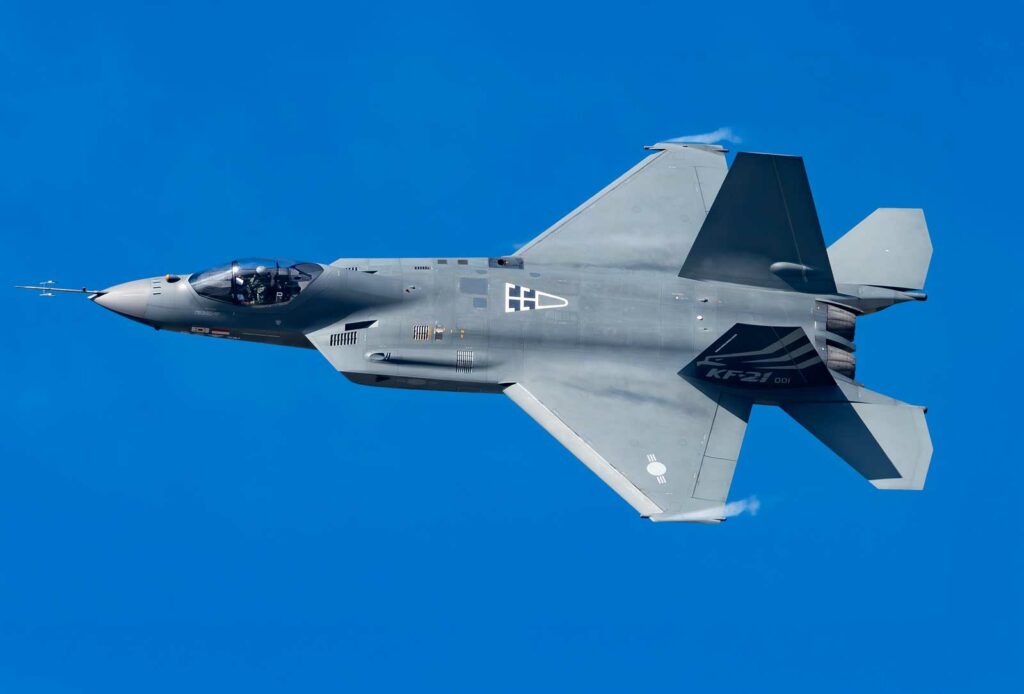
The Farnborough presentation comes as the KF-21 reaches a major program milestone. Development began in 2015, with prototypes completing roughly 1,600 test flights and validating nearly 13,000 test parameters.
The current procurement roadmap calls for 40 KF-21 Block I aircraft focused primarily on air-to-air missions, followed by 80 Block II aircraft featuring expanded air-to-ground capabilities, fulfilling the Republic of Korea Air Force’s requirement for 120 fighters.
South Korea still relies on foreign technological inputs for key components. For example, the KF-21 is powered by two General Electric F414 engines produced locally under license, and several subsystems are sourced from international suppliers.
However, South Korea has developed key strategic components domestically, including the AESA radar, core electronic warfare suites, mission software, and overall systems integration. More than 600 domestic companies participate in the program, achieving a domestic content rate of approximately 65%.
The MUCCA, SUCA, and K-AI Pilot initiatives build directly on this foundation. Seoul has pursued an incremental industrial approach: progressing from licensed assembly to domestic trainers like the FA-50, advancing to military helicopters, maturing the KF-21, and now moving into autonomous systems and collaborative combat.
Another program highlights this industrial breadth: in 2025, the Agency for Defense Development and Korean Air unveiled the LOWUS stealth demonstrator, designed for crewed-uncrewed teaming. While parallel projects risk redundancies, they demonstrate that South Korea’s defense effort is no longer reliant on a single defense contractor.
An ambitious project that still trails global leaders
KAI’s showcase reveals how far South Korea’s defense industry has evolved. The nation is no longer simply trying to catch up with Western manufacturers on conventional fighter platforms; it is seeking to actively participate in defining the next generation of air warfare.
This ambition gains credibility because it is anchored to an existing, flying platform. The KF-21 has completed its primary flight test phase and is entering serial production. KAI is not designing a drone ecosystem around a theoretical concept planned for 2040.
The primary limitation of the project lies in the gap between conceptual architecture and flight-proven hardware. The United States and Australia have already accumulated flight-test data with operational CCAs. KAI must still achieve first flight for the MUCCA, demonstrate air-launch and recovery for the SUCA, and integrate both tiers with the KF-21.
Commanding four medium drones and eight secondary vehicles in a contested environment will require mature, jam-resistant autonomy. A system that performs well in controlled flight tests can prove far less reliable when subjected to active adversary electronic attacks and sensor spoofing.
Ultimately, the Farnborough showcase is less an operational reality than a declaration of industrial capability. South Korea is signaling that it now possesses the airframe design, defense electronics, radar manufacturing, and software engineering capabilities required to build its own networked air combat system.
The next phase will prove more challenging than exhibiting scale models. KAI must fly the formation, demonstrate autonomous decision-making in contested environments, and prove the system remains effective when communications degrade. Only then can South Korea’s operational capabilities be compared to those of the United States and Australia. For now, KAI has demonstrated that Seoul fully grasps where air warfare is headed.