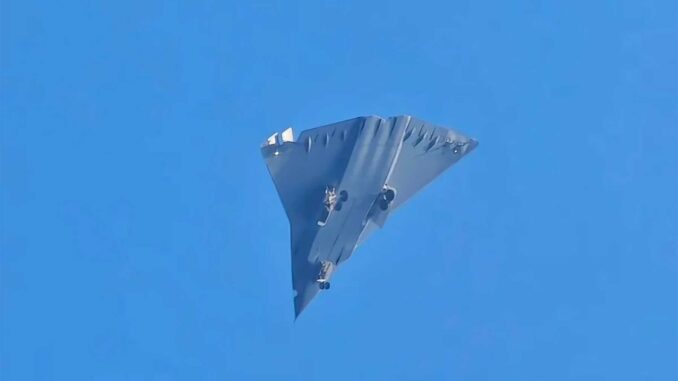
A fifth example of Chengdu’s sixth-generation stealth fighter flew in late July 2026, revealing an architecture still evolving between stability and innovation.
In Summary
Images released on July 23, 2026, show what appears to be a fifth prototype of the Chinese stealth fighter unofficially designated the J-36. Developed by the Chengdu Aircraft Corporation, this tailless, tri-engine aircraft combines recent DSI air intakes with recessed nozzles similar to the very first prototype. This apparent technical hesitation actually reflects a methodical flight-test campaign aimed at finding the best compromise between stealth, thrust, and control. With an estimated combat radius of over 4,000 kilometers, the aircraft could directly threaten enemy refueling tankers and airborne radar platforms in the Pacific. The Chinese timeline, well ahead of Washington’s, is now openly worrying the Pentagon.
A Fifth Aircraft Spotted over Sichuan
On July 23, 2026, amateur video footage began circulating on Chinese social networks. It shows a large, tailless stealth fighter maneuvering in the skies above Sichuan province, the historic home of the Chengdu Aircraft Corporation. Military aviation specialists quickly recognized what they call—for lack of an official designation—the J-36, a name derived from the number “36” spotted on the fuselage of one of the very first photographed examples.
This fifth aircraft stands out due to a revealing technical detail: it pairs DSI (diverterless supersonic intake) air inlets, previously seen on the most recent prototypes, with recessed exhaust nozzles—a configuration believed to have been abandoned since the first example was unveiled in December 2024. This unexpected combination suggests that Chengdu is not following a strictly linear progression from one prototype to the next, but is testing several architectures in parallel to identify the best possible synthesis between radar discretion, propulsive efficiency, and flight control.
No Chinese military or industrial authority has officially confirmed the identity of the aircraft or the exact number of airframes built to date. However, analysts point to at least three to five distinct prototypes observed in flight since the initial maiden flight on December 26, 2024—a date that many observers note, not without irony, coincides with Mao Zedong’s birthday.
A Tailless Architecture Tailored for Stealth
The J-36 breaks away from the conventional design of fifth-generation fighters like the Chinese J-20 or the American F-22 and F-35. It possesses neither vertical fins nor horizontal tailplanes. This lack of a tail assembly sharply reduces the aircraft’s radar cross-section, as it is precisely these protruding surfaces that most effectively reflect radar waves back to their transmitter.
The drawback of this design lies in pitch control. A conventional fighter uses its horizontal tailplanes, positioned far from the center of gravity, as a powerful lever to raise or lower the nose rapidly. Without this feature, a tailless aircraft must rely solely on movable control surfaces integrated into the wings—elevons—coupled with extremely sophisticated digital flight control software. Recently filmed sequences showed the J-36 executing a tight climbing turn, demonstrating unprecedented maneuverability for this type of layout and confirming that Chengdu has mastered an aerodynamic challenge long deemed insurmountable.
The wing adopts a double-delta planform, featuring a leading-edge kink that creates two distinct sweep angles. The wide fuselage, tapered at the nose, houses a cockpit with side-by-side seating rather than tandem, a setup that facilitates coordination between two crew members for sensor and weapons system management.
Three Engines for Unprecedented Power and Range
The most unique feature of the J-36 remains its three-engine powerplant, a configuration that no other fighter aircraft in the world has ever adopted. Two hypotheses are circulating among Western experts. The first suggests insufficient power from current Chinese jet engines, forcing engineers to add a third motor to reach targeted performance levels. The second suggests that this dorsal central engine powers high-capacity electrical systems—active sensors, electronic warfare suite, or future directed-energy weapons—rather than propulsion alone.
Takeoff weight estimates range between 50 and 70 metric tons, well above the J-20’s 37 tons. This considerable mass allows for a massive internal fuel capacity, consistent with a reported combat radius exceeding 4,000 kilometers—or even up to 5,000 kilometers according to some assessments. By comparison, the J-20’s operational radius rarely exceeds 2,000 kilometers. This range places the J-36 in a hybrid category, halfway between an air superiority fighter and a stealthy regional bomber, a role close to what was once envisioned for the JH-XX program.
Estimated length varies according to sources between 22 and 30 meters, with a wingspan between 19 and 21 meters. These dimensions significantly exceed those of both the J-20 and the F-22, nearing those of a tactical bomber rather than a pure fighter.
Exhaust Nozzles Revealing a Strategic Trade-Off
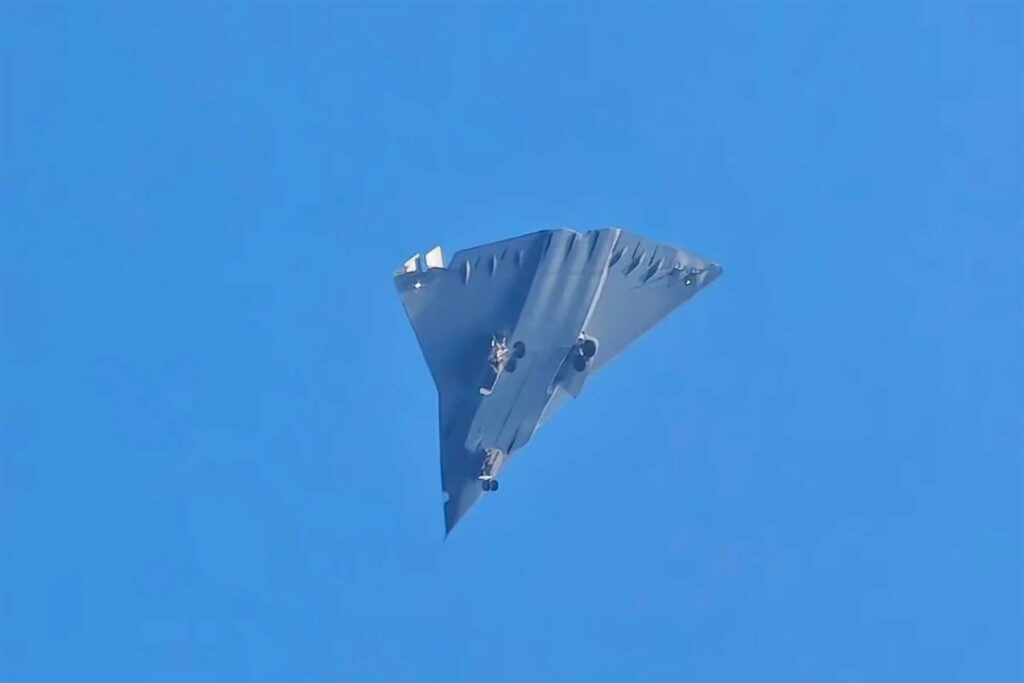
The rear section of the J-36 is undoubtedly the element most scrutinized by analysts. Flat, two-dimensional nozzles had appeared on several intermediate prototypes, recalling the solution selected by Lockheed Martin on the F-22 and suggesting a thrust-vectoring capability. However, the fifth prototype appears to have returned, at least partially, to trench-like recessed nozzles similar to those on the initial prototype.
This choice illustrates a classic trade-off in stealth design. A deeply recessed nozzle better conceals the hot engine parts, reducing the aircraft’s rear infrared and radar signatures. A flat, steerable nozzle, on the other hand, provides additional control authority by deflecting thrust flow—a valuable asset for a tailless aircraft with few conventional control surfaces. The partial return to the recessed setup could therefore reflect a higher priority given to rear-aspect stealth, even at the expense of vector-control authority, or a deeper integration of both approaches within a single system.
Armament Designed to Strike Far and Hard
Satellite imagery has revealed internal weapon bays significantly larger than those on the J-20, potentially capable of carrying the PL-17 long-range air-to-air missile, whose range is estimated at around 500 kilometers. Such armament would shift the tactical balance in the Pacific: it would allow the J-36 to directly target aerial refueling tankers, airborne early warning aircraft, and maritime patrol platforms long before they come into contact with escorting fighters. By forcing these vital support assets to operate much further away from contested areas, Beijing would mechanically reduce the endurance and responsiveness of allied air forces along the first and second island chains.
Balance of Power Against Western Programs
The Pentagon’s 2025 annual report on Chinese military power marked a turning point by officially acknowledging the rapid progress of China’s sixth-generation programs, explicitly citing Chengdu’s J-36 and Shenyang’s J-50. Washington officially targets 2035 for initial operational capability, but some experts estimate that the pace of Chinese flight testing could allow for a limited deployment as early as 2030.
On the American side, the competing F-47 program, awarded to Boeing under the Next Generation Air Dominance project, aims for a maiden flight in 2028. Tech demonstrators, however, reportedly flew in secret as early as 2019, according to statements by the U.S. President when announcing Boeing’s selection. The apparent timeline gap between the two programs has narrowed significantly, if not inverted, explaining the unusually alarmist tone of official American assessments.
A Test Campaign Redefining Chinese Industrial Priorities
Above all, the case of the fifth prototype shows that Chengdu is not advancing along a simple, linear trajectory. The company appears to be simultaneously comparing multiple combinations of air intakes, exhaust nozzles, landing gear, and structural details before locking in a final production configuration. Unconfirmed rumors even suggest the start of low-rate initial production. However, in the absence of standardized data, identifiable serial numbers, or transfers to a military evaluation unit, this hypothesis must be approached with caution.
What emerges clearly from this fifth appearance is the Chinese engineers’ methodical reduction of technical risk, aircraft after aircraft. Far from signaling a frozen design, this fifth prototype demonstrates an aviation industry capable of iterating fast, testing broadly, and directly preparing the combat aircraft that will shape the balance of aerial power in the Pacific for decades to come.
War Wings Daily is an independant magazine.