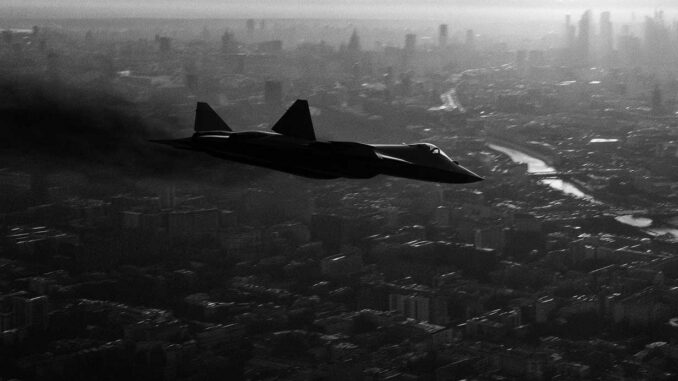
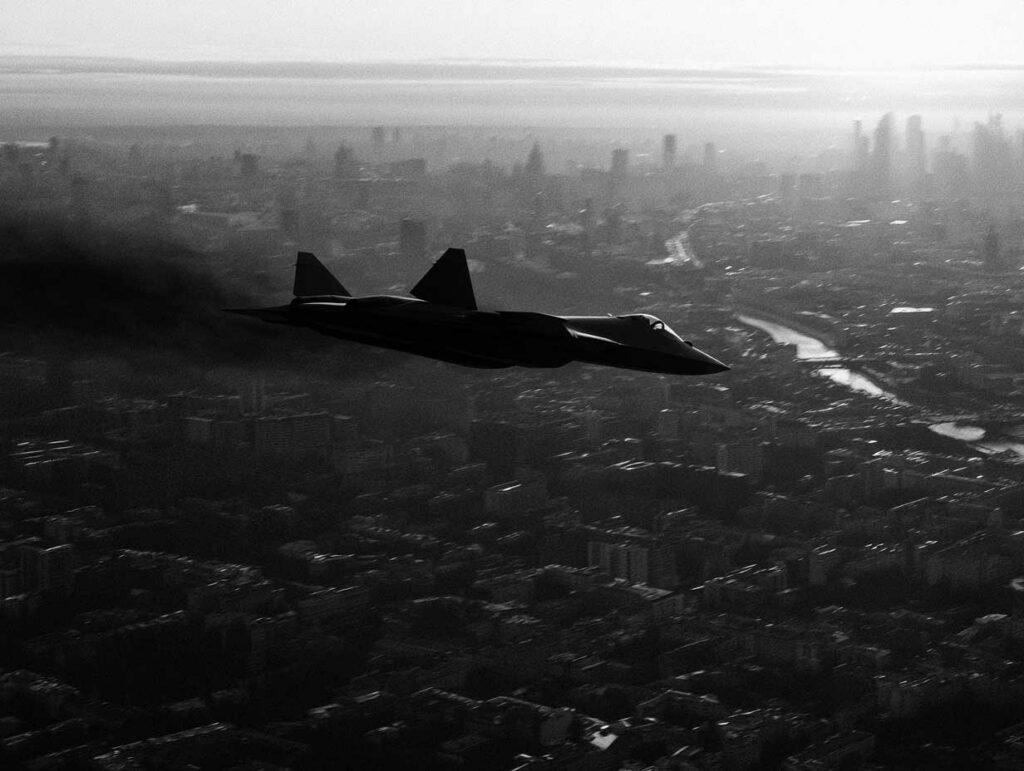
On July 23, 2026, a Su-57 Felon stealth fighter crashed in the Moscow region. The accident exposes the industrial and operational vulnerabilities of Russia’s fifth-generation aviation.
In Summary
On July 23, 2026, a Sukhoi Su-57 Felon stealth fighter crashed in the Odintsovo district near Zvenigorod, approximately 65 kilometers west of Moscow. The aircraft had taken off from Kubinka Air Base on a training flight. The pilot ejected and survived with minor injuries. While the Russian Ministry of Defense cited a technical malfunction, pro-war Russian milbloggers and the Ukrainian organization InformNapalm point to a friendly fire hypothesis involving the BARS-Moskva air defense battery. The incident reveals the true state of a program long presented as the showcase of Russian military aeronautics: a numerically insignificant fleet, engines still in transition, and operational pressure that has been building since the start of the war in Ukraine.
The July 23 Crash: The Established Facts
At 1:50 p.m. local time, a Sukhoi Su-57 crashed in a field near the village of Lutino in the Odintsovo district. Initial images published on Russian Telegram channels showed a blaze in an agricultural area, away from homes. According to witnesses cited by the local channel Zven_Info, the pilot deliberately steered the aircraft toward an open area before ejecting, avoiding a crash in a residential zone.
The Russian Ministry of Defense issued a brief statement via TASS: “A combat trainer aircraft crashed during a takeoff phase in the Moscow region on July 23. The pilot ejected; his life is not in danger.” The military did not confirm the aircraft type and cited a “technical failure” as the preliminary cause. The Investigative Committee of the Russian Federation (SKR) opened a criminal case under Article 351 of the Criminal Code, which relates to violations of flight rules or flight preparation.
Several Russian open sources, including Mash and REN TV, identified the aircraft as a single-seat Su-57 based at Kubinka. The Aviation Safety Network now lists three recorded crashes across the entire Su-57 program, including a prototype accident in 2014 and a crash during a test flight in December 2019 in the Khabarovsk region.
The Friendly Fire Theory and the Ukrainian Cyber Operation
The hypothesis of a purely technical malfunction was quickly challenged from within the pro-Kremlin media sphere itself. The milblogger Romanov, one of the most widely followed voices in the community, wrote on Telegram: “Several questions must be asked of the BARS-Moskva crew.” The channel arrowsmap went further, explicitly suggesting that a surface-to-air missile fired by the BARS-Moskva mobile air defense battery—tasked with protecting the capital against Ukrainian drones—may have shot down the stealth fighter.
The issue took on an additional dimension with a statement from the Ukrainian intelligence group InformNapalm. The organization claims to have conducted a combined HUMINT-CYBINT operation specifically targeting this system. According to its July 23 publications, its analysts intercepted BARS-Moskva crew training feeds as early as July 17, documenting operational algorithms, software vulnerabilities, and combat procedures before passing a dossier to the Ukrainian Armed Forces. InformNapalm claims that this exploitation of system flaws made it possible to influence a crew’s firing decisions, leading to the engagement of the Su-57 by its own protective system.
These claims have received no official confirmation from either Russian or Ukrainian authorities. Moscow maintains the mechanical failure theory. However, the irony of the situation escapes no one: if a fifth-generation fighter was shot down by its own air defense system, its radar signature was detectable enough to trigger the engagement. This observation alone shakes official Russian rhetoric regarding the aircraft’s stealth capabilities.
Structural Shortcomings of the Su-57 Program
The Su-57 has been presented since 2010—the date of its maiden flight under the T-50 designation—as Russia’s rival to the American F-22 Raptor and the Chinese Chengdu J-20. The aircraft was officially accepted into service in 2020, ten years after its first flight. This delay illustrates the magnitude of the industrial difficulties that have plagued the program.
The operational fleet is currently estimated at 20 to 35 serial production aircraft, depending on sources, alongside roughly ten prototypes. In early 2026, RUSI estimated that around 20 Felons were actually in service with the Russian Aerospace Forces. By comparison, the United States has produced more than 1,000 F-35s across all variants. Russia aimed to have 76 Su-57s delivered by the end of the 2020s—a goal experts deem unrealistic under current conditions.
Production rates remain erratic. In 2025, external analysts could document no official deliveries, contrasting sharply with initial ambitions. In February 2026, Rostec and the United Aircraft Corporation announced the delivery of a new batch—without specifying the quantity—featuring updated onboard systems. The Komsomolsk-on-Amur plant, the sole production site for the Su-57, suffers from electronic component shortages tied to post-2022 Western sanctions, which disrupted supplies of microprocessors and precision machine tools.
The Central Engine Question: A Program Still in Transition
The Su-57’s Achilles’ heel remains its propulsion system. Aircraft currently in service fly with AL-41F1 (Izdeliye 117) engines, derived from those powering the Su-35S. These engines deliver 142 kN of thrust with afterburner. They represent a temporary solution: capable, but far short of the performance expected from a true fifth-generation fighter.
The definitive engine, long designated as the Izdeliye 30 or AL-51F1 and intended to provide supercruise—the capability to sustain supersonic flight without afterburners—remains shrouded in uncertainty. On December 22, 2025, a prototype Su-57 completed a flight using an engine presented as the “Product 177,” developed by the Lyulka design bureau within UEC. Rostec announced 16,000 kgf of thrust with afterburner (approximately 157 kN) and improved specific fuel consumption. Serial fielding is projected for 2027 to 2028, subject to supply chain constraints.
In the meantime, operational Su-57s fly with an interim powerplant whose reliability, according to several sources, is compromised by high operational intensity. The war in Ukraine has forced the Russian Aerospace Forces to rely heavily on their existing fleets, accelerating airframe and engine wear on aircraft whose maintenance schedules struggle to keep pace.
A Fleet Tested by War and Ukrainian Strikes
The operational environment in which the Su-57 operates is severely degraded. Most of the fleet was redeployed to Dzyomgi Air Base in the Russian Far East to place it out of reach of Ukrainian long-range drones. This precaution proved insufficient. In June 2024, two Su-57s were damaged by drones at Akhtubinsk Air Base. In May 2026, two additional aircraft were struck at Shagol in the Chelyabinsk region, according to the Ukrainian high command.
Kubinka Air Base, from which the Su-57 shot down on July 23 took off, is primarily used for flight testing, evaluation, and training. It houses the Swifts (Strizhi) and Russian Knights (Russkiye Vityazi), the flight demonstration teams of the Russian Aerospace Forces. Assigning a Su-57 to this base for a training flight underscores the strain on managing the few available airframes.
Russia has lost approximately 430 fixed-wing military aircraft since February 2022, according to available estimates. Losing a Su-57—even a single one—represents a disproportionate symbolic and strategic cost given the size of the fleet. Each aircraft is valued at between $100 million and $120 million.
Strategic Implications of a Weakened Program
The crash on July 23, 2026, is not merely an isolated accident. It crystallizes three major vulnerabilities in Russian combat aviation.
First vulnerability: the numerical weakness of the fifth-generation fleet renders every loss irreplaceable in the short term. Russian industry cannot compensate for losses at the rate they occur.
Second vulnerability: the credibility of the Su-57’s stealth capabilities is called into serious question. If the friendly fire hypothesis is confirmed, it means that the BARS-Moskva radar engaged the aircraft based on a detectable signature—invalidating official claims regarding the aircraft’s level of radar discretion.
Third vulnerability: the erosion of export confidence. Rosoboronexport markets the Su-57 to potential clients in India, Algeria, and Vietnam. An accident of this nature, occurring under such ignominious circumstances, further weakens a commercial offering already battered by production delays and sanctions.
India, which participated in the FGFA (Fifth Generation Fighter Aircraft) program before withdrawing in 2018, is watching. China, whose J-20 fleet numbers in the hundreds, is taking note. And the Russian Aerospace Forces know that at this pace, maintaining a credible Su-57 fleet through the end of the decade will be as much an industrial trial as an operational one.
War Wings Daily is an independant magazine.