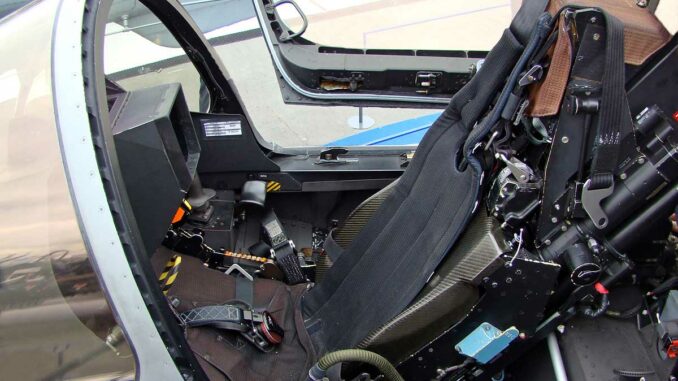
The Rafale uses voice alerts and limited voice control to reduce the pilot’s workload, without entrusting critical functions to voice commands.
In summary
The Dassault Rafale has indeed served as a platform for direct voice control, or Direct Voice Input. As early as the 2000s, Dassault Aviation was testing a system capable of managing displays, navigation, radio frequencies, identification codes and certain autopilot modes. Two production Rafale B aircraft had been specially fitted for this purpose. At the time, the manufacturer announced a vocabulary of between 50 and 300 words, a recognition rate of over 95 per cent and a response time of less than 200 milliseconds. However, this technology should not be presented as a universal voice assistant that is definitely installed on all operational Rafales. In 2009, it was still described as an option offered to customers. Dassault’s current presentations focus primarily on HOTAS controls, touchscreens, the helmet-mounted display and data fusion. The aircraft can alert its pilot via the audio channel. It does not engage in free-flowing conversation with the pilot as a conversational assistant would.
Voice control on the Rafale does exist, but its capabilities are often exaggerated
The idea is appealing. The pilot utters a command. The Rafale understands the request, changes a radio frequency or displays a tactical screen. The crew keep their hands on the control stick and throttle. They keep their eyes on the outside.
This description is based on real technology. However, it becomes misleading when it suggests that all Rafales in service have a fully-fledged voice assistant capable of querying the on-board systems using natural language.
Historical programme documents confirm that Dassault Aviation and Thales developed a Direct Voice Input function. The manufacturer evaluated it in flight. It demonstrated it to foreign pilots. It even fitted two production Rafale B aircraft, the B301 and B302, to continue testing.
In 2001, Dassault described the technology as a component of the ‘Voice, Throttle and Stick’ concept. This principle extended the HOTAS (Hands On Throttle And Stick) system. HOTAS already allows essential functions to be operated without releasing the primary controls. Voice control was intended to add a third channel of interaction.
The system was therefore neither a brochure gimmick nor a mere laboratory project. It actually worked on board the Rafale.
Its operational deployment, however, remains less clear. An assessment published in 2009 by Flight International indicated that voice control was offered as a customer option. More recent official documents from Dassault Aviation describe the Rafale’s human-machine interface in detail, but no longer list Direct Voice Input amongst its main functions.
They highlight the head-up display, the helmet-mounted display, the central tactical display, the side touchscreens and the HOTAS controls. This omission does not prove that the technology has disappeared from all configurations. Equipment may vary depending on customers and standards. It does, however, preclude presenting voice control as a general, uniform capability that is systematically used across the entire fleet.
The most honest way to put it is therefore straightforward. The Rafale has integrated and tested an advanced voice control system. This feature has been offered for export. Publicly available information does not allow us to state that it is currently fitted to all French or foreign aircraft.
The system recognises short commands rather than conversation
The Rafale’s Direct Voice Input belongs to a technological generation very different from that of today’s voice assistants.
It is not a conversational assistant. It does not seek to understand an improvised sentence. It recognises a limited vocabulary, associated with pre-determined functions.
In its 2001 presentation, Dassault announced 50 to 300 words, depending on the customer’s requirements. The claimed recognition rate exceeded more than 95 per cent. The response time was stated as less than 200 milliseconds.
These figures must be put into context. They describe the performance claimed during the system’s development, more than twenty years ago. They do not constitute a public certification of the performance of all Rafale aircraft currently in service.
A vocabulary of 300 words seems limited compared to modern consumer systems. However, it is sufficient for a specialised military interface. The aim is not to understand a conversation. It is to quickly distinguish between short, familiar words that are very different from one another.
Recognition is based on a fixed grammar. The computer does not freely interpret the pilot’s intent. It compares the received signal against a library of permissible commands. Each word or combination of words corresponds to a defined action.
This restriction improves reliability. It also prevents a radio conversation, heavy breathing or a phrase spoken under stress from triggering an unintended function.
The pilot must actively activate the listening mode
The Rafale does not constantly listen to its pilot whilst waiting for a keyword.
Historical documentation indicates that voice recognition was activated by a button on the throttle lever. The pilot would press the button, say the designated word, and then receive confirmation.
This architecture is essential in a fighter aircraft. The microphone in the oxygen mask picks up the pilot’s voice, but it is also used for radio communications and the intercom. A system that listens continuously would need to distinguish between a command intended for the aircraft and a message addressed to an air traffic controller, a crew member or a ground operator.
Manual activation reduces this ambiguity. It also preserves a fundamental military principle: an action must result from an identifiable intention.
Voice control is therefore not entirely ‘hands-free’. The pilot must first press a button. The benefit remains real, however. A single press can replace several actions on menus, buttons or screens.
Commands initially concern non-critical functions
Dassault presented the system as a means of speeding up data entry and mode selection. The examples published related to screen management, navigation, radio aids, the flight plan, certain autopilot modes, radio frequencies and IFF codes.
IFF, which stands for Identification Friend or Foe, enables aircraft to be queried or identified according to coded procedures. Changing a code may require several steps. Voice commands therefore offer a useful shortcut.
The same reasoning applies to radio frequencies. A pilot engaged in a complex mission may need to switch from a control network to a tactical frequency, then to that of a refuelling aircraft. Voice selection reduces the time during which the pilot’s attention is diverted from the combat situation.
The system could also be used to manage displays. It could call up a page, change a mode or alter the presentation of certain information. This function may seem modest. It becomes important when the pilot has to monitor several threats simultaneously.
However, the engineers have restricted voice control to non-critical functions. This choice is not a weakness. It is an essential precaution.
A misrecognised command must not cause a weapon to be released, an engine to be shut down or the aircraft’s trajectory to be abruptly altered. The more irreversible the consequences of an action, the more it requires a clear physical command, confirmation or a secure sequence.
Voice commands can initiate an action; they do not necessarily have to see it through to completion. The pilot can select a mode, display data or prepare a channel. The final decision remains the responsibility of traditional controls.
The cockpit imposes constraints that smart home assistants are unaware of
Recognising a voice in a quiet living room is relatively simple. Understanding it inside a Rafale is another matter entirely.
The pilot wears a helmet and an oxygen mask. Their voice is picked up by a microphone positioned near their mouth. It can be altered by breathing, the pressure of the mask, fatigue and stress.
Ambient noise presents an additional challenge. The engines, aerodynamic flows, vibrations, ventilation and radio communications create a hostile acoustic environment. The relevant signal must be isolated before being compared with the recorded vocabulary.
High G-forces also alter speech. Under several Gs, the pilot tenses the muscles in their abdomen, legs and neck. They use a specific breathing technique to maintain blood flow to the brain. Their voice becomes shorter, more strained and sometimes less even.
A command that is recognised perfectly on the ground may be uttered differently during a high-G turn.
Dassault had already highlighted this problem in the early 2000s. The algorithms had to cope with noise, stress and acceleration. The difficulty lay not only in recognising words. Errors had to be avoided at the very moment when the pilot had the least time to correct them.
Visual feedback prevents silent execution
The development documentation specifies that sensitive voice selections were given visual confirmation.
This principle closes the interaction loop. The pilot utters a command. The system interprets it. The screen displays what has been understood. The pilot can then accept the change or cancel it.
Without this confirmation, an error would remain unnoticed. The pilot might believe that one frequency had been selected, whilst the computer had chosen another.
Visual feedback reduces the risk. It also reduces part of the initial time saving, as the pilot must verify the result. Voice control therefore does not eliminate the need to check the instruments entirely. Above all, it shortens the sequence.
This distinction is important. The technology does not completely free up the pilot’s attention. It reduces the number of actions required and the time spent navigating menus.
Voice control complements an interface already designed to minimise actions
The Rafale did not wait for voice recognition to reduce the pilot’s workload.
Its interface is based on a clear hierarchy. Immediate actions are carried out whilst keeping one’s head up.
The pilot uses the head-up display and, on recent models, the helmet-mounted display. This allows them to keep the key information within their field of view.
The overall tactical situation is shown on the central collimated display. This collimation reduces the effort required to switch from the external view to the screen. The eye does not have to refocus completely between the two planes.
The side touchscreens are used to manage the system’s resources. The control stick and throttle lever group together the most frequently used controls. Finally, data fusion reduces the number of tracks and symbols that the pilot must compare manually.
The Rafale does not simply present raw data from the radar, optronics, SPECTRA and the data link. Its computer cross-references this data, eliminates certain redundancies and produces a coherent tactical picture.
Voice control was intended to complement this architecture. It was not its central feature.
Its value is particularly evident when a secondary function is buried too deep within the menus. Rather than releasing a control, searching for a button and confirming several steps, the pilot can simply speak a short command.
The technology therefore functions as an ergonomic shortcut. It does not replace either the HOTAS system or the touchscreens.
Voice alerts are not the same technology
To say that the Rafale ‘speaks’ to the pilot often confuses two different systems.
The first is voice recognition. The aircraft listens to a command and attempts to identify it.
The second is speech synthesis or, more broadly, an audio alert. The aircraft sends a message to the pilot to signal a danger, an abnormal condition or a high-priority event.
Both functions use the voice channel. Their logic is opposite.
Voice control requires an analysis of the received signal. The computer must isolate the speech, recognise a word and select an action.
The voice alert is simpler. The system selects a pre-recorded message or one generated from a library. It plays it through the headset according to a priority order.
In everyday language, any artificial voice is often referred to as speech synthesis. Technically, however, it may consist of a set of digitised messages rather than a voice that freely constructs sentences.
Public information on the Rafale does not provide an exhaustive list of spoken warnings, tones or their hierarchy. Part of this architecture relates directly to the weapons system and self-protection. It is not intended to be fully documented.
It is, however, certain that the cockpit uses the audio channel to attract attention. A radar threat, a missile launch, a system fault or a dangerous flight situation cannot rely solely on an on-screen symbol.
Sound has an immediate advantage. The pilot can perceive it without looking at the relevant instrument.
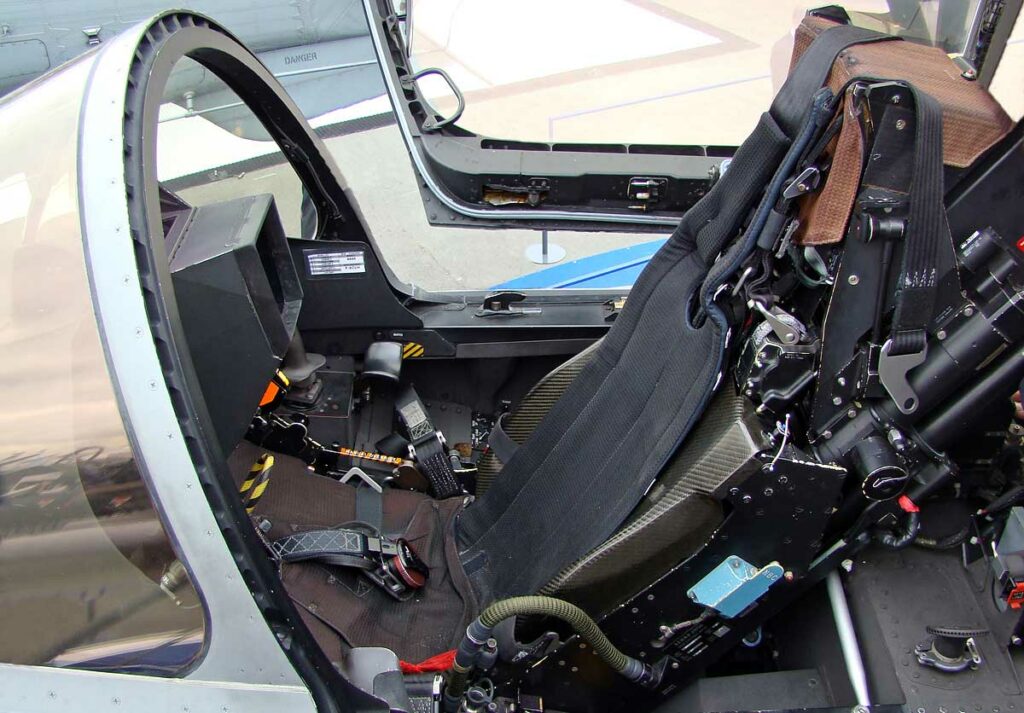
Messages must remain short and prioritised
A voice alert that is too long becomes counterproductive. It monopolises the audio channel. It may mask a radio communication and arrive too late.
The system must therefore use short words. It must also decide which alert takes priority when several events occur simultaneously.
A missile threat must take precedence over a minor anomaly. A fault directly affecting the flight must be reported before a comfort-related fault or maintenance information.
This prioritisation is in line with the Rafale’s overall philosophy. The computer does not merely accumulate information. It seeks to present what matters when it matters.
The voice is only valuable if it reduces confusion. A cockpit that spoke constantly would quickly become unusable.
Historical figures demonstrate performance, not generalisation
The figures announced in the early 2000s remain impressive.
A response time of less than 200 milliseconds made interaction almost instantaneous. A recognition rate of over 95 per cent represented a solid performance for an on-board system of that era. A vocabulary of up to 300 words was already sufficient to cover numerous tasks.
However, these results do not mean that errors were impossible. A 95 per cent rate still corresponds, statistically, to one incorrect recognition in every twenty attempts.
This proportion is acceptable for calling up a page or setting a frequency, provided the pilot can correct the result. It would be unacceptable for an irreversible action.
The figures must also be distinguished from actual usage. They were derived from a test programme conducted on specific aircraft. They do not prove that the function was subsequently installed or activated on every aircraft delivered.
In 2001, Dassault stated that the system would be available on the Rafale export Block 05 variant. In 2009, Flight International still presented it as a customer option.
This consistency is telling. The technology was ready to be offered. It was not necessarily considered essential in all configurations.
Air forces have to balance operational benefits against cost, maintenance, training and software complexity. A feature may be technically successful whilst remaining rarely deployed.
Recent research shows that the problem remains unresolved
Several years after the first Rafale trials, the French Ministry of the Armed Forces launched the ACDC project, standing for Audio Cockpit Denoising for Voice Command.
This programme brought together, in particular, Dassault Aviation, Thales Avionics and the Lorraine Laboratory for Research in Computer Science and its Applications. Its aim was to improve noise cancellation and speech recognition in military cockpits.
The project envisaged more natural interactions. The pilot could ask for the distance to the next refuelling point, call up a tactical map or obtain information on a target.
These examples are more in line with the concept of a modern aviation assistant. Above all, they demonstrate that voice recognition in a military environment remains a work in progress.
An assistant capable of answering a question is far more complex than a system that simply recognises a code word. It must understand syntax, identify the context, consult multiple databases and produce a reliable response.
It must also operate without a permanent connection to an external infrastructure. A fighter aircraft cannot rely on a civilian IT service or a remote data centre to carry out a critical task.
Finally, for safety reasons, the system must clearly explain what it has understood. A plausible but incorrect response would be more dangerous than no response at all.
Consumer-grade assistants can tolerate ambiguity. A military system cannot.
Voice control will remain a secondary tool until its reliability is absolute
Voice control offers a clear advantage in a single-seat cockpit. The Rafale pilot must fly, navigate, communicate, identify threats and deploy weapons. Any function that reduces the number of physical actions can free up a precious fraction of the pilot’s attention.
Voice commands also have their weaknesses. They depend on the quality of the microphone. They vary depending on the pilot’s physical condition. They can be disrupted by noise, communications and acceleration. They use an audio channel that is already heavily congested.
Physical controls remain easier to certify. A button has a visible position. A switch provides tactile feedback. An action on the control stick or throttle is immediately perceptible.
Voice recognition must therefore be regarded as an additional layer. It must not become a dependency.
The pilot must be able to perform every important task using an alternative method. This redundancy is essential in the event of a microphone failure, software malfunction or incorrect recognition.
In this architecture, voice commands complement the controls. They do not replace them.
True progress lies less in speech than in maintaining focus
The Rafale was designed around an idea broader than voice control: the pilot must not become a slave to their own sensors.
Radar, optronics, SPECTRA, friend-or-foe identification and data links can generate a considerable volume of information. The modern challenge is no longer simply to detect. It lies in sorting, fusing and presenting information.
Voice commands contribute to this effort when they avoid unnecessary manipulation or immediately draw attention to a danger. They fail when they add yet another message to an already overloaded cockpit.
The Rafale does not, therefore, become more advanced simply because it ‘speaks’. It becomes so when its interface selects the right channel at the right moment.
Urgent information must be heard without taking one’s eyes off the sky. A secondary command must be issued without interrupting flight control. A critical decision must remain safeguarded by clear confirmation.
It is in this balance that true innovation lies. The pilot retains control. The aircraft relieves the pilot of some of the mechanical work. The voice is neither a gimmick nor an artificial co-pilot. It is an additional tool, useful only when it remains discreet, limited and predictable.
War Wings Daily is an independant magazine.