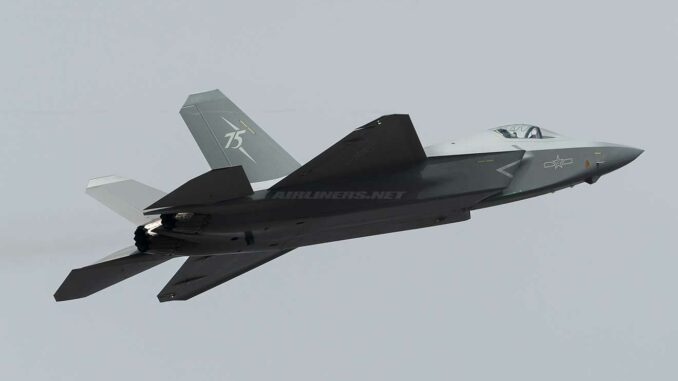
More than 30 J-35s are reported to have already been assembled. This ramp-up provides Beijing with a new asset for its air, naval and industrial capabilities.
In summary
China appears to have reached a decisive milestone in the Shenyang J-35 programme. Specialist observers estimate that at least 30 J-35 stealth fighters had been produced by mid-2026. A photograph showing an aircraft numbered 350030 is one of the main pieces of evidence cited. This figure remains an estimate based on open-source intelligence. Beijing has not confirmed it.
The industrial evidence is, however, hard to ignore. Airframes are regularly spotted at the Shenyang Aircraft Corporation’s facilities. The naval J-35 is now associated with the Fujian aircraft carrier, whilst the land-based J-35A is beginning to enter service with the People’s Liberation Army Air Force. An export version is also in the pipeline.
China is not yet producing the J-35 at the same rate as the American F-35. However, it is building the factories and supply chain necessary to transform a recent programme into a fleet of several hundred aircraft.
The figure of around thirty J-35s marks a threshold, not an absolute certainty
The news is spectacular. However, it must be phrased with precision.
The figure of at least 30 aircraft comes mainly from observers tracking prototypes, production numbers, images from assembly lines and test flights around the Shenyang Aircraft Corporation’s facilities. In particular, a photograph released at the end of June 2026 shows a J-35 bearing the number 350030. The specialist website Chinese Military Aviation therefore estimates that at least 30 naval J-35s had been produced by mid-2026.
This does not necessarily mean that 30 fully operational aircraft have been delivered to a combat unit. The tally may include prototypes, test aircraft, pre-production airframes and aircraft awaiting military acceptance. The numbering may also contain gaps or follow an unknown internal logic.
Other estimates already suggest between 50 and 60 airframes have been produced, taking all the different versions into account. This total is much more difficult to verify. The Chinese authorities do not publish orders, deliveries or the programme’s monthly production rates.
The reasonable conclusion is therefore more nuanced. China has most likely moved beyond the stage of small-scale prototype production. It has entered a phase of serial production, but its exact production rate remains a secret.
Serial production changes the nature of the programme
A prototype demonstrates that an aircraft can fly. A series of 30 aircraft demonstrates that a country can begin to build up a fleet.
This distinction is fundamental. The repeated manufacture of a stealth fighter requires far more than just a successful aerodynamic airframe. Radars, computers, actuators, landing gear, radar-absorbing materials and engines must be produced in consistent quantities. It is also necessary to maintain strict industrial tolerances from one aircraft to the next.
Stealth capability depends precisely on this consistency. A misaligned panel, a gap that is too wide or a defective surface finish can increase the radar signature. Mass production of a stealth aircraft therefore requires a higher level of quality control than that required for a conventional fighter.
The move to producing several dozen airframes indicates that Shenyang has begun to stabilise its suppliers, assembly procedures and acceptance testing. It also suggests that the Chinese military has accepted a configuration that is sufficiently mature to be manufactured even before all planned developments have been completed.
This approach is not unique to China. The American F-35 was also put into production whilst its software, equipment and some of its capabilities were still under development. The first aircraft were subsequently upgraded. This approach saves time, but it results in a fleet comprising aircraft of varying standards.
In the Chinese case, the rationale is clear. Beijing prefers to introduce an initial capability quickly, then improve the aircraft in successive batches. The J-20 followed this trajectory. The J-35 now appears to be taking the same path. As late as the end of 2025, the Royal United Services Institute estimated that the programme was in the early stages of low-rate production, whilst anticipating a rapid acceleration. Observations from 2026 reinforce this analysis.
The two variants provide Beijing with a unified fleet
The term ‘J-35’ actually refers to a family of aircraft. China is developing at least one carrier-based version, one land-based version and an export variant.
This strategy allows development costs to be spread across several customers. It also increases the volumes required to make production lines cost-effective.
The carrier-based J-35 meets the constraints of aircraft carriers
The naval J-35 must take off from a short deck, withstand catapult launches and cope with hard landings. Its airframe therefore features specific reinforcements.
Its nose gear comprises two wheels and a launch rail for the catapult. The wings can be folded to reduce the space occupied in hangars. A retractable arrestor hook allows the aircraft to catch the deck cables. The wing design is also adapted for manoeuvring the aircraft at low speeds.
This equipment increases the aircraft’s weight. It also requires a more robust structure than that of a land-based aircraft. The carrier-based J-35 is therefore not simply a J-35A placed on an aircraft carrier.
Its primary mission is to provide stealth air defence for the Chinese fleet. It is designed to detect and engage enemy aircraft before they can approach the ships. It can also escort J-15Ts carrying heavy missiles or penetrate an air defence system whilst keeping its weapons in its bays.
The land-based J-35A prioritises versatility
The J-35A intended for the People’s Liberation Army Air Force dispenses with several naval features. It uses a single-wheel nose landing gear. It does not appear to require folding wings or such a heavy airframe.
This reduction in weight should improve its range, acceleration or payload. The aircraft is presented by its designers as a medium-class multi-role fighter. Its primary mission is to establish and maintain air superiority. Attacks on land and naval targets, as well as air defence systems, constitute secondary missions.
The J-35A is intended to complement the J-20 rather than replace it. The J-20 is a heavy aircraft, with a long range and large weapon bays. The J-35A is more compact. It can be deployed in greater numbers and assigned to more units.
In September 2025, China Daily announced the delivery of the first batch of J-35As.
The simultaneous presence of the J-35 and the J-35A at the military parade on 3 September confirmed that both branches of the Chinese armed forces had begun introducing them.
The new Shenyang factory prepares for ramp-up
Current production is only part of the story. The real sign lies in the infrastructure.
An analysis of commercial satellite imagery presented in February 2026 by J. Michael Dahm of the Mitchell Institute for Aerospace Studies shows a considerable expansion of China’s aeronautical facilities. In Shenyang, a new complex is reported to comprise more than 370,000 square metres of industrial space and a runway approximately 3,660 metres long.
This area is not consistent with a simple test line. It allows for the installation of several assembly areas, sub-assembly workshops, surface treatment facilities, test benches and pre-flight preparation areas.
Meanwhile, the existing facilities in Shenyang continue to produce the J-15 and J-16, which are derived from the Flanker family. The new capacity is intended to prevent the J-35 from being entirely dependent on production lines already occupied by these programmes.
The construction of buildings does not guarantee their full utilisation. A factory produces nothing without engines, radars, materials, software and skilled personnel. It does, however, define the industrial ceiling that China is seeking to reach.
Analysts estimate that Shenyang could approach a production rate of 100 J-35s per year before the end of the decade. This figure is neither an official target nor a confirmed production rate. It represents a scenario based on the size of the facilities and the acceleration already observed with the J-20.
Across the Aviation Industry Corporation of China as a whole, the new capabilities at Chengdu, Shenyang and other sites could enable the production of between 300 and 400 fourth- and fifth-generation fighters each year from 2027 onwards. This total would include several models and should not be attributed solely to the J-35.
The Fujian transforms the J-35 into a naval asset
The J-35 comes into its own when paired with the Fujian.
Commissioned in November 2025, this aircraft carrier of around 80,000 tonnes is the first Chinese vessel to be equipped with catapults. Its three electromagnetic launch systems enable it to launch heavier and more heavily loaded aircraft than the spring-loaded catapults on the Liaoning and Shandong.
In September 2025, the Chinese Navy released footage showing assisted take-offs and landings by the J-35, the J-15T and the KJ-600 airborne early warning aircraft. These trials confirmed their compatibility with the ship’s equipment.
This combination alters the military capabilities of the Chinese carrier strike group. The KJ-600 is designed to detect threats at long range and coordinate interceptions. The J-35 can advance stealthily to engage enemy aircraft. The J-15T can carry heavier payloads for maritime and land strikes.
The Fujian could accommodate around 40 fixed-wing aircraft, in addition to helicopters. Not all of these will be J-35s. However, a fleet of 30 aircraft is already sufficient to form an initial core for training, conversion and deployment.
We must remain cautious. Launching a fighter from an aircraft carrier does not mean that an air wing has mastered continuous operations, at night or in bad weather. The United States has accumulated several decades of experience in this field. China still needs to train pilots, flight deck officers, deck crews and maintenance personnel.
However, the mass production of the J-35 removes a key obstacle. Beijing no longer has merely a modern aircraft carrier; it is beginning to have the aircraft needed to man it.
The J-35’s stealth capabilities remain credible but difficult to measure
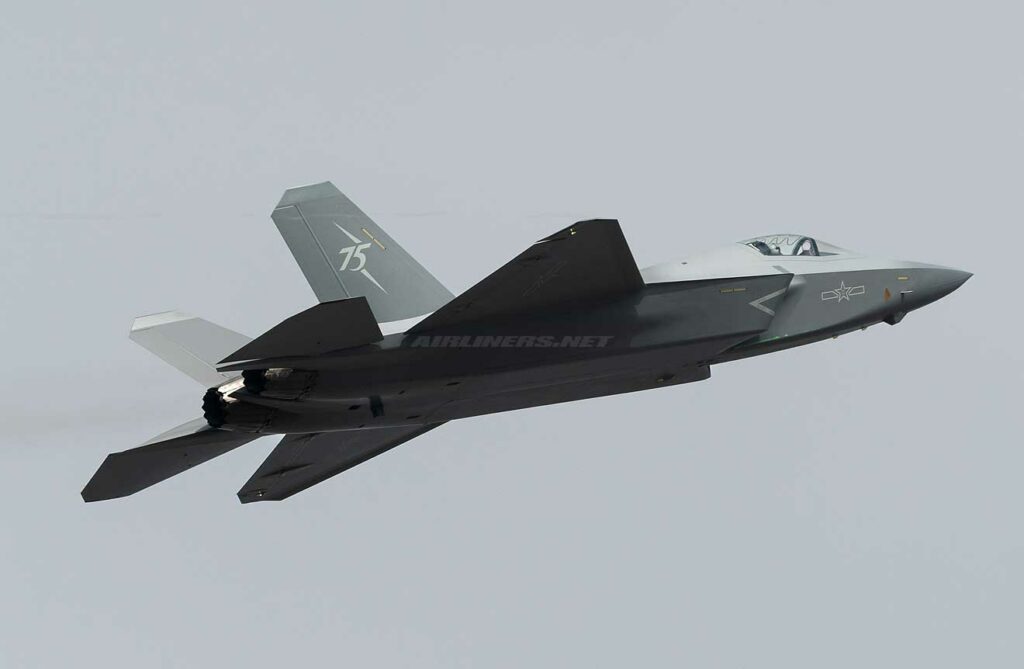
The J-35’s silhouette reveals a thorough pursuit of low observability. The leading edges are aligned at a limited number of angles. The vertical stabilisers are raked. The air intakes feature a geometry with no apparent splitter. The main weapons are carried in internal bays.
These features reduce radar reflections from the front and sides. However, they are not sufficient to determine the aircraft’s actual radar cross-section.
The quality of the coatings, seals, hatches, intake ducts and engine treatment remains unknown. Official Chinese data do not allow for a meaningful comparison of the J-35’s signature with that of the F-35.
The same caution applies to the sensors. The J-35A is likely to be equipped with an active phased-array radar, distributed electro-optical sensors and a system mounted under the nose. The visible architecture also indicates the presence of several communication antennas.
The value of a fifth-generation fighter, however, depends on the fusion of this information. The pilot must receive a coherent picture rather than a succession of separate data points. This fusion requires millions of lines of code, threat databases and secure links.
China has an electronics industry advanced enough to develop these capabilities. There is as yet no public evidence that they have reached the level of maturity of the F-35’s system. The lack of evidence does not mean that they are rudimentary. It simply means that a comparison remains impossible based on the available information.
The propulsion system also remains unclear. Several sources attribute WS-21 engines to the first naval J-35s and regard the WS-19 as the definitive engine sought for certain versions. There is no sufficiently robust public data to confirm the engine configuration for each batch. The performance figures announced for speed or range must therefore be treated as estimates.
When comparing the J-35 with the F-35, it is important to distinguish between capability and production rate
It would be premature to present the J-35 as an immediate industrial competitor to the F-35.
Lockheed Martin delivered 191 F-35s in 2025, a record. However, this figure includes aircraft whose delivery had been delayed by difficulties with the Technology Refresh 3 standard. The programme’s structural production rate stands at around 156 aircraft per year.
By the end of 2025, Lockheed Martin had delivered 1,293 production F-35s, including 927 F-35As. The programme relies on a global supply chain, thousands of suppliers and assembly or testing facilities in the United States, Italy and Japan.
The J-35 is starting from a much lower base. Even assuming 30 aircraft produced by mid-2026, this remains a fraction of the US volume. Future production of 100 aircraft per year would bring Shenyang closer to the F-35, without matching its current production rate.
The comparison becomes more meaningful when it covers the Chinese industry as a whole. The combined production of the J-20, J-35, J-16 and other aircraft could exceed the annual number of F-35s assembled. But these are different aircraft, designed for different missions.
It is also important to distinguish between production and delivery. An aircraft may leave the final assembly line whilst awaiting its engine, software, testing or customer acceptance. The 191 F-35s delivered in 2025 do not necessarily correspond to 191 airframes started and completed during that year alone.
The verdict is therefore clear. The J-35 does not yet rival the F-35 in terms of industrial volume. China, on the other hand, is building up a production capacity that could become comparable as we approach 2030, especially if Shenyang operates multiple production lines and if demand from the army, navy and overseas markets grows simultaneously.
Industrial limitations do not disappear with a large factory
The ramp-up of the J-35 production raises three main challenges.
The first concerns the engines. Producing two engines per aircraft mechanically doubles the demand for engines compared to a single-engine aircraft. A production rate of 100 J-35s per year requires at least 200 engines, to which must be added spare units and those lost during testing.
The second relates to stealth materials. Surface treatments must withstand vibrations, thermal variations and marine conditions. Salt, humidity and handling on deck accelerate ageing. A carrier-based fleet therefore requires particularly rigorous maintenance.
The third challenge is human. Building 100 aircraft is pointless without pilots, mechanics and infrastructure. Training a pilot to operate from an aircraft carrier takes several years. Units must have access to simulators, spare parts and missile stocks.
China has the advantage of a state-controlled domestic market. Industrial decisions can be made over several years without being dependent on a succession of annual tenders. The same state-owned groups control a large part of the airframe, equipment, electronics and propulsion systems.
This centralisation speeds up investment. It can also mask problems. The public is unaware of availability rates, manufacturing defects and the number of aircraft actually capable of carrying out all their missions.
China is primarily building a high-volume combat system
The debate over the ‘Chinese F-35’ all too often reduces the J-35 to its resemblance to the American aircraft.
The strategic issue lies elsewhere. Beijing is building a fleet combining several categories of aircraft. The J-20 provides extended range and heavy interception capability. The J-35 offers a medium-range stealth fighter that can be deployed both on land and at sea. The J-16 carries heavy weapons and has an electronic warfare variant. The KJ-500 and KJ-600 provide detection and command capabilities.
This architecture aims to create detection and engagement chains. A J-35 does not need to keep its own radar switched on continuously. It can receive information from a surveillance aircraft, a ship, a satellite or another fighter. It can then close in whilst minimising its emissions and fire a missile guided by multiple sensors.
The sheer number of aircraft enhances the robustness of this system. A small fleet of high-performance aircraft can be rendered inoperable by losses, maintenance requirements or the destruction of a few bases. A high annual production rate allows aircraft to be replaced more quickly and units to be dispersed.
It is here that China’s ramp-up in production becomes a cause for concern for the United States and its allies. A confrontation in the Pacific would take place close to Chinese bases, but several thousand kilometres from the US mainland. China could concentrate its aircraft, whilst Washington would be dependent on refuelling vessels, forward bases and exposed aircraft carriers.
The challenge, therefore, is not merely whether a single J-35 is superior to an F-35. It is a question of determining how many aircraft can be deployed, refuelled, rearmed and replaced during a protracted campaign.
The real turning point will come after the thirtieth airframe
The thirtieth J-35 does not yet establish parity with the United States. It does, however, reveal that the Chinese programme has moved beyond the precarious stage where a handful of prototypes accounted for the entire capability.
The next stage will be more significant. We will need to monitor the appearance of new production numbers, the equipping of land-based brigades, the frequency of flights around Shenyang and the actual composition of the Fujian Air Group. The entry into service of a final engine variant will be another major indicator.
An annual production rate of close to 100 aircraft would profoundly alter the regional balance of power. It would enable China to equip several ground-based units, support its carrier-based aviation and open up a genuine export market.
The F-35 retains a huge lead in terms of delivery volumes, operational experience, software and the international ecosystem. This lead is not set in stone. Shenyang is not seeking to close this gap by building a single aircraft. The company is establishing an industrial capability capable of producing multiple variants for various users.
The 30-aircraft milestone must therefore be interpreted for what it is. It is not proof that China has already caught up with the United States. It is proof that it is seriously preparing the means to narrow the gap.
War Wings Daily is an independant magazine.