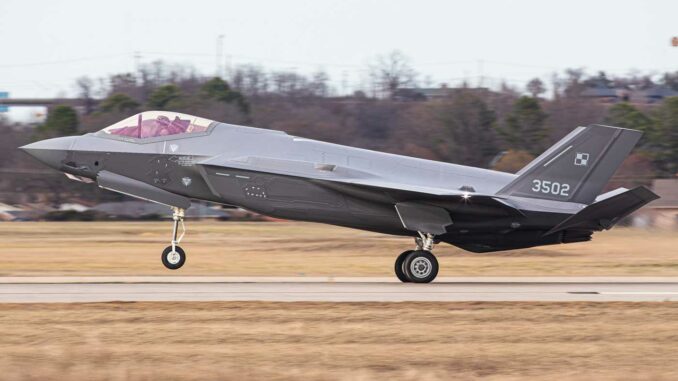
The arrival of F-35As in Poland strengthens NATO’s eastern flank while exposing the financial and technical strains of the American program.
In Summary
Poland officially presented its first three F-35A “Husarz” aircraft on its territory on June 12, 2026, following their arrival at Łask Air Base on May 22. Warsaw ordered 32 aircraft for 4.6 billion dollars, including training, logistics, and initial support. This fleet is set to replace the last aircraft of Soviet origin and operate alongside Polish F-16s, ground-based air defenses, and allied forces. Above all, it provides NATO with its first permanent F-35 operator on the eastern flank. For Lockheed Martin, the program remains a major source of revenue. The group delivered 191 F-35s in 2025, and the program accounted for approximately 27% of its sales. However, commercial success masks persistent difficulties. U.S. orders were scaled back to 47 aircraft for fiscal year 2026. TR-3 and Block 4 also continue to accumulate delays, while the availability of the U.S. fleet continues to decline.
Arrival of First Husarz Jets Transforms an Order Into Military Capability
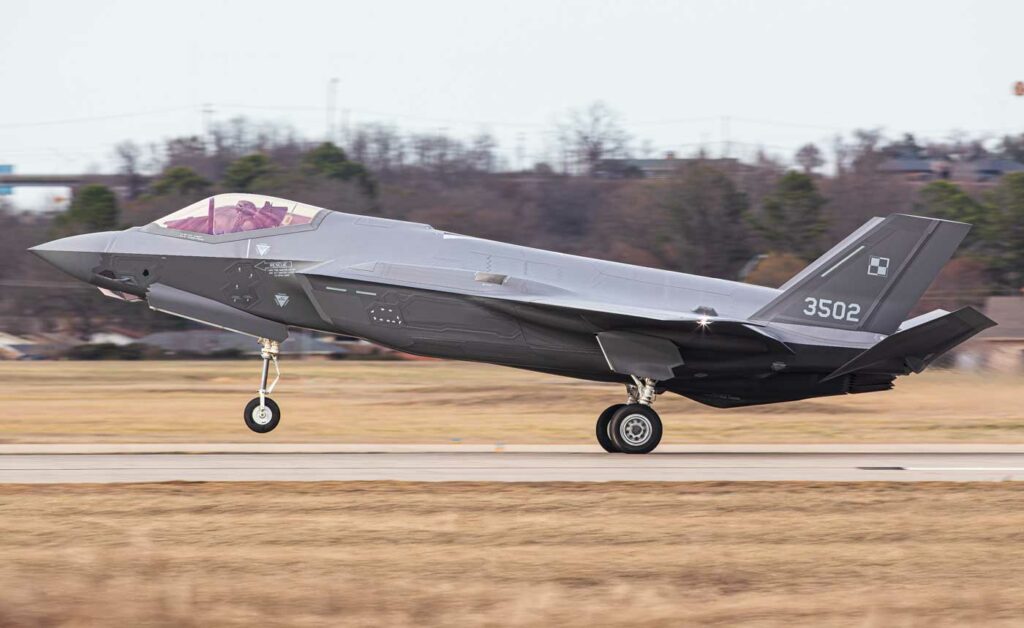
The first three F-35A Husarz aircraft destined for permanent stationing in Poland landed on May 22, 2026, at the 32nd Tactical Air Base in Łask. Their official entry into service was celebrated on June 12 in the presence of Polish authorities, U.S. officials, and industry representatives associated with the program.
The difference between these two dates is significant. May 22 marks the physical arrival of the aircraft. The June 12 ceremony symbolizes their integration into the Polish Air Force. It does not mean the fleet has already achieved full operational capability.
Military capability is not built solely on the delivery of airframes. Pilots and mechanics must be trained. Mission equipment must be installed, parts inventories established, national procedures validated, and the aircraft connected to command-and-control systems. Personnel must also learn to maintain the low-observable coating and manage the mission software.
Poland began this work well before the arrival of the aircraft. The first Polish pilots conducted their F-35A training flights at Ebbing Air National Guard Base in Arkansas in early 2025. Polish aircraft remained in the United States to support this learning phase.
Warsaw thus becomes the first country located on NATO’s eastern flank to permanently operate a fifth-generation fighter from its own territory. This position distinguishes Poland from allied countries that have only hosted temporary detachments of American, British, Dutch, or Norwegian F-35s.
The Polish Order Firmly Covers Thirty-Two Aircraft
The contract signed in January 2020 provides for the purchase of 32 F-35A Lightning IIs. This is the conventional takeoff and landing version of the fighter, designed to operate from land-based runways.
The contract budget reaches 4.6 billion dollars. This does not represent the price of 32 aircraft alone. It also includes training, support equipment, initial spare parts, simulators, logistical assistance, and various services provided under the U.S. Foreign Military Sales system.
A simple division yields an average budget of approximately 143.8 million dollars per aircraft. This result should absolutely not be presented as the unit price of the F-35A. The flyaway cost of the aircraft is significantly lower. The remainder funds the creation of a complete capability, complete with its human, technical, and logistical infrastructure.
Deliveries are scheduled to continue until 2029. The aircraft will be primarily divided between Łask, in the center of the country, and Świdwin, further to the northwest. This basing strategy allows multiple strategic directions to be covered while avoiding the concentration of the entire fleet on a single site.
Polish Defense Minister Władysław Kosiniak-Kamysz has also mentioned the future acquisition of two additional squadrons. Such a decision would bring the total fleet to 64 aircraft. But to be precise: only 32 aircraft are currently under contract. The 32 additional aircraft remain an expression of political and capability ambition for now.
The F-35 Becomes an Advanced Sensor for the Whole of NATO
The primary contribution of the F-35 lies not just in its stealth. The aircraft is designed to detect, fuse, and distribute information.
Its active electronically scanned array radar, infrared sensors, electronic warfare system, and surveillance assets produce a common tactical picture. The mission computer fuses data originating from multiple sources. The pilot thus receives a synthesized representation of the situation instead of having to analyze each sensor separately.
This data fusion allows the F-35 to locate radars, track aircraft, detect missile launches, and identify certain electromagnetic emissions. The aircraft can then transmit a portion of this information to other platforms.
The Multifunction Advanced Data Link ensures low-probability-of-intercept communications between F-35s. The Link 16 data link facilitates exchanges with allied aircraft, command centers, and certain air defense systems.
This architecture holds particular interest for Poland. The country already operates 48 F-16C/Ds, is building its Wisła air defense system around the Patriot, and is deploying the Integrated Battle Command System. It is also developing the Narew and Pilica+ programs to reinforce short-range defense layers.
The F-35 can contribute to this ecosystem by detecting a threat further away and more discreetly than an isolated ground radar. It can provide a track to another fighter or a surface-to-air missile battery without necessarily employing a weapon itself.
However, this capability is not automatic. Systems must be certified. Data formats must be compatible. U.S. security rules also restrict the sharing of certain sensitive information. Possessing the same aircraft improves interoperability but does not remove all technical and political hurdles.
The Eastern Flank Gains Pénétration and Intelligence Capability
Poland’s geographic position gives the Husarz a value greater than their sheer numbers. The country stands in close proximity to Belarus, the Russian enclave of Kaliningrad, and Ukraine. It also constitutes an essential logistical corridor between Western Europe and the Baltic States.
In this context, the F-35A can fulfill multiple roles. It can participate in air defense, escort other aircraft, gather electronic intelligence, and attack heavily defended targets. Its low radar signature increases its chances of penetrating an area covered by modern surface-to-air systems.
The aircraft is not invisible. However, its shape, materials, and internally carried weapons reduce the distance at which certain radars can detect it and generate a track suitable for a weapons engagement.
This characteristic could allow Polish F-35s to identify air defense systems and transmit their positions to other NATO assets. F-16s, cruise missiles, or ground units could then engage based on the collected data.
The gain is collective. Thirty or so F-35s are not enough to defend Polish airspace on their own. Conversely, this fleet can improve the effectiveness of hundreds of other allied platforms. The F-35 then acts as a flying intelligence node.
NATO also benefits from a standardization advantage. Norway, Denmark, the Netherlands, Belgium, Italy, the United Kingdom, and now Poland operate or host the F-35. Finland, Germany, Switzerland, and several other countries are engaged in the same process.
This density facilitates common training, mission planning, and certain support operations. It also creates a growing dependence on U.S. software, parts, and modernization decisions.
Polish Contract Fuels Lockheed’s Revenue Without Fully Returning to It
The 4.6 billion dollar budget does not constitute pure revenue for Lockheed Martin. The group is the prime contractor for the F-35, but the contract includes services provided by other corporate entities and the U.S. government.
Pratt & Whitney, a subsidiary of RTX, produces the F135 engine. Northrop Grumman, BAE Systems, and numerous suppliers work on the airframe, sensors, electronic equipment, and sub-assemblies. Simulators, infrastructure, and training services also involve multiple players.
The exact share returning to Lockheed Martin from the Polish contract has not been made public. Any precise estimate of the profit generated by the group would therefore be artificial.
The economic gain is nevertheless real. Lockheed bills for the production of airframes, a portion of the mission systems, integration, support, and various services. Each new operator also expands the global fleet to be maintained for several decades.
This last point is central. An F-35 sale does not generate revenue only at delivery. It creates long-term needs for parts, software, repairs, technical assistance, and upgrades.
Poland will notably have to finance its aircraft’s evolutions, updates to the mission system, and component replacements. The fleet thus becomes a potential source of recurring revenue for Lockheed Martin and its partners.
Lockheed’s Financial Results Reveal the Program’s Heavy Weight
Lockheed Martin recorded 75 billion dollars in net sales in 2025. Its net income reached approximately 5 billion dollars. Its backlog stood at nearly 194 billion dollars at the close of the fiscal year.
The F-35 program accounted for approximately 27% of the group’s sales in 2025. Based on consolidated revenue, this corresponds to roughly 20.3 billion dollars.
This proportion shows that the F-35 is not a secondary activity. It constitutes Lockheed Martin’s premier industrial program and a principal driver of its Aeronautics business.
Sales for the Aeronautics division reached 30.3 billion dollars in 2025, compared to 28.6 billion in 2024. Lockheed attributes a 1.9 billion dollar increase to the F-35, driven by higher production and support volumes.
Operating profit for Aeronautics nevertheless declined to around 2.1 billion dollars, with a margin of 6.9%. The growth in deliveries therefore does not automatically translate into an equivalent increase in profit. Charges on certain classified programs and accounting adjustments weighed on the division’s performance.
The Polish contract is particularly valuable because it reinforces industrial visibility. It helps sustain the Fort Worth assembly line and the supplier network. It also adds a national fleet to the global support market.
Record of 191 Deliveries Masks an Exceptional Catch-Up
Lockheed Martin delivered 191 F-35s in 2025, compared to 110 in 2024. The previous annual record was 142 aircraft.
This figure presents a picture of spectacular acceleration. Yet it must be interpreted with caution. A portion of the 191 aircraft came from stock accumulated during the delivery halt linked to TR-3.
The Pentagon had stopped accepting new aircraft equipped with this configuration in July 2023. The software was not sufficiently stable. Lockheed continued to produce aircraft and then stored them while awaiting authorization to transfer them.
Deliveries resumed in 2024 with an interim version of the software. The 2025 volume therefore combines current production and the progressive clearing of this inventory.
Production and delivery must not be confused. Lockheed did not necessarily assemble 191 airframes during the single year of 2025. The standard industrial rate announced by the group is around 156 aircraft per year.
The record nevertheless demonstrates the manufacturer’s capacity to process a significant backlog. It also brings in several billion dollars in revenue that could not be fully recognized until the aircraft were officially accepted.
TR-3 Remains the Necessary Path to the True Block 4
Technology Refresh 3 is an overhaul of the F-35’s computing architecture. It includes more processing power, expanded memory, new cockpit displays, and a modernized software infrastructure.
TR-3 does not constitute Block 4 on its own. It is its technical foundation.
Block 4 is meant to integrate new weapons, improve electronic warfare, reinforce detection capabilities, and allow the engagement of more complex threats. Several evolutions also require an APG-85 radar, cooling modifications, and a modernization of the F135 engine.
The problem is that TR-3 fell approximately three years behind schedule. According to available U.S. findings, aircraft delivered in this configuration through the end of fiscal year 2025 did not yet possess all of their envisioned combat capabilities.
The interim software allowed deliveries to resume, but by deactivating or limiting certain functions. This solution reduced the accumulation of new aircraft on Lockheed’s parking ramps. It did not resolve all the difficulties.
The Government Accountability Office estimated in 2025 that the first fully combat-capable deliveries with TR-3 were to begin in 2026. It also projected the completion of a scaled-back Block 4 in 2031, several years behind the initial schedule.
Poland therefore enters the program at a paradoxical moment. It receives an aircraft technologically superior to its legacy platforms, but whose next combat architecture has not yet achieved all its promised maturity.
U.S. Orders Were Indeed Reduced for 2026
The U.S. administration had envisioned the purchase of 74 F-35s for fiscal year 2026. The official request was ultimately scaled back to 47 aircraft.
This quantity includes 24 F-35As for the U.S. Air Force, 11 short takeoff and vertical landing F-35Bs, and 12 F-35Cs destined for aircraft carrier operations.
The reduction is close to 36% compared to the volume of 74 aircraft previously anticipated. It reflects several competing priorities. The Pentagon wants to fund more missiles, drones, and future systems, including the F-47 fighter. It must also allocate more money to supporting the F-35s already delivered.
U.S. lawmakers had proposed raising the number to 69. But the budget text finally approved in February 2026 funds the quantity requested by the executive branch, namely 47 aircraft.
The political debate over future orders remains open. For fiscal year 2026, the decision is now clearer than certain reports still circulating in the press suggest.
Congress nevertheless added approximately 401.6 million dollars to cover economic factors regarding the F-35As. It also allocated 280 million for spare F135 engines and 160 million for F-35 support parts.
This focus reveals the true American dilemma. Washington does not just lack new aircraft. It lacks parts and availability for the aircraft it already owns.
U.S. Availability Weakens the Narrative of Industrial Success
A report published by the Government Accountability Office in June 2026 brings a harsh counterpoint to the delivery records.
The rate of aircraft capable of performing at least one mission fell from 67% in 2021 to 44% in 2025. The rate of aircraft capable of performing all their envisioned missions dropped from 38% to 25% full mission capability.
These figures apply to the U.S. fleet, which numbered more than 800 F-35s at the close of fiscal year 2025. They do not directly describe the future availability of Polish aircraft. They do, however, signal structural difficulties regarding parts, repairs, software, and dependence on corporate suppliers.
The Pentagon has launched a turnaround strategy estimated at an additional 13.7 billion dollars through 2031. More than 7 billion is notably earmarked to fund additional parts and materials.
The success of this strategy is not guaranteed. Industrial capacity remains constrained for certain components. The GAO also criticizes the award fees paid to corporations while availability targets were not being met.
For Lockheed Martin, this situation has two faces. Support problems expose the group to criticism and penalties. But they also generate maintenance and modernization contracts worth several billion dollars.
Allied Sales Partially Offset American Caution
The decline in U.S. orders does not mean the collapse of the F-35 assembly line. Foreign purchases now represent an essential share of production lots.
Poland, Finland, Germany, Switzerland, Canada, and several other clients feed the backlog. International contracts stabilize volumes when Washington temporarily scales back its own purchases.
This situation benefits the United States. Foreign clients participate in maintaining the industrial base. They contribute indirectly to spreading certain fixed costs over a larger number of aircraft. They also fund a portion of the support ecosystem.
The U.S. economy recovers export revenues, industrial jobs, and long-term strategic influence. The F-35 mandates decades of relationships with U.S. administrations for software, parts, weapons authorizations, and technical evolutions.
But this dependence also obliges Washington to meet its commitments. A persistent failure in the logistics system or a new Block 4 delay no longer affects just the U.S. Air Force. It directly impacts the capabilities of numerous allies.
The United States thus becomes the technical guarantor of a growing share of Western combat aviation.
Polish Success Demands That Washington Deliver More Than Just an Aircraft
The arrival of the Husarz at Łask constitutes real military progress. Poland now possesses an intelligence, penetration, and combat asset designed to operate at the center of an allied network.
This progress cannot be measured by the number of aircraft alone. It will depend on their availability, the quality of the crews, weapons stocks, and the ability to rapidly share information with NATO forces.
For Lockheed Martin, the Polish contract extends an exceptional commercial success. The group sells a platform, but also a support system, updates, and an industrial relationship spanning several decades.
The risk appears in the exact same place. The more indispensable the F-35 becomes, the less tolerable its delays are. The 191 deliveries of 2025 illustrate the power of the industrial assembly line. U.S. availability rates show its fragility.
The true test of the Husarz will therefore not be their presence at a ceremony in Łask. It will begin when Poland must generate multiple sorties per day, maintain its aircraft under operational readiness, and connect them to other allied forces. That is the moment when the F-35 program will have to prove it can transform a commercial success into a lasting military advantage.