Tokyo is preparing accelerated trials of autonomous interceptor drones to protect its bases against Shahed-type systems at a sustainable cost.
In Summary
Japan aims to test autonomous interceptor drones as early as the summer of 2026, capable of tracking and neutralizing long-range attack drones. The targeted threat is clearly identified: systems comparable to the Iranian Shahed-136, which are mass-produced, difficult to detect at low altitudes, and inexpensive enough to be deployed in waves. Tokyo is seeking a response that is more cost-effective than traditional surface-to-air missiles. The timeline is extremely tight. Candidates are to be selected in July, demonstrations are scheduled between late July and early August, and an initial contract could be signed before September. This fast-tracked initiative is part of the SHIELD program, which integrates sensors, command centers, and unmanned effectors. However, the project does not yet offer a complete solution against cruise missiles. The performance requirements focus primarily on countering slow drones and saturation attacks.
Japan’s Timeline Imposes Acquisition Within Months
The Acquisition, Technology & Logistics Agency (防衛装備庁), the Japanese agency responsible for defense equipment, is not launching a traditional ten-year research program. Instead, it aims to rapidly acquire a capability that is already sufficiently mature to be tested, adapted, and then manufactured.
The request for proposals published on June 5, 2026, projects the selection of one or more systems in early July. Demonstrations are scheduled to take place between late July and early August. If the results are satisfactory, a production contract could be finalized by late August, with initial deliveries starting as early as September 2026.
Such a timeline is unusual in the Japanese defense sector. National programs typically undergo several years of definition, development, testing, and administrative validation. The use of an accelerated procurement procedure indicates that Tokyo views the threat as immediate.
The specifications target hostile platforms flying below approximately 5,500 meters (18,000 feet) at speeds up to 463 km/h (250 knots). Their maximum weight is set at around 600 kg. This category encompasses long-range suicide drones like the Shahed, as well as certain faster and heavier loitering munitions.
Japan is requesting industry players to provide detailed information on their interceptors’ range, endurance, minimum and maximum speeds, propulsion methods, launch mechanisms, and multi-target tracking capabilities. Candidates must also specify the guidance systems utilized during the initial, midcourse, and terminal phases of flight.
Finally, the Japanese call for proposals requests pricing for batches of 10, 20, 30, 40, and 50 units. This detail indicates that Tokyo is looking beyond a mere demonstrator; it is already preparing a comparison between various mass production scenarios.
The Demonstration Will Not Prove Full Lethality
The initial test campaign will not involve ammunition or explosive charges. It will primarily evaluate launch, flight, guidance, tracking, and the ability to interface with ground equipment.
This restriction is logical for a demonstration organized on such a short timeline. It simplifies safety clearances and limits risks. However, it requires a cautious interpretation of the results.
A drone capable of reaching a simulated target does not necessarily possess full operational capability. It remains to be demonstrated how precise the terminal approach is, how it handles jamming, how it behaves against a maneuvering target, and the actual effectiveness of the destruction mechanism.
A kinetic interception via collision demands extreme precision. A fragmentation warhead eases neutralization but introduces additional constraints regarding storage, safety, and debris management. A directional warhead, for its part, must detonate at precisely the right moment and distance.
The Japanese demonstration will therefore serve as a technical filter. It will not replace live-fire trials against representative targets.
The Primary Target Is the Shahed, Not Cruise Missiles
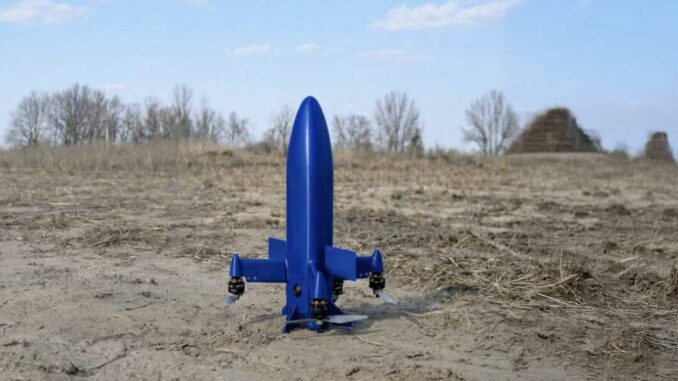
The term “interceptor drone” covers very diverse systems. Some resemble fast quadcopters, while others utilize a fixed-wing design. The most powerful models feature jet propulsion, moving closer in design to a small, reusable missile.
The Japanese requirement primarily addresses the threat of long-range attack drones. The Shahed-136, deployed on a massive scale by Russia under the designation Geran-2, illustrates this threat. It flies relatively slowly, follows pre-programmed routes, and can be launched in salvos against military, industrial, or energy infrastructure.
Its limited speed does not make it harmless. On the contrary, it allows for simple propulsion, increases range, and reduces costs. Low-altitude flight paths complicate radar detection, particularly in mountainous, urban, or maritime environments.
The primary danger stems from volume. A saturation attack can force a defender to engage multiple costly missiles against significantly cheaper platforms. Even if the majority of the drones are destroyed, a few impacts can be enough to damage a radar station, a fuel depot, a runway, or a communications center.
Japan also mentions the threat of cruise missiles. However, a distinction must be made between political ambition and the technical capability currently being sought.
The maximum speed specified for the targets—approximately 463 km/h—remains lower than that of many subsonic cruise missiles, which often travel between 750 and 950 km/h. These missiles also feature more complex flight profiles, more precise navigation systems, and sometimes terminal maneuvering capabilities.
An interceptor designed to chase a Shahed cannot, therefore, automatically stop a cruise missile. It would require greater speed, higher acceleration, a more capable terminal sensor, and a far more responsive detection chain.
The Japanese program could eventually evolve toward this capability. In its current state, it must be viewed as a component of counter-drone defense, rather than a replacement for anti-missile systems.
The True System Integrates Radar, Command, and Effector
An interceptor drone protects nothing if it does not rapidly receive a sufficiently precise target position. The core issue, therefore, does not lie solely within the aircraft itself, but involves the entire operational chain.
The Japanese Ministry of Defense is seeking a system that combines a radar, a command center, and interceptors. This architecture can be summarized by the radar–C2–effector triptych.
The radar detects the intruder and establishes its trajectory. The command and control system verifies the threat, selects an available interceptor, and prepares the launch. The drone then flies to the designated area, acquires the target with its own sensor, and executes the interception.
The available time is tight. A hostile drone flying at 200 km/h covers more than 3 km per minute. If it is detected only 20 km from its objective, the defender has roughly six minutes to identify it, decide to act, launch the interceptor, and achieve a result.
The stated range of an interceptor is therefore not enough. One must evaluate the deployment timeline, the climb rate, the time required for target acquisition, and the system’s capacity to prepare multiple simultaneous launches.
The Japanese Ministry desires a battery capable of operating with a maximum of two personnel after deployment. This requirement implies advanced automation. The system must process radar data, propose an engagement order, calculate a trajectory, and guide the interceptor without permanent manual piloting.
The system must also operate with radars and equipment from other suppliers. This open-architecture requirement is essential. Tokyo does not want to purchase an isolated system incapable of communicating with existing networks.
Autonomy Will Likely Remain Supervised
The term “autonomous” can be misleading. It does not necessarily mean the machine will independently decide to destroy a target.
The Japanese documents primarily describe an aircraft guided automatically from the ground, without an operator directly piloting the drone via a camera feed. The system could follow a calculated trajectory, correct its course, and lock onto the target during the final phase.
This level of automation corresponds more closely to supervised autonomy. An operator likely retains responsibility for the initial authorization, while the computer executes tasks that are too rapid or complex for manual piloting.
However, the publicly released documents do not specify the exact rules of engagement. This question will need to be resolved prior to operational deployment, particularly for interceptions over inhabited areas, ports, or bases hosting civilian aircraft.
The system will need to distinguish a hostile drone from a Japanese aircraft, a light civilian plane, or an object presenting a similar radar signature. An identification error could lead to a severe accident.
The Cost Per Shot Reshapes Defense Doctrine
The economic justification for the program is straightforward. Destroying a drone worth tens of thousands of euros with a missile costing several hundred thousand, or even millions, of euros cannot remain the standard response to a prolonged campaign.
The exact price of Shahed drones varies by version, components, and manufacturing conditions. The most frequently cited estimates range between $20,000 and $50,000 per unit. Their utility lies less in their sophistication than in their capacity to deplete adversarial defenses.
Surface-to-air missiles retain an indispensable value against aircraft, cruise missiles, and high-speed threats. However, their stockpiles are limited. Their production requires complex engines, seekers, electronic components, and energetic materials.
The central issue becomes the cost per interception. The defender must be able to destroy an inexpensive platform without systematically using ammunition that is ten, twenty, or fifty times more expensive.
Ukrainian interceptor drones demonstrate that an effector costing a few thousand dollars can suffice against certain categories of targets. The STING drone developed by Wild Hornets reportedly reaches speeds of around 280 km/h, with a range close to 37 km and a price tag of around $2,000 or less. The manufacturer claims its systems have destroyed several thousand Shaheds since 2025. While these figures remain industry assertions, they illustrate the economic shift being pursued.
The reasoning should not be reduced solely to unit price. A low-cost system that frequently fails can end up costing more. One must measure the average number of interceptors required per target, actual availability, maintenance costs, battery shelf life, and personnel requirements.
The goal is therefore not to obtain the cheapest interceptor, but to find the optimal balance between destruction probability, rate of fire, logistical simplicity, and production capacity.
The Ukrainian Laboratory Offers Japan a Technological Shortcut
Ukraine has become the primary testing ground for interceptor drones. The frequency of Russian attacks forces manufacturers and military units to rapidly modify their equipment.
Solutions evolve within weeks. Motors are reinforced. Radio frequencies shift. Guidance software is updated. Airframes are simplified to reduce assembly time.
Japan is clearly seeking to leverage this experience. The Japanese group Terra Drone has invested in the Ukrainian company Amazing Drones and is developing the Terra A family of interceptors.
The Terra A1 is presented as an electrically propelled aircraft capable of reaching 300 km/h. It features a stated flight endurance of 15 minutes and a range of approximately 32 km. These characteristics place it in the category of interceptors intended for slow, Shahed-type drones.
Electric propulsion reduces both thermal and acoustic signatures while simplifying maintenance. On the other hand, flight duration remains limited. The system must therefore be positioned close to the installations it is protecting and must rapidly receive precise data.
Terra Drone announced the deployment of an initial system in Ukraine in April 2026. This phase is intended to provide real-world data on system behavior, jamming constraints, and necessary adjustments.
The benefit to Japan is clear. A system evaluated in a combat environment yields far more information than a prototype tested solely on a firing range. However, the Ukrainian experience cannot be transposed without adaptation.
Japan will need to account for a humid maritime environment, coastal winds, heavy rainfall, and different storage constraints. Systems installed on naval vessels will need to withstand salt, vibrations, and electromagnetic interference.
The SHIELD Doctrine Prepares a Distributed Defense of the Archipelago
The purchase of interceptors is not an isolated initiative. It is part of a broader transformation of the Japanese forces in response to the growing military capabilities of China, North Korea, and Russia.
The Japanese defense budget for fiscal year 2026 allocates approximately 100.1 billion yen to the SHIELD program, with initial deployment scheduled for fiscal year 2027.
The program aims to bring together several families of unmanned systems. It includes modular drones, small attack drones, ship-launched aircraft, unmanned surface vessels, and underwater drones.
The objective is to create a distributed defense capable of monitoring maritime approaches, complicating adversarial movements, and protecting Japanese installations. Interceptor drones are intended to form the close-in layer of this architecture.
This approach aligns with Japan’s geography. The archipelago extends over several thousand kilometers, and its bases, radars, and ports are widely dispersed. It would be prohibitively expensive to protect every site solely with heavy surface-to-air missile batteries.
Lightweight launchers can be moved, camouflaged, and distributed around sensitive installations. They can also temporarily reinforce a threatened area without tying down an entire anti-missile battery.
The protection of radar installations is of particular importance. These facilities serve as the eyes of the air defense system. Neutralizing them would reduce the effectiveness of Japanese fighter jets and missiles.
The Ministry therefore desires a system capable of countering multiple drones arriving simultaneously. This requirement demands a significant stockpile of interceptors, as well as launchers capable of rapid consecutive firings without lengthy reloading operations.
Technical and Industrial Challenges Remain Severe
While Japan possesses an advanced electronics and aerospace industry, this does not guarantee immediate operational deployment.
Detecting small drones remains difficult. Their radar cross-section is low, and their low-altitude flight places them within the ground clutter generated by terrain, buildings, waves, and vehicles.
Over the sea, reflections produced by the surface can degrade tracking. Near cities, the sheer volume of moving objects increases the risk of false alarms. Birds can also exhibit comparable speeds or radar signatures.
Resistance to jamming presents another significant hurdle. An adversary can disrupt satellite navigation signals, data links, and communications between the radar and the launcher. The interceptor must continue to function during temporary signal loss.
The Japanese documents require manufacturers to specify the aircraft’s behavior when communication links are broken. Options include continuing the mission, returning to a safe zone, landing, or self-destructing. Each of these options carries risks.
The ability to confront a salvo also depends on software. The system must assign each target to an interceptor, avoid collisions between friendly platforms, and conserve ammunition for subsequent threats.
Industrial production capacity will be decisive. Drone attacks can persist for weeks. A battery that exhausts its stockpile in two days provides only temporary protection, not a strategic capability.
Tokyo is therefore requesting information on supply chains, maintenance, and the feasibility of establishing a production base in Japan. A foreign solution will only be attractive if it can be manufactured, repaired, or adapted locally.
The Global Race Confirms a Shift in Doctrine
Japan is not alone in seeking a lower-cost solution. The United States, several European nations, and Gulf states are now funding autonomous interceptors.
Anduril is developing the Roadrunner-M, a vertical takeoff air vehicle powered by twin small turbojets. The system can return to base and land when not engaged. This reusability reduces the cost of alerts that do not result in an interception.
In Europe, France, Germany, Italy, Poland, and the United Kingdom have launched the Low-Cost Effectors and Autonomous Platforms initiative. It aims to accelerate the production of low-cost effectors and autonomous platforms.
Airbus is also collaborating with the Ukrainian company Alta Ares. The X-Locks drone targets Shahed-type platforms, while a faster system, Black Bird, is designed to handle certain threats approaching cruise missile capabilities. This separation confirms that a single interceptor cannot cover all speeds and flight profiles.
The international trend points toward a layered defense. Electronic warfare assets first attempt to disrupt navigation or communications. Cannons, lasers, and interceptor drones then handle slow-moving threats. Surface-to-air missiles remain reserved for high-speed platforms, complex targets, or longer-range interceptions.
This framework protects missile stockpiles and allows for the selection of the appropriate effector for each target. It does not eliminate traditional systems; rather, it prevents them from being consumed against threats that could be neutralized by other means.
The Japanese Choice Will Be Judged on Campaign Endurance
Japan has correctly identified the economic and military challenge. Inexpensive attack drones cannot be countered solely with costly missiles.
The acceleration of the timeline will allow for a rapid comparison of multiple technologies. However, it also carries a risk. An urgent acquisition process may lead to the selection of a system that performs well during a demonstration but proves difficult to mass-produce or maintain.
The true test will not be the destruction of an isolated target. It will be the capacity to detect, classify, and neutralize multiple waves over several days, despite jamming and hardware losses.
Tokyo must also avoid presenting the interceptor drone as a universal solution. Current specifications match the Shahed and similar platforms. Defense against cruise missiles will require faster interceptors and a more demanding detection architecture.
Nevertheless, the program could profoundly alter the protection of the archipelago. Simple interceptors, linked to existing radars and available in quantity, would allow for the defense of more sites without multiplying heavy missile batteries.
Above all, the Japanese decision marks the end of a model reliant almost exclusively on scarce, highly sophisticated munitions. In conflicts dominated by volume, a technology is only truly credible if it can be produced, maintained, and fired at the pace dictated by the adversary.
War Wings Daily is an independant magazine.