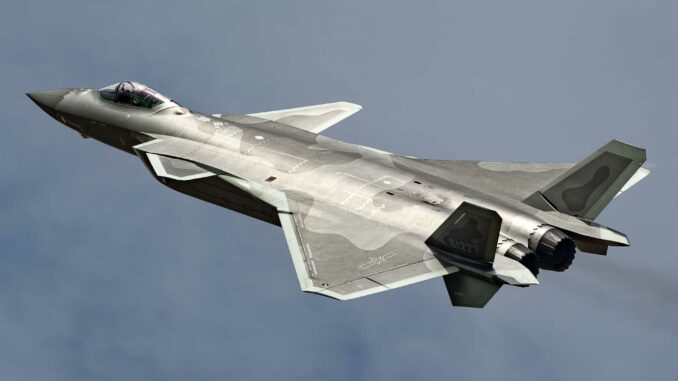
Washington is injecting a further $1.55 billion into the E-7 Wedgetail, a flying radar system that is essential for countering the Chinese J-20 and J-35 in the Pacific.
In summary
The Pentagon intends to allocate $1.55 billion to the E-7 Wedgetail programme during the 2027 financial year. A large portion of this sum, amounting to $899 million, would be transferred from a US Air Force account that funds classified programmes. The remainder would initially come from the US Navy’s E-2D Hawkeye procurement programme. Congress supports the return of the E-7, but refuses to weaken the naval aviation fleet.
This operation does not officially fund a secret radar system intended exclusively for Chinese fighter jets. It is intended to complete two prototypes and continue the development of five additional aircraft. Their mission is, however, directly linked to the Chinese threat. Thanks to the MESA radar, passive detection and data fusion, the E-7 is designed to detect and track the J-20 and J-35 from a great distance. It does not render stealth technology obsolete. Above all, it is intended to prevent Chinese aircraft from remaining undetected long enough to disrupt US forces.
The classified budget funds a public capability
On 17 June 2026, the White House submitted to Congress an amendment to the draft military budget for the 2027 financial year. The text provides for the addition of exactly 1.549 billion dollars to the US Air Force’s research, development, testing and evaluation account.
This sum is intended to enable the delivery of two E-7 Wedgetail prototypes and to continue the engineering and industrial development work required for a future production programme.
The funding is based on a series of transfers. The Pentagon proposed withdrawing $650.5 million from the US Navy’s aircraft acquisition account. This reduction would have affected the E-2D Advanced Hawkeye programme. The remaining $898.5 million was to be taken from the US Air Force’s ‘Other Procurement’ account.
The report by the House of Representatives’ Appropriations Committee specifies that these $899 million come from the Special Update Programme. This budget line covers Special Access Programmes, the objectives and equipment of which are classified.
This does not mean that the new funding for the E-7 is itself secret. Nor does it prove that the money withdrawn was intended for a space-based radar project or a system dedicated to China. Public information merely establishes that classified funds are being redirected to the Wedgetail.
The House committee backed the $1.55 billion for the E-7. However, it refused to cut the US Navy’s procurement budget and restored the funding required for the six E-2Ds scheduled for 2027.
The final vote has not yet taken place. The funding still has to go through the entire budgetary process. The political trajectory is nevertheless clear. A programme that the Pentagon had intended to scrap in 2025 has once again become a priority a year later.
The Pentagon’s U-turn reveals an operational impasse
The US Air Force had selected the E-7 in 2022 to replace part of its E-3 Sentry fleet. These aircraft are derived from the Boeing 707 and use technology developed during the Cold War.
Their availability has declined whilst maintenance costs have risen.
In February 2023, Boeing was awarded an initial contract worth up to $1.2 billion to begin rapid prototyping of a US version. In August 2024, the final contract for two prototypes reached $2.56 billion. This sum covers development, testing, training and initial support. It therefore does not simply represent the price of two modified Boeing 737s.
The programme was then set to result in a fleet of 26 E-7A Wedgetails. The first aircraft were expected towards the end of the decade.
However, the Pentagon proposed scrapping the programme in the 2026 budget. It cited delays, excessive vulnerability in a high-intensity conflict and a rise in the estimated cost per aircraft, which had risen from $588 million to $724 million.
The administration wanted to gradually transfer the aerial surveillance mission to satellites capable of tracking moving targets. It also envisaged making greater use of E-2D Hawkeyes during the transition.
This solution had an obvious weakness. No available orbital network can yet replace all the functions of an airborne command aircraft. A satellite can observe an area and transmit a track. It cannot easily replace a team of controllers who direct fighter aircraft, organise refuelling, assign targets and react within seconds to a rapidly changing situation.
Congress therefore allocated $1.1 billion to the programme for the 2026 financial year. It also prohibited the Pentagon from using funds to suspend or cancel the E-7 programme.
In the spring of 2026, contracts were awarded for five additional development aircraft, in addition to the two prototypes. The US Air Force thus has seven E-7s on order, although their configuration and schedule may still change.
The $1.55 billion proposed for 2027 does not fund seven new aircraft. It is intended to sustain the work already underway on these aircraft and prevent a further industrial disruption.
The MESA radar transforms a Boeing 737 into a combat platform
The E-7 is based on the airframe of the Boeing 737-700. Its silhouette is dominated by a fixed antenna mounted above the fuselage. This bar- and fin-shaped structure houses Northrop Grumman’s Multi-role Electronically Scanned Array (MESA).
Unlike the E-3’s circular, rotating radome, the MESA is a fixed AESA radar. Its electronic modules direct the beams without any mechanical movement of the antenna.
The system simultaneously monitors the forward, rear and lateral sectors, providing 360-degree coverage. The operator can increase the refresh rate in a particular direction, focus more energy on a suspicious area, or share radar resources across multiple missions.
According to Northrop Grumman, concentrating energy on a priority sector can almost double the detection range in that direction, whilst maintaining general surveillance. This statement describes a beam-steering capability. It does not mean that the range is doubled against all targets and under all conditions.
The Royal Australian Air Force reports that the MESA has a range of over 400 kilometres. This figure does not specify the target’s radar cross-section, altitude, orientation or the level of jamming. It should therefore not be presented as the guaranteed detection distance for a J-20.
The E-7 can fly at approximately 12,500 metres (41,000 feet). Its range without refuelling is stated by Boeing as approximately 6,482 kilometres (3,500 nautical miles), whilst the Australian configuration is given as approximately 7,040 kilometres. It has ten mission consoles and is capable of in-flight refuelling.
Altitude is just as important as radar power. A ground-based sensor is limited by the curvature of the Earth, terrain and obstacles. A radar situated at an altitude of more than 10 kilometres can detect aircraft flying close to the surface from much further away.
In the Indo-Pacific, this capability is decisive. The distances between bases, archipelagos and carrier strike groups are measured in hundreds or thousands of kilometres. An airborne radar can shift its surveillance area within a few hours. A ground-based radar remains tied to its island and its infrastructure.
Chinese stealth technology reduces range without eliminating the echo
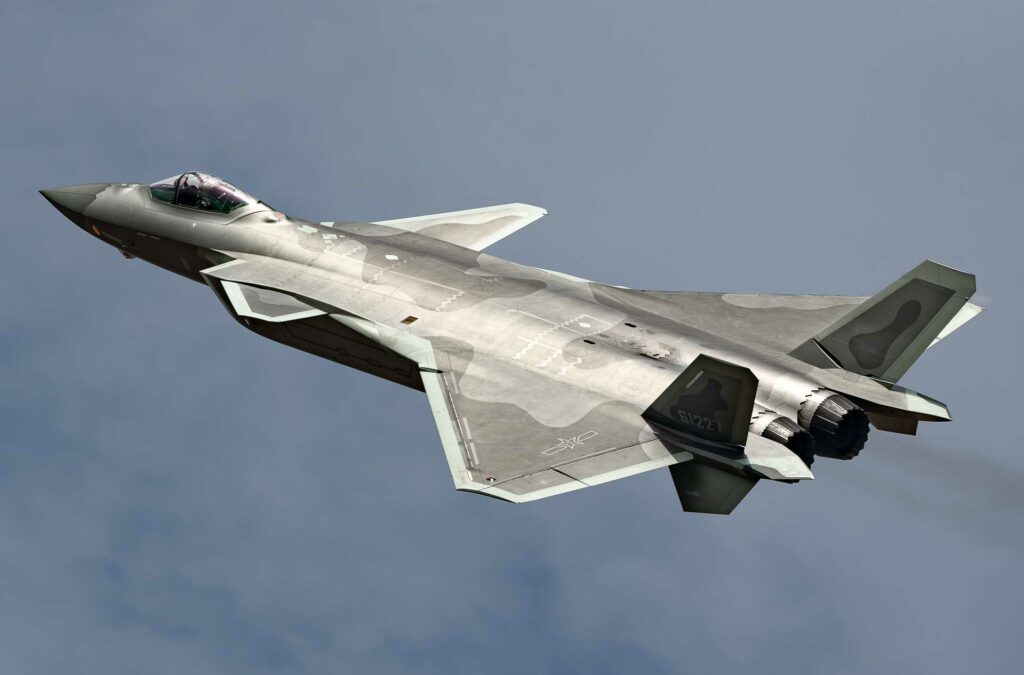
The Chengdu J-20 and the Shenyang J-35 are designed to reduce their radar signature. Their shape limits direct reflections towards the enemy’s radar. Weapons are carried in internal bays. Absorbent materials attenuate some of the electromagnetic energy received.
However, stealth does not mean absolute invisibility. Its effectiveness depends on the radar’s frequency, the angle of observation, the condition of the aircraft’s surface, its configuration and whether its weapon bays are open.
An aircraft optimised to reduce its echo when faced with an X-band fire-control radar may still be detectable by a surveillance radar using a different wavelength. The MESA is generally described as operating in the L-band. Its waves are longer than those of conventional fighter radars.
Longer wavelengths can reveal certain structures of a stealth aircraft that its geometry conceals more effectively at higher frequencies. However, they offer lower resolution for comparable antenna sizes.
This distinction explains the difficulty involved in detecting Chinese stealth aircraft. A radar may detect the presence of an object without knowing its position with sufficient accuracy to guide a missile.
The operational chain comprises several stages:
Detection establishes that a target exists within an area.
Tracking produces a stable trajectory with speed and direction.
Identification determines the nature and probable affiliation of the aircraft.
Weapons-grade tracking provides sufficient accuracy to engage the target.
The E-7 can play a major role in the first three stages. It is not certain that its radar alone, at long range, can generate a fire control solution against a J-20 operating with its best stealth characteristics.
The actual range against a J-20 remains a secret
Radar power is only one element of the equation. Range depends, in particular, on the aircraft’s radar cross-section. This value measures the amount of energy reflected back to the sensor.
In a simplified representation of the radar equation, range varies according to the fourth root of this cross-section. A target whose signature is reduced by a factor of 100 is therefore not detected 100 times further away.
The theoretical range is reduced by approximately 3.16 times, all other things being equal.
This example does not allow us to calculate the MESA’s range against a J-20. The actual radar cross-section values are classified. They also vary considerably depending on whether the aircraft is viewed from the front, side, below or from the rear.
The publicly stated range of 400 kilometres refers to an unspecified target. Applying an unverified estimate of the J-20’s radar signature to this would yield an artificial result.
No official source therefore publishes the distance at which the E-7 can detect, identify and then track a J-20 or a J-35. Any precise figure put forward in the public domain is purely speculative.
Effectiveness is measured less by maximum range than by the ability to maintain continuous tracking. An isolated detection that disappears on the next scan triggers an alert; it does not necessarily enable an interception.
Sensor fusion must overcome the limitations of radar
The Wedgetail is not designed to operate alone. Its true value lies in its ability to combine information from multiple sensors.
An F-35 can detect a signal, an infrared signature or a weak radar echo. A ship equipped with the Aegis system can observe the same area from a different angle. A satellite may report movement. A ground-based radar may provide a new measurement. The E-7 brings this information together and seeks to produce a single track.
This approach reduces the advantage of stealth. The shape of a stealth aircraft is primarily optimised against certain directions of illumination. A target that reflects little energy back towards a radar situated in front of it may be more visible from the side or the rear.
A network of sensors with separate transmitters and receivers can also exploit reflections that do not return to the radar that emitted the signal. This method, known as multistatic, makes the stealth aircraft’s task more difficult.
Passive detection complements radar
The E-7 is also equipped with Electronic Support Measures. These sensors do not transmit. They search for transmissions from the enemy’s radar, communications or data links.
Multiple measurements taken from different positions can be used to geolocate a transmitter. A J-20 using its active radar or exchanging data therefore increases the risk of being detected without the MESA directly illuminating it.
China can respond through strict transmission discipline, low-probability-of-interception links and the use of remote sensors. Chinese fighter aircraft can receive their information from KJ-500s, ground-based radars, ships or satellites whilst limiting their own emissions.
The battle for detection thus becomes a clash between networks. The winner will not necessarily be the one with the most powerful radar. It will be the one who can fuse weak signals most quickly without revealing the position of their own platforms.
The J-20 is specifically designed to threaten support aircraft
The J-20 is already operational within the People’s Liberation Army Air Force. The Pentagon believes that China is increasing its production capacity and continues to modernise the aircraft. The upgrades concern the engines, internal armament, range and cooperative missions with other platforms.
The J-35 is set to extend this capability to the People’s Liberation Army Navy.
The US report on Chinese military power anticipates its future integration into the naval aviation arm of the Fujian aircraft carrier.
These aircraft are not merely intended to confront F-22s or F-35s. Their stealth capabilities and long-range missiles enable them to approach the platforms that make US operations possible: refuelling aircraft, reconnaissance aircraft and command aircraft.
The E-7 is therefore both a stealth hunter and a priority target.
Its survival will depend on distance, escorts, frequent changes of orbit, electronic protection and the sharing of missions with other sensors. It will not be able to remain close to the Chinese coast like a flying radar stationed above a low-intensity conflict.
The further it retreats to evade Chinese missiles, the more the distance reduces the quality of its detection. This contradiction explains the Pentagon’s reservations regarding its survivability.
The Indo-Pacific requires a distributed architecture
A fleet of seven aircraft is not sufficient to ensure continuous surveillance of the Pacific, the defence of North America, operations in the Middle East, training and maintenance.
Having one aircraft available for operations requires several aircraft in the fleet. Some are undergoing maintenance. Others are used for training. Crews need to rest and be rotated. The airframes must return to their bases for major inspections.
The initial plan for 26 aircraft took this reality into account. Even this number would remain modest given the US Air Force’s global responsibilities.
The Wedgetail will therefore need to form part of an architecture comprising US Navy E-2Ds, F-35s, naval radars, ground-based sensors, allied aircraft and future Air Moving Target Indicator satellites.
Australia already operates six E-7As. The United Kingdom is preparing its own fleet, although it has been scaled back. South Korea and Turkey also use variants of the Boeing 737 AEW&C.
This international community facilitates training, support and data sharing. It also provides the United States with complementary capabilities in a region where US bases are spread far apart.
The total budget far exceeds the cost of the aircraft
Several public funding streams overlap within the E-7 programme:
The initial 2023 contract was capped at $1.2 billion.
The final contract in 2024 amounted to $2.56 billion for two prototypes and their development environment.
Congress allocated $1.1 billion for the 2026 financial year.
Contract amendments announced in March 2026 represented an additional $2.43 billion.
The proposed amendment for 2027 provides $1.549 billion.
These figures should not be added together mechanically. Contracts, ceilings, budgetary authorisations and annual appropriations do not correspond to the same accounting realities. A contract amendment may be funded over several financial years. An annual appropriation may cover an obligation that has already been announced.
The high cost is also due to the development of a US version. The US Air Force is not simply taking delivery of the existing Australian aircraft. It requires an open mission architecture, secure communications, identification equipment, cybersecurity measures and integration with its classified networks.
The programme must also address the obsolescence of certain radar components and secure a production line that has been interrupted or scaled back.
The 737-700 used as the base aircraft is no longer a mass-produced civil aircraft.
Congress is now demanding a comprehensive strategy setting out the number of aircraft, timetables and financial requirements beyond 2027. This request reveals that the programme is being relaunched without yet having a stable public roadmap.
Detection will determine the first minute of combat
The importance of the E-7 lies not only in the range of its radar. It lies in the time it buys for US forces.
Detecting a stealth fighter earlier makes it possible to alter the routes of refuelling aircraft, move a transport aircraft out of the way, place an F-35 patrol on an interception course, or activate a naval radar in a specific sector.
An early warning can also prevent the J-20 from reaching the distance required to launch its missiles against support aircraft. It can force Chinese fighters to switch on their radar, alter their course or abandon their stealth approach.
Conversely, the absence of continuous aerial surveillance creates gaps through which a stealth aircraft can advance untracked. In the Pacific, a few minutes’ delay can amount to tens of kilometres.
The Wedgetail therefore does not neutralise Chinese stealth on its own. It reduces the period during which that stealth has its maximum effect.
The US budget debate sometimes pits aircraft against satellites. This is an artificial choice. Satellites provide permanence and global coverage. Aircraft provide mobility, operators and real-time tactical management. Fighters add sensors close to the target.
Faced with the J-20 and J-35, the United States will need all three.
The flying radar remains indispensable but can no longer fight alone
The resumption of funding for the E-7 marks a belated acknowledgement. The United States does not yet have a space-based solution capable of immediately replacing the E-3s, which are reaching the end of their service life. Nor can it delegate the entire mission to the US Navy’s E-2Ds.
The Wedgetail offers a more modern radar, faster processing and better data integration. It can detect signs of a stealth aircraft’s presence and organise searches from multiple directions.
It possesses no magic weapon against the J-20. Its actual range remains classified. Its large airframe remains vulnerable. Its cost has risen sharply. Seven aircraft do not constitute a credible global fleet.
The challenge facing the programme, however, is no longer to prove that the E-7 is perfect. It is to determine whether the US Air Force can afford to be without it for the years required to deploy a mature space-based network.
In a confrontation with China, the first decisive loss might not be a fighter aircraft. It could be the loss of the shared aerial picture that tells the fighters where to look. It is precisely this picture that Washington is now paying $1.55 billion to preserve.
War Wings Daily is an independant magazine.