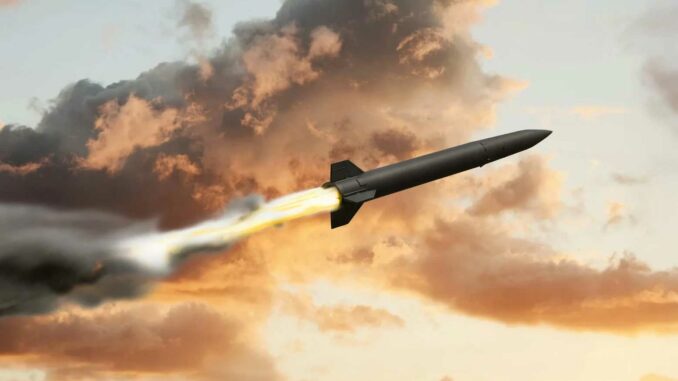
Ukrainian manufacturer Fire Point is developing Freyja, a low-cost missile defence system designed in collaboration with Hensoldt to reduce dependence on the Patriot system.
In summary
Ukraine’s leading manufacturer of long-range strike drones is shifting its focus. Fire Point, whose drones are being used in Ukraine’s campaign against Russian refineries, depots and arms factories, is now developing a ballistic missile defence system. Named Freyja, this project combines the Ukrainian FP-7.X interceptor with Hensoldt’s German TRML-4D radar. Other European partners are yet to supply the seeker heads, data link and command centre.
This development is a response to an urgent need. Ukraine lacks Patriot missiles capable of intercepting Russian ballistic missiles. Fire Point aims to offer an interception capability for under a million dollars, compared to several million for a PAC-3 MSE. However, Freyja remains a programme under development. The exact details of its funding have not been made public, and several key technological components are still missing. Its success could nevertheless shake up the European market by creating a cheaper, modular solution produced in Ukraine.
The drone manufacturer now aims to stop Russian missiles
Fire Point has become one of the key players in the Ukrainian defence industry. The company produces, in particular, the FP-1, a long-range attack drone; the FP-2, a heavier model designed for medium-range strikes; and the FP-5 Flamingo cruise missile.
According to Denys Shtilerman, co-founder and chief designer at Fire Point, the company’s drones are said to account for around 60 per cent of Ukraine’s deep strikes into Russian territory. This figure comes from the manufacturer and cannot be independently verified. It nevertheless gives an idea of the role Fire Point plays in Ukraine’s strategy.
The FP-1 was designed to be inexpensive, relatively simple to produce and robust enough to cover very long distances. Its initially announced range was around 1,600 kilometres (994 miles). Upgraded versions are said to have subsequently exceeded 2,700 kilometres (1,677 miles), and then approached 3,000 kilometres (1,864 miles).
This experience has given Fire Point valuable expertise in engines, composite airframes, navigation, distributed manufacturing and rapid testing. However, the transition from an offensive drone to a missile defence system represents a radical change.
A strike drone can follow a pre-programmed trajectory for several hours. An interceptor must detect, track and engage an extremely fast-moving target within a few minutes, sometimes within seconds. It must also operate within a network of radars and command centres. The challenge is therefore not simply to build a fast missile.
The Freyja project is based on a Ukrainian interceptor and European technologies
On 16 June 2026 at the Eurosatory exhibition, Fire Point and Hensoldt signed a memorandum of understanding to integrate components already available into a comprehensive ballistic missile defence system.
The project is named Freyja. Fire Point is to supply the FP-7.X interceptor missile. Hensoldt is contributing its radar expertise, notably with the TRML-4D.
The FP-7.X is still at the experimental stage
The FP-7.X is derived from the FP-7 ballistic missile developed by Fire Point. The company aims to use a common missile architecture for both offensive and defensive missions, with different guidance systems.
In early June 2026, Fire Point announced that it had carried out a manoeuvred and controlled flight of the FP-7.X. This test demonstrates that the missile can take off, alter its trajectory and respond to commands. It does not yet prove that it can intercept a ballistic target.
This distinction is crucial. A real-world interception requires a full scenario. The radar must detect the enemy missile. The system must calculate its trajectory. The command centre must select an interceptor and transmit a firing solution to it. The FP-7.X must then correct its course before locking onto its target itself during the terminal phase.
Fire Point cites a speed of between 1,500 and 2,000 metres per second. The company is aiming for an interception at an altitude of approximately 24 kilometres (15 miles). These performance figures are as yet unconfirmed. They will need to be validated by instrumented tests against representative targets.
The terminal interception mechanism has not been described in detail. It could rely on a fragmentation warhead, a direct hit, or a combination of the two. Without this information, it is impossible to assess the likely destruction rate against an Iskander-M or another manoeuvrable weapon.
The TRML-4D radar provides the first credible building block
The TRML-4D is a mobile surveillance and target acquisition radar developed by Hensoldt. It is already in use in air defence systems and has been deployed in Ukraine.
According to its manufacturer, the radar can track more than 1,500 targets simultaneously. It can track a fighter aircraft at a range of over 120 kilometres and a supersonic missile at a range of over 60 kilometres. Its instrumented range reaches 250 kilometres and its instrumented ceiling 30 kilometres.
These figures do not mean that the TRML-4D can, on its own, provide the entire missile defence capability. The actual range depends on the target’s radar signature, its altitude, its trajectory, the terrain and interference. A diving ballistic target also requires a high degree of tracking accuracy.
The radar does, however, provide a solid foundation. It reduces the technological risk compared with developing an entirely new sensor. It also provides Fire Point with a recognised European partner, capable of supporting the system’s certification and integration.
The missing components remain the most difficult to master
A missile and a radar do not yet constitute a missile defence battery. Freyja requires a secure data link, a command centre, fire control software and a terminal seeker.
Fire Point is seeking a European partner to supply an imaging infrared seeker. This sensor must detect the target’s heat and generate an image precise enough to distinguish the missile from the atmospheric background, debris or potential decoys.
The company is also in talks with another manufacturer to secure a radio-frequency seeker. This uses electromagnetic waves to track the target. A combination of infrared and radio-frequency sensors could improve resistance to jamming and terminal accuracy.
The FP-7.X must also receive in-flight corrections. The radar continues to track the threat’s trajectory after launch. The command centre recalculates the point of interception and transmits the new data to the missile. This link must function despite jamming, cyber-attacks and the rapid movements of both projectiles.
Fire Point has mentioned discussions with Thales regarding radars, Leonardo for tracking, and Kongsberg for command and control. However, no definitive industrial consortium has yet been officially confirmed.
The choice of an open architecture is key. Fire Point wants to be able to integrate several European radars, seeker heads and software packages. This approach would avoid dependence on a single supplier. It would also allow different countries to choose their own components.
However, the open architecture creates an integration problem. Each component must share data in a common format. Clocks must be synchronised. The software must handle errors and conflicting tracking data. Cybersecurity must be verified. This invisible part of the system may take longer to develop than the missile itself.
The Patriot shortage explains the change in strategy
Ukraine relies primarily on the Patriot system to intercept Russian ballistic missiles. Other Western systems are effective against aircraft, drones and many cruise missiles, but not all offer the same capability against high-speed ballistic trajectories.
This reliance on the Patriot has become a strategic risk. Global stocks of PAC-3 MSE are in high demand from the United States, Ukraine, NATO members and several Middle Eastern countries. Demand is growing faster than the production capacity available in the short term.
Lockheed Martin delivered 620 PAC-3 MSEs in 2025. The US group plans to gradually increase its annual production capacity to around 2,000 missiles. However, this ramp-up will take several years. It will not immediately resolve the shortages.
Europe has the SAMP/T system and is developing the Franco-Italian SAMP/T NG. The system combines a multi-function radar, a command and control centre and Aster missiles. Its new version is set to offer enhanced capability against ballistic missiles, cruise missiles, drones and certain hypersonic threats.
The problem remains one of volume. There are few European batteries. Aster missiles are produced in limited quantities relative to the combined needs of Ukraine and European countries.
Fire Point is therefore attempting to address an industrial shortfall. It is not simply a matter of designing a better missile. Sufficient interceptors must be produced to sustain a protracted war.
The announced cost could alter the economics of missile defence
Fire Point is targeting a cost of around $700,000 for an FP-7.X. Its official objective is to keep the cost of an interception at less than one million dollars.
This figure remains an industrial target, not a price confirmed by mass production. It does not necessarily include the radar, launchers, command centre, vehicles, spare parts, training and logistical support.
A PAC-3 MSE costs several million dollars. Estimates vary depending on the financial year and the terms of the contracts. They generally range from 3.8 to over 5 million dollars per missile.
Furthermore, a battery may fire two interceptors against a single threat in order to increase the probability of destruction.
The potential price difference is therefore considerable. A cheaper system would make it possible to build up larger stocks. It would also reduce the cost of protecting power stations, railway hubs, logistics centres and major cities.
However, one must remain cautious in this reasoning. A missile costing $700,000 is not cost-effective if four have to be fired to achieve the same result as a single PAC-3 MSE. The decisive factor will be the cost per target actually destroyed, not the list price of the interceptor.
Success rate, reliability, maintenance requirements and production capacity will count just as much as the advertised price.
The programme’s funding remains partly unclear
Fire Point has secured major Ukrainian contracts. The company is reported to have over $1 billion in government orders for 2026. These contracts mainly relate to its drones and offensive missiles.
No detailed public funding allocation has been announced for Freyja. No contract has yet been published specifying the development cost, the number of batteries ordered or the financial breakdown between Fire Point, Hensoldt and the partner governments.
The memorandum of understanding signed with Hensoldt constitutes an industrial agreement. It does not prove that the German group is financing the programme itself. Similarly, the political support provided by the Ukrainian and German governments does not yet amount to a full budgetary commitment.
Fire Point can finance part of its work through revenue from its Ukrainian contracts. The company could also receive advance payments from clients, European funding or private investment. At this stage, this financial structure has not been made public.
An investment proposal involving the EDGE Group, based in the United Arab Emirates, envisaged the acquisition of a 30 per cent stake in Fire Point for $760 million. The deal would have valued the company at around $2.5 billion. The application was rejected by the Ukrainian competition authority and discussions are no longer ongoing.
Fire Point claims that a more recent offer from an investment bank would have valued the company at $5.8 billion. The identity of the bank and the terms proposed are not known. This valuation must therefore be regarded as an indication provided by the company, not as a completed transaction.
This lack of transparency is not a minor issue. European customers will demand guarantees regarding governance, capital control, intellectual property and the continuity of supplies. Fire Point is also under investigation by the Ukrainian anti-corruption authorities. The company disputes the allegations made against it and no charges have been brought.
The project could reshuffle the deck in the European market
Freyja could become a competitor to the Patriot and SAMP/T NG in certain segments. It would not necessarily offer the same performance. However, it could provide a more accessible solution for countries unable to purchase an American or Franco-Italian battery system at short notice.
The target market extends beyond Ukraine. Central and Eastern European states are seeking to strengthen their defences against Russian missiles. The Gulf states wish to replenish their stocks. Other armed forces are looking for a solution that is independent of US export decisions.
Fire Point could act as the system integrator. The company would supply the interceptor and assemble equipment from several European partners.
Hensoldt, Kongsberg, Thales and Leonardo would then gain new markets without having to develop a complete system on their own.
This strategy also threatens established positions. Major European groups have invested for decades in certification, security and reliability. They will be reluctant to accept that a new entrant should benefit from rapid access to public funding without meeting the same requirements.
Ukraine’s main advantage remains its speed. Trials can be organised there within a matter of days. Engineers receive direct feedback from the battlefield. Equipment is modified in response to real threats.
This Ukrainian industrial accelerator does not replace qualification procedures. However, it does reduce the duration of development cycles. It may force Western manufacturers to streamline their processes and ramp up production before achieving theoretical perfection.
The impact on the war will remain limited until full validation is achieved
Freyja is not yet operational. It will not transform Ukraine’s air defence in the coming months simply because a prototype has completed a controlled flight.
Fire Point hopes to produce the first interceptors before the end of 2026. The company had previously mentioned a first live interception of a ballistic missile at the end of 2027. These two deadlines are not necessarily contradictory. It is possible to manufacture test missiles before validating the entire system.
The military impact will depend on three stages. Freyja will first need to successfully intercept a target under controlled conditions. It will then need to demonstrate its capability against a manoeuvring and jammed target. Finally, it will need to operate as part of a battery during an attack involving multiple missiles and decoys.
If these trials are successful, Ukraine will be able to protect more strategic sites. Freyja could complement the Patriot system rather than replace it. The American systems would be reserved for the most challenging threats. The FP-7.X systems would cover other sectors or provide a second line of defence.
Ukrainian production would also reduce dependence on foreign political decisions. Kyiv could adapt the software and tactics without waiting for authorisation from a supplier. It would have greater control over stocks, repairs and deployment priorities.
However, Freyja will not create a protective dome over the whole of Ukraine. A battery protects only a limited area. Launchers, radars and command centres can be located and attacked. Russia will seek to overwhelm the system, jam its sensors and strike its manufacturing facilities.
The real test will be as much industrial as it is military
Fire Point’s shift from offensive drones to missile defence illustrates the transformation of Ukrainian industry. A company founded after the 2022 invasion now aims to become the integrator of a European shield.
The project addresses a real need. Russian ballistic missiles remain difficult to intercept. Western stocks are insufficient. The available solutions are costly and take a long time to produce.
But Freyja remains an industrial gamble. The radar exists. The missile has flown. The complete system, however, has yet to be built. The seeker heads, data link, command and control, mass production and funding have not yet been finalised.
Fire Point will only pose a serious challenge to the Patriot or the SAMP/T NG once it has destroyed a representative target during a transparent and reproducible test. Until then, Freyja is a credible promise, but a promise nonetheless.
Its significance lies elsewhere. Ukraine no longer wishes to depend exclusively on the weapons its partners agree to supply. It wants to produce systems that those same partners might one day purchase. If Freyja proves successful, the country will no longer be merely a testing ground for Western missile defence. It will become one of its suppliers.
War Wings Daily is an independant magazine.